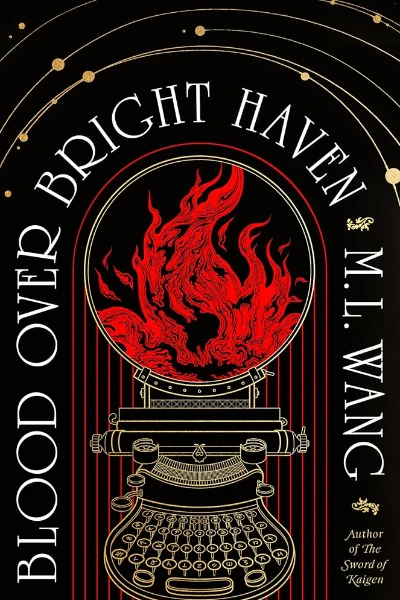
Blood Over Bright Haven
Blood Over Bright Haven — Chapter 23: Out of Oblivion
“UNCLE THOMIL!” CARRA gulped in rage. “Why am I crying so much?”
“Because you’re human.” Thomil rubbed a hand over his niece’s back, feeling her quake with sobs. “Come here.”
Carra groaned, still sounding thoroughly furious with herself, as Thomil wrapped her in a hug. “Why did we have to watch?”
“Well, you didn’t have to,” Thomil laughed, his own voice so cracked with emotion that he scarcely recognized it. “Ridiculous girl.”
A few of his tears fell into Carra’s hair, and she blinked sodden eyelashes up at him. “You’re crying, too. A lot.”
“Yeah.” Thomil pressed a palm to one of his eyes, oddly unable to stem
the flow of tears. “I am.”
Carra sniffed. “Did you love her?”
Thomil had to be honest in memory of Sciona if nothing else. “I did. But you know, we’re Kwen.” He shrugged. “Our fate is to love, and lose, and lose, and lose…” He drew a deep breath in the vain hope that it would quell the grief. “But we keep going. This is nothing new for us, Carra. We keep going.”
Even as he said the words, they felt weak. Because Sciona had been something new. She had brought summer to a part of Thomil that should have frozen to death on the lake with his tribe. And now she was gone too.
In the end, it was Carra who said, “She probably wouldn’t have wanted us to stay up here waiting to get caught with all her spellwork.”
“You’re right.” Maybe this was as bright as hope could burn in a city like Tiran before turning to blood on the ground, but having hit the activation key, Thomil had to keep hope burning as long as he could—for Carra and for Sciona’s memory. “Help me pack this up, and let’s get out of here.”
It wouldn’t be easy to slip through the city while Kwen were being detained for just showing their faces on the streets, but staying put would ultimately be a death sentence. When the dust had settled, someone would think to ask who Highmage Freynan’s accomplices had been. Someone who still lived would remember that her assistant had been a Kwen who kept his head down but had still been a touch conspicuous when he ran errands around the university campus in his brown and white coat. Someone would go into the university’s list of employees and find his address, then interrogate everyone who had ever known him.
Thomil and Carra had both understood the consequences that would come for them—consequences they probably couldn’t outrun—but they were the last and most stubborn of the Caldonnae, so they would try to outrun it anyway.
“So, what are we doing with all this?” Carra said, cramming the bundles of notes and diagrams into Sciona’s travel case alongside the spellograph.
“We’re dropping it in the West River,” where the weight of the spellograph would sink it to the bottom.
“What if we don’t make it as far as the West—”
“We’ll make it,” Thomil said, “but there is a backup plan.” He pulled a red-capped cylinder from his pocket and jammed it into the case between the stacks of paper.
Thomil had just seized the lid of the travel case to pull it closed when a familiar shape caught his attention—white robes fluttering with the quick strides of a mage in a hurry. Two white-clad figures were approaching from
the far side of the rooftop.
“Speria,” Thomil breathed.
It was an old Caldonnish hunting command, meaning simply vanish. And Carra did—but not before gripping the spellograph in both hands and whisking it away with her. As she slipped into the shadow of the water tower and presumably down the stairs behind it, Thomil turned to face the advancing mages.
Renthorn came into focus first, then Jerrin Mordra, trailing a few steps behind him. Neither of them seemed to have noticed Carra slipping away.
In fact, they barely seemed to register Thomil, their green eyes fixed on the light still blazing around the Magistry.
“The little witch really did it!” Renthorn marveled. “Right under our noses!”
“God!” Jerrin Mordra’s expression could not have contrasted more starkly with Renthorn’s elation. “Oh, God have mercy!”
“God favors the merciless, Tenth. He always has.”
The light from the blazing Magistry illuminated a disturbing sight: Renthorn’s expression, stripped of all pretense of civility. Pure glee.
“You know what this means, little Mordra?”
The younger mage was too choked with horror to form words. He could only gape in horror, pale as spellpaper.
“You and I are the last highmages left in the world,” Renthorn said. “We are the High Magistry. And I…” His lips peeled back in a quivering grin. “I am Archmage Supreme!”
“What is wrong with you?” Mordra’s voice broke. “You knew this was going to happen?”
“Well, I’d guessed, based on the sort of spells Freynan was developing and the books she took from the library. I didn’t think she’d actually pull it off with only a stupid Kwen to help her.”
“You knew!” Mordra’s horror turned to rage. “Renthorn, our fathers are in there! Our friends—”
“Were,” Renthorn corrected. “Our friends and fathers were in there. All the real competition, anyone who might have kept us down.”
And it was suddenly clear to Thomil why Jerrin Mordra had been the one spared Renthorn’s betrayal. The younger mage wasn’t competition for Renthorn the way Sciona, Tanrel, and Halaros had been. He was a follower, a disciple to bring into this new regime Renthorn had planned on the back of Sciona’s sacrifice.
“Mitigate me now, Father!” Renthorn hissed at the fading light and screams. “Contain me now!”
So, the next leader of Tiran rode to power on work that wasn’t his, Thomil thought ruefully. Here, truly, was a mage after his forefathers.
“Now”—Renthorn’s green eyes turned to the open travel case, then to Thomil—“Tommy, dear, where’s the spellograph?”
Carra had been smart not to burden herself with the entire case full of papers. The spellograph contained the spellweb that had siphoned the High
Magistry into the barrier—the information Renthorn really wanted—which was why Thomil had to keep him here, talking, for as long as he could.
Each moment Renthorn was distracted was a moment Carra had to dispose of the spellograph and get herself somewhere safe.
“Sorry, Highmage,” Thomil said in his blankest servant’s voice. “What spellograph?”
“Come now, Blighter. You’re not smart enough to lie to me.”
Thomil briefly considered attacking Renthorn, but both highmages had their staffs in hand, and Sciona had explained in detail what those multi- purpose conduits could do. Thomil could physically overwhelm one mage before the staffs came into play, but the second would almost certainly strike him dead. And once Thomil was gone, the next logical step would be to leave the roof in search of the spellograph, putting Carra in danger.
“I keep tabs on all magical equipment registered to my department,”
Renthorn said, “and I tracked an unauthorized spell activation to this location. Freynan physically couldn’t have been the one to activate the spell, and there would have been no way for her to time it beforehand from her cell or Bringham’s custody.” Narrowed green eyes took in the case of notepapers and the radio still crackling softly alongside it—all the pieces an accomplice needed to complete Sciona’s final act of defiance except the spellograph. “You hit the final key, didn’t you? Where is it?”
“You’ll have access to all the notes in Highmage Freynan’s office, I’m sure,” Thomil said, hoping he could compel Renthorn to eat up time explaining himself. “What do you need her spellograph for?”
“Well, I’d like to know how she calculated her final coordinates within Tiran so accurately.” Renthorn indicated the glowing Main Magistry building still lighting the skyline as the barrier stretched and rippled behind it. “God knows, Highmage Sabernyn spent a decade getting that precise with his dark magic, and he had the luxury of committing his murders-by- siphoning from his Magistry office, where he could map for his targets.”
“Oh,” Thomil said as though this was new information.
It was true that Thomil and Sciona hadn’t been able to utilize any mapping spells without triggering an unauthorized magic alert, but in the end, they hadn’t needed to. They had determined the coordinates of the Main Magistry building mathematically, based on their combined knowledge of hunting, siphoning, and the layout of the world they lived in.
And, in fairness to Highmage Sabernyn, their target had been much bigger than any of his.
“Why would you want such magic, Renthorn?” Mordra demanded.
Renthorn shrugged. “You never know when this kind of thing might come in handy.”
“Well, you’re out of luck,” Thomil said. “Highmage Freynan didn’t actually write down her coordinate calculations.” Because she hadn’t done the final calculations. Thomil had, and he worked in his head.
“What remains of her work is in there”—Thomil nodded to Sciona’s travel case, lying open between himself and the highmages. If he could just get Renthorn to put his hands inside the luggage—maybe even just kneel close enough to it—the cylinder could incapacitate him. Then Thomil could probably handle Mordra the Younger.
“It’s mostly notes,” Thomil said, “scrapped drafts, but you could likely deduce plenty from it if you care to have a look.”
“Mmm.” Renthorn tilted his head and called Thomil’s bluff. “I’ll pass.”
Maybe he had spotted the red cap of a cylinder among the papers and recognized the device as one of the custom conduits Sciona had deployed against him in the library. Maybe he had just picked up the lie in Thomil’s voice.
“Instead, I think you’re going to tell me where that spellograph has run
off to.”
“I don’t know, Highmage.”
Renthorn considered Thomil for a moment, an amicable smile hanging on his lips while cruelty animated his eyes. “You know, I should be thanking Sciona Freynan. She’s given me the opportunity to try out all these wonderful combat spells I never would have had the chance to enjoy outside a state of martial law.” Renthorn shifted his grip on his staff as his smirk widened. “A while back, I figured out a way to siphon a creature with a touch of my staff and a verbal command. Only, it’s not a quick siphon like Blight. It goes as slow as I tell it to. Until last night, I’d only tested it on animals, but it turns out to work beautifully on humans. Would you like to see the muscles in your own arms, Kwen? What about your ribs? Your own beating heart?”
“Renthorn,” Mordra said weakly. “This is too much!”
“No, Tenth.” Renthorn touched the tip of his staff to Thomil’s chest. “This is the Light of Truth.”
Thomil blinked down at Renthorn’s staff and found that an eerie calm had come over him. He knew he would scream when it started. His father had screamed. Arras had screamed.
“Start talking, Kwen. The pain will stop when I have what I need.”
“Then this is going to take a while,” Thomil said dryly. “I don’t know where the spellograph is.”
There would be no shame in screaming, Thomil told himself. Loud suffering was exactly the sort of diversion Renthorn couldn’t resist. And Thomil had no doubt that he could stay alive—and suffering—long enough to buy Carra a chance to survive.
Sciona was proof that hope didn’t have to mean living to the end of the story; for Kwen like Thomil, how could it? Carra’s life was worth fighting for, whether fighting meant dying here or stubbornly living on. Maeva had understood that: that it was worth dying at the border of salvation if you could push your love before you over the finish line.
“Maybe you really don’t know,” Renthorn smiled, “but I will extract your
best guesses before you die.”
“You can try.”
Renthorn opened his mouth to verbally activate his staff when— “Hey, Archmage Supreme!” a voice called from above.
Thomil looked up just as Carra launched from the ledge of the water tower. She had waited a split second for Renthorn to turn toward the sound of her voice. As she dropped, she slammed the spellograph into his upturned face. Gravity put the heavy machine straight through his skull.
Thomil started, and Mordra screamed as blood, keys, and brain matter burst in all directions.
“Gods, Carra!” Thomil staggered back with shock. “What are you doing?”
“Keeping the tribe together,” she said as she drew herself up, covered in blood.
Gurgling on the ground, Renthorn twitched as if to rise. Carra stomped on what remained of his head with a terrible crunch, and the mage’s reedy body went still.
“Carra!” What is wrong with you? part of Thomil wanted to demand, as Mordra had demanded of Renthorn.
But as she stood over Renthorn, Arras was in the set of her shoulders. In her, the Caldonnae lived, and that was Thomil’s only mission.
“Alright,” he breathed, “now, we really need to run.”
“Not if we kill the witness.” Steel hunter’s eyes turned to Mordra, and Carra unsheathed the knife at her belt.
At the flash of metal, Mordra shifted his grip on his staff. Carra had started forward, but Thomil moved faster than either of them. He tackled Mordra at full force, sending them both rolling over the concrete rooftop.
The staff clattered away as Thomil slammed the slighter man down and drew his fist back, heedless of the pain in his bruised ribs.
“Please! Please!” Mordra was gasping, racked with sobs. His hands were open in surrender, forearms over his face so he wouldn’t have to look his death in the eye. “I wasn’t going to kill her! I swear!”
“Forgive me for not taking the word of a mage.”
“I didn’t know!” the highmage sobbed shrilly. “About the Otherrealm— or-or Renthorn’s plan—or Freynan’s! Any of it! Please!”
He was telling the truth, Thomil realized. Not because he had any particular confidence in the Tenth’s honesty but because it made sense; Jerrin Mordra had been as new to the High Magistry as Sciona, and he wasn’t the intellectual powerhouse she was. He never would have figured out the truth on his own, and, based on their interactions, it didn’t seem that Mordra the Ninth, Cleon Renthorn, or any of the mages in the Tenth’s circle had been particularly open with him.
“Oh, Father!” Mordra whimpered into his hands. “Father, forgive me, I didn’t know!”
“This again?” Carra said in disgust. “Do they all cry so much?”
“Please, Kwen.” Mordra’s voice had assumed an emptiness through the shudder of his sobs. “Tommy. Please… kill me quickly.”
“No,” Thomil said roughly. And Mordra made a truly pitiful noise as Thomil grabbed his wrists and yanked his hands from his face. “Look at me, mage.” Green eyes blinked, sightless with grief and terror. “I said, look at me!” Thomil growled and waited a beat for those bleary eyes to find their
focus. “We’re not going to kill you.”
“We’re not?” Carra said. “Why?”
“Because we’re not them,” Thomil said. “We’re Caldonnae. We kill to survive.”
“And you think letting this one live is going to help us survive?” Carra was incredulous.
Truthfully, Thomil wasn’t sure. Surely, it wasn’t justice to spare this man, who had grown and thrived on the blood of Kwen. It wasn’t logical. But it was important, because Jerrin Mordra hadn’t proven himself a knowing murderer, and hope was important.
“As long as he doesn’t forget this day.” Thomil looked down at the only remaining highmage of Tiran. “And you won’t forget, will you, Archmage
Supreme Mordra the Tenth?”
“Wh-what?” Mordra stammered.
Thomil was taking a gamble. But Renthorn had been onto something in his hideous way. No matter how many mages died today, someone was going to fill the power vacuum at the top of Tiran. Jerrin Mordra might be the only person left with the credentials and pedigree for the Tiranish to accept his leadership. And, unlike his predecessors and many of his contemporaries, he hadn’t yet spent decades easing into the idea of mass murder as his divine right. There was still a human soul seething at the surface of his being. Raw enough to manipulate, for better or for worse.
“This feeling is energy.” Thomil pressed a hand to Mordra’s chest.
“Remember this day you lost your friends and family to Tiranish magic.
Remember all this grief and terror—and try to do something good with it.
Swear by your god, and I’ll let you live.”
“I swear! By Feryn the Father, I swear!”
“That’s a good mage.”
“I just—I don’t understand. Why? After everything…” Mordra’s voice had turned pleading and taken on a mourning note Thomil knew too well. It was the howl of a wolf still calling for a pack that was gone, Thomil praying to his absent gods inside the barrier. It was the sound of the last surviving creature of its kind. “Why won’t you kill me?”
Thomil answered in quiet honesty. “I watched a woman run herself to death on the belief that there was some good in the High Magistry. She did her best to leave some hope in the world—for your people and mine. I never… Even at the end, I never shared her optimism, but in her honor, this once, I’m going to try.”
High above, the barrier was still rippling with movement, shaking the sky as it crawled westward. With a hand resting on Mordra’s chest, Thomil closed the hunting prayer.
“We have taken so that we may live.
We have taken so that one day we may give back.
And now the taking is done.”
Carra finished the prayer with him in grudging agreement:
“The taking is done.”
Thomil started to stand, but a tearful Mordra caught his hands. “Thank you, Tommy.”
“It’s Thomil.” He pulled from the mage’s grasp. “And don’t thank me.
Thank Sciona Freynan.”
Mordra made no effort to stop the two Kwen as Thomil took his niece’s blood-slick hand and pulled her from the rooftop.
“So, what’s the plan now?” Carra asked.
“Same as it was before. We still have to leave the city.” Initially, Thomil had hoped they would be able to hide their hair and move through Tiran without drawing the attention of any authorities. That wasn’t a possibility now that they had a highmage’s blood all over them. “That way.” He turned his eyes westward to the expanding barrier.
“We’re taking that chance?”
“We have no choice.” It was the lakeshore all over again, Blight at their backs, Blight ahead—only this time, Carra was a hunter in her own right, standing on her own two feet. “If anyone can make it, we can.”
Sciona had theorized that when the barrier expanded and disrupted the Reserve’s parameters, the siphoning in the entire area would stop.
Functionally, there would be no deadly crossing immediately outside the city. The siphoning around Tiran should resume only when new coordinates were defined—if Jerrin Mordra and whatever mages had escaped siphoning even knew how to do that. But even assuming Blight didn’t take them, fleeing into the cold of the Deep Night was still tantamount to a death sentence under most circumstances. Thomil just hoped that their chosen point of exit might be their salvation.
Instead of a lake, the western part of Tiran’s barrier ran along the ground below the Venholt range. The land passage had been blocked with snow when the Caldonnae had attempted their crossing ten years ago, but at this time of year, right at the beginning of the Deep Night, it would still be passable. And by the time the expansion spell had finished pushing the
warming veil westward, it would touch the feet of the mountains, which were porous with caves. Thomil had used those caves as shelter on the few occasions he had risked hunting dangerously close to Endrasta territory.
Some of the caverns were shallow, providing only passing cover from the wind, but some ran deep enough to hold their autumn temperatures even as the world around them froze solid. Survival on those slopes was not certain —not even likely—but there was a chance.
“You have your bag, right?” Thomil turned back to double-check with Carra as they crept into the alley behind their building.
“Yeah.” Carra adjusted the heavy bundle on her shoulders with a frown.
“Although I still think stealing all the widow’s coats was overkill.”
“Eh, you say that now.” Carra didn’t remember the Deep Nights beyond the barrier.
Thomil had hoped that by taking the darkest of back alleys, he and Carra might make it out of the quarter unnoticed, but no such luck. They had barely made it a block before three guards barred their way down an alley.
“You there!” one of them shouted. “All Kwen are to remain indoors until given permission to leave!”
These weren’t regular city guards, Thomil noted, taking in their armor and brass buttons. They were barrier guards, called in from the edges of the city as reinforcement. City mages and police might be unused to getting their hands bloody. But these men had been killing Kwen long before the carnage of the last few days.
“I’m so sorry, sir.” Thomil opted to play things safe. “I’m trying to get this girl to her mother’s apartment. As you can see, she’s injured.” He hoped they didn’t examine the blood on Carra’s shirt closely enough to determine that it was not her own. “I have a permit from my employer in my pocket if you let me—”
One of the guards grabbed Thomil and slammed him against the grimy alley wall, twisting his arm behind his back. A hand clawed at him, digging into his pocket.
“There’s no permit in here,” the guard said, cranking Thomil’s arm a fraction higher, “and what the hell is this?” He held up a cylinder he had fished out of Thomil’s pocket. The mark on the cap was red for danger. And Thomil was grateful Sciona had tasked him with training a conduit on his voice.
“Bang,” he said in Caldonnish—and the guard’s hand blew to pieces.
Before the man could start screaming, Thomil whirled around, gripped him beneath the jaw, and shoved him hard. His head went straight back into the alley wall, and he crumpled, unconscious.
The other two barrier guards had their firearms up and pointed at Thomil, but shooting in such a tight space would put them in danger from ricocheting bullets. Only one of them took his chances. The shot missed, blowing a hole in a rusting garbage can. Thomil was on him before he recovered from the kickback, raining punches on him. Years ago, Thomil would have easily incapacitated a Tiranish guard with one punch. So far removed from his hunting days, it took him three—which was two too many.
The third guard caught Thomil in the head with his club, splitting the world into a hundred ringing fragments, and Thomil came back to himself under the Tiranishman, a knee on his solar plexus, crushing the breath from his body. Thomil lifted an arm to defend himself, and the guard’s club struck it away, cracking bone.
In a moment of icy certainty, Thomil knew he was going to die.
“Carra!” he bellowed through the pain and lack of air. “Run!” Don’t look back!
“Shut up, Blighter!” The man lifted his club to bring it down on Thomil’s head—then jerked back. The light went out of his green eyes as his club slid from limp fingers to the cobbles.
As the Tiranishman slumped sideways, Thomil braced for the sight of Carra with her knife covered in blood. But the guard clearly hadn’t fallen to a stab wound. It had looked more like a hard blow to the back of the head.
And the figure standing over Thomil now was far bigger than Carra.
This was a Kwen he didn’t recognize—a railway worker, from the look of his bulging arms and the hammer in his hands.
“All right there, brother?” a voice asked in Kwen pidgin, and Thomil realized that there were several more workers behind the first, all holding hammers and pickaxes. They were broad in the shoulders like Arras, their hair touched with fire like Carra’s. Endrasta. But they helped Thomil to his feet and brushed him off like he was one of their own, as Carra sheathed the knife she had all-too-predictably drawn.
“Careful out here, brother,” one of the men said. “They’ll see us all dead if they catch us. It’s only a matter of time.”
“Then, what are all of you doing out here?” Thomil asked, gratefully leaning on the shoulder his rescuer offered him.
“We’re getting out of here.” This speaker was a woman, out of breath from rushing to catch up to the men with a baby in her arms. “Look!” She shifted the child on her hip to point west. “The gods have sent us a sign!”
Thomil followed the gesture to where the barrier was expanding toward the mountainous horizon. That was when he noticed the coats and extra blankets bundled onto the Endrastae’s backs. They were serious about braving the Deep Night.
“You don’t know all the risks,” Thomil said.
“You’re right,” one of the railway workers agreed. “But the risks if we stay are certain.”
“The police are already jailing and shooting us without trial,” another worker said. “That man was ready to kill you just now. After whatever that was”—he gestured in the direction of Leon’s Hall—“how long do you think it will be before they round up everyone with a dash of copper in their hair and start Blighting us to death en masse?”
“Run with us!” the woman said, holding her child close. “Let’s be rid of this place before it’s rid of us! Let’s go home.”
These people knew nothing of Sciona’s theories that Blight would drop off with the barrier expansion. If they could have hope, then so could Thomil. Carra took Thomil’s good hand, and with their new kin around them, they ran.
“Do you know the best way to the caves?” Thomil asked one of the Endrastae, wondering if it was too much to hope that he and Carra had fallen into step with experienced mountaineers.
“More or less,” the Endrasta smiled. “You?”
“More or less.”
Outside the barrier, the Kwen would have only minutes to find shelter before the cold began claiming lives. But before that, they had to reach the new edge of the city alive.
The expanding barrier had disrupted the usually placid air inside Tiran, sending winds howling down the streets, swirling dust and knocking down people, trees, streetlamps, anything unused to standing against a gale.
Changing pressure swelled and popped in Thomil’s ears as though he was running full-tilt up a mountain instead of across level pavement.
More guards had taken up position in the streets, blocking the way westward, but the Endrasta railway workers weren’t the only Kwen to take the shifting barrier as a sign, and the sparsely spread Tiranishmen were increasingly overpowered as more Kwen surged from their workhouses and apartment complexes.
In panic, Tiranish guards had begun firing indiscriminately into the tide of fleeing Kwen. A bullet struck the Endrasta woman in the leg. She buckled with a scream, barely keeping hold of her baby. Thomil turned back to reach for her, only to realize how useless he was with his injured arm. But Carra was already there.
“I’ve got him!” She took the child from the woman’s arms and clutched him to her bloodstained chest. “Don’t worry, Auntie, I’ve got him!”
One of the railway workers tossed his pickaxe to a friend and slung the whimpering woman over his shoulders.
“Keep running!” reverberated through the streets and alleys. They were words all Kwen knew well. Even those who had been born inside the barrier knew the echo from their parents and grandparents. “Forward! Don’t look back!”
Somewhere in the chaos, the gunfire had dropped off. Ahead of them, a brass-buttoned barrier guard paused to examine his gun in confusion, only to be trampled by the oncoming Kwen and die screaming as his bones broke beneath their feet.
“Their rifles have stopped working!” one of the Endrastae said in surprise.
“Why? How?”
“Does it matter?” someone else said.
Thomil knew why, but there was hardly time to explain. If the guns had stopped working, it was because the barrier expansion spell had burned through all life inside the Main Magistry building and moved down the subsequent branches of Sciona’s spellweb to tap parts of the Reserve— including the energy pool designated for firearms.
It meant that everyone in Leon’s Hall was dead.
Realizing what the absence of gunfire meant, Carra turned to look at Thomil in pain and concern. If there had been any sliver of doubt, it was certain now. Sciona was gone. Thomil met Carra’s raw silver eyes and
repeated the chorus around him: “Don’t look back.”
The wave of Kwen had reached the former edge of the city, marked only by a line where thick green grass met sodden brown. The moment Thomil crossed onto the brown, bones crunched underfoot. Layers of them. Some fresh and strung with wet vestiges of muscle, some brittle with age, turning to dust beneath the hundreds of feet pelting out of the city.
These people or their parents or their grandparents had all crossed into Tiran separately with different hopes for what the city might hold. They were one now, bound by the sorrow of the crossing and a will to live that could outlast all Tiran’s machinery. One tribe. One purpose.
Sciona had posited that all emotions—fear, anger, sadness—were just energy, equal in their potential power, but Thomil found himself disagreeing as more and more Kwen fell into step around him. There was more power in him now than there had been during the crossing ten years ago when he ran in fear. For the first time, he grasped the force that had kept his sister moving, pulling him onward with her through all their loss. For the first time, he ran the way Maeva had: not from oblivion but toward a hope bigger than himself.
Thomil had always understood that it wasn’t Carra alone that he had borne across the lake. But he now understood that it hadn’t been the Caldonnae alone either. We are one people with one purpose, Beyern had said. But the ‘we’ was more than the Caldonnae, more than any coalition of tribes. It was Arras pushing Maeva a little further than he had gone, Maeva pushing Thomil a little further than she had gone, Thomil pushing Carra a little further still—even Sciona Freynan pushing them both a little further still. Like so many he had loved, maybe Thomil wouldn’t live to see the dawn. Maybe Carra wouldn’t. Maybe it would be a hundred generations before the sun rose on a life of dignity for their descendants, but the worthwhile run was not the sprint.
Tiranish police and barrier guards shouted orders to one another, pursuing the fleeing Kwen into the boneyard, and Thomil put his good hand on Carra’s shoulder.
“Run ahead of me!” He pushed her out before him just in case the Tiranishmen got their guns working again; a bullet would have to go through him first. Carra had a good pair of legs like her father and scarcely slowed him down, even with a pack on her back and a baby in her arms.
The expanding barrier raced ahead of the Kwen, the life force of a hundred mages, politicians, and city guards lighting the way to the
mountains. Thomil felt his legs tiring, an old ache setting into his lungs, exacerbated by years of breathing the factory-poisoned air of the Kwen Quarter—when the barrier slowed as though in mercy. It had reached its planned perimeter on the lower slopes.
As the flood of copper-haired runners poured through the light, there was a tingle, a brutal drop in temperature, but no Blight.
Carra yelped as the icy air bit through her insufficient shirt and trousers.
Thomil just breathed in the cold he had thought he would never taste again.
Home.
Unobstructed stars lit the sky above the mountains, putting all Tiran’s electric marvels to shame.
“Put the baby inside your shirt,” an Endrasta told Carra as he draped a blanket over her and the small child, even as she tried to assure him, through chattering teeth, that she was fine.
“Make for the caves!” an older Endrasta called, taking control of the confused mass of shivering Kwen. “Cover your extremities and keep moving! This way!”
Time was precious, but Thomil took a moment of it to look back at the barrier. Wrapped in the icy arms of his homeland, he imagined that his sister, his parents, and all the Caldonnae watched from that light that had taken their lives. The twinkle of magic became the spring gleam in Sciona’s eyes.
To hope. Sciona lifted her glass, and Thomil raised a fist in return.
To hope, Highmage Freynan.
OceanofPDF.com
End of book
You finished Blood Over Bright Haven
by M.L. Wang