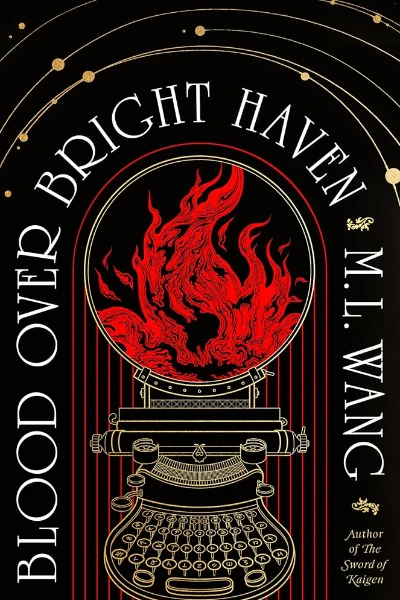
Blood Over Bright Haven
Blood Over Bright Haven — Chapter 21: Damsel and Demon
“Men, love your progeny as God loves his Tiranish children. For, as the Tiranish are made in the image of Feryn, your children are your mirror. He of good character will rule his children well and their quality will speak to his when they go about the world.
Govern your children for, in life, they are your truest reflection; in death, they are your legacy, and a man’s legacy is as near as he may reach to immortal godhood.”
— The Tirasid, Conduct, Verse 28 (56 of Tiran)
THE SUN WAS gone by the time Duris’s car reached Bringham’s mansion.
The Deep Night began with Kwen massed outside the archmage’s estate, rattling at the gates in an attempt to bring them down. The crowd was so dense that it was impossible for Duris’s car to pass the double gates without allowing the Kwen an opening to push inside. Duris had to cast a ring of fire to clear a path, burning clothing and skin from the Kwen who didn’t get out of the way fast enough.
A handful of brown-haired servants met the car inside the second gate, looking shaken to the core—and Sciona had to wonder what had become of the thousands of Kwen serving in the houses of the city’s elite. How many had revolted the moment they grasped what they were seeing in the Freynan Mirrors? How many had been preemptively imprisoned on suspicion of
insurrection before they got up the nerve to do anything? How many were hiding from the chaos?
As the burned Kwen beyond the gates screamed and the others shouted in rage, Sciona selfishly took refuge in the knowledge that Thomil and Carra had a place to shelter. They knew how to disappear when they needed to.
They should survive the night.
“Master Bringham, the magical shielding is down!” one of the servants stammered in terror. “W-we tried everything we could to activate it, but—”
“It’s not your fault.” Bringham put a calming hand on the man’s shoulder.
“It’s all the use of firearms and multi-purpose conduits. The Reserve towers —private and public—are overtaxed.”
“Feryn help us!” Another servant put her hands over her face and started crying. “We’re all going to die, aren’t we?”
“Of course, we’re not going to die,” Bringham said with that total tenderness that had once made Sciona so sure he couldn’t knowingly commit murder. “The gates will hold.”
“Will they, though, Archmage?” Sciona turned toward the Kwen shouting beyond the gates. Their numbers seemed to swell each time she looked.
“It doesn’t matter,” Bringham addressed Sciona and the cluster of servants with an air of perfect calm, benevolent, fatherly. “Now that I’m here, you will all be safe.”
And, remembering what Bringham had done to the Kwen outside the prison, Sciona hoped the gates did hold.
“Duris, you should stay.” Bringham turned to his fellow archmage. “Just until morning. The police should have this mess in hand by then.”
“Morning isn’t coming, Bringham.” Duris had the door of his vehicle open, one foot already back inside. “Not for another two months. I helped you with your little errand like I promised.” He cast a disgusted look at Sciona. “Now, if you don’t mind, I’m getting back to my wife and daughters.”
With a sigh, Bringham nodded to one of the servants. “Reopen the gates for Archmage Duris when he’s ready. And don’t fear. He won’t let any Kwen through.” To Duris, he said: “Good luck out there.”
“I don’t need luck.” Duris slid into the seat of his car and put his hands on the control array. “The forces of darkness are nothing to the Light of God.”
Sciona looked anxiously to the gates as Duris’s car rolled back down the path, but Bringham put a firm arm around her shoulders, steering her away
from the horror.
“Inside, all of you,” Bringham addressed the remaining servants. “You can wait out the night in the kitchen cellars if you’re afraid.”
Bringham’s estate was not unlike his office, sparsely furnished and cavernous. Tasteful was how Sciona had thought it on previous visits.
Tonight, the emptiness contrasted sharply with the visceral press of human bodies in the streets outside, carving an eerie silence from the chaos.
“Finally, a little peace,” Bringham breathed as the doors of his private library closed behind them, cutting off the sounds from outside. “I imagine this is quieter than the jail.”
It’s lonelier, was Sciona’s only thought. Despite there being no one to talk to in her cell, somehow, this was far lonelier.
Unlike most archmages, Bringham had never married. No family had ever filled these halls. Only a limited staff, who, during normal times, all went home at the end of the day. Each chamber was decorated to affect the illusion of humanity; a painting here—though Bringham probably had no affinity for the art style—a vase there—looking expensive and pointless— mounted Kwen ceremonial artifacts from the conquest, valuable only because they were old, not because he understood their significance or cared to learn.
“I’m married to my work,” Bringham had always said to anyone brash enough to ask why he was still single when an archmage could have any woman he wanted. Some of his detractors snidely speculated that he was more interested in men than women. Sciona had always scorned those rumors on the assumption that Bringham was more like her—dedicated to his magic over all else.
After watching him kill on the streets, she realized that she and the rumor mill had both been wrong. It wasn’t that his heart belonged to his work or to some forbidden person. If that was the case, he would have understood that the Kwen were as human as himself. Knowing what his magic and his factories did, he had clearly managed the only way he knew how: he had cut the heart from his being. Sciona had seen the emptiness in him as he blasted Kwen to the ground, and she felt it in this house. Where places like Aunt Winny’s apartment, Duris’s car, and the widow’s home contained something of the owner’s heart, this house did not. The prescribed good taste of these halls made sense now that Sciona understood that her mentor
was a shell—a void wearing the skin of a gentle man who might have existed once, before he learned the truth and hollowed his soul to bear it.
A void couldn’t fall in love. A void couldn’t raise children—unless, perhaps, those children were empty themselves. I know you, Bringham had said when Sciona had tried to talk to him about the Otherrealm. Your first devotion is to magic and advancement. He had seen a void in her, too, a vacuous absence of conscience that cared only for innovation.
As far as Sciona knew, she was the closest thing Bringham had to family.
A daughter. Perhaps, he harbored a similar parental feeling toward his male proteges, Farion Halaros and Cleon Renthorn, but it wasn’t the same.
Halaros and Renthorn had fathers in the High Magistry already. Bringham was the only father figure Sciona had ever known, and, by extension, in a way, she was his only child.
“I suppose this was your idea,” she said into the cold chamber. “The house arrest. I imagine the other mages would have been happy to throw me to the Kwen and be done with it.”
Bringham didn’t answer for a moment, then seemed to realize his silence had effectively confirmed her suspicion. “I couldn’t let them kill you,” he said quietly. “Not like that.”
He motioned for Sciona to sit on one of his reading couches, not caring that her dirty dress would sully upholstery that looked like it cost as much as Aunt Winny’s entire apartment. When she was seated, he sank down on the matching couch opposite her, looking impossibly tired.
“Oh, Sciona…” And how in God’s name did the disappointment in his voice still hurt her? She was just tired too, she decided. Overwrought.
Logically, she should be far past caring what Bringham thought of her.
“Three centuries, we’ve kept our society from this disaster. And it had to be you… it had to be the mage that I brought into the High Magistry. My Freynan.”
“Sorry about your reputation,” Sciona said, annoyed with herself for not being able to summon the frigid tone she intended.
“No.” The utter sadness in his voice was disconcerting. “I’m sorry about
yours.”
“What do you mean?”
Bringham sighed without answering her question. “You could have been something great. You could have changed things for all women in Tiran for centuries to come. Instead, you’ll be a reason for the Council to never let a
female near the order again.” With his elbows on his knees and his staff resting against his shoulder, he rubbed his hands over his face. “Maybe I’ve just been a fool, and the other mages were right. This simply isn’t a job for a woman.”
“I don’t think that’s true,” Sciona said honestly. “It’s not a job for a good person.”
“No, it’s a job for a great person. And Sciona, you could have been so great if you had just kept your emotions under control. Now, all your work and genius will be reduced to a horror story—if that.”
“If that?”
“The High Magistry controls the history books, Freynan. You know that.
If they don’t want Tiran to remember something, then within a few short generations, it will be buried.”
“No.” Sciona’s voice strained with an unwelcome swell of anxiety— unwelcome because it was so profoundly selfish to be thinking of her own legacy on a night like this with so many people’s lives burning to the ground. But Alba was right about her. Bringham was right. Deep in her core, she was a selfish creature. “I dug back into the histories and found things no other mage ever uncovered. Someone will do the same in the future, no matter how well this is concealed.” One way or another, her genius would be remembered. It had to be.
“You underestimate the Council’s power to control historical narratives,”
Bringham said without any relish. “As far as the public is concerned, you will be forgotten—all your skill and innovation.” His voice seemed to catch on something fragile, and he cleared his throat. “It’s happening already.
Tiran is changing the story as it moves through the city. Most civilians think you revealed what you did for self-serving reasons. Many think you cast illusions using dark magic. Those who believe what you revealed about the source of magic will say that it doesn’t matter. The Kwen are uncivilized, inhuman brutes—as evidenced by these riots—deserving of whatever fate befalls them.” Exactly what Thomil had predicted. “A shame.”
“You really sound sad.”
“Should I not?”
“Well, it’s odd, given that you don’t actually care about me or the Kwen,”
Sciona said, tired of this act—this kindly mask Bringham showed her to pretend he wasn’t completely empty inside. “If you cared, you wouldn’t
have misled me about magic for years. If you cared, you couldn’t have built your career on factories that poison Kwen women.”
Bringham didn’t make any attempt to deny the accusation. Instead, he said quietly, “You never worked directly with my alchemists or toured any of my factories in the Kwen Quarter. I didn’t think you knew.”
“And you didn’t feel that was something you should tell me?”
“Honestly, Freynan, it never occurred to me that you would care.”
Disgust overwhelmed Sciona—but as always, it wasn’t as though his line of thinking was unreasonable. When had Sciona ever given an indication that she would care about the well-being of working women in Tiran? She didn’t even treat her own aunt and cousin particularly well; who could guess that her heart could be moved by the plight of women even lower on the social hierarchy, women she hadn’t even met?
“I mean this as a compliment,” Bringham said. “I saw in you a superior mind, one capable of putting progress over emotion when it mattered. I saw greatness. This was how I knew you could succeed where no woman ever had. You could be the woman to make history.”
Sciona’s eyes narrowed. “The other mages were right about you, weren’t they? You just wanted to go down in history as the man who put the first woman in the High Magistry, who made the barrier expansion possible.
That’s how you want to be known, whether or not it has anything to do with the real effect you’ve had on the world.”
“I would have done it without taking any of the credit,” Bringham said, and it didn’t have the oversweetened, oversmoothed denial of his lies. “I needed to do this for you, for Tiran.”
Sciona frowned because how did a man with no heart sound so sad? How dare he sound so sad?
“I would hope that you understand this, if nothing else, my dear Freynan,”
Bringham said softly. “I never helped you for glory. I did it because it was the right thing to do.”
“The right thing to do?” Sciona repeated and only then began to understand that her conclusions about her mentor’s apathy had been off.
There was a hole in her assessment of Bringham, the void.
For her entire career before the Freynan Mirror, Sciona had neglected empathy in the belief that her work was ultimately more important than her personal relationships, that it represented a good that superseded all the
good a woman could affect in her own life. Maybe she and Bringham had this twisted line of thinking in common.
“I’m not your glory,” Sciona realized aloud. “I’m your penance.”
The quality of Bringham’s silence told her she was on to something.
“That’s it, isn’t it? You’ve taken credit for great magic when it is actually murder. You’ve taken credit for employing women for years when you were actually poisoning them, and deep in your soul, you know that. You know these are terrible things you’ve done.”
“Some dyes have unfortunate side effects, yes.” Bringham’s voice rose slightly. “But my factories pay better than other jobs a Kwen woman might hope to get, and in the end, it’s probably good for them.”
“Good for them?”
“My industry has been instrumental in curbing overpopulation among people who are not competent to control it themselves. It is well- documented that, unchecked, Kwen will multiply beyond their capacity to provide for their young.”
“Because we have stolen every chance they have to prosper,” Sciona said, thinking of how Carra hold two jobs instead of attending school and Thomil did the work of a highmage’s assistant—all so that they could afford an apartment smaller than Bringham’s servants’ quarters. “You know that perfectly well, Archmage. All these ugly statistics about Kwen employment, or poverty, or crime are moot in the face of the truth: that we rendered these people’s homeland uninhabitable. We have done a great evil, and you’re smart enough to know that, deep in your soul, no matter what lies you spin around it. You know. And I’m your attempt to get out of that feeling, aren’t I? After years of being a ‘leading employer of women,’ you thought if you got one into the High Magistry, you might feel better about that title. You might feel that you deserve it.”
Bringham didn’t meet her eyes. “We all bear the burden of knowledge in different ways, Freynan. Some of us endeavor to do good.”
“Good?” Sciona’s broken voice went shrill in indignation. “Do you honestly think this balances your scales, Archmage? Do you think that helping to advance me—or the dozen women who might have come after me or the hundred women after them—really makes up for mass slaughter?
And, in your case, mass sterilization?”
“Can you blame me for trying?”
“Of course I blame you! Even taking the cost of siphoning itself out of the equation, you bought your success—and by extension, mine—at the cost of women’s lives, their health, their ability to have children! How could you do that?”
What Thomil had told Sciona about the women in Bringham’s factories had hardly been a surprise, knowing where Tiranish magic itself came from.
It just stripped back another layer of the illusion, making it clear that there was nothing innocent or unknowing about those who practiced the magic— even the gentlest among them, even removed from the source of his magic.
Because Bringham might not look on the Kwen as his sourcers siphoned it, but he had seen his own factories, and there was no writing in the Leonid or the Tirasid mandating the sterilization of women in poverty.
Yet here Bringham was trying to play the caring father figure to Sciona’s face like she was a complete fool.
“How dare you make me a part of this!” Sciona hissed. “And how delusional do you have to be to convince yourself that the answer to women being unequal in our society is to make murderers of them as well? Your solution to being a monster was to drag a woman into the abyss with you!”
“Freynan,” Bringham said wearily, “have I dragged you anywhere you weren’t determined to go by your own power?”
The answer was ‘no,’ of course but, “That’s not the point,” Sciona growled, venom seeping into her voice. “I may have done all my work of my own free will, but you took your own actions—of your own will—to get me into the High Magistry, hoping it would balance all the harm you’ve done the women in your factories. If I was to be your penance for that, is it working, Archmage?” she sneered—because if she was to suffer, she wanted him to suffer as well. “Do you feel absolved?”
Bringham didn’t answer. “Your trial is tomorrow,” he said instead, without affect. “You should get some rest.”
“Rest?” Sciona let out a mirthless laugh. “If that was possible, what would it accomplish?”
“You need to be able to defend yourself before the High Magistry tomorrow morning. You’ll never work as a mage again, but I don’t want you to die.”
“Is that even a possibility?” Here, Sciona suspected that Bringham had wrapped himself in one of his comforting delusions. There was no way the High Magistry would spare her after what she had done.
“Of course, it’s a possibility,” he insisted, “if you repent, throw yourself on the mercy of the Council, and agree to publicly recant all the claims you’ve made about the Otherrealm. No one wants to execute a young woman.”
“You want me to throw away honesty in exchange for my life?”
“You must. Please. For me.”
Sciona was shaking her head.
“They are going to kill you, Sciona.” And with her, his absolution. Hence the fear in his eyes.
A malicious smile split Sciona’s face. “Then I’ll die.”
“No.” He was begging now, which only served to turn Sciona’s cruel smile into a grin. “Don’t do this to me, Sciona. I need—” Pride seemed to stop him from saying: I need you to live. I need you to do something to salvage my legacy. “It doesn’t have to be this way.”
“Of course it does,” Sciona said. “You’re asking me to go back on my own work to save my life.”
“Have you not already gone back on your work?” Bringham asked. “On the idea of magic altogether?”
“I haven’t gone back on truth,” she returned. “I stand by the potential my spells have to better society, and this is where we are at an impasse, Archmage. I might be your absolution, but my work is mine. I’ll gladly die standing by it.”
Bringham let out a slow breath and lowered his head. “If this is really your choice, then you should write a last letter to your family.”
A last letter. The word ‘last’ hit Sciona with a discomforting reality: they were fast approaching the end of her story. Her career would be one of the shortest of any highmage, so short that she had not even fulfilled her dream of publishing research under her name. This was her final chance to put something into the world—even if it was something as simple as a few words to her auntie. And she had to wonder if this had been Bringham’s intent in his seeming gentleness: to make her stare down oblivion and lose her nerve.
“Tell me what you’d like to say.” Crossing the room, Bringham plucked a pen from his desk and dipped the end in an inkwell. “I’ll write it down for you.”
“Give me the pen, and I’ll write it myself.”
“I’m not going to give you a pen.”
Sciona paused in confusion. What did Bringham think she was going to do? Stab him in the neck? His reasoning dawned on her, and she laughed.
“You think just because I cracked a few old texts, I can do magic without a spellograph? Like Stravos? Or a Kwen witch?”
Bringham’s frowning silence said ‘yes’ or at the very least ‘maybe.’ In the old days, many mages had been able to cast spells without the use of spellographs or conduits, but that had been with decades of practice and more materials than a simple ink pen.
“I don’t know what you’re capable of,” he said.
“God,” she marveled with a smile. “You’re really afraid of me.”
Bringham eyed her in unease. “Does that excite you?”
“A little,” she admitted. Just because Bringham seemed committed to playing the innocent, well-intentioned mage didn’t mean she was going to.
So, do you have anything to say to Miss Alba? To your aunt?”
“I suppose I do.”
Sciona’s hands still ached from the tome’s-worth of scrawling and typing she had done in the past week. But through all of it, she hadn’t spared a word for Alba or Aunt Winny. The thought had never crossed her mind.
It was a callous oversight, she realized now, and a damning illustration of all Alba’s accusations. Sciona had stood before the Council and berated them for ignoring the suffering the Kwen had undergone to build this city.
And the whole time, Sciona had largely ignored the sacrifices her own family had made to get her where she was. She swallowed, feeling the sting of Alba’s hand on her cheek anew.
Alba and Aunt Winny deserved better. No matter how wrong they were about the plight of the Kwen, they deserved better from the girl they had raised with so much love. The Kwen might owe them nothing, but Sciona owed them her best effort at an apology.
“Dear Aunt Winny,
The week after I lost my mother to sickness and my father to indifference should be among the worst of my memories. But when I revisit it, it’s not a dark memory. I owe that to you—the way you looked at me like you wanted me there more than anything in the world, the way you wrapped me up without a moment’s hesitation, even knowing an extra child was going to be a financial burden you could barely afford.
“You’re my little girl now.” You kept saying that—“You’re my girl”— even as years passed, and I wasn’t little anymore, and I continued to take, and take, and take without ever giving back.
I understand why you didn’t want to see me in the jail. The most giving being in the world must have a limit, and every lie has to run its course.
See, when you called me “yours,” that was always a lie—a kind one, but a lie all the same. You must have seen, even when I was that tiny girl crying in your arms, that I wasn’t made of the same stuff as you and Alba. I could never give as selflessly or love as earnestly as you.
I won’t apologize for what I did at the High Magistry… But I will apologize for the way I took you for granted.” Sciona paused, realizing that Bringham had stopped writing mid-sentence. He was staring at her, disbelieving.
“You won’t apologize for what you did? Not even for your aunt’s sake?
The woman who raised you?”
“I think it’s important to be honest with the people you care about, Archmage.” Sciona briefly met Bringham’s eyes before looking back down at her hands, her fingers knit together in her lap, one thumb rubbing over the other. “But tell her… I am truly sorry for any pain my work has caused her. I know the sacrifices she made for me. I’ve always been grateful for them, though I’ve been bad at showing it. I’ll still be grateful for her in Hell.” She looked back up at Bringham to find that he hadn’t resumed writing. “What is it?”
Bringham set the pen down. “She’ll blame herself.”
“Well, tell her not to be too hard on herself.” Sciona met Bringham’s gaze again and held it this time. “She’s not responsible for the way I turned out— and neither are you, Archmage.”
“I don’t know that we can say that when, as you pointed out, I consciously brought you into the High Magistry—”
“But you already have said it, Archmage. You told me the day of the exam not to let people credit you or anyone else with my success. Well, that goes for blame, too, alright? You bear the shame for your actions—which is shame aplenty for one soul, I think. My actions are my own.”
“You never had a father,” Bringham said quietly.
“What does that have to do with anything?”
“I suppose you’ve probably always harbored some anger about being left to the care of two working women when your mother should have taught
you to be a lady, and your father should have taught you about the world.”
For a moment, Sciona could only shake her head, dizzied by her own indignation.
Archmage Bringham didn’t know that her real father was Perramis. She had only ever told him that her father was a rich man who had cast her out.
And this had been in deepest confidence, with the unspoken understanding that Bringham would never speak of it again—let alone use it against her.
“I should have realized,” Archmage Bringham said. “In the absence of your real father, that anger could turn back on the Magistry, on me.”
That—listening to Archmage Bringham try to diagnose her with a lack of male influence like that idiot alchemist—was the thing that made Sciona snap.
“This isn’t about you!” she burst out so violently that Bringham drew back, one hand moving to his staff. “None of this is about you, Archmage!
It’s not about my father! It’s not about God!”
“What is this about then, Sciona?”
“This is about me.”
“About you?”
“Tiran got to this hideous, inescapable place because men like Leon and Faene—like you—let greed and ego run away with all their other values.
You took reality and reimagined it to be a story with you at the center, all designed for you, all for your taking. Well, this part of the story is about my ego.”
Every painful thing Alba and Thomil had ever said of Sciona was true.
Having seen the devastation her actions had brought on Tiran, she could no longer deny that, nor would she try to. Because in this one way, she was not like Bringham. She was not a coward.
“Revealing the Otherrealm was my decision, the work that made it possible was mine, and you have no business taking the blame or credit for it. I need you to understand that there was nothing you could have done to stop me. That’s what I’m telling you, what I’m telling Aunt Winny, and what I’ll tell the Council tomorrow morning.” She was back on the ledge of her bedroom window the first night after she had found the truth. That momentum had never gone out of her body, she realized. She had never truly changed her mind after that forward tilt off the edge—only her course.
“So, you truly don’t regret what you’ve done here?” Bringham said, still sounding heartbroken. “You wanted all this to happen?”
“No,” Sciona said. “I didn’t want…” She paused to swallow. “I didn’t want the innocent people of Tiran to suffer. But that collapse out there”— she gestured to the rising sounds of chaos from beyond the gates—“That was the inevitable fate of a rotten city built on lies.”
“Don’t say that!” Bringham’s voice rose for the first time in their conversation. “I know you’re hurt, Sciona, but don’t discount all Tiranish achievement because of one dark truth,” he said as though that one truth didn’t undermine everything Tiran pretended to be. “You—You’re an innovator, Sciona. Regardless of where the magical energy comes from, you must respect what we’ve built here! The sheer vision and majesty of this city. You must!”
And Sciona experienced a savage satisfaction. The great Archmage Bringham still wanted her admiration—still needed it, as a father needed the admiration of his child. Which meant that she could hurt him worse than he had hurt her. She could deny him.
“I respect real innovation,” she said, “not theft. Tiranish magic came from stolen texts, and everything since has operated on stolen life force. What piece of this is really ours? What piece of greatness can we really claim?”
Damn it, though. Her voice was shaking. Of course, this particular knife cut both ways. Of course, battering her own reflection left mirror shards in her flesh. “It was all stolen in the most underhanded, untruthful way possible.
And that would have come back to haunt us, if not by my spellwork, then by some other means.”
A crash from outside. The gates had come down.
Cursing under his breath, Bringham took up his staff and rose.
“Wait!” Sciona scrambled to her feet and followed him out of the library through two sets of double doors toward a wide balcony. Below, Kwen wielding sticks and crowbars poured onto the grounds and up the vast hill
toward the mansion.
Bringham raised his staff.
“Don’t!” Sciona shouted. “Archmage, don’t hurt them!”
“I’ll do what I must to protect you,” Bringham said. Still playing the savior. Still acting like he hadn’t spent the night maiming women and children who posed little threat to him.
“I don’t want your protection! Do you hear me? Do you understand? If you harm any of those people down there, it’s for yourself, not me.”
“Don’t be ridiculous, Freynan.” Taking Sciona by the shoulders like a troublesome child, Bringham pushed her back inside. “Stay in here where it’s safe.”
With the archmage’s hands on her, pretending gentleness but gripping hard enough to bruise, Sciona saw something clearly for the first time–a structure she had passingly glimpsed for her whole life but never fully understood. She saw Tiran, not as a good place scattered with disparate injustices, but as the single hideous machine Thomil had tried to describe to her.
Here in Bringham’s protective grip was the cage that kept women in, made them fearful, made them small. Here in his imposing figure was the barrier that kept Kwen from plenty, siphoned their lives, and starved them into ravenous hordes. The cage and the barrier weren’t different structures. They were components in the same machine, cast and forged for the same ultimate purpose.
Kwen were dangerous when it meant tightening control over Tiranish women. Tiranish women were damsels when it meant tightening control over Kwen. They were all hapless children when it meant denying them access to power—and it was that lack of power that made them helpless, made them monsters, made them subject to the benevolent Tiranishman who would save them from their deficiencies. Each gear turned tidily into its neighbor in a soul-grinding system designed to sustain the men who had named the pieces and made them so: damsel, devil, servant, wife.
Resplendent as Leon, Bringham turned to claim his role as conqueror of the darkness—and Sciona ran onto the balcony after him.
From a logical perspective, it was utterly ridiculous to rush the archmage the way she did. Sciona had never been physically powerful. She hadn’t even been able to fend off a sleep-deprived Cleon Renthorn to save her own honor, and Bringham was a far more imposing man than Renthorn the Third. But, as she locked her hands around the staff and hauled it toward her, she realized that this wasn’t about winning the physical struggle. It wasn’t even about protecting the Kwen below.
Rage had been building in Sciona since Bringham had collected her from the jail—as the archmage maintained the same protective, kindly air toward her, even as he butchered the Kwen around them. Just once, Sciona wanted
to see the gentleness break. She wanted honesty from this man who claimed to care so deeply about her. Just once, she would see him unmasked.
“Sciona, stop this!” Bringham’s calm voice strained as he fought to wrest the staff back without hurting her.
“I won’t!” she hauled on the conduit with all her strength.
“I need to protect you!”
Sciona would have laughed had she not been totally focused on the struggle. The only thing he was protecting was his fantasy that he was a good person. She wouldn’t let him have it.
“Sciona!” Bringham’s voice turned to a growl, the soft exterior slipping. Grinning through bared teeth, Sciona wrapped herself around the staff, clinging like a snake with her entire upper body. “Let go!”
Victory.
Desperation cracked Bringham’s facade. For a split second, Sciona glimpsed the murderer—his green eyes feral, the lines of his face darkly twisting, lips pulled back from his teeth in rage. Void beheld void. Monster beheld monster. He slammed Sciona back into the wall so hard that stars burst before her eyes, then he threw her to the ground.
Sciona stayed where she had fallen, dazed, throbbing, but dimly satisfied.
She didn’t need to see what Bringham did to the Kwen below. She heard the screams clearly enough, even through her haze. And as the howls of agony became whimpers, then fell silent, the nauseating smell of burning flesh scorched her throat. This was the reality behind Bringham’s mask, and it could not be forgiven… just as Sciona could not be forgiven.
Even Thomil, she decided, could never forgive her for what was happening now. The notion made her smile even as tears leaked from her eyes onto the cold balcony under her cheek and her vision went blurry. If nothing else, maybe the horrors of this night would help Thomil make up his mind about her final proposal. It was a slim chance, but it was a comfort as the blur grew and she slipped into unconsciousness.
Maybe she would leave her mark on Tiran yet.
Most of the corpses had been cleared from the courtyard when Bringham escorted Sciona out of his home. The servants had covered the remaining
bodies in sheets so that Bringham wouldn’t have to look on what he had done—as if a few blankets could mask the choking scent of burnt flesh.
The street beyond the double gate was eerily deserted as Duris pulled up in his magical car. The armored vehicle had been cleaned since Sciona last saw it, though as one of Bringham’s servants opened the back door for her, she noted a missed spot where a smudge of blood clung to the chassis.
Duris wore a smirk that seemed to agitate Bringham more than it did Sciona.
“Well-rested, traitor?” he asked as Sciona slid into the back seat.
“All things considered, Archmage.” In honesty, Sciona should be thanking Bringham for the bang on the head. Without it, she probably wouldn’t have gotten to sleep at all.
“The streets are so quiet,” she observed as the car hummed into motion.
“Most of the Blighters have come to their senses,” Duris said with a sneer.
“They know they’ll be arrested or beaten if they leave their homes. This nonsense will blow over, and life will go back to normal.”
“I wonder,” Sciona murmured as she leaned her head into the window.
“What was that, traitor?”
“Nothing.”
The Dancing Wolf—where Sciona had first gotten drinks with Thomil— was deserted, boards hastily nailed over the windows where the glass had broken. Sciona wondered if the Tiranish guards had raided the establishment for Kwen insurgents or if Tiranish citizens had vandalized the building in retaliation for the attacks on their own homes and businesses.
Maybe the destroyers had been Kwen protestors who didn’t know the establishment was Kwen-owned or were simply too angry to care. Would anyone even be sure when the dust had settled?
“Pleased with yourself?” Duris asked, glancing back at Sciona.
Not about this. Maybe all this destruction had been a necessary sacrifice for the truth. Maybe that made Sciona as bad as the archmages who claimed Kwen life as a necessary sacrifice for their ends. Maybe it was as Thomil said, and actions would be weighed at Heaven’s gates without intent in the balance. Regardless, everyone in this car was headed for Hell.
“Are you happy with what you’ve done here?”
“No, Archmage,” she said softly. “Are you?”
Duris hissed and twisted in his seat as if to hurl a retort back at Sciona, but Bringham cut in.
“Eyes on the road, please, Duris. Justice is waiting ahead.”
“Yes,” Duris said with an ugly smile. “It certainly is.”
An army of guards surrounded the Main Magistry building. Hundreds of men in armor, each bearing a rifle, shield, and baton. They obviously weren’t here to contain Sciona; they were here to ensure that the trial went protected and uninterrupted. It wouldn’t matter if every Kwen in Tiran defied martial law to storm the Magistry. They wouldn’t get past that many guns.
At first glance, the number of guards seemed criminally wasteful when there was unrest to worry about all over the city. But Sciona understood: the mage responsible for the collapse of order in Tiran had to be tried and executed immediately. It was the only way for the Magistry to reassert their power and demonstrate that they still had control of the situation. Tiran could not afford to have that process interrupted, no matter how many lives and homes were lost in the interim. The stability of civilization depended on it.
Several guards broke from the perimeter line to flank the three mages as they ascended the stairs and passed beneath the Founders’ peridot eyes into the building. Inside, there were more guards, a gun at every doorway, boots patrolling every corridor.
There were no Kwen in the building, Sciona noted. Either Dermek had heeded her warning to keep his workers home, or the cleaning staff were all hiding from law enforcement… or worse. There had been so much gunfire around the jail alone. So many bodies in the streets… Sciona supposed there was no point in worrying over the fate of the Magistry’s staff. She had no intention of repenting before the Council, meaning she wouldn’t live to know all the effects of the Freynan Mirrors she had unleashed.
Before the entrance to Leon’s Hall, Bringham hesitantly handed Sciona off to a pair of guards and went ahead of her into the packed hall. The last time they had parted ways in this antechamber, Alba had been with her. She swallowed and tried not to think about that as the guards patted her down to ensure she didn’t have any conduits on her and then escorted her into the hall.
One of the guards unfastened her highmage’s robe so that when she stepped forward, she would be just a bedraggled woman in a dress that had seen better days. It would certainly make her seem less threatening.
“Don’t!” Bringham stood up from his Council seat before the guards could pull the robe from her shoulders. “Put it back.”
“She has forfeited her right to wear it,” Archmage Renthorn the Second said. “Just because she’s your pet—”
“Highmage Sabernyn stood before our forebears in his robe,” Bringham said, “because he was a student and creation of the High Magistry. Sciona Freynan is no less. She is our creation. We, the High Magistry, must acknowledge this and take responsibility for her. I insist on this.”
Take responsibility? Sciona fought a laugh as Archmage Orynhel nodded his agreement to Bringham, and the guards returned the robe to her shoulders. Taking responsibility was suddenly important now that Tiranish homes were burning, now that the Magistry looked bad to its adoring public.
Much of the city’s government was present for the trial, though Sciona noted that two city chairs were missing—City Chairs Nerys and Wynan.
The only female chair and the only Leonite. Perhaps, they had some sympathy for Sciona’s position. More likely, they just didn’t want to be party to a mage’s execution.
City Chair Perramis was there, seated alongside the archmages, with his eyes that were large and hungry like Sciona’s. So, on her last day of existence, Sciona got to experience his indifference one last time. But today, she realized, she could at least have some small revenge.
“Archmages,” she nodded to the Council and then to Perramis, “Father.”
The mages and other politicians looked to Perramis in shock as he paled.
There was a rustle of notetaking from the press on the benches, who would surely have every detail dug up by day’s end. It was petty, but Sciona hadn’t been able to help herself. Let this haunt Perramis to the premature end of his career and beyond. His disowned child had brought about the near collapse of Tiran. No politician, no matter how rich or smooth-talking, was going to bounce back from that.
Nerys and Wynan weren’t the only faces missing from the hall, Sciona noted as she scanned the seating. There were mages absent as well.
“You can’t complete a vote,” she realized aloud.
“Miss Freynan, you will speak when spoken to,” Duris said harshly.
She ignored him. “There are highmages missing. Where is Cleon Renthorn? Where is Jerrin Mordra?”
“Highmages Renthorn the Third and Mordra the Tenth, unfortunately, went missing during the riots,” Archmage Orynhel said. “Fortunately, their fathers are both archmages with the authority to vote for them.”
Sciona’s brow furrowed. How had the Magistry lost not one but two archmages’ sons? Even during city-wide pandemonium, it seemed unlikely.
She supposed it didn’t matter. She would never know where they had really gone. She would never leave this building.
Archmage Supreme Orynhel was the presiding authority in all cases involving magic, and if he wanted to change the rules in a state of emergency, there was probably some old law on the books giving him the right. Sciona only half-listened to the charges. They weren’t ultimately relevant, were they? Not in a court where neither life nor truth was important to those in power. Convenience ruled here, and she was inconvenient.
“In summary, Sciona Freynan,” Archmage Justice Capernai concluded, “you stand accused of fabricating evidence, inciting unrest, and violating the trust of the Magistry Council. Do you have anything to say in your defense before we make our judgment?”
“I do, Archmage,” Sciona said, for all the good it would do. “As all of you on the Council are well aware, I fabricated nothing. I have presented myself and my spellwork truthfully throughout all my appearances in this hall.” It was abundantly clear that this didn’t matter to a single one of the archmages, but she took a breath and continued as she had planned.
“You still have a chance to do the right and honest thing.” She said this part without her heart in it. Because she had promised herself that she would try. For Thomil and Carra, and all the lost Caldonnae. For the Endrastae. For the Mersynae. For the black-haired women at the edge of the ocean. For Kaedelli and her baby, who had never gotten to draw breath. She had to try to make the Council change their minds. “Whether or not you decide to execute me today, I hope that you use my mapping spells—use what is now public knowledge of the Otherrealm—to siphon without harming anyone. You still have the Freynan Mirror spell I wrote you for the presentation. You can use that to build a more truthful, more compassionate future for Tiran.”
“Is that all, Miss Freynan?” Archmage Justice Capernai said coldly.
“It is.”
“You do not repent your actions?”
“Of everyone in this room, I’m not the one who should be repenting, Archmage Justice.”
“Your unwomanly arrogance notwithstanding, the mages will weigh your case.”
At a nod from the Archmage Supreme, a small army of guards flanked Sciona and escorted her into the antechamber to await the Council’s decision. So fast, Sciona thought, fairly sure that Sabernyn’s trial had lasted two days. The speed at which the Council was running through hers spoke to their fear. They were not at all certain that they could keep the building— let alone the city—secure.
Under heavy guard, Sciona sat on the bench where she should have waited for the Council’s decision on the day of her exam—if she hadn’t run off to the lavatory to cry in Alba’s arms. Abruptly, she found herself blinking hard because, for everything that had changed since that day, some things stayed the same; Sciona still couldn’t stand the thought of crying in front of a bunch of men. And she had some nerve feeling sorry for herself when this—the fact that she stubbornly swallowed back her tears—proved Alba right. Ego still ruled her, even now. With death so close, it wasn’t worth trying to mitigate that poison at the center of her being. If God had judgment for her, it was surely already made.
Leaning her head back against the wall, Sciona smiled bitterly at the mural that loomed over the antechamber: Leon recounted his visions while Stravos and Faene listened adoringly at his feet. At least, she would spend eternity in the company of her heroes.
“Highmage,” a guard said. “It is time to stand for your sentencing.”
When she re-entered Leon’s Hall, the great chamber was eerily quiet, despite being full to bursting with mages, politicians, press, and guards.
Archmage Bringham had tears in his eyes. Archmage Justice Capernai stood to deliver the verdict without preamble: “Highmage Sciona Freynan, by unanimous vote of the High Magistry,
you are hereby sentenced to death.”
Unanimous.
Bringham wouldn’t meet her eyes. Neither would Gamwen. They had their own careers to think about, after all.
A desk stood before Sciona as it had the day she tested into the High Magistry. Only now, there was no spellograph, no paper, just a copy of the Leonid and a single vial of clear liquid. It was poison. Like Sabernyn, she
would drink it and fall into a sleep from which she would not wake. She had never given much thought to how the tidy, bloodless method of execution served to protect the Magistry’s veneer of civility. Even when they unanimously willed a death, they refused to see it for the violent thing it was.
“Before you is a vial of sleeping death,” Archmage Justice Capernai said and notably skipped over the requisite explanation of the numbing effect the drug would have on Sciona’s body before she died. “Drink, Sciona Freynan.”
Four guards and a medical alchemist stood close around Sciona, ready to seize her and force the poison down her throat if she refused.
She grabbed the vial and knocked its contents back in a single gulp. At first, it didn’t leave any impression except a foul chemical taste on her tongue. But within a minute, she knew the numbness would set in, followed by unconsciousness and the gradual slowing of her heart.
She was supposed to pick up the Leonid now and read from it to show God her piety and repentance. She left the book where it was as she stepped back from the desk to glare up at the archmages.
“Knowing that these are your last moments alive, do you have any final words for your family or for the Council?” Orynhel asked.
Sciona closed her eyes and drew in a breath to speak. That was when she heard the rumbling above—faint but growing louder in the waiting silence.
Her eyes snapped open.
Thomil.
God bless Thomil! He had hated—or loved—Sciona enough to finish her last spell. The laugh started low in Sciona’s stomach and slowly grew to shake her whole body.
“Something amuses you, Miss Freynan?” Orynhel demanded.
Sciona didn’t answer. She didn’t have to. All around, the shaking had intensified as a historically massive spell roared into action.
“What is that?” Archmage Duris asked.
“That is my final word, Archmage,” Sciona said as God’s Light ignited Leon’s Hall.
OceanofPDF.com