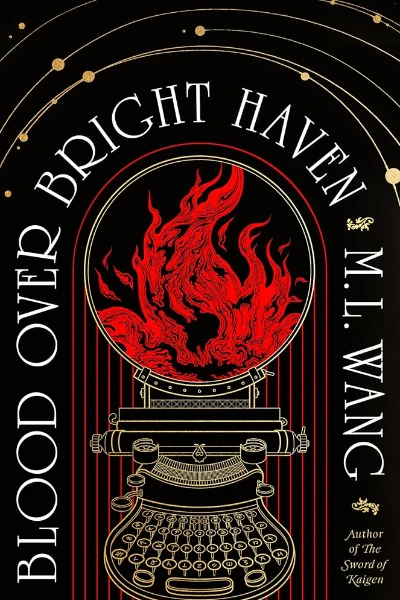
Blood Over Bright Haven
Blood Over Bright Haven — Chapter 2: A Woman Wanting
“All present watched in wonder as Stravos stood upon his crooked leg and raised the barrier from spellwork the like of which even Lord Prophet Leon had scarcely seen—one layer to guard from winter, one layer to guard from bitterest Blight. And within this golden cradle, made by God’s Will and maintained by His mages, we set our nation of the Chosen.”
– The Tirasid, Foundation, Verse 3 (56 of Tiran)
SCIONA PRESSED HER forehead to the seat in front of her and failed to breathe slowly.
“Come on, honey,” Alba said. “Sit up and have a scone.”
“Can’t.” Sciona squeezed her eyes shut, trying to quell the awful squirming in her gut as the train hummed onward. “Not yet.”
“You’re not going to throw up,” Alba sighed.
“No,” Sciona said through clenched teeth. “I still might.”
“You barely touched your breakfast.”
“I perform better on an empty stomach.”
“That doesn’t make sense,” Alba said before crunching into one of the scones herself.
“Maybe not to you.” Hunger had a way of focusing Sciona on days like this—when she needed to be at the top of her game. Satisfaction was the enemy. Comfort was the enemy. She’d picked at her egg scramble this
morning to placate Aunt Winny, but ultimately, she needed this aching
hollow in the pit of her stomach.
“Look, I understand you being anxious—”
“You really don’t,” Sciona said to the back of the train seat. “No one does.
Literally. No woman of our generation has attempted this exam.”
“So dramatic!” Alba laughed, and Sciona didn’t need to look to know her cousin was rolling her eyes. “It must be hard to be you! How terrible to be so singularly talented!”
Not talented, Sciona thought. Insatiable. Insane.
“And look, being a woman should make this easier for you, shouldn’t it?”
“Easier how, Alba? Enlighten me.”
“I mean, no female’s ever passed the exam before, so if you fail, there’s no shame in it.”
No shame. Of course, Alba would think that. To have shame, one had to have pride, and Alba had never had Sciona’s unreasonable excess of that.
“It’s not shame I’m worried about,” Sciona said, although there would be plenty of that after how hard she had worked. “You know why the Council only considers a woman for testing once every decade, right?”
“I…” Alba started but then trailed off with a puzzled look that made it plain she had never stopped to think about it.
“Testing women is considered a waste of resources based on the fact that a woman’s never passed. They only trot out a female hopeful every once in a while to prove the truism. If I fail, I’ll be that proof. I’ll have ruined magic for the next decade of female research mages.”
“I think you’re overthinking this.”
“I think you’re underthinking it. Tests like this are political, and performative, and just—fraught, you understand?” Not that political nuance was Sciona’s strong suit; some functions of the Magistry were just glaringly obvious. “This exam will have consequences for people who aren’t me.”
“Okay, but come on,” Alba said. “Since when do you really care about people who aren’t you?”
“I care,” Sciona protested, immediately aware that her tone was too
defensive to convince.
“Yeah? Where’d these scones come from?”
“Sorry—what?”
“Who made this basket of scones?”
“Aunt Winny?” Sciona assumed.
“Do you remember her baking last night or this morning?”
“Why would I remember that? I was a little busy preparing for the most important test of my life.”
“The scones were a gift from Ansel… the baker’s son,” Alba added when Sciona just looked at her blankly, “who’s waved to you every morning since his family set up shop on our street. He dropped them off last night before you left the table.” When still nothing registered on Sciona’s face, Alba continued, “We were listening to election predictions on the radio when he came in. You looked right at him. You really don’t remember?”
“I didn’t realize the exam was starting,” Sciona said sourly. “Am I going to be tested on the color of his cap too? Some insipid comment he made about the weather?”
“You could stand to be nicer to Ansel.” Alba frowned in that judgmental way that Sciona never quite understood but always hurt. “You remember that he lost his brother last year?”
“Of course, I remember.” The sight of that much blood on the cobbles was difficult to forget. “But what does that have to do with me?”
“I’m just saying, you barely pay attention to the people right in front of you. I’m sure your passing the exam would be good for other women and all that, but I don’t think you can say you’re doing it for them. I mean, can you even name a practicing female research mage—or any practicing research mage—you actually care about?”
Sciona tilted her head, opened her mouth— “Your mentor doesn’t count.”
Sciona closed her mouth. Maybe Alba had a point. Was Sciona really upset that women might not be allowed into the High Magistry or the idea that she might not be allowed in? After twenty years of reading every night instead of sleeping, scribbling formulas instead of touching her meals— “Oh, Sciona, you have to sit up!” Alba slapped at her arm. “Sit up and look! It’s so pretty!”
The train was racing across the highest bridge above the city just as the sky blushed with the promise of sun over the eastern hills. Even after a thousand train rides along these tracks, there was nothing quite like watching the greatest civilization on Earth waking with the dawn.
Tiran’s holy forty-sector energy grid ran all night but only lit up in the early morning, spells flashing like lightning across the skyline as alchemists siphoned ore for the day’s steel production. Electric lights blinked on in the
windows of the work districts first, then in the mansions beyond, creating a sea of sparks that trailed off into the blue-black expanse of the farmlands to the east. Below the train tracks, cars bearing morning milk and fruit deliveries for the wealthy trundled along the roads like a procession of bright-shelled beetles. With Archmage Duris’s new rubber compounds for their wheels and smooth alchemical cement replacing the cobblestones of most major streets, vehicles moved faster now than ever, but the “magic- drawn carriages” still seemed slow and small from the train.
Sciona liked the city best from up here, all its technical marvels on display without the mess of its human inhabitants, no one to bother her with their chatter or attempts at eye contact—well, no one except the excitable woman in the seat next to her.
“Praise Feryn, what a view!” Alba hung on Sciona’s arm as the train climbed. The clock and radio repair shop where Alba worked was only two blocks from their apartment; she didn’t get much occasion to see the wider city of Tiran. “I can’t believe this is your commute!”
“Possibly for the last time.” Sciona had promised Aunt Winny that if the exam didn’t work out, she would get a real job teaching magic to children at one of the local schools. No more university, no more research, no chance at a real legacy, just hordes of snot-nosed schoolboys like the ones who had made her childhood hell.
“Don’t say that, Sciona! You’re going to do amazing.”
“Nobody does amazing on the High Magistry exam,” Sciona said, determined not to torment herself with hope. “They just pass, or they don’t.”
By the time the train slowed at the University of Magics and Industry, the sun had crested the hills to sparkle off the dome that protected Tiran from Blight and insulated it through the dark winter.
A few people eyed Sciona’s dark plum robes in surprise as she picked her way down the train aisle and stepped onto the platform. It wasn’t that women never reached Sciona’s level of study; it just wasn’t common. And of the few women who did make it to a graduate degree in magic, most donned green robes and went into teaching. Why pursue research, after all, when its highest levels were inaccessible to you? Better for a lady mage to employ her talents training the next generation of great male innovators— unless she was a perpetually unsatisfied monster like Sciona, always after what wasn’t hers.
While Alba marveled at the bustle and majesty of the university train station, Sciona’s appreciation landed where it always did—on the sheer magical power of the train itself. She never tired of watching the masterfully designed pressure conduits glow along each of the doors, pushing them closed. As those conduits dimmed, the engine at the front of the train blazed, siphoning energy from the Reserve to turn those great wheels on the tracks.
Sciona felt the train shudder with the massive energy intake—like a thrill down a spine—before it continued east with its remaining passengers.
Decades ago, she had tugged on Aunt Winny’s worn, lacy sleeve and asked what made the trains move. What had the power to animate a machine the size of a dragon?
“The mages make the trains move, dear,” Aunt Winny had said and, when she saw that the answer hadn’t satisfied her niece, added, “clever men who study very, very hard.”
Sciona remembered the shock as she registered that mages were just men who had been boys once. She remembered thinking that she was cleverer than any boy in her primary school. She studied harder than any of them.
So, why not her?
Why not her?
Her stride picked up, making her cousin jog to keep pace. Alba had the longer legs, but she kept pausing, clearly intrigued by the commotion around them—which, in fairness, was more intense than usual.
The highmage examination was always timed to coincide with the election of city chairs, the idea being that new mages and politicians entered the hallowed halls of the theocracy at the same time—the will of God and the people moving as one. Sciona just wished the public election end of the process didn’t have to be so loud when she had magic to concentrate on.
The platform teemed with activists flinging pamphlets around and shouting about their chosen city chair candidates.
“Ladies! Ladies! Vote Nerys for Women’s Rights!”
“Widmont, I say! A chair for the people!”
“Tiran stands on its traditions!” a mustachioed man with an ‘Elect Perramis’ button on his waistcoat shoved a pamphlet at Alba, but Sciona got there first.
“She’s not interested.” She swatted the paper from the man’s hand to flutter to the pavement, and her purple robe was undoubtedly the only thing
that made him back off. “Thank you.” Taking her cousin’s arm, she deliberately trod on the Perramis pamphlet, sure to leave her square-heel boot impression on that face with its upsettingly familiar sharp brow and large eyes.
Beyond the train platform, the crowd thinned as mages, staff, and students all went their separate ways, but Alba’s mouth still hung open as she looked around at the great stone buildings of the university.
“You’ve been on campus before, haven’t you?” Sciona vaguely remembered Alba accompanying her to a few interviews during the application process many years ago.
“Yeah, it’s just…” Alba trailed off as Leon’s Hall came into view, its great intricate dome standing proud between the siphoning towers. “Wow…”
“Beautiful, isn’t it?” Sciona smiled, as proud as Aunt Winny showing a guest into her lovingly furnished sitting room. Maybe it was silly, but the university really was home to Sciona in a way no hearth or kitchen ever would be.
While the larger additions to the Main Magistry building had come later, the great stone entrance had stood unchanged for three hundred years.
Tiran’s five Founding Mages loomed between the columns—Leon, Stravos, Kaedor, Vernyn, and Faene the First—each three stories of benevolent stone. The art of sculpture had advanced in the intervening centuries, but there was something inimitably mighty about these works from the dawn of Tiran, their rough-hewn features and wise eyes inlaid with peridot to give them life.
Founding Mage Leon’s words glinted in polished alchemic gold above the doors:
To Tiran, the Bounty of the Otherrealm. To my Mages, all its Power.
May you ever be good Stewards to this Bright Haven in a world of darkness.
Carved below that was Faene the First’s motto and mission statement of the university:
Truth over delusion. Growth over comfort. God over all.
Sciona had to gather her skirts into a great bundle to climb the steps to the double doors. She never would have worn such a fine bit of frippery to the university, but Aunt Winny had balked when her niece had come downstairs in the usual study blouse and pinafore. To go before the archmages, Aunt Winny insisted, Sciona must look a proper lady. How else would she get them to take her seriously? Sciona could have pointed out that her spellwork was supposed to do that. But she had been too dazed with nerves to object as her aunt manhandled her into the layers of petticoats and printed velvet.
The security conduits in the foyer registered the bronze clasp of Sciona’s robe, and a second set of doors opened to allow the women through. This front chamber of the Main Magistry was accessible to all staff, students, and guests. Some classes were even held in the two modern additions between Leon’s Hall and the siphoning towers. The crowd was sparser during the winter break, but an assortment of mages flurried about preparing for the coming term, robes flapping dramatically behind them—mahogany for undergraduates, fern green for instructors and administrative staff, purple for junior researchers, white for the archmages who commanded them all.
The High Magistry exam always took place in Leon’s Hall beneath the dome where Tiran’s first Council had assembled. To get to the restricted historical chamber, Sciona and Alba had to pass a green-robed secretary.
The elderly woman eyed Sciona’s robe for a moment before lighting up.
“Oh, you must be Sciona Freynan!” Her emerald eyes were all atwinkle as though she’d just seen a unicorn. “You and your friend can go on through to the antechamber. And good luck!”
The gossip mill had been at work within the Magistry if even the first- floor secretary knew there was a female applicant taking on the exam this year; the Council was usually secretive about who they were considering.
The way the secretary raised her fist in encouragement made Sciona wonder if she had been at that desk the last time a hopeful woman passed these doors to break on the challenges beyond. Perhaps, she herself had once dreamed of the High Magistry but had let those dreams go at some point in her career, succumbing to the pressures of tradition and practicality.
Stop that, Sciona, the voice of reason warned. You’re spinning worst-case scenarios where they don’t exist.
But was she? How unreasonable was it to expect failure where no woman had ever succeeded? Realistically, Sciona’s purpose was to fail here.
Realistically, her future would be the same as that secretary’s—trapped behind a tiny desk, serving her male superiors until her quick hands slowed and her mind rotted from idleness. Could Sciona live that sort of future?
Could she bear it?
Her steps slowed as she reached the antechamber, which was already half- full of purple-robed applicants and their male relatives. These men all belonged to good families. Old magic. Old money. They were the ones meant to succeed here, while Sciona was meant to backslide neatly into her predestined position. Secretary. Assistant. Wife. The shadowy truth had been gnawing at the edges of Sciona’s consciousness for weeks. It swelled now, darkening the way ahead. There was no life beyond this exam. If she didn’t pass, she couldn’t go on living. And yet, how could she pass?
Existential terror seized Sciona, swarming her vision with blackness. The blurring floor was rushing up to meet her—when a swish of white drove back the dark like Leon before the Horde.
Archmage Derrith Bringham.
Sciona stumbled, found her feet, and looked up at her mentor. The archmage was in full regalia, gold ropes of distinction hanging from the shoulders of his white robes. Holy light.
“Ah, there she is!” he beamed, arms outstretched. “My soon-to-be highmage, Miss Freynan! And Miss Livian, delightful to see you.”
“Y-you remember me, Archmage?” Now, it seemed that Alba might be the one to faint.
“Miss Freynan’s lovely cousin? How could I forget?”
Alba flushed pink beneath her freckles like she was a schoolgirl. Maybe it was just that men didn’t often call Alba lovely; she was on the tall side for a woman, with a squarish jaw and more muscle in her arms than most men liked. Bringham simply had a gift for telling people what they needed to hear.
“Chin up now, child.” The archmage turned back to Sciona. “They’re going to want to see a little confidence.”
“Alright,” Sciona breathed. Just not too much confidence, she thought, or the testers would think her arrogant. Half of Tiran probably thought it arrogant for a woman to attempt the exam at all.
“You look ill, Miss Freynan. Are you going to lose your breakfast?”
Maybe. Sciona shook her head. “It’s just nerves, sir. I’m fine.”
“Since when is Sciona Freynan nervous for any test?”
“I…”
“Since when is she afraid of a challenge?”
“I don’t know.” Since the roadmap had vanished.
All obstacles to this point had been within Sciona’s control—conquerable with deep thought and hard work. Earning an advanced degree in sourcing had been hard, but other women had done it before. Working as an archmage’s assistant had been grueling, but students younger than Sciona had done it before. There was precedent. Highmagehood was the first mark that seemed out of reach, no matter how perfectly Sciona performed.
“Freynan,” Bringham’s voice brought her firmly back to the present.
“Listen to me. This is a task like any other. It is within your power.”
Of course, Bringham had the right words. Whether they were true was a different matter.
“No nerves, now,” he said as if it were that simple. “We both know nothing can stop you once you get your teeth into a spell. Just wait. My fellow archmages are going to eat their words about you.”
“There were words about me?” Sciona said, wishing the thought didn’t make her quite so queasy.
“They’re paying attention. For the purposes of this exam, that’s a good
thing.”
“Is it?”
“It can be. But you shouldn’t bother yourself about that. Let me worry about the other archmages. You just focus on giving the usual Freynan over- performance, yes?”
And, Feryn, Sciona wanted to be worthy of the confidence in his smile.
Archmage Bringham had staked his credibility on her when he pushed so hard to have her application considered. If she fell short today, she wouldn’t just be ruining opportunities for other women. She would be damaging Bringham’s reputation—after everything he had done for her.
“I’ll try not to disappoint you.”
“Not possible,” he said. “Now, I should get back to the other archmages.
As always, we have a great deal of needless last-minute squabbling over the particulars of the exam. You’ll want to be in there soon, too, Freynan.” He lowered his voice conspiratorially. “I get the feeling you’ll be less nervous
after you take stock of the competition.” He winked and turned in the direction of Leon’s Hall.
“Alright.” Sciona gave Alba’s hand a last squeeze. “I guess I’ll see you on the other side.”
“I’ll be right here when you’re done,” said Alba.
“Oh, Miss Livian.” Bringham turned back to the two women. “Wouldn’t
you like to watch?”
“Watch?”
“Applicants often bring fathers and brothers to their examinations, and you’re Miss Freynan’s family, aren’t you?”
“Yes…” Alba said, “but women don’t usually go in, do they?”
“There’s no law against it. And the exception has already been made”— Bringham inclined his head toward Sciona—“so what’s the harm?”
Through the next set of doors, Leon’s Hall told a story in three parts.
Tiran’s future sat on the crescent of tiered benches along one side of the chamber: purple-robed research mages like Sciona, hoping to join the ranks of the city’s highest innovators. Opposite them sat Tiran’s present in the form of the white-robed archmages of the Council. And the soaring dome above depicted Tiran’s past, rendering all the living small by its glory.
There was Archmage Leon bringing the founding texts down from the highest peak of the Venhold Mountains, then another depiction of him with his staff held aloft to banish the Horde of Thousands from the Tiran Basin.
There was copper-haired Archmage Stravos erecting the barrier that had saved civilization from the foretold Blight. There was Faene the First as a young mage, transcribing the Leonid at Archmage Leon’s feet, then as a wizened elder, composing the Tirasid. There was Mordra the Second at his forge inventing steel.
Sciona normally would have paused to admire the magnitude of the history on display and contemplate her place in it. But the moment she entered, her consciousness sucked inward in self-defense, making the rest of the world fuzzy. She barely felt herself sit on the bench between Alba and another examinee. The purple-robed man looked younger than Sciona —maybe twenty-four? The casually expensive shirt and waistcoat beneath his robes said that he came from money, but he was the only applicant in the chamber who didn’t have a single relative with him.
“Hello,” Alba greeted him, ever friendly. “I’m Alba Livian. This is Sciona Freynan.”
The man nodded at Alba and gave a little grunt before turning away in what was either nervousness or extreme rudeness.
“It’s fine,” Sciona whispered as Alba gave him a sour look. “Ignore him.”
Emotionally, Sciona was at capacity. If she started worrying about her competition, her head would explode, and Alba would have to scrub her brains from the bench. For now, the only mages in the chamber she could afford to contemplate were the examiners.
The twelve mages of the High Council sat raised up behind a long desk, all of them busy conferring, shuffling through their notes, or adjusting their multi-purpose conduits. Their murmurs were too low to make out from the examinee seating but seemed to fill the chamber with their gravity all the same. Only one hundred mages ever practiced in the High Magistry at a given time. Of those hundred, only the twelve greatest sat on this High Council and bore the title of Archmage. These were the men who turned the wheels of Tiran, as their forefathers had since its founding.
Archmage Bringham was the sole Council mage Sciona knew in person, but she knew all of the others almost as intimately through their books on a breadth of magical disciplines. Archmage Supreme Orynhel, Head of State and Clergy, sat in the highest seat. At his right hand sat Archmages Thelanra, Mordra the Ninth, Gamwen, Scywin, Lehar the Fourth, and Eringale. At his left sat Bringham, Renthorn the Second, Duris, Capernai, and Faene the Eleventh. Sciona had read every word these men had ever written down to the footnotes and structured her life around their teachings.
“So, those are the archmages?” Alba whispered in awe.
“Yep.” Having worked with Bringham for so long—having seen him on his off days, when he spilled tea on his notes, got his mapping coordinates backwards, or stubbed his toe on lab equipment—should have taken some of the mystique from the Council. But beholding them all seated together in this hallowed hall sent a thrill up Sciona’s spine.
“They don’t look how I expected.”
“Did you think they were as big as the statues outside?” Sciona joked. “Or that those white robes actually radiated light like in the paintings?”
“No. I’m not five. I just—I guess I thought they’d be carrying staffs?”
“Staffs are wartime conduits,” Sciona said. In battle, you needed a supple yet robust conduit that wouldn’t blow apart with the explosive energy expenditures of combat. But Tiran hadn’t been at war since the Founding Mages defeated the Horde three hundred years ago. “Most highmages still
train with staffs as private religious practice—since it’s mandated in the Tirasid—but conduits that big aren’t really practical for day-to-day magic.”
In the years Sciona had worked for Archmage Bringham, she had never seen him take his staff out of its display case.
“Then… how do they do their magic?” Alba asked. “All with spellographs?”
“No, no,” Sciona said. “That would get time-consuming, wouldn’t it?
Staffs are just one kind of multi-purpose conduit. Highmages all use different objects to implement their pre-written spells. Archmage Duris uses his gloves. Archmage Orynhel has his ring… though most of the older
mages still prefer wands.”
“How does that work?”
“You’ll see.”
All seating in the hall faced inward, overlooking a circular floor where the applicants would demonstrate their skills. This circle had hosted a hundred turning points in Tiranish history. It was where the traitor mage, Sabernyn, had been tried for his heresies and put to death. It was where Renthorn the First had showcased the magical lightbulb that had led to the development of Tiran’s entire electrical grid. Careers were born, nurtured, and slaughtered within this circle. Today, the pale limestone floor was empty save for an unassuming oak desk at its center. On the desk sat a top-of-the- line spellograph and a stack of spellpaper. Other items would be involved in the testing, but the archmages would summon those as they became relevant.
“Jerrin Mordra!” was the first name Archmage Orynhel called into the tense hush, and the unfriendly applicant beside Sciona stood. “Please step
forward!”
Mordra?
Sciona glanced sideways at the young man as he nervously straightened his robes. This was Archmage Sireth Mordra’s son? Sciona immediately hated him for displaying any nerves at all. There were no stakes for him here. He would pass the exam on the basis of legacy, as the sons of Council members always did. There were only two spaces open within the High Magistry since Highmage Tython had retired and Highmage Yeranis had passed away in the last year. If Archmage Mordra’s son met the basest standard on the testing floor, one of those spots belonged to him.
Sciona glared at the legacy’s back as he faced the Council, thanked them for their consideration, and stated his mission.
“Archmages of Tiran, I humbly stand before you to test for the rank of highmage. I have studied magic at Danworth Academy and here at the University of Magics and Industry. My areas of specialization are mathematics and mapping theory.”
In other words, nothing. The theory of magic without the application.
Anyone with an important enough father could get good grades in mathematics and theory since neither required proof of efficacy in a lab, let alone a factory.
“With your permission, I will approach the testing desk.”
As Archmage Orynhel nodded, Sciona leaned forward, keen to see if this little bastard would live up to his forebears. Mordras past had revolutionized Tiran’s transportation and communications systems, so it was a tall order.
Archmage Renthorn the Second was the first to set a prompt. Drawing his wand, he executed a subtle flourish, barely perceptible from the examinee seating. Light flashed at the wand tip, and a bowl materialized on the desk.
“In the vessel before you, you will find four hundred paper strips.
Compose and activate a spell to disperse them throughout the chamber.”
A laughably easy prompt. There were a hundred ways to deliver and precious few ways to screw it up. Sciona supposed an excess of energy might create a spark that set the paper ablaze, but Archmage Renthorn hadn’t demanded that Jerrin Mordra keep the pieces undamaged, only that he disperse them.
Jerrin Mordra attacked the spellograph with the hands of a seasoned composer, fingers punching the steel keys so fast that the individual clicks merged into a cascading clatter. The silence in the hall magnified the sound and made Sciona’s own fingers twitch. After a half minute of typing, Mordra hit the break key with an audible clack and began his mapping composition.
Here, his fingers slowed just slightly, betraying indecision. A simple mapping sub-spell would have taken Sciona half as long to write, but she had served her time since her undergraduate days in Bringham’s lab, handling raw energy as well as numbers. It was hard to predict how those numbers would translate to energy when you had only ever worked on
paper. Finally, Mordra hit the activation key; the spellograph dinged and displayed the fruits of his tentative fiddling.
Alba gasped and gripped Sciona’s hand so hard it hurt.
“What?” Sciona whispered.
“That’s… i-is that…?”
Sciona forgot that the sight of the Otherrealm was novel to non-mages like Alba, who rarely witnessed the magical processes behind their machines. To Sciona, the gray visual in Mordra’s mapping coil just looked sloppy. The lights were dim where they should have been bright, fuzzy where they should have been crisp. It would be hard to nail down the right energy source in that muck. And Jerrin Mordra knew it, his fingers shaking with apprehension before locking in the siphoning coordinates that would power his action spell.
When he hit the activation key, an explosion went off in the bowl, sending paper confetti raining through the chamber and making the idiots murmur in wonder. One of those idiots, of course, was Alba.
“Amazing!” she marveled, plucking a bit of paper from where it had caught in her waves of dark hair.
“That’s not a hard spell,” Sciona muttered under her breath. “Just flashy.”
Sciona could have done it in her sleep, and she was appalled at the uneven quality of the energy. A shred of paper that had stuck to her skirt was torn, and she noted that Mordra scrambled to restack the papers by the spellograph, which had blown out of order.
“There’s no reason to use that much force to disperse paper.” It spoke to a lack of clarity in Mordra’s mapping and, worse, a lack of precision in his targeting. To be expected of a mathematics and mapping theory major.
As the archmages gave Mordra his next prompt, Sciona found her fingers itching anew. Even knitted together in an attempt at dignified posture, she couldn’t keep them from squirming. The keys beneath Mordra’s too-slow hands were calling to her, and the knot of dread in her stomach was rapidly unraveling into a mad flutter of eagerness. What had she been anxious about before, anyway? She could do everything the Council was asking Mordra to do. Perfectly. Elegantly. They just needed to let her at that spellograph so she could show this fool how it was done.
As Sciona had expected, poor Mordra eventually fell short on a sourcing error. The brick he was supposed to levitate only hovered for a few seconds, wobbling, before banging back to the desk’s surface. The mutters this time
were of mixed disapproval and confusion. Archmage Gamwen, Tiran’s foremost mapper, grimaced as he made a note. Archmage Scywin, the greatest manual siphoner in history, looked too disgusted to even note anything down.
“What happened?” Alba whispered. “Did he write the spell wrong?”
“Not the action spell,” Sciona said.
“The what?”
“The part of the spell that tells the brick where to hover and in what position… he wrote that perfectly—not that that’s hard—but it’s only half the spell.”
What the Tiranish layman understood to be a single spell—be it a spell to move a train or light a lamp—was actually two sub-spells comprised of multiple pieces: the action spell, involving naming and commanding, and the sourcing spell, involving mapping, targeting, and siphoning.
“Action spells are easy enough to learn from a book, but sourcing spells are a mix of mathematics and intuition. His action sub-spells are fine; he’s obviously read the right books. And his math seems fine too. But he hasn’t done a lot of practical magic, so he’s weak in the intuition department—the part where you have to choose a siphoning location and make sense of the visual your coordinates produce. He’s struggling with the sourcing sub- spells that power his action spells.”
“So, his spells get too little power?” Alba asked.
“Or too much. He just has very poor control over his energy input. If they ask him to do anything really difficult, be ready to duck.”
“What’s really difficult?”
“I’ll let you know.”
The prompts got more complicated from there—“make this gear into a conduit that spins when it detects heat above a hundred degrees,” “write a conduitless spell that produces light at the sound of a clap”—and Jerrin Mordra started to struggle.
When Archmage Duris asked him to power a small model automobile from one end of the desk to the other, the little car sputtered, vibrated, then shot across the desk. It would have crashed to the floor had Jerrin Mordra not lurched forward against protocol and caught it.
“Sorry.” The young mage grimaced, looking mortified, and took his hand from the car. “I didn’t—”
“Kindly keep your hands off the testing material,” Mordra the Ninth snapped at his son. “And speak when you are spoken to.”
Alba winced sympathetically and whispered to Sciona, “Was it that bad?”
“Extremely.” On both the action and sourcing end. The nerves were
starting to get to the archmage’s son.
“But it worked,” Alba whispered.
“With a lag, sputter, and way too much energy. It wasn’t properly sourced or tightly composed. Imagine if real people had been in that car.” Those were, after all, the stakes involved in being a highmage whose work made its way onto the streets and into people’s homes.
Surprisingly—perhaps admirably—it was Jerrin Mordra’s own father who was the hardest on him. Any archmage at the Council table could prompt any spell from the applicant, but Mordra the Ninth was the one who chimed in most often to demand ever more challenging work. Sciona almost felt bad for the younger Mordra when his father said, “On the table before you, you will find a slab of granite. Bisect it evenly.”
Sciona obviously couldn’t see what Jerrin Mordra entered into the spellograph then, but she sensed that he didn’t have it. The composition was rushed, probably overwritten, his fingers unsure as he hit the activation key.
“Duck, Alba.”
The two women were down safely behind the bench when a bang sent rock fragments in every direction. One of the other examinees swore as a rock clipped his cheek, drawing blood, and a few people stifled yelps of alarm.
“Idiot!” someone among the spectators hissed louder than was perhaps appropriate.
Seeming to take pity on Jerrin Mordra, wizened Archmage Thelanra cleared his throat and said in his kindly wobbling voice, “That’s quite alright, Mister Mordra. Would you like to try it again?”
Try it again? Sciona fought a sneer as she and Alba climbed back into their seats. Working in a real facility, you had to whip up complex spells quickly all the time—and often, there was no redo.
To his credit, Jerrin Mordra did manage the difficult spell on his second try, so perhaps he wasn’t totally worthless. Just not quite highmage material.
When the legacy had finished his deeply mediocre demonstration, Archmage Orynhel waved a hand. His ring glowed, and the contents of the
desk vanished, replaced by a new spellograph and a fresh stack of paper.
The applicants who went next were better than Jerrin Mordra, some downright impressive. As the fifth mage finished his exam, Sciona was quaking in her seat—though not with fear.
“Are you alright?” Alba whispered, clearly noting the way Sciona had started vibrating at her side.
“I just need it to be my turn,” Sciona breathed. She needed this energy out before it burned her up.
Agonizingly, of the ten names called, hers was the very last. By the time the ninth examinee was summoned to the floor, Sciona was shifting in her excess of skirts. With no outlet, her mind began to spin out into more horror scenarios: they had forgotten about her. They were going to decide at the last moment that it had been a mistake to bring a woman into the hall. This would all turn out to have been a joke. Or a dream.
She almost didn’t believe it when Archmage Orynhel peered down at his papers, adjusted his spectacles, and called, “Sciona Freynan!”
She jolted from her seat like an electrified conduit. “Yes, Archmage Supreme!”
Withered fingers beckoned her to the floor, and Sciona stepped into the circle toward her destiny—or toward the end of everything.
OceanofPDF.com