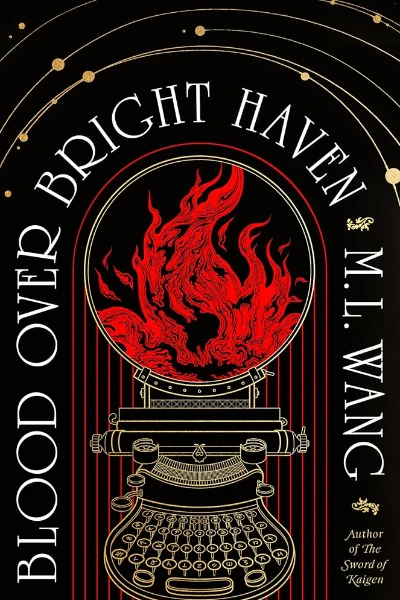
Blood Over Bright Haven
Blood Over Bright Haven — Chapter 10: Far Afield
“I, Leon of the Verdani, hereby establish this plain from the Venhold Mountains to the Gray Barrows as Tiran, which means God’s Haven in Old Verdanish. The faithful who have joined me here will now be called Tiranish, for we and our descendants will serve as stewards of God’s Bright Haven. Here we will dwell from henceforth in the Light of Truth, the pursuit of Knowledge, and the Bounty of God.”
– The Leonid, Conquests, Verse 104 (1 of Tiran)
BEFORE SCIONA COULD ask what on Earth was the matter with Thomil, the Kwen had whirled and fled the laboratory, pushing through the door so hard that it banged off the wall in his wake.
“Thomil!” She followed, but he was ridiculously fast. By the time she had picked up her skirts to pursue him out of the lab, he had vanished down the hall. “Thomil, wait!” When she rushed into the lobby, there was no sign of him.
“Have you seen my assistant?” she asked the secretary.
“The Blighter?” the man behind the desk said, sounding bored. “He ran off that way.”
Sciona found Thomil in a back stairwell between the third and fourth floors, curled up against the wall like a child. He was quaking worse than
before, his head between his knees, strong arms clutched tight around himself as though he feared his body might shake apart.
“Thomil, what is it?” Sciona reached for him, but he flinched back so hard she recoiled.
“Don’t! Mage!” He spat the word like it burned in his mouth. “Don’t touch me!”
“You can’t talk to me like that,” she said, unnerved. “What’s gotten into
you?”
“I told you! That was Blight!”
“And I heard you,” she said, “but what does that mean?”
“The siphoning spell you did…” Thomil’s head was still clenched between his knees, fingers digging into his copper hair. “That white light… That’s what Blight looks like when it takes a living thing.”
“That’s…” Sciona took a step back, shaking her head. He couldn’t be suggesting what he seemed to be. It was insane. Unthinkable. “I’m sure you’re mistaken,” she said in the calmest tone she could muster. “No one siphons energy from this realm. Only from the Otherrealm.”
“Call it the Otherrealm, then. Call it whatever you want. That place we saw in the mapping coil was a meadow in the Southern Kwen.”
“Thomil.” Sciona did her best to channel Alba’s soothing air, though she knew she was bad at it. “Trust me, that’s simply not possible. I promise.”
He looked directly at her, and she was disconcerted to find tears standing in his usually stony eyes, sharpening them to steel. She drew back, afraid of the edge.
“Not possible?” His voice had gone low, and Sciona was abruptly reminded that her assistant was, at heart, a predator from a ruthless wilderness where men sometimes hunted and ate each other. “I grew up on the plains of the Southern Kwen, Highmage. I know what they fucking look
like.”
“Hey now, listen—”
“No, you listen!” Thomil hissed, and Sciona took another step back. “My father died in a deerskin tent pitched in a snowy field like that one. He came apart in spirals of light, just like that bush. Siphoned. It—” His voice caught, shaking with something more than grief. With rage. “It took my sister an hour to scrub all the blood off me. She didn’t cry. She never cried when there was someone who needed her to be strong. She never stopped moving forward, believing the next migration could bring us something
different, something better. But even she…” He paused to take a shuddering breath, and when he blinked, tears spilled from his eyes. “Blight took her, too—during the crossing into Tiran, within a mile of the barrier.”
But it couldn’t be. Sciona shook her head, struggling for the rational explanation she knew existed—because it had to exist. Tiran was built on magic, and Tiran was an inherent good, God’s Chosen City, His Bright Haven in a world of darkness. There had to be some other explanation.
“Look…” Her thoughts, which had scattered like a flurry of panicked birds, lit on the first explanation that seemed stable. “Founding Mage Leon referred to the Otherrealm as a garden—which can also mean ‘paradise’ in Old Verdanish. If it happens to look like the Kwen to you, it’s because that’s your idea of paradise and bounty. Right?” That made sense, didn’t it? Yes.
“You said yourself that our human minds might not be capable of processing the Otherrealm. Maybe God accounts for that. Maybe He only shows us the Otherrealm in a form that we understand.”
“Then what is Blight?” Thomil demanded.
“It’s what our top researchers have always said it is: a sickness that manifests in the unwashed—”
“Blight is not a sickness,” Thomil cut her off. “Pox is a sickness. Fever is a sickness. Blight is a supernatural evil that happens to do exactly what your siphoning spell did to that bush.”
“I…” What could Sciona say to that? How could Thomil be mistaken?
But at the same time, how could he be right? How could that possibly be right? “Maybe you’re not remembering clearly. Sometimes, when an event is too upsetting to wrap your mind around, your memory gets muddled.
When my mother died—”
“You suggest that your god shows us his bounty in the form of our subjective paradise,” Thomil said. “If that’s true, then why would he show me Blight?”
“Maybe it’s because of what you are and what you believe.”
Thomil’s anger didn’t rise. Instead, he blinked, and, for a brief moment, he looked so shattered that it broke Sciona’s heart. She didn’t want to say her next words. She didn’t want to think them. But the alternative was too hideous to contemplate.
“I’ve humored you in your outlandish claims about religion, alright? But the hard fact remains that your people rejected the True God and, by extension, Truth itself. Leon gave your kind a chance to join Him in the
light, and your ancestors refused. You continue to refuse Him, despite all evidence of His holiness and supremacy. Maybe you can’t see God’s Bounty because it’s not meant for the eyes of non-believers. It’s for the true seeker of knowledge. You see a nightmare because it’s what God intends for you—what your people brought on themselves through generations of willful ignorance.”
At some point, as Sciona spoke, all the emotion had left Thomil’s face. He was dead stone when he asked, “What did you see, then, Highmage? If I saw only what a heathen sinner deserves, what did your holy mage’s eyes see in that coil? What did God show you?”
“He…” Sciona faltered. Because Thomil had referenced a snow-covered field. She had seen a field, too, unlike any place she had ever been.
“A Tiranish courtyard garden, maybe?” Thomil suggested. “Flowers that make you think of home?”
Sciona couldn’t put names to the evergreen bushes, or the animal, or any of the tracks she had seen in that field. They had been foreign like the moonlit snow. She shook her head, shutting her mind against the impossible.
“I saw Heavenly light.” She lifted her chin. “It was beautiful.”
“Blight is always beautiful,” Thomil said, “from a safe distance. Up close, it’s your father’s blood on your face. It’s wanting to run to him just to hold him one more time before he’s gone, knowing that if you do, the light will unmake you too. Knowing, even as a tiny child, that you must hold yourself still as your only parent peels to pieces in front of you. That’s what Blight does to a person, you know?” Thomil’s face twisted. “It strips them down in a spiral, skin first, then the rest. You saw the leaves and bark coming free of that bush. Imagine that happening to your sweet auntie, your cousin—”
“You’re out of your mind!” Sciona snarled before he could put one more hideous, ludicrous picture in her head. She wished her voice wasn’t shaking quite so badly as she tried to pull Thomil back from this madness. “I understand that you’ve seen terrible things. You’re in pain—but that’s exactly why you need to take a moment and think about what you’re saying. You’re confused.”
“No, Highmage, I think I’m seeing everything for the first time in total clarity.” Thomil’s pupils dilated slightly against their icy irises as though processing something beyond Sciona’s sight. “The coordinates, Highmage Freynan…”
“What?” she asked—though why was she even humoring this lunacy?
She was a highmage. She didn’t need to stand for this. She should order Thomil to go home for the day and rethink the way he spoke to his superiors. She should— “What coordinates?” she asked.
“You know, Highmage,” Thomil said without breaking eye contact. “If you think about it, somewhere in that busy little brain of yours, it must have
occurred to you.”
“What must have occurred to me?”
“When we first met, you explained the Forbidden Coordinates. I’m an endurance hunter. I place all things on the map in my mind, so I’ve always wondered… why are the Forbidden Coordinates placed the way they are? In a perfect circle. Like a certain city contained within a half-sphere dome.”
“No! You’re making things up. The nature of the Forbidden Coordinates is not for us to know.”
“You don’t believe that, Highmage Freynan.”
“Excuse me?”
“If you really believed there were godly things beyond your understanding, you never would have pushed your way into the High Magistry against the will of your elders. You never would have opened a Faene-forbidden window to the Otherrealm. If you know something is there, you have to peel back the scab, whether or not your god would approve. You can’t tell me this is any different.”
“This is different! It’s heresy!”
“So was opening the window in the first place,” Thomil said—a coaxing demon, drawing her into the fury of those gray eyes. “So, why stop there?
Go on, Highmage Freynan. Fire up that superior Tiranish brain of yours and line up the Forbidden Coordinates on your impeccable mental map of the Otherrealm. I know you can. Line them up and tell me I’m wrong.”
Sciona’s lip trembled. She wished that, for just this moment, she could be a soft and pious woman of Tiran. She wished that her logical mechanisms could slow and succumb to the emotional need for safety. She wished she could look away from Thomil, close her eyes to what she was never supposed to know. But she couldn’t.
Unbidden, her mind cracked open to the unthinkable. She cast the numbers on a grid and mapped them out—the full range of places where siphoning was encouraged and the one area where it was forbidden: a circle, placed like Tiran in the middle of the wide and wild Kwen, good siphoning
in the south where the climate was more hospitable than in the frozen north, better siphoning still in the spots where Highmage Jurowyn had recorded lush forests, a receding siphoning zone in the winter during which northern areas supported less life… “No…” Her voice trembled like a reed in the wind, about to break. “H- how could… That can’t be.” She blinked back tears. “Tiran—the archmages, the founding mages—would never build all this at the cost of human life. It doesn’t make sense.”
Thomil laughed. He actually laughed at her tears—a rough, angry sound with no mirth in it. “Have you no knowledge of the way your city works?
This makes more sense than any formula you’ve ever taught me.”
“I know exactly how this city works!” Sciona protested. “I’ve been in the labs that—”
“This city eats Kwen alive! It draws us in, breaks our bodies in its gears, and spits us out when it can’t wring any more labor out of us. Literally. Do you know what barrier guards do with Kwen who can’t work?”
“I will not hear this!” Sciona’s fists had clenched at her sides. “You have no right to speak this way about the city that gave you a home! You spiteful, ungrateful—”
“Ungrateful?” Thomil growled low in his throat. “All the gods, Highmage! For once, pull your head out of your runes and numbers, and think about the reality the rest of us live in! Kwen are only allowed in this city so long as we provide a cheap source of labor. Our presence here isn’t charity, it’s conditional, and it is brutal. You Tiranish don’t care when your bridges fall on us, when your chemicals poison us, when your malfunctioning factory equipment grabs us and grinds us into meat. Why shouldn’t your magic also treat us like meat—like bounty—to be slaughtered and consumed?”
“This from a savage!” Sciona threw back because she was out of things to throw. “From a land of cannibals!”
“My people are not cannibals,” Thomil returned through bared teeth, not helping his case. “And there were no cannibals at all in the Kwen before Blight—before you—destroyed all our sources of food! How can you not see how this all fits together? I thought you were committed to truth— genuinely committed to it. I didn’t realize you were as blind and stupid as
the rest of Tiran.”
That was when Sciona slapped him.
She had never slapped anyone before. It hurt. Stinging her palm and sending a lance of pain through every bone in her hand. The shock momentarily immobilized her, and she was unprepared for the retaliation.
In a terrifying breath, Thomil surged forward, and she was certain he was going to hit her back. She stumbled over her own boots, her hand flying to the cylinder at her belt. Thomil’s eyes tracked the hand, malevolent in their coldness.
“You’re that committed to your god of greed?” he said. “Go on, then.
Serve him. Destroy me.”
“Thomil!” Sciona gasped as he drove her back against the wall, and she knew she couldn’t do it. She didn’t have the stomach to physically detonate the conduit against his chest. Not this close. “I didn’t—”
“During the crossing, I watched my entire tribe turn to blood on the snow.” Thomil wasn’t looking at her anymore, even as he glared her in the face. He was looking past her at a memory she couldn’t see, something that made his gray eyes silver with tears. “I wonder what they died for.” His voice had dropped to a whisper. “So you could warm your tea? Or power a cute little cylinder to keep yourself safe walking the streets among all those dirty cannibal Kwen?”
Tears spilled down Sciona’s cheeks as her hand clenched impotently on her cylinder. Out of defenses, she doubled down on her last and strongest ally. Because no one could refute God. Least of all a Blighted heathen.
“Your people died because they deserved it.” Yes, that was why. That was why, Sciona assured herself, even as the tears wouldn’t stop. This was all God’s Will. Thomil just couldn’t see it because he wasn’t worthy. “You brought this on yourselves.”
Some last autumn in Thomil’s expression froze over.
“Then, what are you waiting for?” His rough hand wrapped around hers and yanked it to his body so that her knuckles ground into the hard plane of his chest and detonating the cylinder would blow a hole in his heart. “Be a real Tiranish mage. Kill me. Now that I’m no longer of use to you.”
Sciona couldn’t move. She couldn’t think. The only real thing in the world was the beating of Thomil’s heart against her knuckles. Hard and frenetic, despite all the ice in his eyes.
“You’re the worst kind of murderer, I think,” he said, and she felt the terrible words vibrate against her knuckles. “The kind who won’t even acknowledge her crime. You’ve never worshipped a god of truth.” As
roughly as he had pulled her hand to his chest, he shoved it away.
Disgusted. “You worship a delusion.”
Without his hand on hers—rage binding them together—Sciona was suddenly adrift in the dark, frantic. When Thomil turned to leave, inexplicable panic took over.
“Wait!” She clutched at his sleeve, realizing that she couldn’t bear for him to walk away.
She didn’t care if he struck her. She didn’t care if he put those hunter’s hands around her neck and throttled the life from her body. For once, the last thing she wanted was to be alone with her knowledge. But Thomil was stronger than she was. He tore from her grasp.
And she was alone on the landing. In total collapse.
Sciona had imagined this moment since she was old enough to know what a mage was. Standing in the light of truth, having discovered something no mage had before. How had this dream of so many years turned so suddenly into a nightmare? God, it was just a nightmare, wasn’t it? One of her many anxiety dreams? It had to be. She had fallen asleep in the library while combing her fiftieth source on Stravos, and this was her mind playing a terrible joke on her. That was all. That was all.
Sciona shut her eyes tight and forced them open again, pinched a fold of her skin until it turned white, put a fist to her mouth, and sank her teeth into a knuckle. She didn’t wake. She just bled onto the white sleeve of her blouse, trapped in the confines of this utterly unacceptable reality. The world spun. But there was no way to alleviate this feeling of all-drowning
panic. No way except the one.
Thomil had to be wrong.
About God, about Blight, about her.
And she had to prove it.
Snatching up her skirts, she sprinted back to her office, heedless of the blood dribbling from her hand.
“Why all the screaming, Freynan?” Renthorn mocked as she raced past him. “Had a falling out with your Blighted assistant? I bet—”
Sciona closed the door in his face and locked it.
“Wow! Touchy, touchy!” she barely heard him say on the other side.
“Someone’s time of the month, is it?”
Dragging her spare spellograph off its shelf, Sciona heaved it onto a desktop and wrote up an action spell for fire. Her hands were shaking,
dripping blood on the keys, but that didn’t slow her spellwork. It had never been so important in all her life that she finish a spell and see it activated.
She mapped to a familiar spot, a well-known sourcing pool at the far edge of the common coordinates, where sourcers like Sciona often siphoned for energy and alchemists often siphoned for salt. If Thomil’s insane assertions were correct, this location would be far off in the Kwen, perhaps even beyond it.
The mapping spell flared to life, and Sciona gasped.
People told stories of the ocean bounding the Southern Kwen—of blue saltwater vaster than any land—but those stories were older than Tiran itself. Some even claimed that they were myths. Since the Blight’s first ravages, no cartographer had ever made it that far outside Tiran and back.
Not even Jurowyn. But here it was! Ocean. Impossibly blue, frothing white where it kissed the land, then withdrew, then kissed again.
Human figures moved like ants along the shoreline, leaving footprints that lasted only until the next wave washed the sand to a gleaming mirror behind them. Eagerly, Sciona punched additional numbers into the spellograph to bring her closer. The milling humans seemed to have gathered to look for something in the wave-polished sand. Shells, Sciona realized, leaning forward. Each person had a basket over one arm containing iridescent black shells. Perhaps as some kind of currency? Or crafting material? Or perhaps for the flesh of the strange creatures that lived inside—like the poor sometimes ate the snails from Tiran’s channels.
These people were dressed unlike any humans Sciona had ever seen. At first, she thought they had black cloth wrapped around their heads, but when she pulled in closer, she realized that it was hair. Their hair was black.
Not Tiranish brown nor Kwen copper, but dark as ink.
Sciona mapped in closer still on a young woman who had paused in the shallows, kneeling to scrape through the sand. Her bare arms were a warm bronze the color of Thomil’s hair. When the shell-gatherer glanced skyward at a passing bird, her eyes seemed to lack an iris… or perhaps the iris was just the same inkwell black as her pupils.
Wonder filled Sciona with hope and the light of God. Before the Freynan Mirror, she was sure that the God who had created this ocean and this sunlit sand could only be good. The magic that enabled Sciona to behold all these
wonders could only be good.
Thomil would see.
She hit the siphoning key.
Because a God great enough to spin these wonders would never allow His mages to take human life. Bushes, maybe. Animals, maybe. Not humans.
Never— The girl’s hand lit bright white like paper caught in a candle flame. She started, spilling shells. Then threw her head back, black eyes wide and mouth open in soundless agony as her arm began to come apart.
“No!” Sciona screamed as the last of her world collapsed. “No! NO!
NO!”
She scrambled to abort the spell, grabbing a pen from beside the spellograph and slashing a line through the paper. The pen sizzled and split in her hand, burning skin, but it didn’t stop the siphoning. The white light had spun all the way up the black-haired girl’s arm to ignite her chest.
Grabbing hold of the spellpaper itself, Sciona tore it from the machine. The mid-spell disruption caused an explosion, which knocked both Sciona and the spellograph to the floor.
The siphoning had ceased, but the mapping coil had not deactivated.
When Sciona uncurled onto her hands and knees, the foreign girl lay before her in that circle of copper, half unraveled, twitching as she struggled to breathe. The shells she had been collecting were scattered around her, and the crystal ocean shallows had gone pink with her blood. Her right arm was gone but for a fleshless humerus hanging by a few sinews from her shoulder and swaying hideously with the lapping water.
Sciona reached for the girl, tears streaming from her eyes. Her victim was still alive. Through her stripped white ribs, Sciona could see her lungs moving, heaving to sustain her. Other people had rushed to her side. Her family, perhaps? Her friends? An old woman cradled the girl’s head, weeping, screaming without sound. A younger child clutched her remaining hand. But what could they do? What could they do except hold her as the water gently washed her blood and muscle tissue out to sea?
Whatever this girl’s life had been, it was over, traded for a flash of fire here in Sciona’s lab a thousand miles away.
“I’m sorry!” Sciona sobbed. “I’m sorry! I’m sorry!”
She had never felt as powerless as she did before that mapping coil, watching those bright black eyes go dead.
OceanofPDF.com