
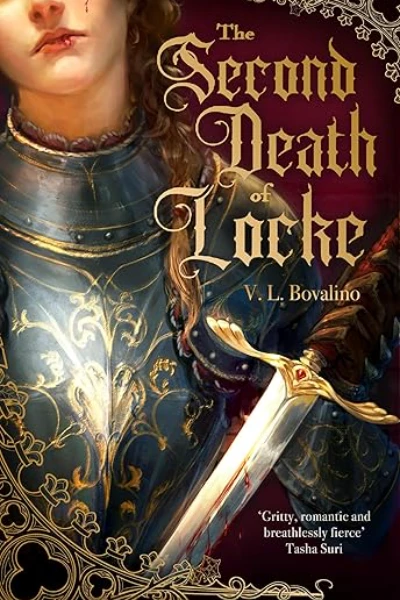
The Second Death of Locke
The Second Death of Locke — Interlude
interlude
N THE ISLE OF Locke, night had only just fallen when the ship arrived atO the harbor.
In the old days—which really weren’t that long ago at all—the child of the Isle who wasn’t selected to inherit married based on letters and furtive meetings and discussions of the exchange of power and renewals. Such was the fate of Lady Wren, sent to Nestria to marry the week after her eighteenth birthday; such was the fate of Locke’s aunts and uncles and great-aunts and great-uncles. Choice, their mothers and fathers always taught them, was an illusion. Though those on the mainland or in the villages could court and engage in dalliances and marry for want, that was not the role of the Isle, nor the role of its family.
No one was foolish enough to speak of love. Especially when whoever married Severin would not know if they were marrying the heir to the Isle and its power, or only their sibling.
“Choice,” Isaak Locke said to his son, as he swiped imaginary lint off Sev’s shoulders, “is your right.”
They stood in an upper room in the fortress, in the suite the family occupied for themselves. The candlelight burned warm against the frigid gloom—it was nearly spring, but that hardly mattered on the Isle, and wouldn’t matter at all until summer came sweeping through Osar and Maerin and the Ghostwood and the Barrens for approximately three weeks before it went racing away again. Isaak had already dressed his firstborn son in one of his own doublets, picked through with shimmering golden thread in the shape of pears and cherries.
From the corner where she sat, Maryse said, “This is boring.”
Severin shot her a glare. They did not often fight more than the usual bickering between children—after all, with seven years between the two of them, there was not usually much to fight about.
“Gremaryse,” Isaak sighed. “Didn’t your mother want to speak to you?”
“She already did,” Maryse said, curling back into the cushion she rested in on the floor. It was supposed to be for Markit, Severin’s large hound, but Markit had been sent to the stables for the evening. She did not take well to visitors, which was usually fine, because the Isle received few of them— until recently.
“And?” Isaak asked. He glanced at his daughter, and Maryse was certain he saw how her braids had already started unfurling, and how curling into Markit’s bed meant she was now covered in dog hair, her new dress wrinkled.
“She told me to behave,” she said primly.
Severin and his father exchanged a glance. Maryse sank deeper into her cushion and closed her eyes, lulled into peace by the scent of firewood and the low murmur of her father’s voice.
“You don’t have to make any decisions,” Isaak said, turning his attention back to Severin. “That’s not what this is about, not yet. I just want you to see if you take to her, if she is someone you would like to speak to again.”
He went back to straightening Severin’s clothes, then took a chain from the collection of jewels he’d brought, securing it across his son’s chest. Maryse was pretty sure it had been a gift from Torrin to her father—the little stone pins at either side shone light blue. Scaelan colors.
“Is this because of Aunt Wren?” Severin asked. “Because Uncle Pol is a cur and a brute and a tyrant.”
Isaak cleared his throat. He aimed a look at Maryse, who was watching the two of them through her eyelashes, feigning sleep—she had the feeling she wasn’t meant to be here for this little speech, so she just snuggled deeper into Markit’s bed, letting a contented smile creep across her lips.
“You did not choose to be born into this,” Isaak said. “You didn’t choose to be born Locke, nor to be a mage, nor to become a piece on the board. So the least I can give you is your freedom, even if your mother resents me for it.”
“She might say she does,” Severin said, stepping away from his father.
“But she doesn’t. She married you for love, after all.”
“She married me for duty,” Isaak corrected. “We just happened to be lucky that duty and love were not mutually exclusive.”
The plot was Isaak’s idea, after all. Maryse had lurked in the halls as her parents fought in hushed tones (which was unusual for them) about the future of their children. Isaak was Scaelan and had married into the Isle; thus, Locke’s customs probably still struck him as cold and unfeeling. After nearly a week of those hushed fights, and another week further of Maryse watching the stony silences between Isaak, Locke, and Severin at family meals, they reached an agreement.
As a child of the Isle not born to inherit, Severin had to marry a noble from one of Idistra’s other nations to protect the alliances between the nations, and to increase power. But Isaak was unhappy with the idea of arranging a marriage, no matter how much his wife reminded him of the customs.
In return, he asked for a compromise: from Severin’s fifteenth birthday until the day he chose to marry, they would host one eligible noble for one week of every month. That allowed Severin to get to know each of them before he was old enough to marry, and write to the eligible girls to build a relationship over time. He would not be forced into a loveless marriage, as Maryse’s beloved aunt was in her youth. He would still marry for power, still follow the rites of the Isle—but he would make his own choice.
When their grandmother heard of the arrangement, she was furious for weeks. The only thing that drew her out of her room when the first visiting noble from Nestria arrived was nosiness—which Maryse understood, because little else kept her from misbehaving.
Now, on the eve of the third visit, Maryse felt the whole business was growing rather dull. After all, how many girls were there in Idistra who would want to marry someone like Severin? Maryse loved her brother, but she could not understand someone else willing to love him unless they were forced to.
“Maryse,” Isaak said softly. She felt his hand on her cheek and opened her eyes. Her father stood above her, smelling of pine and the Isle’s cold, like he always did (unless Uncle Torrin came to visit, in which case he smelled like wine, and sometimes Torrin’s favorite dark liquor). His hair was nearly all gray now, his eyes lined but still joyful. When she thought of her father, she thought of him laughing. She glanced over his shoulder, at
Severin studying his own reflection as he chose an earring.
“Yes?”
He gripped her hands, pulling her up to sitting as he squatted in front of her. Maryse turned her fingers to wrap around his hands, as always tracing his rings with her fingertips: one that showed his marriage to Locke; one that bore the crest of the Isle and his own signature as lord consort; and one that made her grandmother roll her eyes: a token from Scaelas as a show of gratitude.
“What else did your mother tell you?” he asked, his voice a bit more tense, a bit more urgent.
Maryse looked down at their linked hands, at the freckles that speckled her father’s skin below the cuffs of his shirt. “She reminded me of what to do,” she said quietly, “when we have visitors.”
“Recite it for us,” Severin said from across the room. He had turned around to lean on the dresser, his arms crossed over his chest as he stared at his boots. Sometimes, when he stood like that, when she looked up at him, he was still a boy; but sometimes she registered that she was still a child, and he was very much not.
She chewed on her lip. She wished for a day when they could do this, go through these motions, without reminding her of the worst of it.
“If they draw arms,” she said, her voice high-pitched and nervous, “I am to run to the cellar—not the nice cellar, but the root cellar below—and bar the door. There I am to await my guard. I am to wait, no matter what happens, for someone to come for me.”
“And?” Severin prompted, eyebrow raised.
“Whoever comes must know the recitation of the Isle’s holy verses,”
Maryse said. “And I can’t keep picking the twenty-seventh verse, just because I like it, as that makes it too easy,” she added.
“Very good,” Isaak said. He tugged on her hair. “Your ribbons?”
She turned her head, swallowing hard. Her mother had done her hair herself. Isaak ran his fingers over the ribbons and the pearls threaded through them, which really were not pearls at all. They were poison.
“And your boots?” he asked.
She got up, using her father for balance as she turned and lifted her heels, showing him one boot heel, then the other. He tapped them, checking the knives.
“And Maryse,” Severin said. “If one of them tries to kidnap you?”
She hated this question most of all. “They are not to succeed,” she said quietly.
“Very good,” Isaak said, kissing her knuckles. He stood, knees creaking, keeping Maryse’s hand in one of his. “And Severin? If you’re with her? If you are able to save her?”
A muscle in Severin’s jaw tensed. “I know what to do.”
It wasn’t the third month they came for her, or the fourth, or even the fifth.
It was the seventh month, weeks before the feast to celebrate Maryse’s ninth birthday, when Isaak’s desire to give his son a choice became the Isle’s undoing.
In Retarik’s temple in Osar, now a great hall, Severin and Maryse sat at the high table, awaiting their company. Maryse hated the cold, massive hall, and she was growing so tired of these monthly reception feasts, and Severin had stolen the last of her honey cakes. She sat pouting, arms crossed, as the courtiers in front of her danced. She did her best to avoid Locke’s gaze; her mother was surely sending her a stern look to act in a way more befitting her station. To act like the heir to the Isle.
Before these monthly feasts began, Locke had so rarely hosted great dinners like this, so rarely called all the inhabitants of the Isle together for a feast—but now, seven months in, they too danced as if they were weary of the adventure.
Maryse wondered, kicking a wooden beam under the table, how long the treachery could endure.
Beside her, her brother slouched in his chair, one knee brought up to support his elbow. Their father kept darting reproving glances over at him, which Sev studiously ignored.
This was the seventh month—but it was the first time the visitor was a repeat suitor, specifically requested by Severin for a second visit.
It wasn’t a wedding, but it wasn’t an insignificant event, either. Maryse kept glancing over at Severin. He was only fifteen, but he would probably have to marry at eighteen, which wasn’t really that far away—but at least he would be marrying someone he knew. Someone he chose. If she had to marry someone she’d never met before, like Aunt Wren had to, she
supposed she would be terrified. She supposed she’d want three years of awful monthly parties to prevent something so heinous.
Maybe, she thought, if Severin made his choice now and focused on courting instead of meeting, the parties could stop, or at least slow down.
If anyone was left in Maerin that night, they would’ve noticed the shimmering of shields bending around ships, and the soldiers that unloaded from them after the lady was unhanded and taken up to the temple. They would’ve noticed as the forces moved swiftly through Maerin, then the little houses between Maerin and Osar, making tidy work of anyone who had stayed behind from the night’s festivities. They would have noticed the cloying scent in the air—some drug only just discovered on the mainland, one that broke the tether between a mage and a well. One that rendered the warning system of magic between the guards and their High Lady unusable.
They would’ve noticed as the first of the houses began to burn.
In the great hall, the revelers came to a stop as the doors opened, and the citizens of the Isle melted away toward the walls, clearing a wide aisle between the doors and the head table.
Next to Maryse, Severin stopped his fidgeting. He did not look any less bored, but that in itself was a mask.
The knights came in four columns, their surcoats bearing the crest of Eprain: a boar, speared through, over a field of arrows. When they reached the head table, they split apart to reveal the girl. Last time, she had come with her father, Eprain’s commander and Epras’s younger brother; this time, she stood alone. She was dressed in pale pink silk, her blonde hair braided and pulled away from her face. She seemed to Maryse to be dripping in gems, from the heavy sapphires at her throat and ears to the pearl and diamond netting that covered her hair, as if she’d been dipped in the sea and had brought the shining remnants of the deepest blue with her.
Maryse wondered if any of her gems were poison, too.
The girl dropped to her knees before the table, her head bowed. “Your majesty,” she said to Locke, a show of deference. Then, softer, “My lord.”
Locke stood. “Lady Polenna,” she replied, addressing the girl first before she nodded at the knights. “How lovely it is to see you again.”
It was a lie. The last time, after Lady Polenna left, Maryse and her mother went on a spirited ride through the forest to practice Maryse’s tethers under pressure, and at a distance.
I don’t like her, Maryse had admitted to her mother as they tore through the forest. I think she’s dull.
Locke had frowned, looking over at her daughter, and Maryse prepared for disapproval—but her mother’s eyes sparkled, and she had only shaken her head. I can’t say I disagree, she said finally. But a dull wife is better than a dangerous one.
There was no sign of that now. As usual, Locke greeted outsiders with a cool, lofty disinterest—maybe even superiority—that Maryse herself never managed, no matter how often she practiced the look and tone in the mirror.
“His Lord Epras apologizes for his absence, your majesty,” one of the knights said.
“I am dismayed to hear he could not accompany his niece,” Locke said.
Maryse watched her mother’s hand on her wine goblet. The silver seal ring tapped against the metal as she lifted it to her lips.
Something was wrong. Unlike Maryse, Locke never fidgeted.
“As is he, I assure you.”
Locke inclined her head.
Maryse shifted in her finery. She did not like the look in her mother’s eyes—there was an anger there, simmering just below the surface. It was like when Maryse did something she wasn’t supposed to in front of strangers and Locke had to keep her temper and not scold her until they were alone. Maryse was very happy, in that moment, that the look was not directed at her.
“You’ve brought quite the force,” Locke said. “Especially for a second
meeting.”
The knight said nothing.
The girl, ignored until now, made her way toward the table and bowed her head to Severin. Severin inclined his as well, not as low as formalities would deem appropriate, but enough to acknowledge. Maryse saw her brother’s hand by his side, clenched into a fist.
“Did you get my last letter?” the girl asked, her voice low and sweet.
“I did,” Severin said. Maryse did not really understand what they were talking about. She’d seen her brother blushing as he read parchment in the keep’s library, but he always folded the papers and pushed her away when she came close. None of your business, he said when she asked what he was reading. He spent long hours in his room after the letters started arriving,
his fingers stained more and more frequently with ink.
He was so nervous that his voice trembled. Maryse looked at him with something like wonder as Severin reached out to touch the girl’s face, his own expression softening. Locke herself did not look at the couple; neither did Isaak. Both stared straight ahead as if daring their court to comment.
“How was the voyage?” Severin asked quietly.
The girl opened her mouth to answer—just as bells started outside. The tolling, Maryse knew, was the sound of alarm for when all other enchantments of warning failed.
Outside the hall, there was a shout. Maryse, paying attention again, felt a great wrenching inside her stomach as the drugs outside began to wear off, as she sensed the desolation unfolding across the Isle without their notice.
A ripple went through the crowd. Maryse heard someone shout, then Locke was on her feet. “Guards!” she shouted.
Maryse tore her eyes from Severin—there were people falling all around the room, mages crumbling, wells standing shocked. She saw one of the girl’s soldiers turn, plunging a sword into someone’s stomach.
Severin moved so quickly that Maryse missed it. One moment he was standing still with the girl at his arm; the next, his dagger was through her heart, and she was falling to her knees before him, shock clear on his face.
Maryse stood watching, jaw dropped. For all her lessons, all her poisoned pearls and boots full of knives, Severin had been learning his own rites of protection over the Isle and his sister.
Severin had learned not to hesitate.
“Take her,” Locke said urgently, moving around Severin to Isaak as he rose.
Severin grabbed Maryse, his hands still slick with blood. It took Maryse a moment to realize she was sobbing, great racking cries tearing from her throat. Sev shushed her as he fled through the kitchens with her in his arms, then down a back passage into the cellar. There was another stairwell down that way that led to the sea—but when he wrenched the door open, they were greeted with a wall of flame. He slammed the door, coughing from the smoke.
He hesitated, and they both heard the boots on the floor above them.
“I thought you loved her,” Maryse cried, unable to make sense of it all.
Upstairs, someone shouted—one of the cooks.
“I love you more,” Severin said fiercely. He set her down in the dirt and paced, pulling at his hair. “I just—Retarik’s bones, this wasn’t supposed to happen. What do we do? What do we do?”
Maryse flinched when Sev swore on the name of the gods. She sat, her knees pulled to her chest. Upstairs, she could feel the push and pull of magic; she could sense the wells being extinguished like flames. She could not make herself reach for her pearls, nor her knives—not when she wasn’t alone here, not when Severin had escaped too, not when it was actually happening.
“Is Locke living?” Severin asked, dropping to his knees in front of her.
She reached out—she was not good at it, unpracticed still, but she pressed. She tried to sense her mother in the battle above. There was a great flame in the middle of it, but it was waning.
“Yes,” she said. But not for long, something whispered in her mind.
Severin must’ve read the look on her face.
He gripped both of her hands. “I cannot protect you from this,” he said.
He held her face, pressed her close to kiss her forehead. “Don’t be afraid,
Maryse.”
“I’m not.”
He took a breath, the panic on his face clearing, resolving into a peaceful calm she did not understand. It scared her, then, how much he looked like their father. “I need you to do something.”
She looked up at him, terrified. There were boots on the stairs, then fists slamming the doors. Severin looked up, over her shoulder, and sucked a breath through his teeth. “We don’t have much time.”
Agony tore through her. Maryse gasped, gripping her stomach as some great power extinguished. She screamed, trying to keep the pain at bay, but it was no use. She fell forward onto her hands. Severin caught her and held her close. He shook against her, and when she looked up, her brother was crying.
“Locke has fallen,” he said, reading the expression on her face. He closed his eyes for one brief moment. Maryse could not stop the sobs that racked her body, the wailing noise coming from somewhere deep in her chest. There was a crackling sound behind them, and she sobbed harder as the door behind Severin smoked, then burned.
He shook his head. “Stay quiet.”
She stayed quiet. He repositioned them so they sat on the floor, facing each other. She tried to wipe her nose, but he caught her hand and held it.
He took her free hand with his. A closed circuit.
There was pounding overhead, pounding behind her, crackling flames behind him.
“You are Locke now,” Severin said, very quietly. “Do you understand?”
She shook her head.
“I need you to do it, Maryse.” He did not explain, and he did not need to. He wanted her to do the thing she had been expressly told she mustn’t do unless the Isle itself was at stake. He wanted her to do the thing that hurt more than anything else, the thing that felt the very best of all.
“I can’t.”
“You must.”
“I—”
“Maryse, if they find you, if they take you, they’ll get all the power of Locke. They will find a way to control it.” He spoke quickly, so quickly that his words were tangled, but she understood them all the same. It was the same thing her mother had always told her, had always warned her might
come to pass.
“We can run. Together.”
“We can’t,” Severin said, and now the tears flowed freely down his cheeks. “If they take you, if you refuse to let them control you, they will make you bear an heir as soon as you’re able. One who will hand over all the power, who they can control—and then they’ll kill you anyway. I can’t save you. You have to save your power, Maryse—you have to save yourself.”
She knew. She knew all of it, and what would happen to her if she didn’t use her own power. She could barely breathe, choking on tears.
“After it’s done, you have to run. You will live, Maryse, if you forget
us.”
“No.”
“Do you promise,” Severin whispered, “to let us go?”
“No,” she whimpered. She did not hug him; she did not break the circuit.
He squeezed both of her hands, and it hurt.
“You have to,” he said.
As she sobbed, the door behind Severin exploded in a shower of sparks.
They both ducked, but the hot embers showered down on Sev’s body.
Above her, he screamed in pain even as he shielded her. She felt the tether take, the most familiar sensation in the world.
“Now, Locke!” he shouted.
Maryse relented. She reached out, felt the swell of the island below her, felt the swell of the power as she stripped it from every other well on the Isle. It all rushed into her in one great torrent, so much power for such a small body, too much power. She pushed it at Severin even as he screamed.
Eyes shut, his hands gripped in hers, they detonated Locke and everything with it.
OceanofPDF.com
It is not a weakness, Alma—or should I only call you Locke now?—to love.
I wish my own union had been as lucky, and frankly, I envy you. It is a mighty, powerful thing for someone to see your worst faults (and as your sister, I assure you there are many) and want all of you anyway.
Letter from Wren Locke Teinek to Alma, High Lady of Locke, 18 years AD
OceanofPDF.com



















