
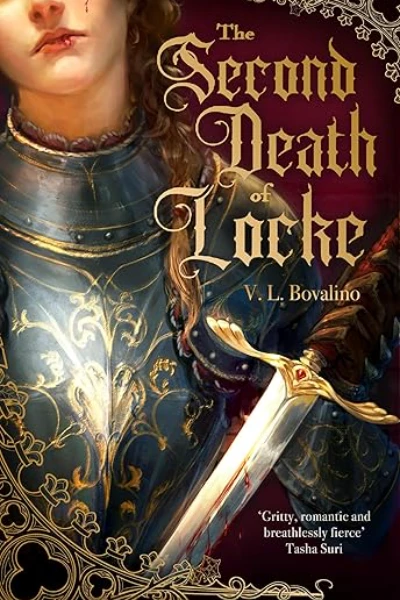
The Second Death of Locke
The Second Death of Locke — Chapter no 6
six
HEN GREY REACHED THE infirmary, she found Leonie and a fewW assistants moving through the wards, checking bandages, removing stitches, administering salves and remedies, and doing whatever else they could to make the patients comfortable. There hadn’t been more than a skirmish since Grey’s company returned, so most of the patients were either there for long-term treatment or had sustained minor injuries during practice bouts.
Leonie glanced up when Grey swept into the ward. “Back for another round?” she asked.
Grey snorted as she moved past Leonie, past the beds, into a small room at the back of the ward full of changes of clothes and cots for healers taking breaks. She shrugged off her cloak and pulled on one of the navy-blue aprons the healers wore to protect their clothes from bodily fluids.
“When was your last break?” she asked, returning to the line of beds and taking the tray of labeled poultices and salves from Leonie’s hands.
“Yesterday,” Leonie said. She was many things, but she was not a liar— there was no reason to hide her exhaustion from Grey.
“Go. I’ll take care of things. I have a few hours.”
Leonie looked at her, lips pursed. “Are you okay?” she asked. “You look
—”
“Go.”
Leonie sighed, but she didn’t argue. “We’ll talk when I’m back,” she said. She hesitated, just a second, laying her hand on Grey’s arm. “Thank you.”
Grey only nodded. Leonie didn’t need to know that she wasn’t just here
to help. She was hiding.
When Leonie was gone, Grey settled into the familiar pattern of the infirmary with the easy relief of an old routine. It wasn’t required of her to do anything when Kier was injured—as his Hand, as a Hand captain herself, her duties extended only as far as his. But she had never been particularly good at staying still, and she’d worked in Scaela’s infirmaries long enough to know the need for extra hands, particularly capable ones. So she’d made a habit of filling in when she could. When they had a few days between skirmishes, or in instances when Kier needed time to recover, she found herself drawn here. Unlike her previous tenure as a healer, as Kier’s Hand she was not required nor requested (nor able) to use her power for speeding up the healing process for mages who were not her own. All she needed was her own natural skill. That suited her just fine.
She didn’t allow herself to think of their usual routine: often the captain accompanied her, providing company for the injured while she worked, or doing some of his endless paperwork at one of the empty tables used for writing notes. Too many times she looked up to see him staring into space, chewing on the end of a pen, or tracking her around the infirmary with his ringed hazel eyes.
Perhaps it was a relief to be alone for once. To have the time and space to think. So she distributed remedies, and when that was done, she started on the cleaning. They were always creeping toward filth, the infirmaries, and with all the mud, this one was no exception—despite Leonie’s careful cleaning schedule, it was impossible to keep everything sterile and tidy.
As she cleaned, her thoughts turned to their argument: Kier’s grip on her, the words he’d whispered in her ear: Maryse, always Maryse; but Maryse was not her true name. Kier knew that, too, but he wasn’t fool enough to say it out loud.
When she was little, she’d hated it: Gremaryse, named after the old god of the sea, one of the mythical protectors of the Isle. But that was her true name, at least the first of it; and in the short span of time she spent having one, her mother always said, Keep it close to your chest, Maryse. True names are for Hands and husbands.
If her brother, Severin, was around to hear it, he always laughed and responded, More like mages and mistresses, which never failed to earn him both a loving thwack to the ear and a small smile.
So her true name stayed close to her chest, and it was shortened for public knowledge, and she was Maryse of Locke until the Locke name and nation died underneath her feet.
Days after the destruction, she was found by a Scaelan regiment. She’d wandered perilously close to the burning remains of a town Eprain had reduced to rubble, so she was left with the rest of the rescued orphans. At first, when they asked her name, she’d said nothing. It was only later, when she was handed over to Imarta, that the problem presented itself.
Hands and husbands. Mages and mistresses. Locke is gone, and I am gone with it.
Grey, she decided, was a better shortening anyway. She couldn’t bear to be Maryse anymore, nor could she risk it. Close enough to cling to something of her old self in desperation, close enough that she couldn’t fully forget.
Grey of Locke, she whispered to herself sometimes, alone in the small hours of the morning. It was the name of a girl who had never existed.
If she had grown up, grown into herself, she wouldn’t be Grey or Maryse anymore, anyway—when a ruler came of age in Idistra, they took the diminutive of their nation. Their true name, then, was known only by the closest family members. Scaela had Scaelas; Cleoc Strata had Cleoc; Eprain belonged to Epras and Luthar to Luthos; and Nestria was ruled by Nestrias. It was only the High Sovereign of Locke, the oldest and most traditional of Idistra’s nations, who took the name of the Isle, unchanged.
Grey’s mother had herself been Locke, both the heart of the nation and its High Lady. It was only fitting, Grey thought exhaustedly, that the name died with her.
She did not whisper any of her lost names now, as she cleaned—she was not a fool. No one spoke the name of Locke lightly anymore.
Grey found solace in her work. By the time everything was finally still and quiet, night was falling outside. Leonie returned to find her sitting at one of the tables at the back of the infirmary, redacting a letter to Imarta.
“I know you’re avoiding something when you take the time to write to your mother,” Leonie said. “Anything catch on fire while I was gone?”
“Nothing to report,” Grey said, folding her letter and slipping it into her
pocket.
“Good. I brought you food.”
Grey sighed as if this was an inconvenience, but in truth, she was hungry. She’d been so focused during the afternoon that she hadn’t even thought about eating.
“Come to the back,” Leonie said. “Things will be fine out here for a bit.”
Grey went to the back room while Leonie stopped to speak to one of the attendants. Alone, she pulled off the apron and put it in the wash bin with the rest, then eyed her cloak. It was a good idea to get into it, but she relished the cold for just a second. The frigid air, the icy sea—they were among the few things she still kept of Locke, that she was able to find in Scaela. She always felt more like herself with goosebumps prickling on her arms and a chill in her chest.
“How was your meeting with the master?” Leonie asked, bustling into the room and drawing the curtain. Her deep black curls were up again, gathered now in a tight bun on the back of her neck, but when her hair was released, it floated around her shoulders and face in a cloud of jet and onyx.
Grey remembered the feeling of it between her fingers, Leonie’s mouth on her skin. She frowned, pushing those thoughts away.
“As well as could be expected,” she said. She had the urge, again, to throw something.
“Do you want to talk about it?” Leonie asked, hopping up onto one of the extra beds by Grey’s makeshift table. Grey forced herself to sit down, forced herself to put bread in her mouth and chew it and swallow instead of
picking a fight with the wall.
“Talk about what?”
“Captain Seward.”
“Why would I want to do that?”
“Flynn.” The name was weary, a sigh caught on an ocean of exhaustion.
“We don’t have to talk about him,” Grey said, looking up from her tray of bread and porridge and dried fruit, gazing at Leonie through her lashes.
“We could talk… about you? About us?”
“Grey Flynn, you absolute rake,” Leonie said with a laugh. “There is no
us. There was one time—”
“Two,” Grey corrected primly.
“Doesn’t count if it’s the same evening. One time, and we both knew what it meant before, during and after. I’m hurt, Hand— I thought you considered me a friend.”
Leonie was right, and they worked better as close confidantes. Moving between places the way they did, Grey found friendship hard to find and harder to stomach, but there was just something about Leonie that she trusted.
Leonie’s expression wasn’t hurt at all. That mischievous smile curved on her face and she looked at Grey with eyes like dark polished river stones. “I knew from the start you were not open territory.”
Grey pushed the uneaten half of her food away. “I don’t know what you’re talking about.”
“You’re hiding in the infirmary. There are very few people here you would hide from other than Captain Seward. And don’t look at me like that —finish eating, or else I’m making you take a whole host of vitamin
drafts.”
“Who said I was hiding?” Grey muttered.
Leonie shook a packet of herbs in her direction, somehow managing to make the action look threatening.
Grey groaned, but she turned back to her food. “He’s stubborn,” she said, conceding on the more obvious point. “Too stubborn sometimes.”
Leonie got up to prep the nighttime medications, dividing herbs into tiny capsules for easier consumption, cross-checking her notes. “Yes, I imagine so. But so are you.”
Grey shrugged, allowing it. “And we know each other too well, I think.”
“It’s the nature of wells and mages—you’re required to have some level of… intimacy.”
Grey wrinkled her nose. “That’s not how Kier is.” She didn’t know, exactly, what she was protesting.
“You practically live on top of each other.”
“We all do.”
The healer pressed on, ignoring her. “You nearly let him drain you, Grey. And the worst thing is, it’s clear you’re not just obsessed with him.
He’s as devoted to you.”
Grey chewed the inside of her cheek. “He would die for me,” she said.
He would desert for her, at least, which was a death sentence in itself.
“Undoubtedly,” Leonie said in a voice that made it very clear she didn’t see that as a positive trait. “But… Grey, you know the way of wells.”
She did. It was a dizzying sort of thing, to have this much power—
enchanting, even. And that was the worry with Kier: she did not know if he adored her or the power she provided.
“I still have years on my contract until retirement,” she said, as if that was anywhere close to the true problem. “I can’t… go anywhere. This is my life, whether I like it or not.”
“Maybe,” Leonie said, finishing her sorting and putting the tray on one of the carts. “But you are a good healer. You could write to one of the continental cities to find work there, or seek respite at a university further afield. You don’t have to stay if they buy your contract.”
Grey sighed. She’d thought of it before, desperately, on nights when Kier was injured. Thought about leaving, working until she was wealthy enough to buy out his contract, too.
“They’d never let a well leave,” she said, and it was the simple truth.
With magic waning, conscripted wells were not a resource Scaelas could
squander.
“They might,” Leonie said.
Grey shook her head. Not after the stunt she’d pulled—not after Attis and Concord realized that she had real worth. “I appreciate your worry,” she said. “But this is what I’ve chosen.”
“It seems,” Leonie said carefully, “to be what the captain chose.”
Grey closed her eyes. It was impossible to explain without revealing too much. But the truth was, Kier never would’ve chosen this without her. It wasn’t about him chasing titles or needing her as his Hand. Above all, as long as they were enlisted, as long as they were two faces in a sea of nondescript armor, even if he gained rank—as long as they were unextraordinary—she would never be discovered. She would never have to go back. Even with Kier’s promotions, she was the girl in the shadows, standing behind him. It was a delicate dance, trying to rise high enough to make it safely out of the worst battles but to hold back so that no one would question her power. So that no one would suspect that the captain’s Hand was the long-lost daughter of Locke.
But he’d promised her they’d never go back.
Grey got up and grabbed Leonie’s sleeve before she could return to the infirmary, to work. Leonie’s face was a mask of surprise when Grey cupped her cheek and pressed her mouth tenderly to hers.
“Thank you,” she murmured, “for caring.”
When she pulled back, Leonie was holding back a smile, her lip between her teeth. “Get out of my infirmary and fix your own problems,” she said, but she also swatted Grey’s ass on the way out, so all was forgiven.
Kier was a different matter.
Grey found him working in the office tent they shared with two other typic captains, bare except for three rickety tables and four chairs, dully lit with the fire in the brazier. She tethered to him of her own accord and felt the threads of his answering magic. There was a buried line of pain in him, echoed in her own body—for the moment, she couldn’t tell if it was physical, emotional or both.
She could read so much of him through the tether of her power—and it still left so much unsaid between them.
He looked up when she hesitated in the doorway, clearing her throat. He pressed his lips together. She saw a hint of apology in his eyes and nodded her head behind her, back toward their tent. They couldn’t talk openly here.
Kier rose, saying a quiet word of farewell to the others, swinging on his cloak.
Back in their tent, he shrugged off his cloak and lit the fire without touching her. “I thought you’d stay with Leonie tonight,” he said.
“Why’s that?”
He gave her a long, level look.
“How do you even know about that?”
“Gossip spreads,” he said mildly, shucking his shirt. She didn’t look at the newly healing scar on his stomach or the fine dark trail of hair traveling down from his navel, though all of these things were burned into her memory whether she wanted them to be or not.
“I’m not sweet on Leonie,” she sighed, pulling off her boots and dropping to her bedroll fully clothed. She fought out of her cloak and spread her arms wide, letting the warmth of the fire creep through her.
He perched on the bottom of her pallet, taking her ankles and dragging her feet onto his lap. “It wouldn’t matter to me,” he said, “if you were.”
She threw an arm over her face to hide her wince. It was, quite possibly, the worst thing he could’ve said. She wanted him to care. She could’ve fallen on her knees right then and there and begged him to care.
Kier had explained his version of attraction to her when they were teenagers: how it was less about the gender and more about the person themselves; that his taste did not lie one way or another but with whoever enchanted him at the time. Grey didn’t have a preference for one gender over any others, either—but she wished, above all, that there was something about her that ensnared him. It was a desire that was left unrequited.
“I’m sorry,” Kier said. “About earlier.”
Grey sighed. She felt the apology coming, maybe even guilt through the
tether.
“Flynn.”
“What.”
“We should talk about what happened. During the battle.”
“I should’ve let you die,” Grey lamented.
“You probably should’ve,” Kier agreed, but he grabbed her hand and hoisted her up into a sitting position, then arranged her bodily to sit with her legs crossed, knee to knee. “You used too much of yourself on me. You should’ve snapped the tether earlier. Far earlier.”
“When you have power,” Grey said, “you can tell me how to do it.”
“Grey,” he said, so soft on her name that it broke her heart. He picked up one of her hands, brushed his lips against her knuckles. “You cannot put yourself at risk for my sake. I cannot live without you. Okay?”
“And I won’t live without you,” she said, like it was simple. “But I will try to be safer, for both of our sakes.”
His eyes were very serious, dark shadows never fully gone from underneath. She remembered again how it had felt to see him for the first time in that sunny office, superimposing the remembered boy over the man he’d become. Sometimes she looked at him and it was like nothing would ever change about him; not his scars, not even the silver of his hair.
“Concord pulled me aside today,” Kier said. “Threatened in earnest to send me to retraining.”
Grey snorted. She could imagine it: Mare, she suspected, was a force to be reckoned with. “I was not kind to her when she brought the matter up
with me.”
One eyebrow arched. “When?”
Grey waved a hand. “While I was stitching you up. After I—very kindly, might I add—did not let you die.”
He moved slowly to cup her face in his hands. It was easy to read this as something it wasn’t, and she kept her own hands balled into fists in her lap even as she leaned into the warmth of him despite herself—mages usually ran hot, and Kier was no exception. “You,” he said, “are a credit to your profession.”
“Fuck off,” she said. But she let him press a kiss to her forehead and did not allow herself to think what would happen if she asked for more of him.
OceanofPDF.com
Think of Hands as devoted hounds. The handbook encourages “healthy respect,” yes, but it often appears more as obsession. A good Hand will do everything in their power to protect their mage, murder included. It would be in your best interest to encourage your own Hand to take a path of mercy and sensibility rather than retribution. You do not want to be on the receiving end of their fiery anger, nor should you wield it without careful consideration.
Surviving the Front: An Unofficial Military Companion by Captain Iowain Jessop, published 4 years PD
OceanofPDF.com



















