
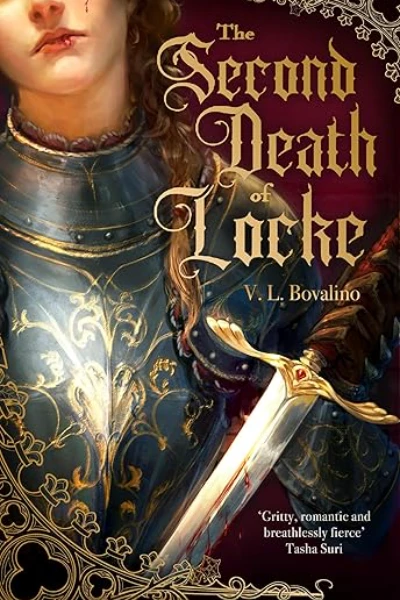
The Second Death of Locke
The Second Death of Locke — Chapter no 25
twenty-five
REY DID NOT REMEMBER waking, but her eyes were open, and she was noG longer on Kier’s body. She jolted up, searching for him, but he was not there. She was in the Ghostwood now, surrounded by the skinny trees, just off the path. She knew where she was immediately—if she turned and walked in the other direction, she’d find the graves of all the Lockes who’d lived here before, and beyond that, the old abbey.
The first thing that came back to her was the grief. She felt it in every part of her body, the aching emptiness, the knowledge that with every second that stretched forward, she was living in a time in which Kier no longer existed. It was unbearable, the magnitude of that grief. She did not think she would ever find the bottom of it. She did not know, either, how she had moved from his body, or where his body had been taken.
She turned to find him, and froze, her heart in her throat.
Her mother waited, standing straight and tall as ever, the mist stirring near the bottom of her skirts. Locke had always had the unnatural, brutal beauty of someone who’d learned very early that to be iron strong, cruelty was its own kind of currency. Isaak walked from the mist behind her, his hand coming to rest on his wife’s waist. Grey felt the bitter weight of them
on her heart.
“You’re here,” she said.
“We’ve been waiting,” someone said behind her. She turned—it was Severin. Severin, who’d grown nearly six inches in the summer before he died; Severin, with his mop of curly hair like his father’s; Severin, who had held her hands and told her to forget. For one aching moment, Grey had hoped… but he was still fifteen, still as young as he was when they’d
brought the Isle down.
He was still dead. They all were.
She rose slowly to her feet—she had never seen them from this height, never known that she’d grown to be taller than her mother. She was older now than Severin ever got to be. They spoke with the rounded vowels and smooth burr of the Isle, the accent that she herself had hidden over time, partially for protection. She spotted more shapes in the mist, more relatives that she only half remembered.
“You’re not really here,” she said, laying her hand over her heart. She could not feel it beating. Perhaps this was death after all.
“No,” her mother said. She moved forward, the mist stirring as she walked. She did not look dead. When she reached up to touch Grey, the silver of her signet ring gleamed in the opaque light. “You are Locke now.”
Before she could think better of it, Grey went to grab her mother’s hand.
Her own fingers went right through it—they both stepped back, as if burned.
Behind her parents, the mist was clearing. There in the meadow where the Lockes were buried, Grey could see someone else: in the rubble of the old temple, he sat on a sepulcher with his back to her, his black tunic sticking to his skin with the damp.
No, she realized. Not a sepulcher. The altar.
He wasn’t alone—there was another person, a woman, standing beside him.
“Kier?” Grey asked, stepping forward. Her heart was again in her throat.
Isaak looked over his shoulder, frowning at the place where Kier sat. Grey looked back at her mother. “Is he…?” She swallowed down any sign of her own weakness. She was Locke; she was born of these hard black cliffs and unforgiving sea. “Is he dead?” she asked, forcing herself to be steady.
Alma looked over her shoulder, her face a mask of grief and regret. “It required a sacrifice to save the Isle,” she said slowly. Grey remembered what Scaelas had told her. That they all died, so she could live.
“And it required a sacrifice to bring it back,” she said through numb lips.
Alma did not look at her. Grey felt her knees go weak; the very fabric of her world shredded around her. She stared at his back, but Kier did not turn to look at her, did not seem to hear.
In that moment, she understood the future. She would wake on this Isle,
to a Locke resurrected, and she would find the bodies of her family. She would bury them. Kier’s body would be there, too; he would join her family in death as he had never met them in life.
She would be Locke restored, and all of the power in the world would be hers. She could feel it now, thick in her stomach, waiting for her to call on it.
Without Kier, she was free to tether to anyone, if she chose. She would lead the forces and hold the Isle. She would power armies.
She would bury Kier, right here, on this Isle. The thought caught in her throat—she felt for a moment like she was choking, like she’d never draw breath again.
What she would give to see his face one last time, alive. His smirk—the light that came to his eyes when he saw her. How much she’d taken him for granted.
Her breath stuttered, her heart heavy in her chest—because she could not bear it. She could not bear a future that did not include him. She could not bear to stand on this Isle, the place where everyone she loved had died for her, and was still dying; she could not bear to do it alone.
But she was Locke, and this was bullshit.
“No,” she said. She stalked across the path, across the wood, toward
where Kier sat.
“What do you mean, no?”
She whirled on her mother, her father, her brother; the three ghosts gathered behind her. “I said no. I do not accept it. I will not let him be your fucking sacrifice. You can have your power—you can have the entire Isle.
But I am taking Kier.”
“You cannot just take it back,” Severin said, reaching for her, as if that would do anything.
“Then I am going with him,” Grey said, her voice catching.
“You can’t,” Alma said fiercely. She moved toward her daughter, but Grey twisted out of reach.
“I am Locke,” she seethed, feeling the power of the Isle rise up inside of her. “I can do whatever I want.”
“Gremaryse Pellatisa, thirty-fourth daughter,” a voice said from somewhere behind the others.
Grey’s head snapped up. She watched a figure come through the trees,
wearing the old armor of the early Isle. She was utterly unfamiliar, with dark hair braided into an intricate formation that fell over her shoulders. She carried a jeweled blade in one hand. Her skin was alabaster pale, paler even than Alma’s; her lips were too red to be real.
“And who are you?” Grey snapped.
“Do you not know me?”
Grey started to say no—but she did. She was utterly unfamiliar because she was real and human, looking like flesh and blood instead of a ghost or a saint. But when Grey focused, she realized that she’d seen her face on icons and tapestries, painted on the murals of the crumbling abbey, carved into the face of the tombs.
She hadn’t recognized her because it wasn’t possible to fully capture the awful, terrifying beauty of her, or the shade of her eyes, or the deep metal of her armor, set with details of birds and ivy.
This was Kitalma, the first of the Lockes, her great-ancestor many times over.
“If you’re also here to tell me all the reasons I can’t have Kier back, I don’t care. I am taking him, and I will forsake this Isle and your power. I promise you.”
Alma winced. Grey wondered whether, if she’d grown into a woman under her mother’s watch, she’d disappoint her as most daughters tended to do.
“Hold your promises, daughter of Locke,” Kitalma said, a smirk curling on those unnatural lips.
“Please,” Grey begged, barely recognizing the raggedness of her own voice.
Kitalma’s face was unchanged. “What’s done is done,” she said.
But Grey would not accept that—she could not accept that. “In the old stories,” she said shakily, “the ones my mother used to tell, of the gods and their power. When you and your bride fought for the Isle, you won, but she perished. When Retarik fell—when she died—you did everything in your power to bring her back. You begged the sea for her life, and the sea listened.” A touch softer, she said, “I am pleading now. I am calling upon you, in all of your power. Will you not listen to me?”
“I am here to give you the mantle of power, and you ask more of me?”
“I have given everything up for you and your power,” Grey said, her
voice turning bitter. “I have proven again and again that I would die for that power. Everyone I love died to protect it, to protect me. Even Kier. You cannot ask me to keep going without him.” But it felt fruitless, an eternity of bargaining that she would never find the end of. “Please. He is all I ask for. His life is all I ask for.”
Kitalma watched her, her gaze otherworldly. “You have made him one of my own,” she said finally. “A sacrifice has been made, and a sacrifice must be kept.” Grey opened her mouth, already searching for words, but the goddess held up a hand. “But I do pity you, daughter of Locke—’tis a sorrowful thing, to be alone in the world.”
Grey regarded her warily, uncertain she understood, too heartbroken to hope.
“As such, I will offer you three choices. Under my terms.”
Grey’s shoulders sagged. There would be terms—there would always be terms. She felt the weight of her exhaustion, tempered with grief. She just wanted to wake up. To wake Kier up. “Of course,” she said. “Just tell me what to do, and it is done. I will give up anything to bring him back.”
“The sacrifice has been made. I cannot just give him back to you without keeping something in return.” Kitalma spread her hands, the gleam of the dagger and its gems winking in the light. “The first choice: I will keep the boy’s life, and you will keep the Isle, as we stand now. Sometimes, daughter, the best way is to accept what has come to pass.”
“I will not accept it,” Grey said savagely.
“Very well, then. The second choice: I keep the boy, but only his freedom. You may have him as long as he remains here. Should he leave, his life again is forfeit.”
Grey stared at her, uncomprehending. “What… what does that mean?”
“If I breathe life into him,” Kitalma said, her eyes gleaming—they were black as the Isle’s cliffs, Grey realized. Black as the deepest part of the sea.
“He can never again leave this isle. He will be as he was, as long as he remains here until the end of his days.”
Grey sucked a breath through her teeth. Kier’s freedom—she could not fathom cursing him like that, sentencing him to a life here, forever. “I cannot give you that.”
“Then the third choice: he may have his life and his freedom, and leave this place as he wishes. In return, you surrender to me your power. It is your
choice, Gremaryse, daughter of Locke.”
Grey’s stomach dropped. Without her intending to, her hand went to her middle, palm pressed to her sternum, where she felt her power unfurling
strong and true.
“Maryse…” Alma started.
But Isaak only watched her sadly. “What is love without freedom?” he asked. “Is that love at all?”
Grey met his gaze. It was like he had pulled the words directly from her own heart. “I cannot give my power,” she said through numb lips. “I am Locke. Kier isn’t a well—he can’t… There will be no grounding for the Isle.”
The old goddess raised a brow. “Do you doubt me?”
“No.”
“All will be well, daughter. Your own heir will continue the line of Locke,” she said, as if it was a foregone conclusion that Grey would have
an heir.
“But without my power—”
“I could just keep his life,” Kitalma said flatly. “But the boy is already one of mine, by your own rite. If he lives, he would be connected to the very foundation of the Isle.”
Grey’s heart sunk. Torrin was right—she had no idea what she’d done, how she had changed him, when she had bound to Kier.
“I have given you choices. If you want his life back, you must either give me his freedom, or hand me your power. Remember, this is a mercy—I could leave him free and dead, and your power intact. Those are my terms.”
Grey forced herself to breathe. Here she was, fighting with a goddess.
No wonder she always got written up for insubordination.
“I would prefer he not be free and dead,” she said. The power mattered less; she could not imagine holding it without him. The very idea of tethering to someone else made her sick. She needed to think rationally, but she found it impossible—if she finished this conversation, she could have Kier back. Whatever followed was a matter for the version of her who didn’t feel like this. “And what… When do I have to decide?”
Kitalma gazed up, as if she could see anything in the gloom. “Keep the Isle, daughter. You may have one cycle of the moon, and then we shall meet again, at my altar, and I will need your answer. Until then, I will give your
mage back to you and await your decision.”
Grey chewed her lip, but what else could she do? She could barely think past her own grief—she did not know how she would be able to make a decision with his body there, in front of her. She did not know how she could look upon him, dead, and not die herself.
“Thank you,” she said, “for your mercy.”
“Very well. Go now,” Kitalma said, turning away. “It is not safe here, in the between, for one who is yet so alive.” She glanced over her shoulder at Grey as the mist rose and thickened. “Be careful, daughter. Iron, too, has its weaknesses.”
Grey turned to look at her mother, but she too was gone. They all were.
She was alone in the misty wood.
“Grey?”
Her breath caught in her chest—not alone at all. She spun around to see Kier getting up from the altar, wincing at the way every movement jarred his broken bones. She stared at him, the words stuck in her throat, as he
eyed her warily.
“Where are we?”
“We’re in the Ghostwood,” she said, the words barely making a sound.
He looked around, taking it all in. “I don’t… I don’t remember getting here.”
Grey shook her head. She pressed a hand to her chest, as if she could stop the ache of losing him, as if she could rip it out of her. “No,” she said, voice raw.
He stopped scanning and looked at her, his eyes warm and soft, his mouth tugging up into a relieved smile at the sight of her. He came close, his smile faltering as he reached very carefully to touch her face.
“My beautiful Locke,” he said, his fingertips only just brushing the bruise on her cheek. “Does it hurt?”
She did not know how to stop the pain, even now when he was standing in front of her. “Yes,” she said, the word sounding more like a sob.
She threw herself at his chest, not caring about the blood and dirt and seawater. He made a low noise in his throat—she was obviously hurting him, ruinously prodding his broken ribs, but he didn’t care enough to push her away. His good arm wrapped around her, holding her tight, and it was as if the entire world made sense again.
His freedom or her power. She gripped him tighter, as if she could will the choice away.
“Are we home?” he murmured in her ear, his voice a raspy whisper. She squeezed her eyes shut.
“Yes,” she said, bittersweet. The relief was just as heavy as the power welling between them. She found the tether and locked into it, pouring so much power into him that he jerked. He shivered, then swallowed it down.
She pressed her hand into his broken collarbone, forcing it back into place.
He rested his head on her shoulder, breathing hard, as she finished her work and moved her hand to run her fingers through his wet, wild hair. “We’re home.”
OceanofPDF.com
When Retarik died defending the Isle, Kitalma laid her body over her wife’s and wept, begging her life from Gremaryse, pleading with the goddess of sea and death for her mercy. After thirty days and thirty nights of weeping, Kitalma woke to her wife restored and blessed with an heir to carry on the line in the blood of Locke.
Folklore recovered from the Isle of Locke, date unknown, author unknown
OceanofPDF.com



















