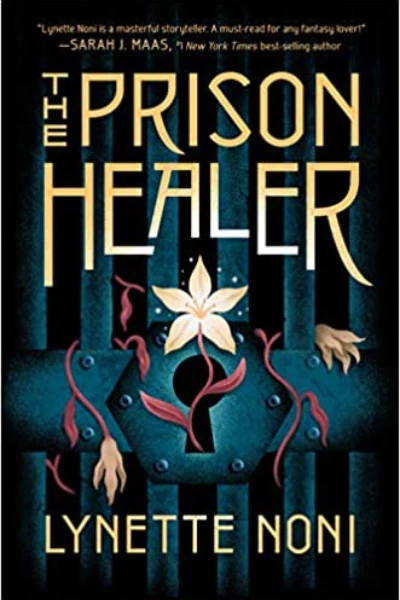
The Prison Healer
The Prison Healer — Chapter no 4
C H A P T E R F O U R
Kiva staggered backwards as the young man sat bolt upright. She wasn’t sure which of them was more startled—her, him, Tipp, or the guard.
“What the—” the man started, his gaze moving frantically around the room. “Who— Where—”
“Easy,” Kiva said, raising her hands. His eyes homed in on the bone needle before noting the blood staining her arms—his blood. The next second, he scrambled off the other side of the metal bench and was backing away like a cornered animal.
Aware that Naari was approaching fast, Kiva spoke again, trying to calm the man before things could escalate. “You’re at Zalindov. You were hurt on the way here. I’ve been”—she motioned helplessly to her bloodied hands—“stitching you back together.”
It was then that the man’s gaze settled on the guard. His eyes were blue, Kiva noted, but there was a gold rim in the center around the pupil. Striking eyes, unlike any she’d seen before.
Striking eyes, in a striking face. There was no denying it now that he was awake. And yet, her words to Tipp remained true: she would not be swooning anytime soon.
Upon seeing the fully armed guard, something in the man seemed to wilt, as if he were finally catching up, realizing where he was and perhaps recalling why. He stopped backing away—not that there was anywhere else for him to go, since he was now pressed up against the workbench—and he pivoted from Naari to take in the wide-eyed Tipp, who stood frozen with his mouth hanging open. The man peered down at his own body, noting his lack of clothes and the dressings on his wounds, including the fresh wrappings on his hand. He then, finally, turned back to Kiva, seeming to come to a decision.
“Forgive me,” he said in a calm, smooth voice. “I didn’t mean to startle you.”
Kiva blinked. Then blinked again.
“Er, that’s all right,” she replied, feeling unbalanced. He had woken up to her hovering above him with a bloodied needle, after all. It was she who had startled him. “You should sit down again. Let me finish with the cut on your head.”
He touched his brow, wincing when he found the bump, his fingers coming away red with blood.
Kiva bit her cheek to keep from scolding him. She’d have to clean it again now, before adding the sutures.
The young man’s face paled, as if his sudden exertion had caught up to him, shock setting in. Kiva lunged forward, as did Tipp, the two of them arriving just in time to grab the new prisoner as his knees buckled.
“Don’t w-w-worry,” Tipp said, barely reaching the young man’s chest but still taking on a good amount of his weight. “We’ve g-got you.”
Kiva, meanwhile, was just trying to get ahold of him without stabbing him with her needle. She’d already done enough damage to his flesh today.
“Sorry,” the man said, his voice thinner than a moment ago. “I don’t—I don’t feel so great.” And then he groaned softly.
“Tipp,” Kiva barked, his name a command.
The boy knew what the groan meant as well as Kiva, and he rushed away, causing her to grunt quietly as she took the young man’s full weight. She managed to drag him the few remaining steps to the metal bench and forced him to sit just in time for Tipp to run back with an empty pail in his hands.
Kiva shoved it into place just as the man groaned again, leaned forward, and vomited.
“That was c-close,” Tipp said with a grin.
Kiva didn’t reply. She just tightened her grip on the pail as the man continued retching.
She wasn’t surprised. Head injuries were notorious for prompting nausea. Until she could treat his wound and get some poppymilk into him, he was going to feel awful. If only he could have remained unconscious for a few more minutes, then at least he wouldn’t have to suffer through the last of her ministrations.
When finally it seemed like there was nothing left in him, Kiva helped him lie back down, handing the pail to Tipp, who was quick to disappear out the door with it.
“I’m sorry,” the young man said, his voice even weaker than before, his face now alarmingly pale.
“Stop apologizing,” Kiva told him, before checking herself. He could apologize or not, that was his prerogative. What he said and did was none of her business.
Kiva spared a glance at Naari, finding the guard halfway between the door and the man, as if she didn’t know whether he was a threat or not. Given that he couldn’t even sit upright at the moment, Kiva wasn’t concerned, and the look she sent Naari communicated as much. The guard didn’t back away, but her shoulders lost some of their tension.
“I’ll be quick with this, then give you something for the pain,” Kiva said. “After that, you can get out of here.”
Swiftly cleaning the wound again—and grateful that the young man kept his eyes closed as she did so—Kiva hovered over him, inspecting the cut, considering how best to stitch it. When Tipp returned with the newly cleaned pail, she quietly instructed him to fetch some fresh clothes and watched him run off again.
Aware that no matter how she closed the wound, it was going to sting, Kiva said, “Try to stay still.
This’ll hurt a little.”
The man’s eyes shot open, blue-gold meeting Kiva’s green, causing her to suck in a swift breath.
Seconds . . . minutes . . . she wasn’t sure how long had passed until she finally tore her gaze away, focusing anew on his cut. His eyes remained on her face—she could feel him watching her as she pressed the needle into his flesh.
The slightest of winces, that was his only reaction.
Her heart, however . . . It was pumping double time as she began her sutures.
In, out, around, knot.
In, out, around, knot.
In, out, around, knot.
Kiva let the familiar rhythm steady her, aware all the while that the young man was watching her. If that was what it took for him to keep from flinching, then she could deal with her own discomfort.
“Nearly done,” she told him, as she would any of her patients.
“It’s fine.” He paused, then added, “You’re very good at that. I can barely feel it.”
“She’s had p-plenty of practice,” Tipp said, reappearing at her side. Kiva gave a slight jerk, but fortunately she wasn’t in the middle of a stitch.
“Tipp, what’d I say about—”
“Sorry! Sorry!” he said. “I always forget how j-jumpy you are.”
She wasn’t jumpy; she was in the middle of a death prison. That was more than enough of an excuse to be on edge.
“Done,” Kiva said, snipping the last stitch and smearing on the ballico sap. “Help him sit up, Tipp.”
She said the last offhandedly, hoping the boy wouldn’t comment or question why she wasn’t helping the young man rise. In truth, normally she would. But given that her pulse hadn’t quite returned to a resting heart rate after merely locking eyes with him, she figured it was wise to keep as much professional distance between them as possible, and not have her hands on his naked flesh again anytime soon.
“Let me just get you some poppymilk, then you can—”
“No poppymilk.”
The two words from the young man were sharp enough to draw Kiva’s eyes back to his. She frowned and said, “I won’t give you much, just enough to help with the pain. It’ll soothe your head, and”—she waved, indicating the rest of his bruised, cut, and carved body—“everything else.”
“No poppymilk,” he repeated.
Hearing his unyielding tone, Kiva slowly said, “All right, how about some angeldust? I can—”
“No, absolutely not,” he said, his face having paled all over again. “I—I don’t want anything. I’m good. Thank you.”
Kiva studied him, noting the stiffness of his posture, his muscles straining as if preparing for flight.
She wondered if something had happened to him under the influence of either remedy, or if perhaps he’d overdosed before. Maybe he knew someone who was addicted. Whatever the reason, short of forcing the drugs into him, she had little choice but to honor his wishes, even knowing it was to his detriment.
“Fine,” Kiva said. “But at least let me give you some pepperoot ash. It won’t take away all the pain, but it’ll help a little.” She paused, thinking. “If we combine that with some hashwillow to ease your nausea and some yellownut to give you an energy boost, then that might be enough to get you through . . . what’s next.”
One golden eyebrow arched, but he didn’t question the end of her statement, nor did he argue her treatment options again. Instead, he gave a short nod, the color slowly returning to his face.
Kiva looked toward Tipp, and the young boy scampered off to collect the ingredients. Pepperoot ash worked well topically when dusted onto wounds, but it could also be ground into a paste and taken orally, targeting pain receptors in the whole body. Kiva had never mixed it with hashwillow and yellownut before, but the smell of the liquified combination had her wrinkling her nose and looking at the young man in question, certain that he’d prefer the nutty-flavored poppymilk or the caramelly angeldust, both of which went down considerably smoother.
In answer, he reached for the stone tumbler without a word, swallowing the concoction in one go.
Kiva noted Tipp’s full-faced grimace, and she struggled to keep her own features from copying him. The young man, however, gave only the slightest of shudders.
“That should, uh, kick in within a few minutes,” Kiva said, taken aback. She gestured to the gray tunic and pants that Tipp had placed at the end of the metal bench. “Those are for you.”
She busied herself by returning the empty tumbler to the workbench as the young man changed, leaving Tipp to help him. When she’d put all the ingredients back in their rightful places and could no longer act like she had something to do with her hands, she turned around to find the man dressed, with everyone watching her, waiting. Naari included.
Looking pointedly at the guard, Kiva said, “Isn’t this where you step in?”
She wasn’t sure what it was about this young man that was getting to her. All her self-preservation instincts were going haywire. She would never have talked to any guard so directly before today. She hadn’t lasted ten years in this place by being reckless.
Naari’s dark brows rose a fraction, as if she knew what Kiva was thinking—and agreed with her.
But just as Kiva tried to figure out how to beg forgiveness and avoid punishment, the guard said, “I’m allocating him to you for orientation.”
Kiva jerked with surprise. She was never tasked with prisoner orientation. She’d done it once or twice back when she’d been in the workrooms, but never since undertaking her role as the prison healer.
“But . . . what about . . .” Kiva started, then tried again. “I have patients to see to.”
Naari’s brows rose even higher as she looked around the empty infirmary. “I think your patients”— she nodded to the two dead men—“can wait.”
Kiva had meant the prisoners who were quarantined, but Naari’s posture had tightened, so Kiva swallowed her reply. Orientation wouldn’t take long. She’d show the young man around Zalindov, find out which cell block he was assigned to, then leave him with his cellmates for the night.
Tomorrow he’d be given a work allocation, and someone else would take over from there.
“Fine,” she said, wiping her hands—still stained with his blood—on a damp cloth. Once they were mostly clean, she moved toward the infirmary’s exit. “Follow me.”
Seeing Tipp step forward as well, Kiva cut off his advance by saying over her shoulder, “Can you go and tell Mot that we need a collection?” She dipped her chin toward the deceased men.
Tipp shuffled his feet and wouldn’t meet Kiva’s gaze. “Mot isn’t real h-happy with me right now.”
Kiva paused at the door. “Why?”
If anything, Tipp looked even more uncomfortable. He glanced from Kiva to Naari, then back again, and Kiva realized that it must be bad if Tipp was managing to keep a filter around the guard.
With a sigh, she said, “Never mind, I’ll do it myself. Can you check on the quarantined patients?
Wear a mask, and don’t get too close.”
“I thought it was just t-t-tunnel fever?”
“Better safe than sorry,” Kiva warned, before stepping out the door, the young man following in her
footsteps.
And . . . Naari, too.
Kiva looked at the guard quickly, then away again, unsettled by her continued company. It was normal for guards to be stationed at each of the work buildings—rarer for the infirmary, at least before the surge in riots of late—but they never tailed inmates out in the open spaces of the prison.
There was no need. Zalindov had around-the-clock surveillance from multiple watchtowers and patrolling guards, both human and canine, the latter of whom were trained to tear flesh from bones at a single whistle.
Naari’s company was unnerving, prompting Kiva to wonder if the guard suspected the young man was more dangerous than he seemed. It was all the more reason for Kiva to hurry up and get his orientation over with.
Deliberating quickly, she turned left and started toward the next building along, the gravel underfoot crunching loudly in the quiet early-evening air. The other prisoners would be heading back to their cell blocks soon, if they weren’t already there. But for now, the grounds were silent. Almost
peaceful.
“What’s your name?”
Kiva looked up sharply, finding the young man walking calmly beside her and peering at her in question. Despite his bruised and battered body, and despite his new, unfamiliar surroundings, he seemed completely, unfathomably, at ease.
She remembered her first day at Zalindov, the moment she’d stepped out of the infirmary cradling her bandaged hand, aware that her family, her freedom, and her future had been taken away from her in one fell swoop. She hadn’t asked anyone for their name. That had been the last thing on her mind.
“I’m the prison healer,” Kiva answered.
“That’s not your name.” He waited a beat, then offered, “I’m Jaren.”
“You’re not,” she returned, looking away from him. “You’re D24L103.”
Let him make of that what he will, the reminder of how—and why—she’d been close enough to memorize his identification band. He had to feel it, had to know what lay throbbing beneath the wrappings on his hand. Kiva had heard about Zalindov’s own personal form of branding long before her arrival, and she’d only been seven. There was no way this young man—Jaren—wouldn’t have known about the Z prior to being dumped inside his prison wagon. It was an inevitability for all those sentenced to Zalindov.
She waited for the repulsion and anger, both of which usually came while she was carving the symbol. But he’d been unconscious, so now was his time. She didn’t brace herself. There was nothing he could say that she hadn’t heard before.
“D24L103,” he finally repeated, inspecting the characters etched into the metal band. His gaze drifted to the bandages, as if he could see through to the three deep slashes beneath. “That’s a bit of a mouthful. Probably easier if you stick with Jaren.”
Kiva stumbled slightly, her head whipping toward him only to find his blue-gold eyes lit with
humor.
Humor.
“Is this a joke to you?” she hissed, stopping dead on the gravel path between the infirmary and the stone building nearest to it. “You do realize where you’re standing right now, don’t you?” She threw her hands out, as if doing so would help open his eyes. While the light was steadily fading as dusk settled over the expansive grounds, the limestone perimeter walls rose high on all sides around them, making it impossible to forget that they were trapped like rats in a cage.
Jaren’s humor dissolved, his eyes flicking to Naari, then back to Kiva. “You’re right. I’m sorry.”
He rubbed his neck, looking uncomfortable. “I guess—I’m not sure how I’m supposed to act in here.”
Kiva inhaled deeply, then shook the tension from her shoulders. People dealt with fear and uncertainty in different ways, she reminded herself. Humor was a coping mechanism, and certainly not the worst of them. She needed to have more patience with him.
“That’s what I’m here for,” she told him, more gently. “To tell you what you need to know. To help you survive this place.”
“And how long have you been surviving this place?”
She held his gaze. “Long enough to be a good teacher.”
That seemed to satisfy him, since he followed without argument when she started forward again. At least until she stopped them at the entrance to the next building over and said, “I figure the first place you visit should also be the last.”
When Jaren looked at her in puzzlement, she nodded to the dark doorway and finished, “Welcome to the morgue.”