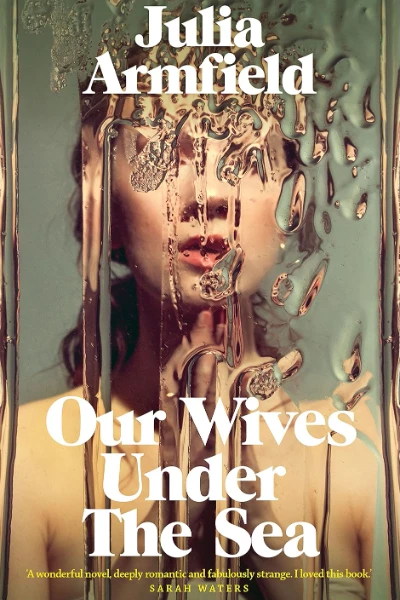
Our Wives Under The Sea
Our Wives Under The Sea — Chapter no 5
Miri.
I hold the phone to my collarbone and yell for Leah. I don’t typically like to raise my voice, but the sound of running water has taken on the ubiquity of traffic in our flat and I have to shout sometimes just to make myself heard.
The woman on the line has asked to speak to the authorised personnel directly, as she cannot deal with me on Leah’s behalf.
“But I have all the numbers,” I say, “you know the reason I’m calling – why can’t you just deal with me?”
It has taken six separate attempts on six different days to get through to a real person, and the elation of this has unfortunately led me to overestimate the extent to which a real person is actually going to be able to help.
“I’m afraid I can’t do that,” the real person says now, “I can only speak about company matters with the authorised personnel.”
I open my mouth, close it, try again.
“But she’s my wife. I have all her details. What if I just pretended to be her. Would that be OK?” The real person makes an awkward little noise.
“I’m afraid I can’t do that.” The sound of running water continues. I consider shouting for Leah again and don’t.
“I could put the phone down and call you back and do a different voice, if you liked? I’ll say it’s Leah from the start, that way you won’t get into trouble. You just tell anyone who asks that I’m her and it’s fine, I swear.”
There is a curious noise on the line – I can’t tell if the real person is sighing, or crying, or eating a sandwich.
“I’m afraid I can’t do that, Miri.”
+
A thin, needling rain, like someone is throwing pins from the rooftops. On the sofa, Leah pours Cherry Coke into a plastic glass patterned with hamburgers and then does not drink it, glides her fingers down the skin of her left arm. She is silvered over, oystered at her elbow creases and around the neck. This is something I noticed when she first came back and wasn’t
sure how to bring up, though she pointed it out herself before too long: Look at this, and this, they told us to expect some stuff like that.
It’ll go away, she says, not so much to me as to herself. Just another reaction, a thing to be dismissed, like the bleeding, like the way she sometimes sleepwalks to the bathroom and holds her head under the water, having first filled the bath to a point just shy of overflowing. She doesn’t know that the first time I noticed the change in her skin, I was so alarmed that I called 111 and hung on the line for thirty minutes, only for someone to finally come on and ask if I’d ever heard of impetigo.
“You don’t need to look at me like that,” she says now, still moving her fingers along the skin of her arm. “I can feel your look,” she adds when I open my mouth to say something, “but you don’t need to. It’s OK.”
“I’m not looking at you in any special way,” I say, in a voice which aims for a joke and misses. She gives me a sideways look, starts to smile and then doesn’t entirely.
“OK,” she says, “so you’re not looking at me. My mistake.”
The conversation, brief as it is, is a welcome break in the silence, though the silence re-settles shortly afterwards, somehow heavier than before. I have found myself trying to escape this new lack between us, grown conscientious about my running, lingering hours in the supermarket, pointlessly deliberating over brands of detergent, scrutinising tubs of yogurt and butter and butter substitute. Occasionally, I will tell Leah I’m leaving the flat to complete a specific activity and instead simply walk to some fixed point and stand there until I get bored enough to return. I don’t think I’m even particularly clever about this. You said you were going to the gym, she’ll say to me sometimes, but you didn’t take any kit with you. I’ll tell her she misheard me and she will accept it, going back to staring at a point on her inner arm or to running the taps in the kitchen until the sink fills up.
In the supermarket, then. Carmen squints at cans of chopped tomatoes, raises and lowers packets of differently shaped pasta. She has left her glasses in the office and can’t see the number of fingers I’m holding up if I stand more than a foot away.
“What’s this?” she asks, holding up a parcel of orecchiette. “Is this the one that looks like ears?”
We’ve been friends since university but her eyesight only really started to deteriorate over the past year or so. It went downhill so suddenly that she went to the doctor about it, make-believing brain tumours, grey shadows on
X-ray printouts of her skull. This has always been the chief point over which our friendship has endured – the hypochondriac back and forth of two women with too much time on their hands. We’ve talked each other down from any number of ledges – from Carmen’s meningitis panic to my generalised fears around cancer and Alzheimer’s and diseases I’m concerned I might catch or inherit – though when Carmen’s eyesight started failing I was too busy to help her as much as I should have, and I feel that between us a little now.
“So how’s it going?” she asks later, the two of us folded over coffees, our hair identically greased by the rain and fizzing out around our temples. The cafe is one we visit often and familiarity has become a key concern for Carmen, just lately. I watch her fumble her way to the counter and back, her long hands running over the perspex cake cabinet, twin smears that will need to be wiped away.
“It’s fine,” I say, carving my initials through latte foam with a teaspoon handle, “it’s strange, you know, but it’s fine.”
“I guess it must be weird,” she says – the sweet plum of her voice, the way her vowels seem to take up more space than the shape of her mouth allows – “living with someone again after such a long absence. I guess it must be weird,” she says, “having to share your space.”
I look at her, open my mouth to tell her that’s not what I meant at all.
Living with someone again, I want to say, isn’t what it feels like.
“When I moved in with Tom,” she carries on, unable, I suppose, to read the fact of my open mouth, “it was so weird for so long – like it felt such an invasion, you know? Like you love someone but that doesn’t mean you want to be with them all the time, you know? Like sometimes I’d lock myself in the bathroom and just lie in the bath for half an hour – not with the water running, I mean, just in the empty bath – just because it was the only way I could get some space. And I loved him, you know? So I really do get the disconnect.”
Carmen’s ex-boyfriend Tom was a social worker and weekend DJ who eventually left her for reasons I never quite managed to grasp. Carmen typically speaks about him the way one might refer to a degree: a three-year period one has to endure in order to talk with overbearing authority on exactly one subject. She is the world’s living expert on loving and losing thirty-year-old men named Tom.
“It’s not really that so much,” I say, turning my head towards the window so she can’t follow the expression on my face. The rain has picked up. “I never minded sharing the space. That felt like the whole point of living together.”
Later on, walking home, I stop at the petrol station and buy another Cherry Coke to replace the one Leah wasted earlier in the day. I stand in the car park and watch the sky growing dark beyond the tower blocks, the buildings like faces buried in unclean pillows. We have always lived here – met in a pale electric summer, moved quickly from our respective basement studios to the first-floor flat we have shared for seven years. Before she transferred to the Centre, Leah used to take the train each morning, an hour at least to run her out through brown uncertain marshlands to the research facility, minutes from the sea. An hour back in again at night, her clothes salt-glazed, her skin scoured smooth by coastal weather. Strange, to live in such proximity to an ocean that I almost never see.
The city is veined with inland tributaries and close-dispersed canals, water-logged about its edges. Bridged across its belly, a river running down its throat. August in the city is always strange, wet, scuttled through with insects freshly burst from shells. I scratch my calf with the toe of my left shoe and think about Leah – about her bright pale eyes and the shape of her mouth and the feeling when we spoke for the first time that there were vast places in the world that I had never yet thought to go.
+
A thousand years ago, Leah held a hand over my mouth in the bathroom at the wedding of a mutual friend. We’d gone into the stall together because I needed help with the buttons up the back of my jumpsuit and had ended up trapped when one of the bridesmaids came in and started sobbing to someone on the phone.
It was roughly five o’clock, fireworks planned for seven thirty and rain forecast for six. I just don’t think, the bridesmaid wailed into her mobile, that it’s such a big deal when I’ve been carrying her fucking spare shoes around with me all day. I just don’t think that it’s so much to ask, to be understanding, when I handmade those fucking centrepieces myself.
In the stall, I pictured the bridesmaids: six of them, goosefleshed in summer dresses. During the ceremony, they had stood in line as if in
preparation for a hanging, the sense of a barely under control Salem implicit in their fixed expressions, in the mess of arms that later reached towards the bride at the behest of the wedding photographer: we’re doing a funny one now – act like you all want to choke her!
Leah gave me a warning look which tumbled off into a smile, pressing her hand down harder to stop me from laughing. I’m just so tired, the bridesmaid sighed – the plink of earrings removed and dropped into the sink – I just can’t believe she’s so angry at me because I – oh – right, yes of course, I’m sorry. Absolutely, go if you have to go. She dissolved into fresh sobs and I watched Leah’s face change a little, her typical reaction to genuine suffering always being to cease laughing before I did and then look at me until I stopped. I rolled my eyes at her and she pulled her hand away from my mouth, murmured come on before easing the bathroom door open.
The bridesmaid by the sink had apparently suffered a catastrophically unexpected period, the lavender silk of her dress streaked red all up the back. Hey, Leah said, and the bridesmaid jumped and turned and then carried on crying, and Leah told her not to worry and then listened to her sob for twenty minutes while I sat beside the sink and handed over a pound for the tampon machine.
Later on, fireworks called off because of rain, Leah went out to the covered porch and I went with her. Across the courtyard, a view of the rest of the venue – wide white outbuildings arranged in a semicircle. Georgian by design, it had apparently been used as the primary setting for a recent Austen adaptation on a mid-budget cable channel – cardboard cut-outs of the hero and heroine standing life-size in the reception area, sun-faded towards the end of the tourist season. For all its photogenic lines, the house retained little of its original features beyond a tottering cupola and a widow’s walk made semi-lethal with age. A folly, so the receptionist had explained unprompted when we first arrived: Widow’s walks are typically a feature of coastal dwellings. Wives would watch for their husbands’ ships, mothers for their sons – fishing boats, whalers, smugglers. And there was always the possibility of pirates. Things to look out for. Not so helpful sixty miles inland.
Back inside, the previously distraught bridesmaid was now dancing, having tied her boyfriend’s suit jacket around her waist to cover the stain.
That’s sweet, Leah had said when she saw the boyfriend offering the jacket
and I had grinned at her without really knowing why. I’ll do that for you, she had added, next time you have a terrible period and I’m wearing a suit.
On the porch, I took her hand and we stood like that for a while, saying nothing. It occurred to me to joke that when we got married, I wouldn’t want anyone to worry about bleeding through their dresses, that when we got married I’d be offended if everyone didn’t menstruate freely all over the place. I didn’t say this, as we hadn’t yet officially talked about getting married, and anyway, the quiet was as nice as anything else.
+
I guess it must be weird, Carmen had said, having to share your space. I think about this a lot in the gaps where my and Leah’s conversation ought to be. At dinner, leaning up against the counter, my tongue swells with it, my throat and palate clenching vainly around the lack. We say nothing to each other – I ask her if she wants to eat, she tells me no, she asks me what I’m drinking, but still in a very fundamental sense we say nothing. Even her reassurances about the blood, about the places where her skin has changed colour, are starting to fade away. Sometimes, I imagine the things I want to say to her, but increasingly I find myself capable of producing little but a kind of mental white noise. My brain moves like a jump between radio stations, falling off topics without warning, cutting to music, to adverts, to weather. I go about my work, chop onions, over-season my food. Every so often, I imagine I hear the neighbours’ television prompting me to speak, although on these occasions it’s typically just a gameshow host inviting a contestant to answer a question before the time runs out.
One morning, I read a newspaper article about a Korean woman who ate improperly prepared seafood and subsequently went to the doctor complaining of a growth on the inside of her cheek. The doctor, assuming a cyst or fibrous tumour, ordered a biopsy, but on opening her up they found nothing to indicate cancer. Instead, embedded inside the growth, they found the bodies of twelve tiny organisms, squirmed with suckers, each a little over a centimetre in length. So it transpired, the squid that this woman had eaten had been prepared without first having its organs removed. The woman, or more specifically her buccal mucosa, had thus become unwitting host to a dozen squid paralarva – minute creatures which, on removal, the
doctor thoughtfully placed in a fluid preservative and gave to the woman to take home.
“Listen to this,” I say, reading aloud from the kitchen table without exactly meaning to. “On first discovering the paralarva, Dr Shim was heard to remark that he would be cancelling the sushi he had ordered for lunch.
That’s funny,” I say. “Don’t you think that’s funny?”
Leah is sitting across the table, staring at some point just north of my head. When I nudge my foot against hers, she blinks, her expression that of someone who’s been pulled from some more practical task. I spread the paper out on the table between us, point out the pictures which accompany the article. In the first, a woman holds up the jam jar into which she has decanted her specimens, the ossified little bodies in their greenish liquid reminding me oddly of the Sea Monkeys I begged for for my eighth birthday and never received. The caption beneath the picture: Ms Moon presents her offspring. The second photograph shows the doctor who performed the biopsy posing incongruously before a wall of white hydrangeas. I squint hard at the two photographs, replaying the article like a fairy story and imagining the patient and doctor going on to fall in love and marry, bridesmaids strewing a wet confetti of squid eggs at their wedding.
“Do you think she felt better with those things out of her,” Leah asks and I look at her – tight, piercing thrill of her saying something, like a needle forced through skin. I look at her for a moment, the long neck and back and all of her leaning down over the newspaper, two fingers pinched around the head of the doctor in the photograph as though attempting to prise it off. I poke my tongue into my mouth and try to imagine such a haunting, of prying open Leah’s mouth and finding something pressed against the backs of her teeth. I want to tell her it should all come out, every piece of it – bad cells extracted from her body. I want to tell her that it has to feel better to be rid of it. In the end, however, I only shrug, still squinting at the photo of the woman with her jar of tiny bodies – the tight bouquets of tentacles and fleshy white mantles, a convention of sheeted ghosts.
“Who knows,” I say. “Think of the inside of someone’s mouth. All that squelching dark. I’d expect they were gladder to be shot of her.”
“What would you have done if you’d found something like that in your mouth?”
She is looking at me seriously now. I think about my own mouth, imagine it filled with things that have no business being there – ghost
groans of words that died before my tongue could shape them.
“If I found something like that in my mouth, I’d spit it out.”
+
We used to watch movies – it was our thing, our first obvious point of connection. Our first dates revolved around it – watching movies by Cronenberg and Bava alone in cinemas emptied out by summer weather, Leah’s shoulder damp against my own and the scuffle of mice in dark places, behind the screen and along the backs of our chairs. In the evenings after these dates, we would wander together, arguing about Shivers and The Fly, about whether or not a movie even counted as a date if it didn’t come attendant on dinner. The first time Leah stayed over at mine, we watched Jaws and afterwards talked so long about how Hooper and Brody were obviously in love that we forgot to have sex and simply fell asleep together, Leah’s ankle hooked over my hip. In the morning, she woke me up by playing the Jaws theme full volume in my ear. (My friends often told me in these early days that we were similar, something I always thought bizarre, although Leah pointed out that all they meant by this was that we both talked fast and watched movies in the evenings after work. In truth, I never thought there were too many points of congruence between us. We were both small, though I was specifically short and Leah specifically skinny; we both hated loud noises and bad manners and enjoyed the peculiar clench of city space. Beyond that, there were few similarities. On occasion, particularly with friends like Carmen, it occurred to me that this perceived resemblance between Leah and myself had more to do with the two of us being women than it did with anything real. You’re just like twins, Carmen said once, I wish I had what you have. I found myself wanting to point out that she and her boyfriend Tom actually had a lot in common, though this didn’t seem a point on which she longed for me to press.) I watch movies alone now – Leah’s concentration is not what it used to be. When I can’t sleep, which is often, I take myself out of the spare room and watch movies on the living room floor until the sky grows light beyond the telegraph poles and my back starts to hump from sitting so long with my arms curled over my knees. I watch only movies I’ve seen before – impossible, I think, to follow something new, to find the will to do so. I put
Jaws on, once, although this turned out to be a mistake and I turned it off within the first ten minutes. The first time we watched that movie together, Leah went into great detail about all the ways she would have gone about catching the shark, about the technology available, the ways in which our ability to observe and understand marine life has advanced since the mid- nineteen-seventies. After talking like this for several minutes, she suddenly grinned at me, cutting herself off and rolling her eyes to the ceiling – but this is boring, she said, I don’t want to be boring. We’re watching a movie. I shook my head and turned down the sound on the television. No, I said to her, no not boring at all.
OceanofPDF.com