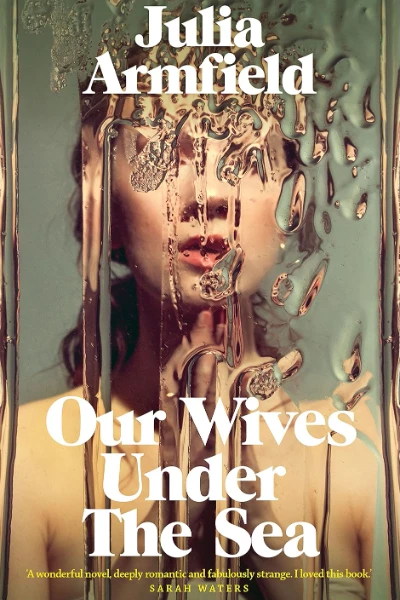
Our Wives Under The Sea
Our Wives Under The Sea — Chapter no 39
Miri.
Sometimes, I imagine my mother and Leah meeting, though this is not a thing which ever actually happened. In the fantasy, if fantasy is quite the word, this typically takes place at my mother’s house by the sea, and perhaps my mother has never been ill, or perhaps she has but I haven’t failed her, I have chosen to take better care of her and this has saved her, in whatever impossible way. Most of the time, what happens is that she and Leah get along so well that they start having little jokes that exclude me and I enjoy this enormously. Some of the time, Leah takes my mother down to the beach below the house and tells her something she has told me many times before: that we think of the place we live as important, but that a far greater percentage of the world is made up of the ocean and that most of the creatures that live on the planet live there. In this dream, if dream is quite the word, my mother tells her that that’s a terribly pretentious thing to say and this makes Leah laugh, which is what makes my mother like her.
+
We arrive in the early morning – white mist on the ground like a tripwire, my mother’s house as yet untouched by the first of the light. Juna has driven at what seems to me a mad pace for a route she is unfamiliar with, but I can’t deny that when we round the elm grove that covers the headland and come down into the final stretch of road, I feel a sort of wild relief I have really not expected and I lean forwards to tell her so.
“Nothing easier,” she says, waving a hand. “Do you think I can park just anywhere?”
At this point I haven’t been to the house in several years, have expressed the intention of selling it on more than one occasion and then failed to follow through. Selling it, in some way, seemed like the last thing, and so instead I gutted it of its useful attributes, stole its furniture, pulled its teeth and left it standing as it was. Once inside, the main rooms carry a particular chill of disuse, blank spaces on the walls stained darker colours by the missing frames and photographs. In the main room, I pull the dust sheets
from the sofas and briefly feel my mother at my elbow, though when I turn, her chair is empty. In the doorway, Juna clears her throat and I turn, find her leaning there with a shadow in the passage behind her which, again, I take to be my mother, though in truth it is only the shape of Juna’s coat which she has removed and hung from a hook on the door.
“We should get her out of the car,” I say and she nods at me.
“And then I need a cup of tea.”
“I can turn the water on at the mains, but I’m not sure where you’re going to find a teabag.”
We get Leah in, somehow, move her up to my mother’s bathroom, where I pour the salt water into the bath from the bottles we have brought before filling it the rest of the way from the taps. I unwrap her from her towels as gently as I can and manoeuvre her into the water, her hair like a halo and her bandage slipping down to reveal the wide dark space where her eye should be. I kneel down by the side of the bath and ask her to forgive me for moving her, for the car journey she had been in no position to approve. “It just seemed like the best thing,” I say to her, noticing as I do so that the remains of her face are weeping sideways in the water, becoming something less like flesh and more like liquid. “It just seemed like something I had to do.”
When I was younger, I think some glib or cavalier part of me always believed that there was no such thing as heartache – that it was simply a case of things getting in past the ribcage and finding there was no way out. I know now, of course, that this was a stupid thing to think, in so far as most things we believe will turn out to be ridiculous in the end.
+
The day is cold, too long because we started early, washed curiously blank by the rain which comes in off the sea and lasts well into the afternoon. For the most part, I stay in the bathroom with Leah, though at irregular intervals, Juna comes in offering cups of tea, a sleeve of Penguin biscuits, explaining that she took the car back up across the tops and stopped to buy supplies at a petrol station she had noticed on the way in. At some point, I suppose at lunchtime, she tells me she thinks I ought to come downstairs and eat something, and when I refuse, she comes and sits with me in the
corridor outside the bathroom with a plastic plate of sandwiches and the door ajar, and tells me some of what she knows.
She tells me that when the craft surfaced, only Leah and one other crew member were aboard, that she isn’t sure of the other crew member’s name or condition.
“I have to assume the same happened to them as Leah,” she says, “or is happening to them. Whoever they were. Or maybe I don’t. Maybe they quarantined like Leah and went home just fine. Maybe they’re fine now. I don’t know how we find out.” I remember his name, I think of telling her, I remember Leah worked with him before.
She tells me that the Centre informed her via letter of her sister’s accidental death during the course of the dive and explained that, as was regulation, the body had been expelled from the craft while still submerged.
She had not been encouraged, she said, to come down to the Centre, but did so anyway after several unhelpful phone calls as she believed they might be in possession of various of her sister’s effects. She tells me, only as an aside, that during the long absence of the dive, she had grown increasingly convinced that someone with information was trying to call her on the phone. “You said it happened to you,” she says, “which is why I mention it.
Sometimes I thought it was someone from the Centre too, someone trying to warn me and losing their nerve. Other times I imagine it was all just a practical joke. The whole thing can feel like a joke to me now, a little, so I’m not sure I’d even be surprised.” On arriving at the Centre, she had been told that Leah and the other crew member were both in quarantine and that any personal belongings would be subject to the same restrictions. She tells me, calmly enough, that an altercation followed. This is how she describes it, too: “There was an altercation. I mean, you have to understand, my sister’s dead and here’s some bitch at what amounts to a front desk at this creepy place I’ve never visited before telling me I can’t have, what, her shoes? Her underwear? These weird fucking people – I remember Jelka when she first got the job, she just kept saying, These people are weird. So I start arguing, obviously, I tell them I’m going to go to the newspapers, or get a lawyer, that all of this sounds wrong to me, that they never told us what was happening when they went down and didn’t come up. I say all kinds of crazy shit, that I think they hired them under false pretences – that my sister and the rest didn’t know what it was they were getting into, that it was all a sham, and on and on like that – until eventually some other guy
comes out and I tell him no I don’t want a fucking supervisor I want whoever is the most senior person at this place. And then finally this guy appears, this guy who’s wearing a fucking sports coat, mind you, like a sports coat and jeans, and he tells me hey, my name is whatever – see, I don’t even remember his name – and he tells me that of course he wants to help.”
She tells me that after this other man appeared (Leah, in the back of my mind, jokingly referring to the boss at the going-away party), everything was easy, that they gave her her sister’s effects as though there had never been an issue, that he even passed her a personal number and told her to call him if there was anything else he could do. “It was weird,” she says, “this weird loopy little attitude he had, like it was all fine, like he could make it fine. I didn’t think to try the number until a few weeks afterwards, but of course when I rang it there was just a message saying the line was no longer in service. It was meant to be a research trip, you know. Just observing, taking notes. I don’t know what it really was, but I’ve been trying to find out.”
She sits beside me in silence for a while after this, still – as it only occurs to me now – in last night’s pyjamas, her skin without make-up the consistency of something clawed with a fork. I say nothing, only glancing at my sandwich and thinking, in a dull sort of way, that this should all be more interesting to me than it is. “I think,” Juna says after a pause, “that the thing about losing someone isn’t the loss but the absence of afterwards.
D’you know what I mean? The endlessness of that.” She looks sideways at me and sniffs. “My friends were sad, people who knew my sister were sad, but everyone moves on after a month. It’s all they can manage. It doesn’t mean they weren’t sad, just that things keep going or something, I don’t know.” She rolls her shoulder, shakes her head. “It’s hard when you look up and realise that everyone’s moved off and left you in that place by yourself.
Like they’ve all gone on and you’re there still, holding on to this person you’re supposed to let go of. Let go of them in the water, is something I read once. Seems a bit of a joke in the circumstances, but still. Something about how living means relinquishing the dead and letting them drop down or fall or sink. Letting go of them in the water, you know.”
I look at her and I feel a collection of curious things, none of which feel quite correct for the circumstances. I feel the coolness I always feel towards strangers, the gentle yawn of distance I still can’t help but preserve, even
despite her sharing all of this with me. I feel, too, the blank exhaustion of everything, the fact that I should not be out here but in the bathroom with Leah, the fact that I need to message Carmen and tell her I hope her eyes are doing better, the fact that I need to call Sam and apologise for dropping off the face of the earth. I lean my head back against the wall for a second and then roll it sideways until it is resting on Juna’s shoulder. She allows me to do this, hunches up a little to prevent me stretching my neck, and for a moment I am able to banish my other thoughts and feel only what I ought to feel, which is grateful.
+
Here are some things I didn’t have space for:
Putting on Alone by Heart and miming the lyrics in Leah’s face until she started laughing.
Leah’s long hands and her yellow hair and the werewolf quality to her eyebrows. The way she walked around the flat in shorts and a sports bra and told me off for staring. The way she kissed me and then apologised for biting.
The time Leah told me that making me laugh was always an achievement because my face was so typically set against it.
The way I was often bored and Leah never was.
Talking with Leah on early dates about the panic of doing what everyone else was doing and then feeling like a dick about it.
The way Leah was kind by nature, where I always seemed to have to struggle. The way she tipped my face towards hers and told me otherwise – You’re the kindest person I know, and I know six or seven people.
+
So here’s what happens, obviously.
Morning again – a rain that persists at first, grows full and hammering in its insistence and then passes away without warning, a white sky, the windows filled with sharp corners of sunlight. I had not intended to take Leah down to the water, but when I wake beside the bath, having apparently fallen asleep with my cheek against the lip of the tub, I catch the direction of her remaining eye beneath the surface, the way it turns towards the window, and I think, Well, yes.
I soak the towels again, wrap her up as before and manoeuvre her down the stairs. I find Juna lying awake on one of my mother’s sofas, still in pyjamas and with one arm pillowed behind her head. She doesn’t ask me where I’m going or whether she needs me to come with her, only nods her head towards the moleskin coat still hanging from the hook on the door and tells me there is something in the pocket she’d like me to have. “Later on,” she says, “if you like. It was in with Jelka’s things when they gave them to me but it’s actually Leah’s, something she wrote – pages and pages. I brought it to give to you the first time we met, but it didn’t seem like you’d want to take it. It’s how I knew to come and find you. Not,” she adds, with the strange sort of smile I am just about getting used to, “that you ever asked.”
It is not difficult getting Leah down to the water. You might imagine it would be, but by this point the lightness in her body adds little to the weight of the towels which I’ve used to bundle her up. I take her up into my arms and carry her out towards the smuggler’s path: a narrow track cut down into the cliffside which rears around my mother’s house. Protected from the worst of the wind by a high tangle of gorse which grows up like a wall along its sea-facing side, the path is more tunnel than lane, enclosed by an overarching shrubbery. I focus on my feet, on the tight nestle of Leah in my arms, and I think about nothing very much besides the rattle of her breathing and the fact that I have not heard her voice in something like two weeks. The path winds further down the cliffside and along for several minutes before turning suddenly inland, rising up steeply and then evening out as we emerge at last onto a flat and grassy overhang, which juts out above a narrow inlet some feet below. Pausing to catch my breath, I glance down over the edge, where a system of caves reveals itself, flooded by waves in the waning tide. One fork of the path we are standing on splits off and straggles downwards – a precarious but viable route down to the beach.
“Smugglers used to stow rum in those caves,” I say now, my voice conversational, something I barely recognise, “did I ever tell you that?
Rum, brandy, tea leaves, whatever they could get. They could moor here in good weather without being seen. Town’s too far inland for anyone to have heard them or seen them coming in. See those rocks just before the base?” I nod my head in the direction of the water, look down at Leah as though expecting her to respond. “You could throw a rope around just about any one of them, no problem at all. Tide’s never completely out here – this part of the headland juts out so far – but it’s dry towards the backs of the caves most of the time, so it was the perfect place to store things you didn’t want to be found. Sometimes they’d even sleep there. Those caves go pretty far back but they certainly don’t get roomier the further in you get. I knew a boy at school who got stuck there once for almost a day and a half. Just mucking about, you know. I think he did it on a dare. Eventually the coastguard had to come and fish him out. We got to watch the whole thing from the house, my mother and me. I don’t think I ever told you that. I don’t know why I didn’t.”
The beach is just over the next rise, the sand yawning out like a bite taken out of the coastline, a mile at least towards a rocky outcrop that seems to mark its natural end. The sea reels outwards, the tide some distance off and still retreating, revealing an extra inch of sand with every heave.
It is early still, deserted but for us, and I know what I am doing now.
I take her down towards the water, feet sinking in wet sand – lugworm tunnels, oarweed stretching up the beach like clambering hands. The water, when it penetrates my shoes, is freezing, the tight cold climbing sharply up my ankles, but I continue outwards, down into the water until the tide is at my calves, and then my knees. I keep Leah high in my arms, move further, press my feet into the sand when the water is at chest height, kick my legs and push us further, hold her in as closely as I can. The waves are gentle here, an easing surge of early morning. I no longer have much purchase on the sand, one leg tangled up with seaweed, mouth filling once with water, then again. I have never been a very good swimmer, even after Leah’s lessons, and it is this thought, this memory, which makes me grasp her tighter, pulling her into me from where my arms have slackened with the cold. A desperate squeeze inside my heart. My Leah – the way she held me round the waist at the lido and told me to kick, told me that she would buoy me along. My Leah.
But I can see it happening already, look down at her in my arms as the towels fall away, weighed down by the water that has saturated each in turn and left them too heavy to cling. Passingly, I think that this might always have been inevitable, that perhaps she had always known it but had wanted to hold on for me, for as long as she could. I can see it now, the way her chest begins to frill, the upward swell and tremor of the skin that registers its natural habitat, growing first translucent, then entirely clear. I can feel, as well, the way the body I am holding is becoming less a body, the way she slides between my fingers – first my Leah, then the water, first my Leah’s arms, her chest, her ribcage, then the water they are struggling towards. I think of nothing, then I think about the sea lung, the day on the beach with Leah where the ice sat on the water and the air around us seemed about to take some other form. This alchemist sea, changing something into something else. I think of this and I look at her face, the remains of her face, my Leah. She is looking at me – this now, the last of her – and she is still looking at me when I move my arms to release her, when she melts between my hands and into water, twisting down into the rolling tide.
What persists after this is only air and water and me between them, not quite either and with one foot straining for the sand.
OceanofPDF.com