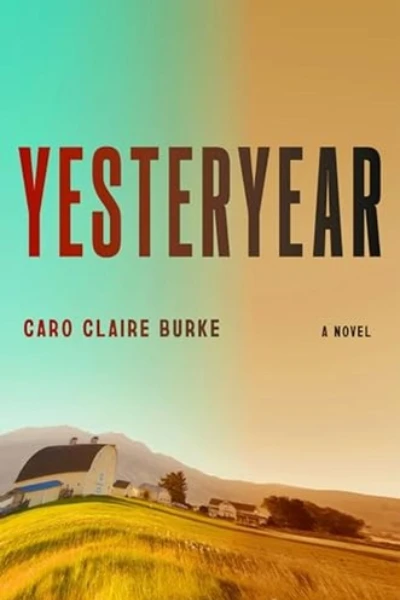
Yesteryear
Yesteryear — Chapter 29
29
“COLD FRONT’S COMING through this afternoon.”
I look up in surprise. Old Caleb is standing a few feet away from the laundry tub.
“It’s a big one,” he says. “Might even get some snow.”
Behind him, on the porch twenty feet away, Mary is beating the table rug over the railing. She pauses when she sees him standing before me. I’m sure she’s thinking the same thing I am: He never talks to me if he can help it.
“We’ll need to take the animals inside the barn,” Old Caleb goes on.
“And we should stack some extra wood. We might be snowed in for a day or longer.”
I don’t know what to say. He hasn’t asked me a question, so I return my focus to the laundry. Plunge my hands into the frigid water and watch them work. They’re so numb I can’t feel them at all, can only watch them move through the water with a sort of amazed wonder. So much work to get these clothes clean, and for what? The boys will stomp around in muddy puddles
the next day.
“Nattie,” Old Caleb says.
Underwater, my fingers twitch and dance. I swallow the rising bile in my throat. It was a good day, and now it’s starting to feel like a bad day. I pull my hands out of the tub, wipe them dry on my apron, and look up at him. In
my periphery, I notice the porch is empty. Mary has gone back inside.
“I don’t like hitting you,” Old Caleb says. “You know that.”
I imagine a camera zooming in on my face. I tilt my chin slightly so the sunlight catches my pout.
“I didn’t want to do that,” he says. “You made me do that. You were… hysterical. And the trap—”
As if on cue, my poor bandaged foot begins to throb.
This man. My husband. I wonder which of the tools in the barn I’d use if I needed to kill him. The wood-chopping ax would work nicely, I think. No— the scythe. More personal, I think, and smile.
“Anyways,” Old Caleb says. “I’ve been keeping my distance. Sleeping in the boys’ room with them. I’ve wanted you to rest. But you seem much better now.”
Poor idiot, I think. You misunderstand my smile.
“So,” he says, and casts his glance over my head, toward the mountains.
“I’m going to share a bed with you tonight.”
The smile slips off my face.
“I won’t have any complaints about it, either,” he goes on. “You’re my wife, and I’m your husband, and we’re meant to share a bed.”
I just stare at him. Pray against all rationality that I might hear, in the faraway distance, a director shouting Cut. There’s nothing but the wind whistling through the valley, a sky the color of frostbitten skin.
Shame. I’d let my guard down. So many weeks of my own bed, I’d actually started to think it could stay that way. But of course that’s not how this works.
Everyone has a role on this farm. Old Caleb tends to the fields, and Noah tends to the horse, and Abel tends to his father, and Mary tends to the kitchen and to Maeve, and Maeve tends to the chickens—and me?
A few days ago, I might have said my role is to take care of the laundry.
That is, of course, not correct. The laundry is an addendum, a footnote, a midafternoon side quest for a woman with too much time on her hands. This, right here, is my true role. To spread my legs when my husband demands. To have as many children as I can until my legs give out beneath me, and to feel nothing but gratitude on the hour of my death. To smile while the spirit hemorrhages out of me.
Ha. It really is funny to think of how I all but begged Caleb, in our early years of marriage, to become the kind of man who is standing before me now. The opposite of a kindergarten teacher. A farmer. A cowboy. A patriarch. A man without a single soft edge. I craved it, I prayed for it, and what did the Lord do? He listened. He gave me what I wanted. He gave me a man.
For the husband is the head of the wife as Christ is the head of the church, his body, and is himself its Savior.
Old Caleb is looking at me expectantly. I feel like I’m sitting beneath a spotlight, like the whole world is waiting for me to speak. Can someone tell me my line?
Yes, master. As you wish, master. Should I lift my skirts and bend over right here by the laundry, master? Would you like to come on my face or my tits, master?
But that last joke doesn’t work, does it? This man doesn’t want to come anywhere but deep, deep inside me, so that I may have—Lord save me from this waking nightmare—a baby. Here. In this world.
I wipe my wet hands against the fabric of my lap, then look up at him.
“Who are you, really?”
Old Caleb shakes his head, looks up at the sky, looks back at me. “I don’t think I’m interested in playing this game today.”
A voice in my head, echoing softly: America hates angry women. The Lord hates angry women. You hate angry women. Do not be an angry woman.
Except I am angry. I am very, very angry. So angry that I can’t keep myself from saying, “What do you want from me?”
“I want you to behave like a mother and wife,” Old Caleb snaps, and suddenly I realize he’s angry, too. As angry as I am. It’s a terrifying, thrilling realization. You could strike a match through the air between us and watch it catch flame.
“Well,” I say. “Maybe I’m not interested in that anymore.”
Old Caleb raises a hand swiftly into the sky. I close my eyes. I’m so prepared for the thunderclap of pain that it takes me a moment to realize the moment has passed. I open my eyes, watch his hand push back his hair in agitation. He didn’t hurt me again, he can always hurt me again, he will eventually hurt me again. A sob escapes me. I’m so tired of this place. “Why am I here?”
“You’re here because this is where you want to be,” he roars.
“Well, now I want to leave,” I cry out. “Now I want to go home.”
“Go home, then, Natalie. Go walk on home, wherever you think that is.
See what good that brings you.” He leans over and spits, then wipes his mouth with the back of his hand. Stares past me at the mountains with a tight, working jaw.
“If I try to leave again, will you stop me?”
He’s still looking past me when he says, “It won’t be me that stops you, no.”
A chill runs through me. I am looking at my husband, this stranger, but I am thinking of the woods, and then the world beyond those woods. I can’t imagine what they hold.
That’s not true, actually.
The truth, the real truth, is that sometimes, out here on this ranch, I have this terrible feeling, like a loose electrical wire in my chest, that if I think hard enough for long enough, I will know exactly what is waiting for me on the other side of those woods, and the horror of this knowledge will eat me alive.
Lord, God, save me, wake me from this dream— The wind picks up and a chill whips past the house. Old Caleb grabs his hat to keep it from flying away. I tuck my cheek against my shoulder to protect it from the stinging cold. He’s right. A storm is coming.
—
The clouds move quickly down the valley. One minute, it’s just me and Old Caleb outside, a blue sky overhead, and the next minute the world has gone gray and the wind is blowing my hair out of its braid and the children are pouring out of the house like little weathervanes.
“The snow will be here in a minute,” Old Caleb says to me, raising his voice to be heard over the wind. “Get the clothes inside.”
I look at the tub in indignation. “But they’re sopping wet!”
But he’s already walking toward the pasture. I watch in amazement as the cow and the horse trot over to meet him by the pasture entrance, eager to be guided to the safety of the barn. Does every animal on this property have a better sense of the world’s shifting currents than me?
Then Maeve is by my side, tugging my arm. “Clothes, Mama.”
I plunge my hands back into the freezing water, hauling the soaking pile of fabric out and wringing it as best as I can. Maeve holds her arms out, and I drop some of the clothing into her arms. A few pieces fall to the ground, immediately dirtying themselves, and I let out a cry of frustration. I pick them
up and stuff them back into the pile. Together, we run two loads of laundry into the house, setting up the clothing by the fire to dry. Around us, the other children are moving just as quickly, stacking wood and closing the barn up and shutting the kitchen windows and securing them with flimsy wooden latches.
I’ve experienced storms on this land before. I know how powerful they are. In recent years, we even lost power a few times, but the generator always kicked in. Now I stare at the fire and remember that this is the only source of warmth we have. “Get more wood,” I shout at the children. My first true command in who knows how long, and an utterly useless one at that. They’re already doing it.
—
Not an hour later, hail pounds the roof like machine-gun fire. It’s late afternoon, but the sky is so dark it looks like the dead of night. Mary is cutting up chunks of bread and slathering them with butter. That will be our dinner tonight. I am sitting by the fire, Maeve resting in my lap. Across me, the boys sit, their legs splayed out in front of them to warm their feet. Abel mimics holding a rifle, pointing the imaginary trigger toward the roof. “Pow, pow, pow,” he whispers. “Take that, you savages.” Noah watches with rapture. Through his gaze, Abel’s rifle seems so terribly real.
As the storm pounds away at our little cabin, I close my eyes and imagine it. Cowboys and Indians. A great bloody battle for these rolling hills. Old Caleb scalped by some hardened warrior chief. The boys slain. The girls and I carried off to some faraway teepee with smoke spilling out the top.
Taken hostage. That’s how people would describe the ladies in those Western stories when we were growing up—those poor beautiful dignified homestead women, taken hostage by the savages. It used to thrill me. Now I
find it funny that no one ever acknowledged how those pioneer women were technically already hostages to begin with.
—
Hours after dinner, the children are in their rooms and the hail has given way to a heavy silent snow when Old Caleb walks into the bedroom, leaving the door open behind him.
I look at the open door. “Aren’t you—don’t you want to—”
He gives me a look. “It’ll be freezing in here in three minutes if we shut this door.”
Well, then. I suppose the children will listen.
I lie in my—our—bed, the quilt pulled up to my chin, and watch as he takes off his cowboy hat and sets it on the bureau. He hesitates. Then he gives a little shake of the head, as if ridding himself of some terrible thought, and begins to undress.
My mind skitters nervously left and right. I think of reality shows, of producer vans and scripted conversations, and my spirit tightens in my chest.
What a silly fantasy. That little pebble I pulled from the ground and shoved under my mattress—what a shameful game of play-pretend. A desperate act of imagination. This home is no production set. There are no hidden cameras in the kitchen, no microphones tucked away in the collar lines of the children.
No one is coming to save me and take me home. If I needed any more evidence to prove this point, it is here, right now, in this room: maybe a show might soon allow a man to hit a woman, might even allow her to walk right into the steel jaws of a trap—but we’re not yet at the point where he could rape her.
Though of course it can’t be rape, what’s happening here. There’s no such thing as a husband raping his wife.
His shirt’s off, now. His pants fall to his feet, and he kicks them to the corner. He takes off his underwear. This is my husband’s body. There is the mole on his stomach; there is the leftward-leaning hang of his ball sack. I am biblically familiar with this alien body. I close my eyes and send off a quick prayer.
Stay with me, Lord. Do not leave me in my hour of need.
He reaches for my body beneath the blanket. Hand on hip. Turning me over. Climbing across. Opening me up.
You’ve done this countless times before, Natalie. There’s no reason to be afraid.
Except this man’s erection is hard, harder than hard. Fully risen. It doesn’t help that I’m completely dry. From the deepest part of my body, three words rise to the surface, the greatest and most instinctual act of survival I can offer for myself: “I love you,” I say.
Above me, my husband smiles.
—
It hurts. He doesn’t ask me what I want. He doesn’t ask if I’m all right. It’s exactly how I imagined sex to be when I was a young girl: a man who takes without asking, who fills me completely, who assumes control of my body and finger-puppets me from the inside out. Yes. Exactly this. Like Abel’s imaginary rifle: terribly real. He grunts, pulls out of me, flips my body over, and reenters from behind. I cry out. I feel like a barnyard animal, a pig rutting in the straw, but it’s a relief to let the whites of my eyes travel wildly around the room, searching for some sort of visual comfort. The windows, the wall, this quilt. The pace of this, the steady thudding—my teeth rattle in my skull. I focus on the stitching beneath my fingers while prayers fly along the corridors of my mind.
Though outwardly we are wasting away, yet inwardly we are being renewed day by day…For our light and momentary troubles are achieving for us an eternal glory that far outweighs them all…So we fix our eyes not on what is seen, but on what is unseen, since what is seen is temporary, but what is unseen is eternal— A pause, a single tap on my thigh, a manual instruction, like I’m a trusty quarter horse. I lower my thigh. He pushes deeper. I gasp. In an instant the pain tips over into brightness, heavenly warmth, a love I’ve never known.
Instinct takes over. I find myself reaching toward it, arching my body in response, lifting my head in ecstatic prayer— How long, O LORD? How long will you hide your face from me?… Consider and answer me, O LORD my God; light up my eyes— And then He does. He answers my prayer, He speaks back to me. The room fills with light. I cry out in shock. Old Caleb keeps pushing, carrying my body closer and closer to His heavenly arms. It feels like choir music is echoing through my limbs, and I say Thank you, I say Oh, God, my God, I say yes, yes, yes, YES—
—
Oh, my God.
My God!
I say yes.
—
We are lying together, husband and wife, in the freezing dark. Old Caleb is snoring. I am wide awake, staring into the darkness, counting my breaths.
When I reach one hundred, I sit up, throw back the covers, and get out of bed.
I stand by the mattress for a moment, listening to his steady breathing to make sure my movement hasn’t woken him up. He lets out a long, nasal snore.
I tiptoe away from the bed, slip through the door, step out in the hallway, and close the door a few inches behind me. Then I walk quickly down the hallway and into the kitchen, where the fire is still working feebly. I add a log to the fire. The children have been sleeping for hours, hopefully. The house is quiet as death.
Now that I’m alone, I’m buffeted by a strange, chilling calm. I’ve had a revelation—no, not a revelation. That would imply the realization is new, and it doesn’t feel new. It feels like a truth I’ve known all my life; like a childhood memory, resurfacing after so many years of being lost to the annals of my mind.
I’m under surveillance in this house, yes—but only by Him. This, all of this, is a test.
My Maker wants to see what I am capable of.
I sigh and wander wordlessly over to the kitchen sink. Watch the snow falling onto the roof of the barn. It’s gathering quickly. We’ll get several feet overnight.
Doubt your doubts before you doubt your faith, sweetheart.
Sometimes the most obvious truths of our world are the ones that get buried most easily. Obviously, the Lord has put me here, on this homestead, with this family—and like all things He does, He brought me here with intention, with a plan. So much of my life was dedicated to broadcasting a vision of nostalgia; a better and more beautiful version of America. A celebration of the days of yore. Now the Lord wants me to feel the truth of my own message. He wants me to learn, and listen, and improve, and submit, and—
Well, I’m not sure exactly what the end goal is, but that’s fine. He’ll tell me when He’s ready.
In the darkness of the kitchen, I pray feverishly, whispering my gratitude, then I bless myself and drop into a crouch. I hike my nightgown up and scrape as much of Old Caleb out of me as I can.
I make two promises to myself. First: I won’t forget the Lord’s message again. And second: I won’t allow myself to get pregnant here.
I’ll do anything, Lord. Please. Anything but that.
As I finger myself, my mother’s voice echoes in my head, a gentle loving song: A man may work from sun to sun, but a woman’s work is never done, never done, never done.