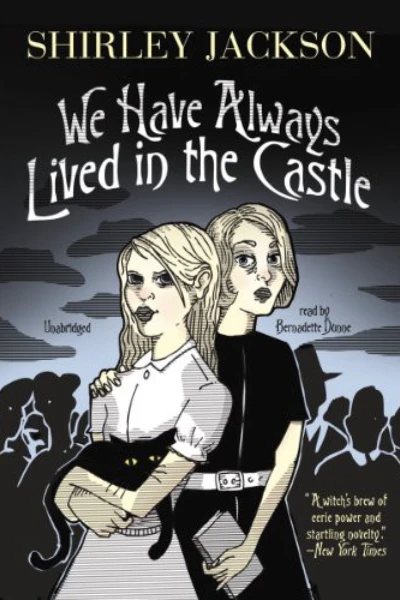
We Have Always Lived in the Castle
We Have Always Lived in the Castle — Chapter 9
9
Sometime during the night an ambulance came and took Uncle Julian away, and I wondered if they missed his shawl, which was wound around Constance as she slept. I saw the ambulance lights turning into the driveway, with the small red light on top, and I heard the distant sounds of Uncle Julian’s leaving, the voices speaking gently because they were in the presence of the dead, and the doors opening and closing. They called to us two or three times, perhaps to ask if they might have Uncle Julian, but their voices were subdued and no one came into the woods. I sat by the creek, wishing that I had been kinder to Uncle Julian. Uncle Julian had believed that I was dead, and now he was dead himself; bow your heads to our beloved Mary Katherine, I thought, or you will be dead.
The water moved sleepily in the darkness and I wondered what kind of a house we would have now. Perhaps the fire had destroyed everything and we would go back tomorrow and find that the past six years had been burned and they were waiting for us, sitting around the dining-room table waiting for Constance to bring them their dinner. Perhaps we would find ourselves in the Rochester house, or living in the village or on a houseboat on the river or in a tower on top of a hill; perhaps the fire might be persuaded to reverse itself and abandon our house and destroy the village instead; perhaps the villagers were all dead now. Perhaps the village was really a great game board, with the squares neatly marked out, and I had been moved past the square which read “Fire; return to Start,” and was now on the last few squares, with only one move to go to reach home.
Jonas’s fur smelled of smoke. Today was Helen Clarke’s day to come to tea, but there would be no tea today, because we would have to neaten the house, although it was not the usual day for neatening the house. I wished that Constance had made sandwiches for us to bring down to the creek, and I wondered if Helen Clarke
would try to come to tea even though the house was not ready. I decided that from now on I would not be allowed to hand tea cups.
When it first began to get light I heard Constance stirring on the leaves and I went into my hiding place to be near her when she awakened. When she opened her eyes she looked first at the trees above her, and then at me and smiled.
“We are on the moon at last,” I told her, and she smiled.
“I thought I dreamed it all,” she said.
“It really happened,” I said.
“Poor Uncle Julian.”
“They came in the night and took him away, and we stayed here on the moon.”
“I’m glad to be here,” she said. “Thank you for bringing me.”
There were leaves in her hair and dirt on her face and Jonas, who had followed me into my hiding place, stared at her in surprise; he had never seen Constance with a dirty face before. For a minute she was quiet, no longer smiling, looking back at Jonas, realizing that she was dirty, and then she said, “Merricat, what are we going to do?”
“First we must neaten the house, even though it is not the usual
day.”
“The house,” she said. “Oh, Merricat.”
“I had no dinner last night,” I told her.
“Oh, Merricat.” She sat up and untangled herself quickly from Uncle Julian’s shawl and the leaves; “Oh, Merricat, poor baby,” she said. “We’ll hurry,” and she scrambled to her feet.
“First you had better wash your face.”
She went to the creek and wet her handkerchief and scrubbed at her face while I shook out Uncle Julian’s shawl and folded it, thinking how strange and backward everything was this morning; I had never touched Uncle Julian’s shawl before. I already saw that the rules were going to be different, but it was odd to be folding Uncle Julian’s shawl. Later, I thought, I would come back here to my hiding place
and clean it, and put in fresh leaves.
“Merricat, you’ll starve.”
“We have to watch,” I said, taking her hand to slow her. “We have to go very quietly and carefully; some of them may still be around
waiting.”
I went first down the path, walking silently, with Constance and Jonas behind me. Constance could not step as silently as I could, but she made very little sound and of course Jonas made no sound at all. I took the path that would bring us out of the woods at the back of the house, near the vegetable garden, and when I came to the edge of the woods I stopped and held Constance back while we looked carefully to see if there were any of them left. For one first minute we saw only the garden and the kitchen door, looking just as always, and then Constance gasped and said, “Oh, Merricat,” with a little moan, and I held myself very still, because the top of our house was gone.
I remembered that I had stood looking at our house with love yesterday, and I thought how it had always been so tall, reaching up into the trees. Today the house ended above the kitchen doorway in a nightmare of black and twisted wood; I saw part of a window frame still holding broken glass and I thought: that was my window; I looked out that window from my room.
There was no one there, and no sound. We moved together very slowly toward the house, trying to understand its ugliness and ruin and shame. I saw that ash had drifted among the vegetable plants; the lettuce would have to be washed before I could eat it, and the tomatoes. No fire had come this way, but everything, the grass and the apple trees and the marble bench in Constance’s garden, had an air of smokiness and everything was dirty. As we came closer to the house we saw more clearly that the fire had not reached the ground floor, but had had to be content with the bedrooms and the attic.
Constance hesitated at the kitchen door, but she had opened it a thousand times before and it ought surely to recognize the touch of her hand, so she took the latch and lifted it. The house seemed to shiver when she opened the door, although one more draft could hardly chill it now. Constance had to push at the door to make it open, but no burned timber crashed down, and there was not, as I half thought there might be, a sudden rushing falling together, as a house, seemingly solid but really made only of ash, might dissolve at a touch.
“My kitchen,” Constance said. “My kitchen.”
She stood in the doorway, looking. I thought that we had somehow not found our way back correctly through the night, that we had somehow lost ourselves and come back through the wrong gap in time, or the wrong door, or the wrong fairy tale. Constance put her hand against the door frame to steady herself, and said again, “My
kitchen, Merricat.”
“My stool is still there,” I said.
The obstacle which made the door hard to open was the kitchen table, turned on its side. I set it upright, and we went inside. Two of the chairs had been smashed, and the floor was horrible with broken dishes and glasses and broken boxes of food and paper torn from the shelves. Jars of jam and syrup and catsup had been shattered against the walls. The sink where Constance washed her dishes was filled with broken glass, as though glass after glass had been broken there methodically, one after another. Drawers of silverware and cooking ware had been pulled out and broken against the table and the walls, and silverware that had been in the house for generations of Blackwood wives was lying bent and scattered on the floor.
Tablecloths and napkins hemmed by Blackwood women, and washed and ironed again and again, mended and cherished, had been ripped from the dining-room sideboard and dragged across the kitchen. It seemed that all the wealth and hidden treasure of our house had been found out and torn and soiled; I saw broken plates which had come from the top shelves in the cupboard, and our little sugar bowl with roses lay almost at my feet, handles gone.
Constance bent down and picked up a silver spoon. “This was our grandmother’s wedding pattern,” she said, and set the spoon on the table. Then she said, “The preserves,” and turned to the cellar door; it was closed and I hoped that perhaps they had not seen it, or had perhaps not had time to go down the stairs. Constance picked her way carefully across the floor and opened the cellar door and looked down. I thought of the jars and jars so beautifully preserved lying in broken sticky heaps in the cellar, but Constance went down a step or two and said, “No, it’s all right; nothing here’s been touched.” She closed the cellar door again and made her way across to the sink to wash her hands and dry them on a dishtowel from the floor. “First, your breakfast,” she said.
Jonas sat on the doorstep in the growing sunlight looking at the kitchen with astonishment; once he raised his eyes to me and I wondered if he thought that Constance and I had made this mess. I saw a cup not broken, and picked it up and set it on the table, and then thought to look for more things which might have escaped. I remembered that one of our mother’s Dresden figurines had rolled safely onto the grass and I wondered if it had hidden successfully and preserved itself; I would look for it later.
Nothing was orderly, nothing was planned; it was not like any other day. Once Constance went into the cellar and came back with her arms full. “Vegetable soup,” she said, almost singing, “and strawberry jam, and chicken soup, and pickled beef.” She set the jars on the kitchen table and turned slowly, looking down at the floor.
“There,” she said at last, and went to a corner to pick up a small saucepan. Then on a sudden thought she set down the saucepan and made her way into the pantry. “Merricat,” she called with laughter, “they didn’t find the flour in the barrel. Or the salt. Or the potatoes.”
They found the sugar, I thought. The floor was gritty, and almost alive under my feet, and I thought of course; of course they would go looking for the sugar and have a lovely time; perhaps they had thrown handfuls of sugar at one another, screaming, “Blackwood sugar, Blackwood sugar, want a taste?”
“They got to the pantry shelves,” Constance went on, “the cereals and the spices and the canned food.”
I walked slowly around the kitchen, looking at the floor. I thought that they had probably tumbled things by the armload, because cans of food were scattered and bent as though they had been tossed into the air, and the boxes of cereal and tea and crackers had been trampled under foot and broken open. The tins of spices were all together, thrown into a corner unopened; I thought I could still smell the faint spicy scent of Constance’s cookies and then saw some of them, crushed on the floor.
Constance came out of the pantry carrying a loaf of bread. “Look what they didn’t find,” she said, “and there are eggs and milk and butter in the cooler.” Since they had not found the cellar door they
had not found the cooler just inside, and I was pleased that they had not discovered eggs to mix into the mess on the floor.
At one time I found three unbroken chairs and set them where they belonged around the table. Jonas sat in my corner, on my stool, watching us. I drank chicken soup from a cup without a handle, and Constance washed a knife to spread butter on the bread. Although I did not perceive it then, time and the orderly pattern of our old days had ended; I do not know when I found the three chairs and when I ate buttered bread, whether I had found the chairs and then eaten bread, or whether I had eaten first, or even done both at once. Once Constance turned suddenly and put down her knife; she started for the closed door to Uncle Julian’s room and then turned back, smiling a little. “I thought I heard him waking,” she said, and sat down again.
We had not yet been out of the kitchen. We still did not know how much house was left to us, or what we might find waiting beyond the closed doors into the dining room and the hall. We sat quietly in the kitchen, grateful for the chairs and the chicken soup and the sunlight coming through the doorway, not yet ready to go further.
“What will they do with Uncle Julian?” I asked.
“They will have a funeral,” Constance said with sadness. “Do you
remember the others?”
“I was in the orphanage.”
“They let me go to the funerals of the others. I can remember.
They will have a funeral for Uncle Julian, and the Clarkes will go, and the Carringtons, and certainly little Mrs. Wright. They will tell each other how sorry they are. They will look to see if we are there.”
I felt them looking to see if we were there, and I shivered.
“They will bury him with the others.”
“I would like to bury something for Uncle Julian,” I said.
Constance was quiet, looking at her fingers which lay still and long on the table. “Uncle Julian is gone, and the others,” she said. “Most of our house is gone, Merricat; we are all that is left.”
“Jonas.”
“Jonas. We are going to lock ourselves in more securely than ever.”
“But today is the day Helen Clarke comes to tea.”
“No,” she said. “Not again. Not here.”
As long as we sat quietly together in the kitchen it was possible to postpone seeing the rest of the house. The library books were still on their shelf, untouched, and I supposed that no one had wanted to touch books belonging to the library; there was a fine, after all, for destroying library property.
Constance, who was always dancing, seemed now unwilling to move; she sat on at the kitchen table with her hands spread before her, not looking around at the destruction, and almost dreaming, as though she never believed that she had wakened this morning at all.
“We must neaten the house,” I said to her uneasily, and she smiled across at me.
When I felt that I could not wait for her any longer I said, “I’m going to look,” and got up and went to the dining-room door. She watched me, not moving. When I opened the door to the dining room there was a shocking smell of wetness and burned wood and destruction, and glass from the tall windows lay across the floor and the silver tea service had been swept off the sideboard and stamped into grotesque, unrecognizable shapes. Chairs were broken here, too; I remembered that they had taken up chairs and hurled them at windows and walls. I went through the dining room and into the front hall. The front door stood wide open and early sunlight lay in patterns along the floor of the hall, touching broken glass and torn cloth; after a minute I recognized the cloth as the drawing-room draperies which our mother had once had made up fourteen feet long. No one was outside; I stood in the open doorway and saw that the lawn was marked with the tires of cars and the feet which had danced, and where the hoses had gone there were puddles and mud. The front porch was littered, and I remembered the neat pile of partly broken furniture which Harler the junk dealer had set together last night. I wondered if he planned to come today with a truck and gather up everything he could, or if he had only put the pile together because he loved great piles of broken things and could not resist stacking junk wherever he found it. I waited in the doorway to be sure that no one was watching, and then I ran down the steps across the grass and found our mother’s Dresden figurine unbroken where it had hidden against the roots of a bush; I thought to take it to Constance.
She was still sitting quietly at the kitchen table, and when I put the Dresden figurine down before her she looked for a minute and then took it in her hands and held it against her cheek. “It was all my fault,” she said. “Somehow it was all my fault.”
“I love you, Constance,” I said.
“And I love you, Merricat.”
“And will you make that little cake for Jonas and me? Pink frosting, with gold leaves around the edge?”
She shook her head, and for a minute I thought she was not going to answer me, and then she took a deep breath, and stood up.
“First,” she said, “I’m going to clean this kitchen.”
“What are you going to do with that?” I asked her, touching the Dresden figurine with the very tip of my finger.
“Put it back where it belongs,” she said, and I followed her as she opened the door to the hall and made her way down the hall to the drawing-room doorway. The hall was less littered than the rooms, because there had been less in it to smash, but there were fragments carried from the kitchen, and we stepped on spoons and dishes which had been thrown here. I was shocked when we came into the drawing room to see our mother’s portrait looking down on us graciously while her drawing room lay destroyed around her. The white wedding-cake trim was blackened with smoke and soot and would never be clean again; I disliked seeing the drawing room even more than the kitchen or the dining room, because we had always kept it so tidy, and our mother had loved this room. I wondered which of them had pushed over Constance’s harp and I remembered that I had heard it cry out as it fell. The rose brocade on the chairs was torn and dirty, smudged with the marks of wet feet that had kicked at the chairs and stamped on the sofa. The windows were broken here too, and with the drapes torn down we were clearly visible from outside.
“I think I can close the shutters,” I said, as Constance hesitated in the doorway, unwilling to come further into the room. I stepped out onto the porch through the broken window, thinking that no one had ever come this way before, and found that I could unhook the shutters easily. The shutters were as tall as the windows; originally it was intended that a man with a ladder would close the shutters when
the summers were ended and the family went away to a city house, but so many years had passed since the shutters were closed that the hooks had rusted and I needed only to shake the heavy shutters to pull the hooks away from the house. I swung the shutters closed, but I could only reach the lower bolt to hold them; there were two more bolts high above my head; perhaps some night I might come out here with a ladder, but the lower bolt would have to hold them now. After I had closed the shutters on both tall drawing-room windows I went along the porch and in, formally, through the front door and into the drawing room where Constance stood in dimness now, without the sunlight. Constance went to the mantel and set the Dresden figurine in its place below the portrait of our mother and for one quick minute the great shadowy room came back together again, as it should be, and then fell apart forever.
We had to walk carefully because of the broken things on the floor.
Our father’s safe lay just inside the drawing-room door, and I laughed and even Constance smiled, because it had not been opened and it had clearly not been possible to carry it any farther than this. “Foolishness,” Constance said, and touched the safe with her toe.
Our mother had always been pleased when people admired her drawing room, but now no one could come to the windows and look in, and no one would ever see it again. Constance and I closed the drawing-room door behind us and never opened it afterwards.
Constance waited just inside the front door while I went onto the porch again and closed the shutters over the tall dining-room windows, and then I came inside and we shut and locked the front door and we were safe. The hall was dark, with two narrow lines of sunlight coming through the two narrow glass panels set on either side of the door; we could look outside through the glass, but no one could see in, even by putting their eyes up close, because the hall inside was dark. Above us the stairs were black and led into blackness or burned rooms with, incredibly, tiny spots of sky showing through. Until now, the roof had always hidden us from the sky, but I did not think that there was any way we could be vulnerable from above, and closed my mind against the thought of silent winged creatures coming out of the trees above to perch on the broken burnt
rafters of our house, peering down. I thought it might be wise to barricade the stairs by putting something—a broken chair, perhaps— across. A mattress, soaked and dirty, lay halfway down the stairs; this was where they had stood with the hoses and fought the fire back and out. I stood at the foot of the stairs, looking up, wondering where our house had gone, the walls and the floors and the beds and the boxes of things in the attic; our father’s watch was burned away, and our mother’s tortoise-shell dressing set. I could feel a breath of air on my cheek; it came from the sky I could see, but it smelled of smoke and ruin. Our house was a castle, turreted and open to the sky.
“Come back to the kitchen,” Constance said. “I can’t stay out here.”
Like children hunting for shells, or two old ladies going through dead leaves looking for pennies, we shuffled along the kitchen floor with our feet, turning over broken trash to find things which were still whole, and useful. When we had been along and across and diagonally through the kitchen we had gathered together a little pile of practical things on the kitchen table, and there was quite enough for the two of us. There were two cups with handles, and several without, and half a dozen plates, and three bowls. We had been able to rescue all the cans of food undamaged, and the cans of spice went neatly back onto their shelf. We found most of the silverware and straightened most of it as well as we could and put it back into its proper drawers. Since every Blackwood bride had brought her own silverware and china and linen into the house we had always had dozens of butter knives and soup ladles and cake servers; our mother’s best silverware had been in a tarnish-proof box in the dining-room sideboard, but they had found it and scattered it on the floor.
One of our whole cups was green with a pale yellow inside, and Constance said that one could be mine. “I never saw anyone use it before,” she said. “I suppose a grandmother or a great-great-aunt brought that set to the house as her wedding china. There once were plates to match.” The cup which Constance chose was white with orange flowers, and one of the plates matched that. “I remember
when we used those dishes,” Constance said; “they were the everyday china when I was very small. The china we used for best then was white, with gold edges. Then Mother bought new best china and the white and gold china was used for everyday and these flowered dishes went onto the pantry shelf with the other half-broken sets. These last few years I have always used Mother’s everyday china, except when Helen Clarke came to tea. We will take our meals like ladies,” she said, “using cups with handles.”
When we had taken out everything we wanted and could use, Constance got the heavy broom and swept all the rubble into the dining room. “Now we won’t have to look at it,” she said. She swept the hall clear so we could go from the kitchen to the front door without passing through the dining room, and then we closed all the doors to the dining room and never opened them again. I thought of the Dresden figurine standing small and courageous under our mother’s portrait in the dark drawing room and I remembered that we would never dust it again. Before Constance swept away the torn cloth that had been the drawing-room drapes I asked her to cut me off a piece of the cord which had once drawn them open and shut, and she cut me a piece with a gold tassel on the end; I wondered if it might be the right thing to bury for Uncle Julian.
When we had finished and Constance had scrubbed the kitchen floor our house looked clean and new; from the front door to the kitchen door everything was clear and swept. So many things were gone from the kitchen that it looked bare, but Constance put our cups and plates and bowls on a shelf, and found a pan to give Jonas milk, and we were quite safe. The front door was locked, and the kitchen door was locked and bolted, and we were sitting at the kitchen table drinking milk from our two cups and Jonas was drinking from his pan when a knocking started on the front door. Constance ran to the cellar, and I stopped just long enough to be sure that the kitchen door was bolted, and then followed her. We sat on the cellar stairs in the darkness, and listened. Far away, at the front door, the knocking went on and on, and then a voice called, “Constance?
Mary Katherine?”
“It’s Helen Clarke,” Constance said in a whisper.
“Do you think she has come for her tea?”
“No. Never again.”
As we had both known she would, she came around the house, calling us. When she knocked on the kitchen door we held our breath, neither of us moving, because the top half of the kitchen door was glass, and we knew she could see in, but we were safely on the cellar stairs and she could not open the door.
“Constance? Mary Katherine? Are you in there?” She shook the door handle as people do when they want a door to open and think to catch it unaware and slip in before the lock can hold. “Jim,” she said, “I know they’re in there. I can see something cooking on the stove. You’ve got to open the door,” she said, raising her voice.
“Constance, come and talk to me; I want to see you. Jim,” she said, “they’re in there and they can hear me, I know it.”
“I’m sure they can hear you,” Jim Clarke said. “They can probably hear you in the village.”
“But I’m sure they misunderstood the people last night; I’m sure Constance was upset, and I must tell them that nobody meant any harm. Constance, listen to me, please. We want you and Mary Katherine to come to our house until we can decide what to do with you. Everything’s all right, really it is; we’re going to forget all about it.”
“Do you think she will push over the house?” I whispered to Constance, and Constance shook her head wordlessly.
“Jim, do you think you could break down the door?”
“Certainly not. Leave them alone, Helen, they’ll come out when they’re ready.”
“But Constance takes these things so seriously. I’m sure she’s
frightened now.”
“Leave them alone.”
“They cannot be left alone, that is absolutely the worst possible thing for them. I want them out of there and home with me where I can take care of them.”
“They don’t seem to want to come,” Jim Clarke said.
“Constance? Constance? I know you’re in there; come and open the door.”
I was thinking that we might very well put a cloth or a piece of cardboard over the window in the kitchen door; it simply would not
do to have Helen Clarke constantly peering in to watch pots cooking on the stove. We could pin the curtains together across the kitchen windows, and perhaps if the windows were all covered we could sit quietly at the table when Helen Clarke came pounding outside and not have to hide on the cellar stairs.
“Let’s leave,” Jim Clarke said. “They’re not going to answer you.”
“But I want to take them home with me.”
“We did what we could. We’ll come back another time, when they’ll feel more like seeing you.”
“Constance? Constance, please answer me.”
Constance sighed, and tapped her fingers irritably and almost noiselessly on the stair rail. “I wish she’d hurry,” she said into my ear, “my soup is going to boil over.”
Helen Clarke called again and again, going back around the house to their car, calling “Constance? Constance?” as though we might be somewhere in the woods, up a tree perhaps, or under the lettuce leaves, or waiting to spring out at her from behind a bush. When we heard their car start, distantly, we came up out of the cellar and Constance turned off her soup and I went along the hall to the front door to be sure they had gone and that the door was safely locked. I saw their car turn out of the driveway and thought I could still hear Helen Clarke calling “Constance? Constance?”
“She certainly wanted her tea,” I said to Constance when I came back to the kitchen.
“We have only two cups with handles,” Constance said. “She will never take tea here again.”
“It’s a good thing Uncle Julian’s gone, or one of us would have to use a broken cup. Are you going to neaten Uncle Julian’s room?”
“Merricat.” Constance turned from the stove to look at me. “What are we going to do?”
“We’ve neatened the house. We’ve had food. We’ve hidden from Helen Clarke. What are we going to do?”
“Where are we going to sleep? How are we going to know what time it is? What will we wear for clothes?”
“Why do we need to know what time it is?”
“Our food won’t last forever, even the preserves.”
“We can sleep in my hiding place by the creek.”
“No. That’s all right for hiding, but you must have a real bed.”
“I saw a mattress on the stairs. From my own old bed, perhaps.
We can pull it down and clean it and dry it in the sun. One corner is burned.”
“Good,” said Constance. We went together to the stairs and took hold of the mattress awkwardly; it was unpleasantly wet and dirty.
We dragged it, pulling together, along the hall, with little scraps of wood and glass coming with it, and got it across Constance’s clean kitchen floor to the kitchen door. Before unlocking the door I looked out carefully, and even when the door was opened I went out first to look around in every direction, but it was safe. We dragged the mattress out onto the lawn, and put it in the sun near our mother’s marble bench.
“Uncle Julian used to sit right here,” I said.
“It would be a good day, today, for Uncle Julian to sit in the sun.”
“I hope he was warm when he died. Perhaps he remembered the sun for a minute.”
“I had his shawl; I hope he didn’t wish for it. Merricat, I am going to plant something here, where he used to sit.”
“I am going to bury something for him. What will you plant?”
“A flower.” Constance leaned, and touched the grass softly. “Some kind of a yellow flower.”
“It’s going to look funny, right in the middle of the lawn.”
“We’ll know why it’s there, and no one else will ever see it.”
“And I will bury something yellow, to keep Uncle Julian warm.”
“First, however, my lazy Merricat, you will get a pot of water and scrub that mattress clean. And I will wash the kitchen floor again.”
We were going to be very happy, I thought. There were a great many things to do, and a whole new pattern of days to arrange, but I thought we were going to be very happy. Constance was pale, and still saddened by what they had done to her kitchen, but she had scrubbed every shelf, and washed the table again and again, and washed the windows and the floor. Our dishes were bravely on their shelf, and the cans and unbroken boxes of food we had rescued made a substantial row in the pantry.
“I could train Jonas to bring back rabbits for stew,” I told her, and she laughed, and Jonas looked back at her blandly.
“That cat is so used to living on cream and rum cakes and buttered eggs that I doubt if he could catch a grasshopper,” she said.
“I don’t think I could care for a grasshopper stew.”
“At any rate, right now I am making an onion pie.”
While Constance washed the kitchen I found a heavy cardboard carton which I took apart carefully, and so had several large pieces of cardboard to cover the glass window in the kitchen door. The hammer and the nails were in the tool shed where Charles Blackwood had put them after trying to mend the broken step, and I nailed cardboard across the kitchen door until the glass was completely covered and no one could see in. I nailed more cardboard across the two kitchen windows, and the kitchen was dark, but safe. “It would be safer to let the kitchen windows get dirty,”
I told Constance, but she was shocked, and said, “I wouldn’t live in a house with dirty windows.”
When we had finished the kitchen was very clean but could not sparkle because there was so little light, and I knew that Constance was not pleased. She loved sunshine and brightness and cooking in a light lovely kitchen. “We can keep the door open,” I said, “if we watch carefully all the time. We’ll hear if any cars stop in front of the house. When I can,” I said, “I will try to think of a way to build barricades along the sides of the house so no one will be able to come around here to the back.”
“I am sure Helen Clarke will try again.”
“At any rate she cannot look in now.”
The afternoon was drawing in; even with the door open the sunlight came only a short way across the floor, and Jonas came to Constance at the stove, asking for his supper. The kitchen was warm and comfortable and familiar and clean. It would be nice to have a fireplace in here, I thought; we could sit beside a fire, and then I thought no, we have already had a fire.
“I will go and make sure that the front door is locked,” I said.
The front door was locked and no one was outside. When I came back into the kitchen Constance said, “Tomorrow I will clean Uncle Julian’s room. We have so little house left that it should all be very clean.”
“Will you sleep in there? In Uncle Julian’s bed?”
“No, Merricat. I want you to sleep in there. It’s the only bed we have.”
“I am not allowed in Uncle Julian’s room.”
She was quiet for a minute, looking at me curiously, and then asked, “Even though Uncle Julian’s gone, Merricat?”
“Besides, I found the mattress, and cleaned it, and it came from my bed. I want it on the floor in my corner.”
“Silly Merricat. Anyway, I’m afraid we’ll both have the floor tonight.
The mattress will not dry before tomorrow, and Uncle Julian’s bed is not clean.”
“I can bring branches from my hiding place, and leaves.”
“On my clean kitchen floor?”
“I’ll get the blanket, though, and Uncle Julian’s shawl.”
“You’re going out? Now? All that way?”
“No one’s outside,” I said. “It’s almost dark and I can go very safely. If anyone comes, close the door and lock it; if I see that the door is closed I will wait by the creek until I can come safely home.
And I will take Jonas for protection.”
I ran all the way to the creek, but Jonas was faster, and was waiting for me when I got to my hiding place. It was good to run, and good to come back again to our house and see the kitchen door standing open and the warm light inside. When Jonas and I came in I shut the door and bolted it and we were ready for the night.
“It’s a good dinner,” Constance said, warm and happy from cooking. “Come and sit down, Merricat.” With the door shut she had had to turn on the ceiling light, and our dishes on the table were neatly set. “Tomorrow I will try to polish the silverware,” she said, “and we must bring in things from the garden.”
“The lettuce is full of ashes.”
“Tomorrow, too,” Constance said, looking at the black squares of cardboard which covered the windows, “I am going to try to think of some kind of curtains to hide your cardboard.”
“Tomorrow I will barricade the sides of the house. Tomorrow Jonas will catch us a rabbit. Tomorrow I will guess for you what time it is.”
Far away, in the front of the house, a car stopped, and we were silent, looking at one another; now, I thought, now we will know how safe we are, and I got up and made sure that the kitchen door was
bolted; I could not see out through the cardboard and I was sure that they could not see in. The knocking started at the front door, but there was no time to make sure that the front door was locked. They knocked only for a moment, as though certain that we would not be in the front of the house, and then we heard them stumbling in the darkness as they tried to find their way around the side of the house to the back. I heard Jim Clarke’s voice, and another which I remembered was the voice of Dr. Levy.
“Can’t see a thing,” Jim Clarke said. “Black as sin out here.”
“There’s a crack of light at one of the windows.”
Which one, I wondered; which window still showed a crack?
“They’re in there, all right,” Jim Clarke said. “No place else they could be.”
“I just want to know if they’re hurt, or sick; don’t like to think of them shut up in there needing help.”
“I’m supposed to bring them home with me,” Jim Clarke said.
They came to the back door; their voices were directly outside, and Constance reached out her hand across the table to me; if it seemed that they might be able to look in we could run together for the cellar. “Damn place is all boarded up,” Jim Clarke said, and I thought, good, oh, that’s good. I had forgotten that there would be real boards in the tool shed; I never thought of anything but cardboard which is much too weak.
“Miss Blackwood?” the doctor called, and one of them knocked on the door. “Miss Blackwood? It’s Dr. Levy.”
“And Jim Clarke. Helen’s husband. Helen’s very worried about
you.”
“Are you hurt? Sick? Do you need help?”
“Helen wants you to come to our house; she’s waiting there for you.”
“Listen,” the doctor said, and I thought he had his face up very close to the glass, almost touching it. He talked in a very friendly voice, and quietly. “Listen, no one’s going to hurt you. We’re your friends. We came all the way over here to help you and make sure you were all right and we don’t want to bother you. As a matter of fact, we promise not to bother you at all, ever again, if you’ll just once say that you’re well and safe. Just one word.”
“You can’t just let people go on worrying and worrying about you,”
Jim Clarke said.
“Just one word,” the doctor said. “All you have to do is say you’re all right.”
They waited; I could feel them pressing their faces close to the glass, longing to see inside. Constance looked at me across the table and smiled a little, and I smiled back; our safeguards were good and they could not see in.
“Listen,” the doctor said, and he raised his voice a little; “listen, Julian’s funeral is tomorrow. We thought you’d want to know.”
“There are a lot of flowers already,” Jim Clarke said. “You’d be really pleased to see all the flowers. We sent flowers, and the Wrights, and the Carringtons. I think you’d feel a little different about your friends if you could see the flowers we all sent Julian.”
I wondered why we would feel different if we saw who sent Uncle Julian flowers. Certainly Uncle Julian buried in flowers, swarmed over by flowers, would not resemble the Uncle Julian we had seen every day. Perhaps masses of flowers would warm Uncle Julian dead; I tried to think of Uncle Julian dead and could only remember him asleep. I thought of the Clarkes and the Carringtons and the Wrights pouring armfuls of flowers down onto poor old Uncle Julian, helplessly dead.
“You’re not gaining anything by driving away your friends, you know. Helen said to tell you—”
“Listen.” I could feel them pushing against the door. “No one’s going to bother you. Just tell us, are you all right?”
“We’re not going to keep coming, you know. There’s a limit to how much friends can take.”
Jonas yawned. In silence Constance turned, slowly and carefully, back to face her place at the table, and took up a buttered biscuit and took a tiny silent bite. I wanted to laugh, and put my hands over my mouth; Constance eating a biscuit silently was funny, like a doll pretending to eat.
“Damn it,” Jim Clarke said. He knocked on the door. “Damn it,” he said.
“For the last time,” the doctor said, “we know you’re in there; for the last time will you just—”
“Oh, come away,” Jim Clarke said. “It’s not worth all the yelling.”
“Listen,” the doctor said, and I thought he had his mouth against the door, “one of these days you’re going to need help. You’ll be sick, or hurt. You’ll need help. Then you’ll be quick enough to—”
“Leave them be,” Jim Clarke said. “Come on.”
I heard their footsteps going around the side of the house and wondered if they were tricking us, pretending to walk away and then coming silently back to stand without sound outside the door, waiting. I thought of Constance silently eating a biscuit inside and Jim Clarke silently listening outside and a little cold chill went up my back; perhaps there would never be noise in the world again. Then the car started at the front of the house and we heard it drive away and Constance put her fork down on her plate with a little crash and I breathed again and said, “Where have they got Uncle Julian, do you suppose?”
“At that same place,” Constance said absently, “in the city.
Merricat,” she said, looking up suddenly.
“Yes, Constance?”
“I want to say I’m sorry. I was wicked last night.”
I was still and cold, looking at her and remembering.
“I was very wicked,” she said. “I never should have reminded you of why they all died.”
“Then don’t remind me now.” I could not move my hand to reach over and take hers.
“I wanted you to forget about it. I never wanted to speak about it,
ever, and I’m sorry I did.”
“I put it in the sugar.”
“I know. I knew then.”
“You never used sugar.”
“No.”
“So I put it in the sugar.”
Constance sighed. “Merricat,” she said, “we’ll never talk about it again. Never.”
I was chilled, but she smiled at me kindly and it was all right.
“I love you, Constance,” I said.
“And I love you, my Merricat.”
Jonas sat on the floor and slept on the floor and I thought it ought not to be so difficult for me. Constance should have had leaves and soft moss under her blanket but we could not dirty the kitchen floor again. I put my blanket in the corner near my stool because it was the place I knew best, and Jonas got up onto the stool and sat there, looking down on me. Constance lay on the floor near the stove; it was dark, but I could see the paleness of her face across the kitchen. “Are you comfortable?” I asked her, and she laughed.
“I’ve spent a lot of time in this kitchen,” she said, “but I never before tried lying on its floor. I’ve taken such good care of it that it
has to make me welcome, I think.”
“Tomorrow we bring in lettuce.”