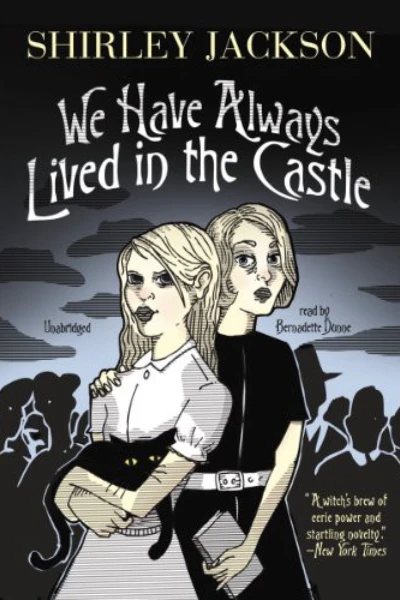
We Have Always Lived in the Castle
We Have Always Lived in the Castle — Chapter 10
10
Slowly the pattern of our days grew, and shaped itself into a happy life. In the mornings when I awakened I would go at once down the hall to make sure the front door was locked. We were most active in the very early morning because no one was ever around. We had not realized that, with the gates opened and the path exposed to public use, the children would come; one morning I stood beside the front door, looking out through the narrow pane of glass, and saw children playing on our front lawn. Perhaps the parents had sent them to explore the way and make sure it was navigable, or perhaps children can never resist playing anywhere; they seemed a little uneasy playing in front of our house, and their voices were subdued.
I thought that perhaps they were only pretending to play, because they were children and were supposed to play, but perhaps they were actually sent here to look for us, thinly disguised as children.
They were not really convincing, I decided as I watched them; they moved gracelessly, and never once glanced, that I could see, at our house. I wondered how soon they would creep onto the porch, and press their small faces against the shutters, trying to see through cracks. Constance came up behind me and looked out over my shoulder. “They are the children of the strangers,” I told her. “They
have no faces.”
“They have eyes.”
“Pretend they are birds. They can’t see us. They don’t know it yet, they don’t want to believe it, but they won’t ever see us again.”
“I suppose that now they’ve come once, they’ll come again.”
“All the strangers will come, but they can’t see inside. And now may I please have my breakfast?”
The kitchen was always dark in the mornings until I unbolted the kitchen door and opened it to let the sunlight in. Then Jonas went to sit on the step and bathe and Constance sang while she made our breakfast. After breakfast I sat on the step with Jonas while Constance washed the kitchen.
Barricading the sides of the house had been easier than I expected; I managed it in one night with Constance holding a flashlight for me. At either side of our house there was a spot where the trees and bushes grew close to the house, sheltering the back and narrowing the path which was the only way around. I brought piece after piece from the pile of junk Mr. Harler had made on our front porch, and heaped the broken boards and furniture across the narrowest spot. It would not really keep anyone out, of course; the children could climb over it easily, but if anyone did try to get past there would be enough noise and falling of broken boards to give us plenty of time to close and bolt the kitchen door. I had found some boards around the tool shed, and nailed them rudely across the glass of the kitchen door, but I disliked putting them across the sides of the house as a barricade, where anyone might see them and know how clumsily I built. Perhaps, I told myself, I might try my hand at mending the broken step.
“What are you laughing about now?” Constance asked me.
“I am thinking that we are on the moon, but it is not quite as I supposed it would be.”
“It is a very happy place, though.” Constance was bringing breakfast to the table: scrambled eggs and toasted biscuits and blackberry jam she had made some golden summer. “We ought to bring in as much food as we can,” she said. “I don’t like to think of the garden waiting there for us to come and gather growing things.
And I’d feel much better if we had more food put securely away in the house.”
“I will go on my winged horse and bring you cinnamon and thyme, emeralds and clove, cloth of gold and cabbages.”
“And rhubarb.”
We were able to leave the kitchen door open when we went down to the vegetable garden, because we could see clearly whether anyone was approaching my barricades and run back to the house if we needed to. I carried the basket and we brought back lettuce, still grey with ash, and radishes, and tomatoes and cucumbers and, later, berries, and melons. Usually I ate fruit and vegetables still moist from the ground and the air, but I disliked eating anything while it was still dirty with the ash from our burned house. Most of the dirt
and the soot had blown away and the air around the garden was fresh and clean, but the smoke was in the ground and I thought it would always be there.
As soon as we were safely settled Constance had opened Uncle Julian’s room and cleaned it. She brought out the sheets from Uncle Julian’s bed, and the blankets, and washed them in the kitchen sink and set them outside to dry in the sunlight. “What are you going to do with Uncle Julian’s papers?” I asked her, and she rested her hands against the edge of the sink, hesitating.
“I suppose I’ll keep them all in the box,” she said at last. “I suppose
I’ll put the box down in the cellar.”
“And preserve it?”
“And preserve it. He would like to think that his papers were treated respectfully. And I would not want Uncle Julian to suspect that his papers were not preserved.”
“I had better go and see that the front door is locked.”
The children were often outside on our front lawn, playing their still games and not looking at our house, moving awkwardly in little dashing runs, and slapping one another without cause. Whenever I checked to make sure that the front door was locked I looked out to see if the children were there. Very often I saw people walking on our path now, using it to go from one place to another, and putting their feet down where once only my feet had gone; I thought they used the path without wanting to, as though each of them had to travel it once to show that it could be done, but I thought that only a few, the defiant hating ones, came by more than once.
I dreamed away the long afternoon while Constance cleaned Uncle Julian’s room; I sat on the doorsill with Jonas asleep beside me, and looked out on the quiet safe garden.
“Look, Merricat,” Constance said, coming to me with an armful of clothes, “look, Uncle Julian had two suits, and a topcoat and a hat.”
“He walked upright once; he told us so himself.”
“I can just barely remember him, years ago, going off one day to buy a suit, and I suppose it was one of these suits he bought; they are neither of them much worn.”
“What would he have been wearing on the last day with them?
What tie did he have on at dinner? He would surely like to have it
remembered.”
She looked at me for a minute, not smiling. “It would hardly have been one of these; when I came to get him afterwards, at the hospital, he was wearing pajamas and a robe.”
“Perhaps he should have one of these suits now.”
“He was probably buried in an old suit of Jim Clarke’s.” Constance started for the cellar, and then stopped. “Merricat?”
“Yes, Constance?”
“Do you realize that these things of Uncle Julian’s are the only clothes left in our house? All of mine burned, and all of yours.”
“And everything of theirs in the attic.”
“I have only this pink dress I have on.”
I looked down. “And I am wearing brown.”
“And yours needs washing, and mending; how can you tear your clothes so, my Merricat?”
“I shall weave a suit of leaves. At once. With acorns for buttons.”
“Merricat, be serious. We will have to wear Uncle Julian’s clothes.”
“I am not allowed to touch Uncle Julian’s things. I shall have a lining of moss, for cold winter days, and a hat made of bird feathers.”
“That may be all very well for the moon, Miss Foolishness. On the moon you may wear a suit of fur like Jonas, for all of me. But right here in our house you are going to be clothed in one of your Uncle Julian’s old shirts, and perhaps his trousers too.”
“Or Uncle Julian’s bathrobe and pajamas, I suppose. No; I am not allowed to touch Uncle Julian’s things; I will wear leaves.”
“But you are allowed. I tell you that you are allowed.”
“No.”
She sighed. “Well,” she said, “you’ll probably see me wearing them.” Then she stopped, and laughed, and looked at me, and
laughed again.
“Constance?” I said.
She put Uncle Julian’s clothes over the back of a chair, and, still laughing, went into the pantry and opened one of the drawers. I remembered what she was after and I laughed too. Then she came back and put an armload of tablecloths down beside me.
“These will do you very nicely, elegant Merricat. Look; how will you feel in this, with a border of yellow flowers? Or this handsome red
and white check? The damask, I am afraid, is too stiff for comfort, and besides it has been darned.”
I stood up and held the red and white checked tablecloth against me. “You can cut a hole for my head,” I said; I was pleased.
“I have no sewing things. You will simply have to tie it around your waist with a cord or let it hang like a toga.”
“I will use the damask for a cloak; who else wears a damask cloak?”
“Merricat, oh, Merricat.” Constance dropped the tablecloth she was holding and put her arms around me. “What have I done to my baby Merricat?” she said. “No house. No food. And dressed in a tablecloth; what have I done?”
“Constance,” I said, “I love you, Constance.”
“Dressed in a tablecloth like a rag doll.”
“Constance. We are going to be very happy, Constance.”
“Oh, Merricat,” she said, holding me.
“Listen to me, Constance. We are going to be very happy.”
I dressed at once, not wanting to give Constance more time to think. I chose the red and white check, and when Constance had cut a hole for my head I took my gold cord with the tassel that Constance had cut from the drawing-room drapes and tied it around me for a belt and looked, I thought, very fine. Constance was sad at first, and turned away sadly when she saw me, and scrubbed furiously at the sink to get my brown dress clean, but I liked my robe, and danced in it, and before long she smiled again and then laughed at me.
“Robinson Crusoe dressed in the skins of animals,” I told her. “He had no gay cloths with a gold belt.”
“I must say you never looked so bright before.”
“You will be wearing the skins of Uncle Julian; I prefer my tablecloth.”
“I believe the one you are wearing now was used for summer breakfasts on the lawn many years ago. Red and white check would never be used in the dining room, of course.”
“Some days I shall be a summer breakfast on the lawn, and some days I shall be a formal dinner by candlelight, and some days I shall
be—”
“A very dirty Merricat. You have a fine gown, but your face is dirty.
We have lost almost everything, young lady, but at least we still have clean water and a comb.”
One thing was most lucky about Uncle Julian’s room: I persuaded Constance to bring out his chair and wheel it through the garden to reinforce my barricade. It looked strange to see Constance wheeling the empty chair, and for a minute I tried to see Uncle Julian again, riding with his hands in his lap, but all that remained of Uncle Julian’s presence were the worn spots on the chair, and a handkerchief tucked under the cushion. The chair would be powerful in my barricade, however, staring out always at intruders with a blank menace of dead Uncle Julian. I was troubled to think that Uncle Julian might vanish altogether, with his papers in a box and his chair on the barricade and his toothbrush thrown away and even the smell of Uncle Julian gone from his room, but when the ground was soft Constance planted a yellow rosebush at Uncle Julian’s spot on the lawn, and one night I went down to the creek and buried Uncle Julian’s initialled gold pencil by the water, so the creek would always speak his name. Jonas took to going into Uncle Julian’s room, where he had never gone before, but I did not go inside.
Helen Clarke came to our door twice more, knocking and calling and begging us to answer, but we sat quietly, and when she found that she could not come around the house because of my barricade she told us from the front door that she would not come back, and she did not. One evening, perhaps the evening of the day Constance planted Uncle Julian’s rosebush, we heard a very soft knock at our front door while we sat at the table eating dinner. It was far too soft a knock for Helen Clarke, and I left the table and hurried silently down the hall to be sure that the front door was locked, and Constance followed me, curious. We pressed silently against the door and listened.
“Miss Blackwood?” someone said outside, in a low voice; I wondered if he suspected we were so close to him. “Miss Constance? Miss Mary Katherine?”
It was not quite dark outside, but inside where we stood we could only see one another dimly, two white faces against the door. “Miss Constance?” he said again. “Listen.”
I thought that he was moving his head from side to side to make sure that he was not seen. “Listen,” he said, “I got a chicken here.”
He tapped softly on the door. “I hope you can hear me,” he said. “I got a chicken here. My wife fixed it, roasted it nice, and there’s some cookies and a pie. I hope you can hear me.”
I could see that Constance’s eyes were wide with wonder. I stared at her and she stared at me.
“I sure hope you can hear me, Miss Blackwood. I broke one of your chairs and I’m sorry.” He tapped against the door again, very softly. “Well,” he said. “I’ll just set this basket down on your step here.
I hope you heard me. Goodbye.”
We listened to quiet footsteps going away, and after a minute Constance said, “What shall we do? Shall we open the door?”
“Later,” I said. “I’ll come when it’s really dark.”
“I wonder what kind of pie it is. Do you think it’s as good as my pies?”
We finished our dinner and waited until I was sure that no one could possibly see the front door opening, and then we went down the hall and I unlocked the door and looked outside. The basket sat on the doorstep, covered with a napkin. I brought it inside and locked the door while Constance took the basket from me and carried it to the kitchen. “Blueberry,” she said when I came. “Quite good, too; it’s still warm.”
She took out the chicken, wrapped in a napkin, and the little package of cookies, touching each lovingly and with gentleness.
“Everything’s still warm,” she said. “She must have baked them right after dinner, so he could bring them right over. I wonder if she made two pies, one for the house. She wrapped everything while it was still warm and told him to bring them over. These cookies are not crisp enough.”
“I’ll take the basket back and leave it on the porch, so he’ll know we found it.”
“No, no.” Constance caught me by the arm. “Not until I’ve washed the napkins; what would she think of me?”
Sometimes they brought bacon, home-cured, or fruit, or their own preserves, which were never as good as the preserves Constance made. Mostly they brought roasted chicken; sometimes a cake or a pie, frequently cookies, sometimes a potato salad or coleslaw. Once they brought a pot of beef stew, which Constance took apart and put back together again according to her own rules for beef stew, and sometimes there were pots of baked beans or macaroni. “We are the biggest church supper they ever had,” Constance said once, looking at a loaf of homemade bread I had just brought inside.
These things were always left on the front doorstep, always silently and in the evenings. We thought that the men came home from work and the women had the baskets ready for them to carry over; perhaps they came in darkness not to be recognized, as though each of them wanted to hide from the others, and bringing us food was somehow a shameful thing to do in public. There were many women cooking, Constance said. “Here is one,” she explained to me once, tasting a bean, “who uses ketchup, and too much of it; and the last one used more molasses.” Once or twice there was a note in the basket: “This is for the dishes,” or “We apologize about the curtains,” or “Sorry for your harp.” We always set the baskets back where we had found them, and never opened the front door until it was completely dark and we were sure that no one was near. I always checked carefully afterwards to make certain that the front door was locked.
I discovered that I was no longer allowed to go to the creek; Uncle Julian was there, and it was much too far from Constance. I never went farther away than the edge of the woods, and Constance went only as far as the vegetable garden. I was not allowed to bury anything more, nor was I allowed to touch stone. Every day I looked over the boards across the kitchen windows and when I found small cracks I nailed on more boards. Every morning I checked at once to make sure the front door was locked, and every morning Constance washed the kitchen. We spent a good deal of time at the front door, particularly during the afternoons, when most people came by; we sat, one on either side of the front door, looking out through the narrow glass panels which I had covered almost entirely with
cardboard so that we had each only a small peephole and no one could possibly see inside. We watched the children playing, and the people walking past, and we heard their voices and they were all strangers, with their wide staring eyes and their evil open mouths.
One day a group came by bicycle; there were two women and a man, and two children. They parked their bicycles in our driveway and lay down on our front lawn, pulling at the grass and talking while they rested. The children ran up and down our driveway and over and around the trees and bushes. This was the day that we learned that the vines were growing over the burned roof of our house, because one of the women glanced sideways at the house and said that the vines almost hid the marks of burning. They rarely turned squarely to look at our house face to face, but looked from the corners of their eyes or from over a shoulder or through their fingers.
“It used to be a lovely old house, I hear,” said the woman sitting on our grass. “I’ve heard that it was quite a local landmark at one time.”
“Now it looks like a tomb,” the other woman said.
“Shh,” the first woman said, and gestured toward the house with her head. “I heard,” she said loudly, “that they had a staircase which was very fine. Carved in Italy, I heard.”
“They can’t hear you,” the other woman said, amused. “And who
cares if they do, anyway?”
“Shhh.”
“No one knows for sure if there’s anyone inside or not. The local people tell some tall tales.”
“Shh. Tommy,” she called to one of the children, “don’t you go near
those steps.”
“Why?” said the child, backing away.
“Because the ladies live in there, and they don’t like it.”
“Why?” said the child, pausing at the foot of the steps and giving a quick look backward at our front door.
“The ladies don’t like little boys,” the second woman said; she was one of the bad ones; I could see her mouth from the side and it was
the mouth of a snake.
“What would they do to me?”
“They’d hold you down and make you eat candy full of poison; I heard that dozens of bad little boys have gone too near that house
and never been seen again. They catch little boys and they—”
“Shh. Honestly, Ethel.”
“Do they like little girls?” The other child drew near.
“They hate little boys and little girls. The difference is, they eat the little girls.”
“Ethel, stop. You’re terrifying the children. It isn’t true, darlings; she’s only teasing you.”
“They never come out except at night,” the bad woman said, looking evilly at the children, “and then when it’s dark they go hunting little children.”
“Just the same,” the man said suddenly, “I don’t want to see the kids going too near that house.”
Charles Blackwood came back only once. He came in a car with another man late one afternoon when we had been watching for a long time. All the strangers had gone, and Constance had just stirred and said, “Time to put on the potatoes,” when the car turned into the driveway and she settled back to watch again. Charles and the other man got out of the car in front of the house and walked directly to the foot of the steps, looking up, although they could not see us inside. I remembered the first time Charles had come and stood looking up at our house in just the same manner, but this time he would never get in. I reached up and touched the lock on the front door to make sure it was fastened, and on the other side of the doorway Constance turned and nodded to me; she knew, too, that Charles would never get in again.
“See?” Charles said, outside, at the foot of our steps. “There’s the house, just like I said. It doesn’t look as bad as it did, now the vines have grown so. But the roof’s been burned away, and the place was
gutted inside.”
“Are the ladies in there?”
“Sure.” Charles laughed, and I remembered his laughter and his big staring white face and from inside the door I wished him dead.
“They’re in there all right,” he said. “And so is a whole damn fortune.”
“You know that?”
“They’ve got money in there’s never even been counted. They’ve got it buried all over, and a safe full, and God knows where else
they’ve hidden it. They never come out, just hide away inside with all that money.”
“Look,” the other man said, “they know you, don’t they?”
“Sure. I’m their cousin. I came here on a visit once.”
“You think there’s any chance you might get one of them to talk to you? Maybe come to the window or something, so I could get a picture?”
Charles thought. He looked at the house and at the other man, and thought. “If you sell this, to the magazine or somewhere, do I get
half?”
“Sure, it’s a promise.”
“I’ll try it,” Charles said. “You get back behind the car, out of sight.
They certainly won’t come out if they see a stranger.” The other man went back to the car and took out a camera and settled himself on the other side of the car where we could not see him. “Okay,” he called, and Charles started up the steps to our front door.
“Connie?” he called. “Hey, Connie? It’s Charles; I’m back.”
I looked at Constance and thought she had never seen Charles so
truly before.
“Connie?”
She knew now that Charles was a ghost and a demon, one of the strangers.
“Let’s forget all that happened,” Charles said. He came close to the door and spoke pleasantly, with a little pleading tone. “Let’s be friends again.”
I could see his feet. One of them was tapping and tapping on the floor of our porch. “I don’t know what you’ve got against me,” he said, “and I’ve been waiting and waiting for you to let me know I could come back again. If I did anything to offend you, I’m really sorry.”
I wished Charles could see inside, could see us sitting on the floor on either side of the front door, listening to him and looking at his feet, while he talked beggingly to the door three feet above our heads.
“Open the door,” he said very softly. “Connie, will you open the door for me, for Cousin Charles?”
Constance looked up to where his face must be and smiled unpleasantly. I thought it must be a smile she had been saving for Charles if he ever came back again.
“I went to see old Julian’s grave this morning,” Charles said. “I came back to visit old Julian’s grave and to see you once more.” He waited a minute and then said with a little break in his voice, “I put a couple of flowers—you know—on the old fellow’s grave; he was a fine old guy, and he was always pretty good to me.”
Beyond Charles’ feet I saw the other man coming out from behind the car with his camera. “Look,” he called, “you’re wasting your breath. And I haven’t got all day.”
“Don’t you understand?” Charles had turned away from the door, but his voice still had the little break in it. “I’ve got to see her once
more. I was the cause of it all.”
“What?”
“Why do you suppose two old maids shut themselves up in a house like this? God knows,” Charles said, “I didn’t mean it to turn out this way.”
I thought Constance was going to speak then, or at least laugh out loud, and I reached across and touched her arm, warning her to be quiet, but she did not turn her head to me.
“If I could just talk to her,” Charles said. “You can get some pictures of the house, anyway, with me standing here. Or knocking at the door; I could be knocking frantically at the door.”
“You could be stretched across the doorsill dying of a broken heart, for all of me,” the other man said. He went to the car and put his camera inside. “Waste of time.”
“And all that money. Connie,” Charles called loudly, “will you for heaven’s sake open that door?”
“You know,” the other man said from the car, “I’ll just bet you’re never going to see those silver dollars again.”
“Connie,” Charles said, “you don’t know what you’re doing to me; I never deserved to be treated like this. Please, Connie.”
“You want to walk back to town?” the other man said. He closed the car door.
Charles turned away from the door and then turned back. “All right, Connie,” he said, “this is it. If you let me go this time, you’ll
never see me again. I mean it, Connie.”
“I’m leaving,” the other man said from the car.
“I mean it, Connie, I really do.” Charles started down the steps, talking over his shoulder. “Take a last look,” he said. “I’m going. One word could make me stay.”
I did not think he was going to go in time. I honestly did not know whether Constance was going to be able to contain herself until he got down the steps and safely into the car. “Goodbye, Connie,” he said from the foot of the steps and then turned away and went slowly toward the car. He looked for a minute as though he might wipe his eyes or blow his nose, but the other man said, “Hurry up,” and Charles looked back once more, raised his hand sadly, and got into the car. Then Constance laughed, and I laughed, and for a minute I saw Charles in the car turn his head quickly, as though he had heard us laughing, but the car started, and drove off down the driveway, and we held each other in the dark hall and laughed, with the tears running down our cheeks and echoes of our laughter going up the ruined stairway to the sky.
“I am so happy,” Constance said at last, gasping. “Merricat, I am so happy.”
“I told you that you would like it on the moon.”
The Carringtons stopped their car in front of our house one Sunday after church and sat quietly in the car looking at our house, as though supposing that we would come out if there was anything the Carringtons could do for us. Sometimes I thought of the drawing room and the dining room, forever closed away, with our mother’s lovely broken things lying scattered, and the dust sifting gently down to cover them; we had new landmarks in the house, just as we had a new pattern for our days. The crooked, broken-off fragment which was all that was left of our lovely stairway was something we passed every day and came to know as intimately as we had once known the stairs themselves. The boards across the kitchen windows were ours, and part of our house, and we loved them. We were very happy, although Constance was always in terror lest one of our two cups should break, and one of us have to use a cup without a handle. We had our well-known and familiar places: our chairs at the
table, and our beds, and our places beside the front door. Constance washed the red and white tablecloth and the shirts of Uncle Julian’s which she wore, and while they were hanging in the garden to dry I wore a tablecloth with a yellow border, which looked very handsome with my gold belt. Our mother’s old brown shoes were safely put away in my corner of the kitchen, since in the warm summer days I went barefoot like Jonas. Constance disliked picking many flowers, but there was always a bowl on the kitchen table with roses or daisies, although of course she never picked a rose from Uncle Julian’s rosebush.
I sometimes thought of my six blue marbles, but I was not allowed to go to the long field now, and I thought that perhaps my six blue marbles had been buried to protect a house which no longer existed and had no connection with the house where we lived now, and where we were very happy. My new magical safeguards were the lock on the front door, and the boards over the windows, and the barricades along the sides of the house. In the evenings sometimes we saw movement in the darkness on the lawn, and heard whispers.
“Don’t; the ladies might be watching.”
“You think they can see in the dark?”
“I heard they see everything that goes on.”
Then there might be laughter, drifting away into the warm darkness.
“They will soon be calling this Lover’s Lane,” Constance said.
“After Charles, no doubt.”
“The least Charles could have done,” Constance said, considering seriously, “was shoot himself through the head in the driveway.”
We learned, from listening, that all the strangers could see from outside, when they looked at all, was a great ruined structure overgrown with vines, barely recognizable as a house. It was the point halfway between the village and the highway, the middle spot on the path, and no one ever saw our eyes looking out through the vines.
“You can’t go on those steps,” the children warned each other; “if you do, the ladies will get you.”
Once a boy, dared by the others, stood at the foot of the steps facing the house, and shivered and almost cried and almost ran
away, and then called out shakily, “Merricat, said Constance, would you like a cup of tea?” and then fled, followed by all the others. That night we found on the doorsill a basket of fresh eggs and a note reading, “He didn’t mean it, please.”
“Poor child,” Constance said, putting the eggs into a bowl to go into the cooler. “He’s probably hiding under the bed right now.”
“Perhaps he had a good whipping to teach him manners.”
“We will have an omelette for breakfast.”
“I wonder if I could eat a child if I had the chance.”
“I doubt if I could cook one,” said Constance.
“Poor strangers,” I said. “They have so much to be afraid of.”
“Well,” Constance said, “I am afraid of spiders.”
“Jonas and I will see to it that no spider ever comes near you. Oh, Constance,” I said, “we are so happy.”
End of book
You finished We Have Always Lived in the Castle
by Shirley Jackson