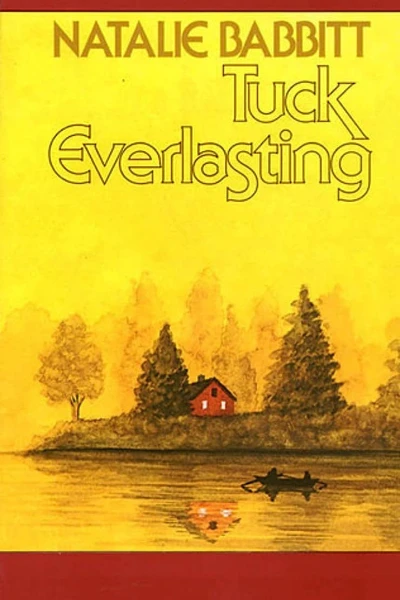
Tuck Everlasting
Tuck Everlasting — Chapter 22
22
Next morning Winnie went out to the fence directly after breakfast. It was the hottest day yet, so heavy that the slightest exertion brought on a flood of perspiration, an exhaustion in the joints. Two days before, they would have insisted that she stay indoors, but now, this morning, they were careful with her, a little gingerly, as if she were an egg. She had said, “I’m going outside now,” and they had said, “All right, but come in if it gets too hot, won’t you, dear?” And she had answered, “Yes.”
The earth, where it was worn bald under the gate, was cracked, and hard as rock, a lifeless tan color; and the road was an aisle of brilliant velvet dust. Winnie leaned against the fence, her hands gripping the warm metal of the bars, and thought about Mae behind another set of bars in the jailhouse.
And then, lifting her head, she saw the toad. It was squatting where she had seen it first, across the road. “Hello!” she said, very glad to see it.
The toad did not so much as flick a muscle or blink an eye. It looked dried out today, parched. “It’s thirsty,” said Winnie to herself. “No wonder, on a day like this.” She left the fence and went back into the cottage.
“Granny, can I have some water in a dish? There’s a toad out front that looks as if he’s just about to die of thirst.”
“A toad?” said her grandmother, wrinkling her nose in disgust. “Nasty things, toads.”
“Not this one,” said Winnie. “This one is always out there, and I like him. Can I give him a drink of water?”
“Toads don’t drink water, Winifred. It wouldn’t do him any good.”
“They don’t drink water at all?”
“No. They take it in through their skins, like a sponge. When it rains.”
“But it hasn’t rained forever!” said Winnie, alarmed. “I could sprinkle some water on him, couldn’t I? That would help, wouldn’t it?”
“Well, I suppose so,” said her grandmother. “Where is he? In the yard?”
“No,” said Winnie. “He’s across the road.”
“I’ll come with you, then. I don’t want you leaving the yard alone.”
But when they came out to the fence, Winnie balancing a small bowl of water with enormous care, the toad was gone.
“Well, he must be all right,” said her grandmother. “If he could hop off.”
With mingled disappointment and relief, Winnie tipped the water onto the cracked earth at the gate. It was sucked in immediately, and the wet brown stain it left behind paled and vanished almost as quickly.
“I never saw such heat in all my life,” said Winnie’s grandmother, dabbing uselessly at her neck with a handkerchief. “Don’t stay out here much longer.”
“I won’t,” said Winnie, and was left alone once more. She sat down on the grass and sighed. Mae! What could she do to set Mae free? She closed her eyes against the glaring light, and watched, a little dizzily, as brilliant patterns of red and orange danced inside her eyelids.
And then, miraculously, Jesse was there, crouching just on the other side of the fence. “Winnie!” he hissed. “You sleeping?”
“Oh, Jesse!” Her eyes flew open and she reached through the fence to grasp his hand. “I’m so glad to see you! What can we do? We have to get her out!”
“Miles’s got a plan, but I don’t see how it can work,” said Jesse, speaking quickly, his voice almost a whisper. “He knows a lot about carpentering. He says he can take Ma’s window frame right straight out of the wall, bars and all, and she can climb through. We’re going to try it tonight when it gets dark. Only trouble is, that constable keeps watching her every minute, he’s so durned proud of having a prisoner in that new jail of his. We been down to see her. She’s all right. But even if she can climb through the window, he’ll come after her soon’s he sees she’s gone. Seems to me he’ll notice right off. That don’t give us much time to get away. But we got to try it. There ain’t no other way. Anyhow, I come to say goodbye.
We won’t be able to come back here for a long, long time, Winnie, if we get away. I mean, they’ll be looking for Ma. Winnie, listen—I won’t see you again, not for ages. Look now—here’s a bottle of water from the spring.
You keep it. And then, no matter where you are, when you’re seventeen, Winnie, you can drink it, and then come find us. We’ll leave directions somehow. Winnie, please say you will!”
He pressed the little bottle into her hands and Winnie took it, closing her fingers over it. “Jesse, wait!” she whispered breathlessly, for all at once she had the answer. “I can help! When your mother climbs out the window, I’ll climb in and take her place. I can wrap myself up in her blanket, and when the constable looks in, he won’t be able to tell the difference. Not in the dark. I can hump up and look a lot bigger. Miles can even put the window back. That would give you time to get away! You’d have at least till morning!”
Jesse squinted at her, and then he said, “Yep—you know, it might work.
It might just make the difference. But I don’t know as Pa’s going to want you taking any risk. I mean, what’ll they say to you after, when they find out?”
“I don’t know,” said Winnie, “but it doesn’t matter. Tell your father I want to help. I have to help. If it wasn’t for me, there wouldn’t have been any trouble in the first place. Tell him I have to.”
“Well…all right. Can you get out after dark?”
“Yes,” said Winnie.
“Then—at midnight, Winnie. I’ll be waiting for you right here at midnight.”
“Winifred!” an anxious voice called from the cottage. “Who’s that you’re talking to?”
Winnie stood up and turned to answer. “It’s just a boy, Granny. I’ll be in in a minute.” When she turned around again, Jesse was gone. Winnie clutched the little bottle in her hands and tried to control the rising excitement that made her breath catch. At midnight she would make a difference in the world.