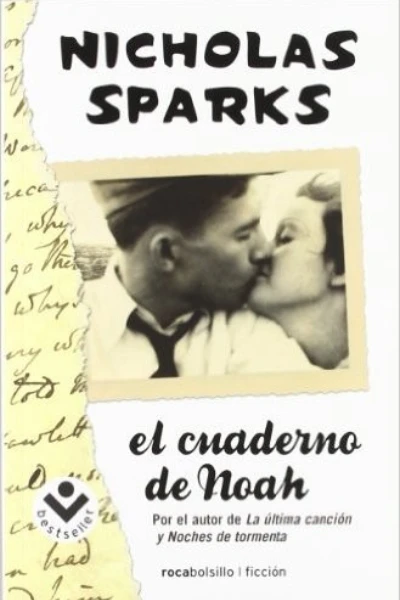
The Notebook
The Notebook — Nicholas Sparks on Nicholas Sparks
Nicholas Sparks on Nicholas Sparks
I was born in Omaha, Nebraska, on New Year’s Eve, a scant eighty minutes prior to 1966. As fate would have it, my father was a bartender at the time and was scheduled to work that night, usually the busiest night of the year. Short on tip money but long on pride, he demanded the finest obstetrician in Omaha, and I was brought into this world for $124, which covered not only my care, but two days in the hospital for my mother.
I led a largely nomadic life in the beginning—my father was still a student, working to get into a master’s program, and he was eventually accepted at the University of Minnesota. I spent two years there and my memory of the place is limited. I had a dog named Pepper, a cardboard-box train I liked to sit in, and I remember picking bugs off the grill of the moving van when we finally left for Los Angeles in the summer of 1969.
Los Angeles—my home for four years while my father went to the University of Southern California for his Ph.D.—is also fairly shadowy. I remember getting hit in the head with a brick thrown by an eighteen-year-old thug, I learned to ride a bike (losing only one tooth in the process), and unfortunately my pet turtle committed suicide by diving off our second-floor patio. In 1973, I went to Grand Island, Nebraska, for a year with my mom (and brother and sister) while my dad did his thesis, then we all returned to Fair Oaks, California, on December 1, 1974. I remember very clearly that Kolchack, the Night Stalker was on television the moment we arrived at our new house. Perhaps that’s why I seem to associate Darrin Mc- Gavin with my adopted hometown.
I survived elementary school, that’s the best way to describe it. My first teacher had flaming red hair; a big, round face; and a fondness
for Nile green evening dresses that draped her rather large body. I flunked English, but since my paper-maché volcano spewed purple lava (baking soda, vinegar, and food coloring), my creativity was deemed impressive and I was allowed to continue up the educational ladder.
High school was better. For some reason, my brain kicked in when I was fourteen, and I never received a grade lower than an A. I ended up as the valedictorian, but I couldn’t give the commencement address. I was due in Los Angeles (again) for the state track meet. I hold a number of school records at my high school, and received a full track scholarship to the University of Notre Dame. Life was good in high school. Damn good.
Then, as it often does, my life took a U-turn, and things got tough.
I got injured, went a little insane, and after breaking the Notre Dame record in the 4 x 800 relay (at the Drake relays—a record that still stands), I spent the rest of the year icing my Achilles tendon. On summer break back home after my freshman year, icing my tendon and moping around the house, my mom said, “Do something—don’t
just pout.”
I asked “What?”
She shrugged and said, “I don’t know . . . write a book.”
“Fine,” I said, and eight weeks later, I was the proud creator of my first novel—The Passing, a book that was never published. I laid it to rest in a literary graveyard of sorts—my attic—and it’s still there, next to my football card collection. In all honesty, it’s a wonderful story— except for the writing. That was the humble birth of my Faulknerian career.
Fast-forward through college—good friends, lots of football games, too much beer—until March 1988. I met a girl—Cathy—on spring break in Florida. She was from New Hampshire and it was love at first sight. I told her the day after we met that we would be married someday. She laughed at me and told me to get another
drink.
In July 1989, we married.
Nineteen eighty-nine was also the year that I wrote my second novel, The Royal Murders. Better writing this time—wonderful dialogue, but too damn long. It’s also in the attic, filed with rejection
slips. I decided to concentrate on another career. Since I was rejected not only by publishers but law school as well, I went through a number of short-term jobs looking for something that captivated my interest. I appraised real estate, bought and restored houses, waited tables, sold dental products by phone, and finally started my own business (manufacturing orthopedic products). Although I knew nothing about the medical field or engineering—my science education began and ended with Biology 101—I put myself in charge of everything. Thirty-thousand dollars in credit-card debt later, I realized my folly, big as a whale. Being a Capricorn, I had no choice but to take a deep breath, roll up my sleeves, and avoid the evil- death-ray stares that my wife was laser beaming into the back of my head. I pressed on, and eventually it worked out— sort of. After two and a half long, long years, I broke even. We celebrated our smashing success wildly and without care, and nine months later Miles Andrew was born.
During this time I wrote yet another book, Wokini, with Billy Mills, a long-time friend and Olympic gold medalist, and it was published by Feather Publishing, a small outfit in Sacramento. It did well regionally and was picked up by Random House in 1994. Success at last!
Eventually, I sold my business and looked around for something to do while I was still breathing. Pharmaceutical Sales, the ad read.
“Okay,” I said, and it’s really been a good choice. The hours are good, the pay is good, and I only see my boss once a month.
Couldn’t ask for anything more. I asked for and received a transfer from Sacramento to New Bern, North Carolina, and in December 1992 we moved across the country to a place we’d never seen. We celebrated our arrival with champagne and candles, and nine months later Ryan Cody was born.
Midtwenties life check. Good job, nice wife, kids, beautiful house overlooking a creek—what more could there be? In May 1993, I found out. Cheers, the television show, broadcast its final episode.
Bob Costas did an hour-long show prior to the episode, and I remember lying awake most of the night after it aired. Cheers had been on for eleven years—an entire era of my life—and yet, I still hadn’t fulfilled my dreams. At 4:00 A.M., I knew I had to give writing
another shot. A good one though, not a half-hearted effort like before. I researched the market, decided on my topic (a love story), conjured up a couple of characters based on my wife’s grandparents, and thought about my plot for almost two months before writing a word. At the time, Alzheimer’s was big in the news, and I decided that would be the “vehicle” I would use to create a sense of tragedy necessary for a quality love story. I typed out 80,000 words, cut it by 28,000 words, and in January 1995 I finished the book.
In February, my company transferred my family from New Bern to Greenville, South Carolina. I put the book on hold till I had a permanent address, sent out letters to twenty-five agents in July, and signed with Theresa Park of Sanford Greenburger Associates. On October 19, the book arrived in New York and on October 23, 1995, at 12:02 P.M., my life changed forever. At that moment, I remember, I was serving fried chicken to a group of nurses.
More
Nicholas Sparks!
Please turn this page for a preview of
The Wedding
Nicholas Sparks’s long-awaited sequel to The Notebook.
AVAILABLE IN TRADE PAPERBACK