The Notebook
The Notebook — A Q & A with Nicholas Sparks
A Q & A with Nicholas Sparks
What is the inspiration for this book? Is it based Q.to any extent on your own experiences or the experiences of those you know?
The Notebook was originally inspired by the story of my wife’s beloved grandparents. They had a truly magical relationship, one that withstood the test of time and circumstance. At the time I’d met A. them, they had been married for over sixty years and I remember marveling at how much they still seemed to care for each other. The Notebook attempts to describe such a love.
With that said, The Notebook is a novel, not a memoir. Many changes were made regarding their story, in order to make the novel more universal, while staying committed to my original intent.
How do you account for the success of your Q.novel? What do you think its overriding appeal is?
A. It’s never simple to pinpoint the reasons for a book’s success. In the case of The Notebook, I
think the most obvious reason is that the story touched people in a deeply personal way. It seems that nearly everyone I spoke with about the novel knew a “Noah and Allie” in their own life. As people made this connection, the book became a so-called “word of mouth” success, with those who enjoyed it recommending it to others. In the end, any book that sells well needs to have this sort of support from readers.
On a more practical level, the novel’s short length was appealing to many people.
Nowadays, we all seem to have less time to read and The Notebook probably owes much of its success to the fact that people could finish it in one or two sittings. I think that readers also appreciated that the novel did not include foul language and its love scene was tasteful and mild compared to what’s found in many other novels. These factors made people feel comfortable about recommending it to others.
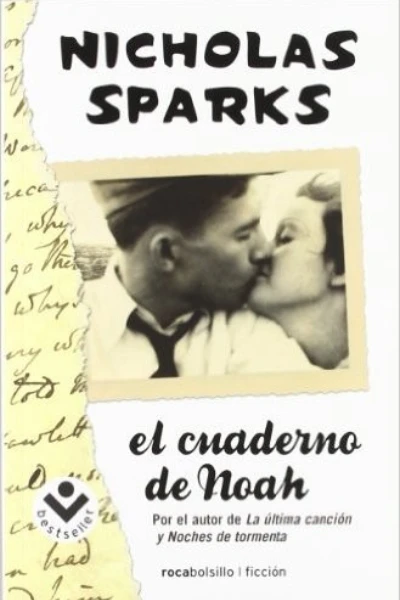
Finally, I can’t ignore the fact that the publisher did an outstanding job with the novel. It was well promoted, it had a beautiful cover, and it was enthusiastically supported by the sales representatives. In addition, I was sent on a fifty- city tour (unusually large, by the way) and that also helped get the word out.
Q. The Notebook is an intensely romantic book—a
novel about the everlasting power of “true love.”
Do you believe that this kind of love exists in real life?
Yes, absolutely. True love exists and there’s evidence of it every day. I think talking about romantic love, however, is similar to talking about schools for children. It seems that most people feel that the school their child goes to is wonderful, but elsewhere, schools are terrible.
A.
But if most people feel that way, then it becomes a contradiction. Same thing with romantic love.
People feel it in their own lives, but doubt if other people do. And those who don’t have it hope that someday they will. I think The Notebook tapped into that feeling.
The Notebook takes place in a small southern Q.town. Why did you choose that setting rather than, say, a big city like New York?
I live in a small southern town, and life there is different than in a big city. Last night, for instance, a friend of mine got hurt. Instead of bringing him to the hospital or an urgent care A. clinic, I took him to the doctor’s house. The doctor took care of him, then drove to the office to pick up a temporary cast, returned, and then bandaged him up. No charge, by the way.
Small towns feed into a nostalgia that people have for the way things used to be. Simpler, less
rushed, more community oriented, things like that.
The book details the lives of very old, as well as very young, people. How did someone as young Q. as yourself acquire the insight to write about the experience of being old in such a moving way?
That’s what writers strive to do. Though I can’t describe the process of writing and how I do it (I A.don’t really understand where my ideas come from), I do keep a few general rules in mind, no matter what type of character I’m writing.
First, I tend to assume that most people— male or female, young or old—have largely the same types of thoughts. However, the difference lies in their perspective. So I try to put myself in their shoes and see the world the way they do. Then, I read constantly and see how other authors have written from varying perspectives, and I try to figure out whether they accomplished what they’d set out to do, or if they failed. Either way, I ask myself, “Why?” Finally, I work hard at it—I edit constantly, until it “feels right” to me. Only then will I accept it.
Letter writing plays such a big part in The Q.Notebook. Is there something about letter writing that intrigues you?
A. The epistolary form of writing has been around for centuries, of course. I’m neither the first nor
the finest to use it. But letters are a wonderful vehicle for writing, if used effectively and sparingly. In the case of a novel written primarily in third person, for instance, a letter might allow for deeper insight, since a letter is written in first person.
Also, I’m fond of letter writing myself. Call it old- fashioned, but that’s how my wife and I fell in love. We lived a thousand miles apart in the early stages of our relationship, and I used to write her every day. She’s told me often that it was the most romantic thing that had ever been done for her.
How has the success of The Notebook affected Q.your life? Do you find that your family lifestyle has changed much? Or your values?
The success has been wonderful. It’s enabled me to concentrate on writing full-time, but more than that, it’s allowed me to spend far more time A. with my family. Financially, of course, there’s been a change as well and it would be dishonest of me to overlook that.
But other than that, our lifestyle is still largely unchanged. I coach soccer for my sons’ teams, we go to church every Sunday, we’re in a “Supper Club” with the same people we knew before, my wife volunteers at the school like
every other mom, we still eat Kraft Macaroni and Cheese.
Nor have our values changed. We worry about the same things all parents do, and we’re doing our best to raise kind and confident children. Our relationship with each other, with our children, with our community, and with God will always be the most important things in our lives.
What was it like going on your author tour and Q.meeting and hearing from so many people
whose lives were affected by your book?
That was truly wonderful. Writing is communication; so is talking to readers about A. their impressions of the novel. It’s one of the aspects I most enjoy about being an author.
Q. What advice do you have for aspiring writers?
My advice is four-fold. First, read as much as possible. Read all types of novels—don’t limit yourself to one genre. Each genre seems to have A.its own strengths and weaknesses. For instance, “techno-thrillers” are very good at describing action, not so good at describing romance or love. Romance novels are just the opposite.
Second, learn as much as you can about publishing. Learn how it works, how to get published, how to market your book, what editors look for, etc. There’s a wealth of information in any bookstore and it’s important to understand
the business aspects of writing. Publishing is, after all, a business.
Third, have realistic goals for the type of writer you want to be. For instance, is your goal to sell a million hardcover copies of your novel? If so, you need to understand the conventions of so- called “commercial fiction.” Or is your goal simply to get published? If so, write what you want, but write it well.
And finally, write. You can’t be a writer without writing.