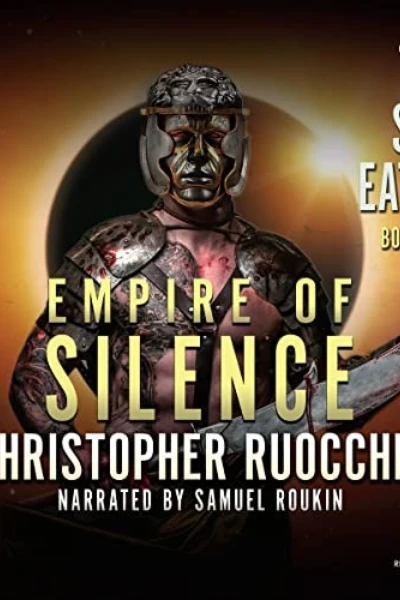
Empire of Silence
Empire of Silence — Chapter 28: Wrong
CHAPTER 28
WRONG
ALREADY NUMB FROM A stunner graze and clutching my useless left arm, I slalomed round a street corner and up onto a set of crates, using them to springboard over the parked float-palette that blocked the road. The gray concrete glowed with heat, but my scarred and grimy soles could not feel it. I cannot say which day it was or how many months or years of my life had washed into those canals like so much garbage.
I heard shouts behind me and shrugged the straps of the stolen purse into the crook of my still-working arm. Gasping, I darted up a set of stairs and into an alley so narrow my broad shoulders almost scraped the sides. The buildings hung close above my head, piping and ductwork exposed and bracketed to metal walls. My shirt snagged on a bolt and tore, doubtless gashing my unfeeling arm in the process. The electric crackle of stunner fire and shouts of, “Stop! Thief!” followed me like the hounds in one of my late uncle’s foxhunts. My chapped lips pulled into a mean grimace, hair blowing in my face. I turned, shouldered past a pair of women carrying shopping baskets on their heads and onto a high street running along the saline bend of a canal.
Though my instinct was to run, though years of bruises and broken bones badly set by backstreet hacks screamed at me to keep going, I knew that would only make me stand out. Many’s the time I watched a crowd turn against a fellow thief, the brightly dressed throng transmuted into a wall of solid flesh as the prefects brought him down.
Instead I slipped around an iron railing and settled at an empty glass table at the edge of a cafe’s sitting area. Holographs for ordering flickered on the glass surface, and I made a show of riffling through
my purse—no mean feat with one of my arms stunned and useless. I did not doubt that there was a camera somewhere on me, but I didn’t think that information would make it to the prefects before they slipped by me. I ignored the universal card in the purse and the identification forms, both belonging to the powdered man in the low- slung sarong I’d stolen it from. I found a pair of slightly ovoid glasses— silver-rimmed with lenses of ruby glass—that I shoved onto my nose. I took a moment to gather back my long hair and bind it with an elastic band, also courtesy of the bag. What’s more, I found a full half-kaspum note and nearly another kaspum in steel change. These I stuffed into my pocket with a small smile before setting the purse down beside my chair.
Behind me, I heard the drumming of boot heels on the pavement, but I did not turn. I bowed my head and pretended to look over the menu embedded in the table.
“Don’t worry,” a rough voice said. “I won’t say a thing.”
I looked up to find an older man smiling at me from the next table over. He raised his eyebrows and smiled over the rim of his drink. We were the only clients for three tables. An old book sat closed beside one fist, and he wore an indigo jacket cut in Nipponese fashion, square sleeves patterned with gold and black diamonds about the cuffs. His graying hair was pulled back into a greasy topknot, frayed and bristling like a calligrapher’s long-abused brush.
I decided to play dumb. “I’m sorry?” My voice came out ragged, masking somewhat the effect of my clipped Delian accent.
“Your arm’s gone stun-lame and you’re breathing like the Duchess Antonelli’s prize racehorse. Don’t take a scholiast to figure you’ve done a runner.” He wasn’t Nipponese either, judging by the craggy lines of his face or the tenor of his words. Indeed, I couldn’t place his accent.
Durantine, maybe? Or one of the Norman freeholders, though he didn’t have their coloring. I stood sharply, turned to go. “Don’t be that way. Old Crow ain’t going to say a word. Why don’t you sit awhile?” He kicked a chair out with a sandaled heel. When I didn’t answer or move, he sighed, slipping a loose lock of graying hair behind his ear. “How
long’s it been?”
“How long has what been?”
“Since you was stranded, boy! You got the stink of space all over you, and anyone with eyes can see you’re no Emeshi.”
I let my numb arm fall and swallowed the impulse to object to being called boy, but I didn’t take his offer of a seat. “I don’t know,” I said.
“Couple of years.”
Old Crow frowned. “Couple of years . . .” He shook his head, topknot wavering. “That’s hard.”
I risked a glance over my shoulder to where the prefects—four of them—were working their way through the crowd. Suddenly nervous, I slunk into the chair opposite the other man.
From his complexion and the strangeness of his dress and accent, it was clear he was as Emeshi as I was, so I asked, “Where are you from, messer?” I could have kicked myself. The messer made me sound more than half-educated, not the common thief I seemed.
Crow smiled as if he understood, waving a hand around noncommittally. “Oh, lots of different places.” He peered over my shoulder, watched the prefects press on down the high street toward one of the many bridges that arched over the canal. “But I’m bound for Ascia, in the Commonwealth. You?”
I chewed my lip, looked down at the table. I didn’t want to answer. I regretted sitting down. At last I said, “I’m from . . .”
He slapped the table. “Not that. Where are you going?”
Slowly I raised my eyes to his, confused. “Nowhere. What do you care? I shouldn’t even be talking to you. Whatever you’re selling—”
“Not selling a damn thing,” Crow said, scratching behind one ear.
“Just seeing a man in need’s all, only I ain’t got nothing to give, neither.” He groaned, leaning in over the table. “Bones don’t thaw like they used to. Damn fugue creches.” Despite his complaints, he looked to be on the near side of middle-aged. I couldn’t guess his caste, or even if he had one. He splayed a hand on the tabletop, and only then did I realize the man was at least a little drunk. “A man’s got to be going somewhere. That’s why Old Crow here . . .” He gestured at the sky, trailed off. “Anyway . . .”
I rose to leave, checking my pockets for the coins I’d taken from the stolen purse. They were still there, and I crumpled the half-kaspum note in my fingers. The prefects had vanished around a bend, and I peered out through the lenses of my pilfered red glasses, seeking them.
The sailor made no objection to my leaving but said, “This planet’s a shithole, you know? How’s a man supposed to breathe? Even the whiskey’s wrong.” He made a face at his mug.
Wrong.
It was precisely the word I’d thought of a hundred times since my rude awakening on this world. It was all wrong. The sunlight, the two moons, even the air. I could not have imagined my current state from the comforts of Devil’s Rest nor wished them on even the lowliest peasant. At once the stolen coins seemed a terrible weight in my pocket, a yoke upon my shoulders.
The drunken sailor was still talking, though less to me and more to the world in general, it seemed. “Listen to Old Crow here. A man’s got to have a fire under him.”
“How’d you become a sailor?” I asked without thinking. There was a better life, one I might aspire to in my meanness. Thoughts of Simeon the Red—of traveling the unending night—filled me. Even if I would never be a scholiast or part of the Expeditionary Corps, the adventure and mysteries I sought and the prestige of exploration need not be barred from me.
Crow cocked his head at me, scratching at his ear again, a look on his face like I’d asked him a hard question. “I was born one. So many are.” He pointed a finger at me, jerked his thumb like the hammer in an antique firearm. He winked, then squinted at me. “You ain’t thinking of signing on, are you?”
My heart leaped into my throat. The thought of again being on a cold ship, clean and fed, positively swelled within me. I darted a glance over the cafe rail to the street, keeping an eye out for the khaki uniforms of the urban prefects. Interpreting my quietude for an affirmative, Crow said, “That’s a hard life, brother. You’d be better off getting a job in the hothouse farms than sailing. Black Earth! Be a fisherman. Fishermen make an honest living without all the damn freezing.” He rubbed at the back of his neck, grimacing. “Say, you thought about the pit fights? Strapping lad like you . . . They got no shortage of need over in the Colosso. Someone’s got to fill in for the
dead boys.”
“Are you a recruiter?” I asked.
“Am I a recruiter?” he repeated. “Shit no, just like a good fight.” He leaned forward, pointed at my chest. “You’d be great, though. Got the build for it.” Old Crow looked sourly at his drink and said, “Remember, though—be a myrmidon, not a gladiator. Girls don’t like the professional killers.”
That struck me as odd. Girls loved the gladiators in no small part because they were killers. Heroes. Real men. No one liked a corpse.
Looking back, I suppose it was prophecy, or perhaps it was just because the old bastard was foreign.
“I’ll consider it.” I took a mincing step away, making for the gate to the street, aware now that my standing was drawing the attention of a few other diners. The impulse to run warred with my desire to stay, and I must have looked a fool, dancing as I was from foot to foot. If I did, the sailor paid no mind. He was again in his cups, one finger tapping on the ordering service built into the table. I thought I saw a flash of khaki in the crowd and jerked back. My movement drew the other man’s attention, and for a moment all the drunkenness seemed banished from his craggy face.
“You can’t go on like this, brother.” He waggled a finger at me.
“That’s no way for anyone to live. You’re lucky it were me this time, but next time you duck into a cafe with some lady’s purse”—he kept his voice low—“someone might just call the guards.”
I looked down at my bare feet, at the mud caked there. I wanted to ask him to take me with him, but I thought of Cat—about her smile and her crooked teeth—and I bit my tongue.
“You don’t know me,” I said sharply.
“Sure don’t,” Crow said. “But folk ain’t that different, one-to-one, no matter what’s on the outside. Doesn’t even matter where you been.
Hurt the same, need the same. Need someone to remind them they’re human.” He scratched at his ear thoughtfully. “You got means, boy, even when you got nothing. You got you. And I don’t mean blood.”
From the way he cocked his eyebrows, I swear he knew me then for what I was: nobile, palatine, scion of the peerage now fallen. But then he grinned, a gold tooth flashing, and the impression that here was a man wise as sages was shattered and obscured by all that roughness the way an ancient bit of shattered pottery only hints at the vanished
empire that crafted her. “Who you are don’t mean shit. Don’t mean enough, anyhow. It’s what you do as matters, you hear?”
He spoke the truth, but I was not really listening, and it was a long time before the drunken sailor’s words penetrated that armored bunker I called a skull. But I was nodding, craning my neck all the while to get a look round the street corner through the windows of the cafe.
From behind me I heard a shout from the high street, and looking back saw one of the prefects pointing straight at me. I felt the blood tighten in my veins even as Crow raised his cup in salute. “Run,” he
said. “But run somewhere, eh?”
I ran.