
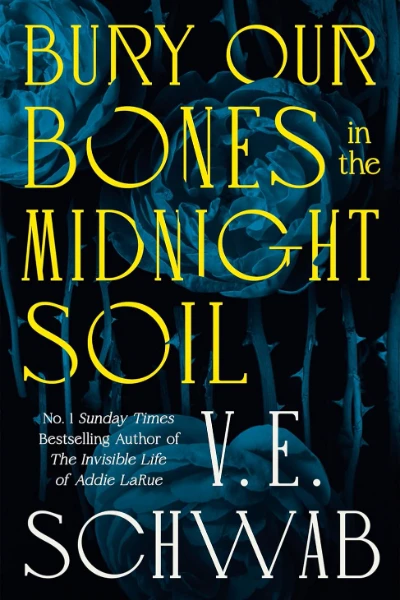
Bury Our Bones in the Midnight Soil
Bury Our Bones in the Midnight Soil — Chapter no 1
I
Santo Domingo de la Calzada, Spain 1521
The widow arrives on a Wednesday.
María remembers, because Wednesdays are for bathing, and her hair takes an age to dry after it’s been washed and combed. She remembers, because it is warm for the end of April, and she is sitting in a patch of sun at the edge of the yard, sucking on a cherry pit (one of the first of the season) and holding a lock up to the light to see if the hair is turning darker, or if it is simply still damp.
María’s mother says she is becoming too vain, but then, her mother is the one who makes her go to bed each week with clay in her hair, hoping it will mute the glaring strands. As far as María can tell, it isn’t working. If anything, the hair looks even brighter.
She would not mind so much, María’s mother, if the hair were honey- colored, or earthy, even auburn, but such an angry shade of red, she says, is a bad omen. Not a warm color, but the hot orange of an open flame. One she cannot seem to douse.
Something tickles María’s shin. A thread has come loose on the hem of her dress, and she will have to ask her mother to fix it. Her mother is a seamstress, small fingers making perfect lines. The trick to sewing, she is always telling her, is patient hands and patient hearts, but María came into this world with neither. She is always pricking herself with the needle, losing her temper and flinging the work aside, half-done. Born restless, her father used to say. Which was fine for a son, but bad for a daughter.
María rolls the cherry pit along the inside of her teeth as she pulls at the thread, unraveling her mother’s patient heart a little more, when the church bells begin to ring.
And just like that, the day is suddenly more interesting.
She springs up and takes off barefoot down the road, skirts tangling around her legs until she hoists them up out of the way. Heads for her favorite watching spot, the top of Ines’s stable, only to find that Felipe is already there.
“Go back home,” he calls as she hoists herself up into a cart and then onto the slanted tiles of the roof. “It’s not safe.”
Only three years between them, his thirteen to her ten, but he’s taken to acting like it’s an uncrossable distance, as if he’s full grown and she is still a child, even though he still cries when he gets sad or hurt, and she has not cried since before their father died.
“I mean it, María,” he scolds, but she ignores him, squinting into the late- afternoon light as the caravan rolls into town.
María cannot read or write, but she can count. And so she counts the horses as they come—six, seven, eight, nine—has started numbering the riders too, when a voice barks up at them.
“Madre de Dios. Get down, before you break your necks.”
Felipe turns, almost slipping on the slick tiles as he does, but María doesn’t bother. It is just Rafa, and she doesn’t have to look down to picture him perfectly, hands on his hips and head thrown back, frowning the way their father did. The way her oldest brother has for the last year, since taking his place. As if that’s all their father was: a set of shoulders, a stoic jaw, a hardened voice. A space he can so easily fill.
“Now!” he barks.
Felipe’s bravado dissolves under Rafa’s glare, and he climbs down, shuffling carefully across the tiles. María holds her ground, just to prove she can, but there is nothing to see now, the caravan has rounded the bend on its way into town, so she finally complies, and jumps, landing in a puddle that splashes her skirts. Felipe is just as dirty, but Rafa directs the full force of his glare at her, and her alone.
Before María can dance out of reach, he grabs her by the shoulder.
“You could have fallen.”
“Nonsense,” she says. “I would fly.”
“I do not see your wings.”
“I need no wings,” she says with a smirk. “I am a witch.”
It was only a joke. He called her one last week, when he came in and saw her sitting by the hearth, her red hair wild and loose, her attention lost inside the flame.
But now, as the word leaves her lips, his hand lashes out, striking her across the cheek.
The pain is sudden, hot, but the tears that brim are those of shock, and rage, and for an instant she imagines lunging at her brother, raking her short, sharp nails across his cheek, the look on his face, marred by bloody crescents.
But it is a feral kind of an anger, and María knows that it would only get her whipped, so instead she decides she’ll fill his good boots with manure.
She grins at the thought and the sight of her smile seems to unnerve her brother even more.
Rafa shakes his head. “Go home to Mother,” he says, flicking his hand as if she’s a stray cat, something to be shooed. He sets off down the path, and Felipe trails silently behind, a shadow in his wake, the two boys heading into town to greet the caravan.
María rubs her cheek and watches them go. Counts to ten, then shifts the cherry pit between her teeth and bites down so hard it splits.
She spits the broken shards into the dirt, and follows.
Santo Domingo is a blessed town.
It sits on the Camino de Santiago, the pilgrims’ road. María has always been fascinated by the people who come down it. Her father told her that they made the trip to cleanse themselves of sins, and when she was small, she thought of those sins as boulders, heavy burdens like theft and murder and abuse, each enough to weigh a body down, bend a spirit low. María would marvel at the constant train of criminals, advertising their guilt even as they attempted to atone.
Only later did her mother say that not all sins were boulders, that most in fact were more like pebbles. An unkind thought. A hungry heart. Small weights like greed and envy and want (things that didn’t seem to her like sins at all, but apparently they added up). More disappointing still was when María discovered that some who walk the pilgrims’ road are not guilty of a sin at all. That they make the trip not to atone for their past, but to secure their future. To ask for miracles, or intercessions, or simply pave the way into God’s grace.
That struck María as horribly dull, so to amuse herself, she’s taken to
concocting sins to assign to each and every traveler.
As the caravan unloads in the town square, she decides that the man at the front stole a cow from a family who then could not survive the winter.
The woman behind him drowned an unwanted baby in the bath, and then could not get with child herself.
The man with the red cross emblazoned on his cloak is a knight of the Order, there to shepherd the flock, but María decides that he has wives dotted like seeds along the road, a breadcrumb trail of sins.
The old man behind him prayed for his wife’s death, and then it came to
pass.
The young one slayed a man in a duel.
And the woman in gray . . .
The woman in gray . . .
María falters.
It’s not that her imagination fails her, but it is hard to come up with a story when she cannot make out the woman’s features. She is draped in fabric, all one shade, like a pillar cut from a block of stone, or a drawing made in mud. A ghost wrapped in a dark gray frock, a gray hat with a gray veil pinned around its rim, hands gloved in matching cloth despite the heat of the cloud-strewn day. She is a statue, cold and colorless, among the bright brigade.
María skirts the square till she finds Felipe. His gaze flicks toward her, and he gives a world-weary sigh. “Rafa will cane you.”
“I’ll bite him if he tries,” she counters, flashing teeth.
Felipe rolls his eyes, seems intent on ignoring her, but she elbows him in
the side.
“What?” he hisses.
She points to the woman, asking why she looks so strange, and he replies under his breath that she looks to be a widow, and that it must be a kind of mourning dress. María frowns. She has seen widows on the road before.
They have never looked like this.
But Felipe simply shrugs and says that maybe she is French.
María’s frown deepens, unsatisfied. She wants a closer look.
The bells have stopped ringing, and now the town is moving through its motions.
The baker’s son appears with loaves of bread, the innkeeper with salted fish and ale. María’s mother arrives, offering to mend any holes from travel
wear, which gives her an idea. María slips forward, weaving toward the widow’s horse as a man holds out a hand and helps her down. There is no pack, only a small wooden crate that he frees for her.
When it shakes, the contents sound like bells. María wonders what it holds.
She is almost to the widow’s side, about to ask if anything needs mending, when the widow turns her way. She can’t make out the woman’s face, reduced to smudges by the heavy veil, but she has felt the heat of Rafa’s glare enough times to know the widow’s gaze is leveled straight at her. And María, who thinks herself afraid of nothing—not the dark corners of the yard at night, or the height of the stable roof, or the spiders that hide in the wood stack—stops in her tracks, the words turned to rocks in her throat.
She stares back at the strange woman, perplexed by the feeling that rolls over her. No doubt, she would have flung it off, continued forward, but before she can, Rafa’s hand lands on her shoulder, and then it is too late.
The widow is turning away and the party is dispersing, the horses for the stable, the humans for the inn, and María finds herself herded roughly back home.
The next day is hot and bright and cloudless.
By late morning, the caravan has moved on, but the widow hasn’t. Her pale horse stays stabled by the inn, where she remains inside her room, the curtains drawn. The hours pass, and as they do, the widow requests no water or wine, accepts no offered food, till some wonder if she means to become a saint. If it is piety, it is surely the strongest kind. If it is sickness, they want no part.
The hours pass, and as they do, the gossip spreads like shadow, and here
is what it says:
Perhaps she is old.
Perhaps she is weak.
Perhaps she needs rest.
Perhaps she is sick.
Perhaps the journey is too much.
Perhaps the heat— Perhaps the sun—
There is no consensus, save that the men do not like her. They treat her like a nuisance, a parcel dislodged off another pilgrim’s horse.
“What kind of woman travels by herself?” they gripe.
“What kind of woman stays behind alone?”
The answer is, of course, a widow.
But there is another word that trails behind it, in a whisper. (Witch.) But then, a witch would never go on pilgrimage.
Whatever the reason, the men lean away, but the women—they have always had a taste for gossip. They arrive at the widow’s door throughout the day, pass an hour in her room, perhaps for company, or charity, or simply talk, a chance to hear where she has been, where she is going.
María thinks of the wooden crate, and wonders if the widow is selling something. It happens often enough—pilgrims act like ants, carrying things along the road, tracking other places in like mud on the bottom of their feet.
Her mother clucks her tongue, and hands her a basket of freshly mended things.
She does not like the widow, and has been out of sorts since she arrived.
But when María asks why, she will not say, only crosses herself, a gesture that piques María’s interest as she takes the basket and sets off for the families Baltierra and Muñoz and Cordona.
She passes Rafa at the edge of the yard, shoring up the fence, which always seems one strong breeze away from falling down. He glares at her as she goes by, and she knows he is looking to find something wrong. Stand straighter, María. Be tidy, María. Have some modesty, María. She smiles and curtsies as she passes, a gesture with all the flair of a curse.
The day started hot, but soon a swell of clouds rolls in, and by the time she’s delivered her mother’s work, a storm is churning.
She quickens her pace, the now-empty basket swinging from her fingers, the taste of rain on her tongue. She cuts through the copse that runs like a road along the edge of town, is startled when one of the trees steps sideways, and María sees it’s not a tree at all, but the widow.
María stops, breath caught between her teeth.
The widow’s face is uncovered, the veil tucked up into her hat brim.
María stares at the curls of blond hair now visible against her neck. Stares at her smooth cheeks, her pointed chin, the smooth pink bow of her lips. She
doesn’t look sick, or old, or weak. If anything, she is younger than María would have guessed. And twice as pretty.
The wooden crate sits beside her in the grass, its lid thrown back, contents winking in the light. She’s disappointed to see it holds only small, stoppered bottles and none of them look to have blood or feathers or bones.
The widow sinks to her knees at the base of a tree, gloved fingers sliding
through the roots, and— “What are you doing?” María asks.
The widow doesn’t jump at the sound, doesn’t even look up from her work.
When she speaks, her voice is smooth, and surprisingly low, and she speaks Castilian so well María doubts Felipe’s guess that she is French.
“I’m gathering herbs.”
“For a spell?” she asks, the words out before she thinks to stop them.
The widow looks up, then, revealing eyes that are a startling shade of blue, the edges crinkled in amusement. “For a tonic.”
María frowns. “Is a tonic the same thing as a spell?”
“Only to a fool,” says the widow. “Are you a fool, little girl?”
María shakes her head, but cannot help herself. “So you are not a witch?”
The widow straightens, and for a moment, the full force of her attention lands on María again, solid as a stone, before it slides past her, toward the town. “So much superstition, from a place that believes a roasted hen really sprang up off a dinner plate and began to sing.”
She is speaking of the tale that made Santo Domingo famous.
“That,” declares María, “was a miracle.”
The widow seems to consider. “And how is a miracle different from a spell? Who is to say the saint was not a witch?” She says it blithely, as if the words have no weight. And María finds herself grinning at the sheer scale of the blasphemy. The way it would make Rafa scowl, and her mother cross herself.
“So you are a witch, then?” she asks brightly.
The widow laughs. It is not a witch’s laugh, which María has always imagined would sound like the splitting of wood, or the guffaw of crows.
No, the widow’s laugh is soft, and heady, thick as sleep.
“No,” she says, the humor clinging to her voice. “And this is not magic.
It’s medicine.” She holds out a small red weed, pinching it between gloved fingers as if it were a rose. “Nature gives us what we need,” she says, and
for the first time, María thinks she catches it, the faintest trace of somewhere else, the edges of another accent, one she cannot place. “There are teas and tonics for many things,” continues the widow. “To shed a fever, or ease a cough. To help a woman get with child, or get rid of it. To make a man sleep . . .”
María’s gaze drops to the ground between them. She spots another crimson stem, is already reaching down to pull it out when the widow catches her hand.
Even though they were several strides apart.
Even though she never saw the widow move.
She is there now, a head taller than María, one gloved hand circling her wrist.
“Careful. In nature, beauty is a warning. The pretty ones are often poisonous.”
But María has already forgotten about the plant. Her world has narrowed to the widow.
The sun is gone now, lost behind low clouds, and up close, she smells like candied figs and winter spice. Up close, her gray clothes are not so dull, but finely sewn, and trimmed in glinting silver thread. Up close, her blue eyes are fever bright, and there are faint shadows in the hollows of her cheeks, and María wonders if she was wrong, and the widow has indeed been sick.
The woman’s mouth twitches, one corner tilting into a rueful smile. Her pink lips part, and the world goes small and tight as a held breath. María feels herself falling forward, even though she hasn’t moved an inch.
Then thunder snaps like a branch over their heads, and the widow’s hand withdraws.
“Run home,” she says as the first drops of rain break through the canopy.
And for once in her short, stubborn life, María obeys. She turns, sprinting out of the copse of trees and down the road, as if she can outrun the rain.
She can’t, ends up soaked through by the time she drops the empty basket inside the door.
Her mother mutters about wet clothes and catching cold as she peels her out of her dress and puts her by the fire, afraid she will take ill.
She doesn’t, but that night, señor Baltierra dies in his sleep.
By dawn, the widow is gone.
It will be ten years before María sees her again.
OceanofPDF.com



















