
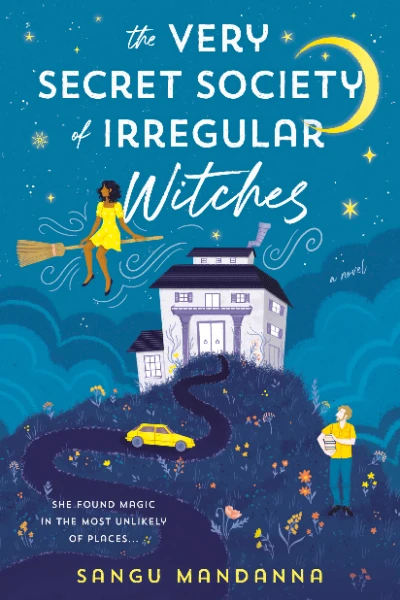
The Very Secret Society of Irregular Witches
The Very Secret Society of Irregular Witches — Chapter no 2
CHAPTER TWO
ITCH WANTED.
Two weeks later, those were the words that had Mika tappingW her fingers nervously on the steering wheel of the Broomstick, her trusty butter-yellow hatchback. She had just driven past the sign that welcomed her to Norfolk, a part of the country she hadn’t been to since she’d spent two years as a student at the University of East Anglia, and the satnav stuck to the bottom corner of her windscreen told her she still had about an hour to go.
WITCH WANTED. Live-in tutor wanted for three young witches. Must have nerves of steel. Previous teaching experience not necessary. Witchiness essential.
Fourteen thousand followers weren’t very many, really, but it was enough to make sure Mika’s social media accounts always had a collection of odd, intrusive, or downright offensive new messages on any given day.
She could now tell just by looking at an overview of her inbox, with its previews of each new message, which ones would be worth reading and which ones would not.
A message that began with the words WITCH WANTED, presented just like that in all capitals like it was announcing the birth of a new royal baby, should have gone straight into the bin. Mika knew, even as she clicked on the message out of pure curiosity, that it would probably be some kind of invitation to partake in kinky witch sex with the sender.
Imagine her surprise, then, to discover it was, in fact, even weirder than that.
She had found herself reluctantly amused. In spite of her better judgement, she had sent a reply.
Full marks for creativity, but I’m afraid my nerves are made of marshmallow.
As it happens, came the response, almost instantly, we’re desperate enough to take your nerves in whatever state they’re in.
And then, before Mika could scoff or quit the app or do any of the other things she might have been tempted to, a new message appeared. It had a
single word.
Please.
Which was how, after asking many more questions and getting very little in the way of actual answers, Mika found herself driving all the way from her flat in Brighton to a place that was, most ominously, named Nowhere House.
All because someone on the internet had good manners.
That, and the fact that her last job had ended in September, the six-month tenancy on her flat was almost up, and as unlikely as it seemed that this was a real, legitimate, not-at-all-hinky offer, she needed a new place to live and the paid work that came with it.
And also maybe, just maybe, because the magic, that song that never left her, had given her a little nudge.
“In a quarter of a mile, turn left,” said the satnav.
She had left the big, busy roads behind by now and was on a country lane, winding through small towns and villages dotted with pubs, schools, and old cottages, each place named something quaint and quintessentially English like Catfield or Hickling. Soon, even these dwindled away, leaving behind the streams and ponds of the Norfolk Broads, endless farmland dotted with sheep, cows, and horses, and, on the horizon, the heathery dunes that lined the coast. It was almost implausibly perfect, an idyllic world painted with the soft gold strokes of the November sun.
As the Broomstick inched closer and closer to the dot on the map that marked the mysterious Nowhere House, the farmland gave way gracefully to woods, with tall, mostly bare trees and blankets of yellow leaves lining
each side of the narrow road.
“You have reached your destination.”
Mika slowed the car, frowning. She couldn’t see anything other than trees, leaves, and the road. Had she been tricked? Was she about to be
murdered in the woods like every wide-eyed damsel in every horror movie ever? She tutted disapprovingly.
She double-checked the last texts her mysterious summoner had sent her.
You may have a hard time finding the house. Look very closely.
Okay, then.
After making sure there were no cars behind her, she reversed slowly, peering out of all the windows to make sure she hadn’t missed anything along the road.
There. She had missed something: a pair of simple iron gates wedged between hedges that were half-hidden by trees. Through the gates, she could see a narrow, pebbled driveway that led past a barn and a cottage, coming to an end in front of a large, gabled house set against an endless pale sky.
Mika turned right and guided the Broomstick up the driveway at a crawl, mindful of the supposed existence of three children, any of whom could no doubt be counted on to run into the driveway with no warning at any given time. But as she passed through the gates, there was an unmistakable
crackle in the air around her.
Magic.
It couldn’t be. Could it?
Unsettled, Mika wondered if it was too late to turn the car around and flee. She glanced warily ahead at the house at the end of the driveway, but before she could make up her mind, she came level with the barn and cottage. Someone waved wildly at her through the latter’s front window.
Pulling the Broomstick as far to the left side of the driveway as she could without actually knocking over the low stone wall that surrounded the cottage, she cut the engine and climbed nervously out of the car. The cottage was adorable: a tiny, storybook piece of perfection with a bright red door, an actual thatched roof, and a small, exquisitely tended front garden set on either side of a path of large flagstones. There was a tiny vegetable patch in one corner of the garden, with a handful of perfectly ripe squashes waiting to be harvested, and Mika spotted an old man kneeling among them.
He stood as Mika stepped on to the path, squinting against the sun. He was bald, Japanese, and in his seventies, dressed in jeans and a striped jumper with a gardening apron over the top, with broad shoulders slightly rounded by age and a warm smile that made it impossible not to smile back.
“You must be Mika,” he said, pulling his apron off and wiping his hands on it before holding his right out to her. “Welcome.”
“Thank you,” said Mika, shaking his hand. It was calloused, very much the hand of a man who did a lot of gardening. “Are you Ian?”
At that, he laughed. Before he could answer, the front door of the cottage banged open and a hurricane in fluffy slippers whirled out.
“That’s Ian,” said the man, patting her on the shoulder with what she suspected might be sympathy. “Good luck.”
The cyclone turned out to be an old white man who was so exuberantly energetic that Mika found herself exhausted just looking at him. He was tall and skinny, with a shock of white hair, twinkling blue eyes, and a striped rainbow scarf wrapped around his long neck. Between the scarf and the fluffy slippers were, rather unexpectedly, a very ordinary pair of black trousers and a black jumper.
“Ian Kubo-Hawthorn, at your service,” said the cyclone, beaming as he seized Mika in a hug that almost crushed all her bones. His voice was deep and musical, with the kind of crispness that she associated with Shakespearean performers and BBC presenters. “Perhaps you’ve heard of
me?”
“Ian,” said the other man.
“You’re right, of course, dear,” said Ian at once, the words rocketing out at the speed of light. “Now is not the time. You’ve met Ken, I see,” he went on to Mika, jabbing his thumb in the direction of the other man. “I’m his husband. Or he’s my husband. I’m not sure which way it goes.”
“Both, I think,” said Mika.
“Ian and I live here in the cottage,” said Ken, his calm, mellow voice an almost comical contrast to Ian’s.
“It gives us a bit of privacy,” said Ian, winking. “We’d get none of it at the main house, I promise you. But you,” he added hastily, as if he had just
remembered he was supposed to be making the house sound appealing to her, “will have plenty of privacy at the main house if you decide to stay with us.”
Mika looked between them, tried valiantly to repress a smile, and said, very firmly, “I’m afraid I’m going to need some answers before I decide anything. You were extraordinarily mysterious in my inbox. Deliberately, I suspect.”
“There are some things one doesn’t want in writing,” said Ian unapologetically. His eyes crinkled at the corners. “But we are so very grateful you came all this way just to have this conversation, my dear. You
can’t imagine how much we need you.”
“Do you actually need a live-in tutor?”
“Yes.” Ken answered the question before Ian could, possibly (and correctly) guessing that Mika was more likely to believe him. “Come with us to the main house and you’ll see why.” He draped his apron over the stone wall and started to lead the way up the rest of the driveway.
“Am I okay to park here while we’re at the house?”
“Yes, of course,” said Ian. “We normally leave our cars in the barn, which you’re welcome to do if you move in, but you’re fine where you are for now.”
Mika glanced back once at the gates, at the spot where she’d felt that peculiar, unlikely crackle of magic. Was she imagining that glimmer of gold
dust in the air?
“Mika?”
She looked away quickly, locked the Broomstick, and followed the two men across the smooth pebbles of the driveway.
Ian jabbed his thumb over his shoulder. “Something at the gates caught
your eye?”
“Not at all,” Mika said at once.
“Hmm,” said Ian, sounding amused.
Ken turned to her as she drew up with them. “Do you know anything
about Lillian Nowhere?” he asked.
Mika shook her head. “Should I?”
“No, probably not. Lillian is an archaeologist, and the owner of Nowhere
House.”
“Oh, am I supposed to be meeting her?”
“No, Lillian’s away at the moment,” Ian told her. “She usually is. She tends to be home for a few weeks, then away for a few months, then back here for a few weeks, and so on. This time, it’s an excavation in South America. That’s why the house and the children are in our care.”
“Yours and Ken’s care?” Mika frowned, struggling to believe that they were living in a cottage while three children lived alone in the big house.
“Ours, and Lucie and Jamie’s,” said Ken. “Lucie has been Lillian’s housekeeper and friend for almost thirty years now. Jamie worked at the library when the children first arrived”—Ken gestured at the large extension on the right side of the house—“but now he’s more or less the only parent they have. As for Ian and me, I’ve been Lillian’s groundskeeper for over twenty years. Lillian and Ian met at a charity gala back when he was still acting. She hired me and sold us the cottage for almost nothing.”
“All of which is relevant backstory to the tale we’re about to tell you,”
Ian assured Mika.
An absent archaeologist, a housekeeper, a librarian, a gardener, a retired actor, and three unlikely witches. As backstories went, it was one of the weirdest Mika had ever heard.
“Who exactly are the children?” Mika asked. “I mean, how are they related to any of you?”
“Legally, they’re Lillian’s adopted wards,” said Ian. He paused, and his mouth twisted ruefully as he added, “But she’s away so often that Jamie and the rest of us have done the real raising of them.”
They had stopped in front of the house while Ken had been speaking, and Mika looked up at it now. It was an old, two-storied structure, with gabled roofs and windows, walls built out of warm, brownish grey brick and covered in vines of flowering ivy, and a merrily smoking chimney. On either side of the faded white front door, which was tucked under eaves, were wide bay windows, both gabled like the windows of the second story.
And in front of the house, stretching out on either side of the front path all
the way out of sight around the house, were the gardens, which were just as lovely as the tiny garden outside the cottage: oak trees, lavender plants, freshly cut green grass, a swing set, and an entire fenced-off vegetable patch. It looked, frankly, like a small piece of heaven.
“It’s beautiful,” she said simply.
“Beautiful enough to move in at once?”
“Ian.”
Mika bit back another smile and held firm. “I still need my answers. You haven’t really explained why you need me.”
“Let’s go in,” said Ken, pushing open the front door.
Mika lingered for a moment, her eyes on the garden. She hadn’t imagined the magic at the gates. There was magic here, she could feel it, and it wasn’t just because she was here, either.
There couldn’t really be three young witches living here together, could there?
“Is something the matter?” Ian asked her, rocking excitedly on the balls of his feet.
Mika avoided answering that by asking a question of her own. “How are the lavender plants still in bloom?”
Ian looked a little disappointed, like he’d hoped she might say something else entirely, but Ken smiled. “That has nothing to do with me, I’m afraid.
You’ll notice a number of unseasonal oddities here.”
It’s because there’s a lot of magic here.
But she couldn’t say that. Maybe there really were witches here. Or maybe this was something else entirely, some sort of wicked, Gothic trap designed to ensnare reckless, naïve witches who didn’t know how to keep their mouths shut. Was that unlikely? Yes. Impossible? No. Either way, this much she did know: she, Ian, and Ken were all dancing around the subject, each trying to figure out how much the other knew, and she couldn’t be the one to crack first.
So she pretended to lose interest in the unseasonal lavender, smiled her sunniest smile, and said, “Shall we go in, then?”
Mika had had a number of doubts about the existence of the children, people on the internet not typically being known for their attachment to the truth, but the inside of the house put most of those doubts to rest. It was crammed full to bursting with cheerful armchairs, blankets, plants, and books. The walls were painted a creamy white that was occasionally interrupted by the squiggle of a crayon or a smudge of finger paint; the pairs of trainers, ballet flats, and wellies crammed into an untidy line in the front hallway varied in sizes from pre-schooler to adult; one of the windows had a distinctive smear on it that suggested a child’s nose was frequently pressed up against it; and, of course, there were toys all over the place.
A lot of work had obviously been done on the house to keep it clean and warm. New radiators clanked merrily and there was a lit fireplace in the enormous front room. Bright cushions and cosy rugs added life to the soft sofas and armchairs. The stairways, tables, and floorboards were all made of polished, sturdy wood, and there were potted plants in every hallway and room they passed on their way to the very back of the house, where they stopped at last in a rustic, sunlit kitchen.
There were two people in the kitchen: a short, round white woman in her fifties, who Mika presumed was Lucie, and a scowling white man in his mid-thirties, who had to be Jamie. The woman, who was examining a tray of potted herbs with a critical eye, turned as they entered, but the man remained at the open French doors on the other end of the kitchen, his arms crossed over his chest and his scowl pointed out into the back garden.
“Perfect timing! You can start dinner,” the woman said to Ian.
“Mika, meet Lucie,” said Ian, bounding across the kitchen. “Won’t someone put the kettle on while I preheat the oven?”
“Ian’s the best cook in the house,” Ken said to Mika in an undertone.
“But don’t tell him I said that. It’ll go to his head.”
Lucie had pink cheeks, wrinkles clustered almost exclusively around her eyes, brown hair with grey roots, and what looked like a sloppily made paper tiara sitting askew on top of her head. Flicking the switch that would turn the kettle on, she smiled warmly at Mika. “It’s lovely to meet you,
Mika,” she said. “Goodness, your smile is even prettier than it is in your videos!”
“Isn’t it just?” Ian said, so proudly that you would have thought he’d had a personal hand in the architecture of Mika’s smile.
Mika laughed, then addressed the man by the French doors. “You must be Jamie. Hi.”
He turned, his lean shoulders shifting almost grudgingly. He wasn’t quite as tall as Ian, so Mika put him at about six feet or so, a full head taller than her. The mortifying phrase devastatingly handsome flashed across Mika’s brain before she promptly banished it. His brows were dark and straight, his face all hard, angular planes, and he had short, untidy hair somewhere between dark blond and brown, a beard shadow of the same colour, and unsettlingly sharp grey eyes. Considering the scowl, she thought it was downright impolite of him to look as good as he did.
“Jamie Kelly,” he said. He had a rough voice, like it had been sandpapered. And was there a bit of Irish in there? “Hello.” A perfectly polite reply, but not friendly. Not even a little friendly. There was none of the easy warmth and enthusiasm that the others had offered.
Mika refused to take it personally, so she simply smiled at him. “Did you
used to live in Belfast?”
“Yes.” He didn’t smile back.
Mika turned back to Ken, more than ready for the answers she’d been promised. “I should probably mention that the only experience I’ve ever had working with children is this one time I had to extract a pea out of a toddler’s nostril on a train, but I assume that’s not the kind of thing you asked me here to do.”
“We have most of the children’s education covered,” Ken explained.
“They’re homeschooled. They have a few online lessons, but for the most part, we educate them ourselves. Jamie teaches them English and history, Ian teaches them theatre, cooking, and unwise things like how to climb trees, Lucie teaches them maths, and I teach them Japanese, science, gardening, and whatever else I can come up with.”
Mika looked from one face to the next, bewildered. It all sounded extraordinarily normal. “It doesn’t sound like there’s anything left. What do you need a live-in tutor for?”
There was a pause, as if a collective breath was taken, and then Ian said: “To teach them magic, of course.”
She supposed she shouldn’t have been surprised, considering his first communication had very specifically expressed a desire for a witch.
“Magic,” she said slowly. “You want me to teach them magic.”
“Well, you are a witch, aren’t you?” said Ian, like nothing could be more obvious. “So are they. Ergo, they need you.”
“Is this some kind of extracurricular activity where you let the girls decide what they want to be and then teach that?” Mika asked. “So they’ve decided they want to be witches and you’ve found someone who posts witchy videos online to humour them?”
Another silence. Lucie and Ken looked uncertain, while Jamie narrowed his eyes. Only Ian remained unfazed. He tsked. “Mika Moon,” he said in a grandfatherly tone that left her in no doubt that she was being gently, kindly, told off. “Yours is one of hundreds of accounts that posts witchy videos. I don’t want any of those undoubtedly lovely people. I want you.
Why do you think that is?”
“Proximity?”
“@SilverSpoons lives in Suffolk,” said Ian. “Much closer than Brighton.
She has fifty-three thousand followers to your fourteen thousand. And yet, as you may have observed, she’s not here.”
A small tremor of unease passed through Mika, but she had spent the best part of thirty-one years learning how to deftly manage exactly this sort of situation, and so she held her ground. “Just to be clear,” she said, opening her eyes very wide like she was incredulous, “you’ve watched my videos and now you think I’m an actual witch? With actual magic?”
Good God, let it not be so. Primrose would murder her dead.
“Yes,” said Ian simply. He stepped up to her, tipping her face up to look him in the eye. His eyes were earnest and kind as they searched hers, begging her to trust him. “Mika. Please.”
That please again. Fuck’s sake.
“Okay,” said Mika, taking a step back and switching strategies. “Let’s say, hypothetically, that real witches exist. Are you saying the three children living in this house are witches?”
“That is exactly what we’re telling you.”
“Not possible,” said Mika.
For one thing, witches were uncommon. It wasn’t every day you stumbled upon one, let alone three. And for another, three witches living together was absolutely not allowed. Primrose was, admittedly, not lord and master of every witch there ever was, but she was old, powerful, and, most importantly, persuasive. There was no way she would have permitted three young witches to be raised together in one house.
Unless she didn’t know about them.
“Ian,” Lucie said uncertainly, “I don’t think—”
“Oh, I give up!” Ian interrupted, throwing his hands up in the air.
“Skirting around this is excessively exasperating. Mika, I gather you don’t want to tell us the truth until we tell you the truth. Very well. You win.”
“Ian—”
“There are three children living in this house,” Ian said firmly, looking Mika straight in the eye. “All three of those children are witches. Jamie, Ken, Lucie, and I know they’re witches. We know about witches. Lillian
told us. Because she’s a witch.”
“Ian,” Lucie protested.
“Hold on,” Mika said, well and truly taken aback. “Lillian is a witch?
The woman who owns this house? The archaeologist who’s never home?”
“The very same.”
“And she told you about witches?”
Ian nodded enthusiastically. “So you see?”
Mika’s thoughts tumbled over each other as she tried to make sense of what she’d stumbled into. It added up, didn’t it? There was so much magic here that it had to be the home of a witch, or in this case, a number of witches. And what about the magic she’d felt at the gates? What if what she’d really felt was the presence of wards, a set of protective enchantments
placed around the house and gardens, hiding the children inside? Mika herself had grown up in Primrose’s warded house, a place where spellwork and accidents would go unnoticed by neighbours, passers-by, and even other witches. What if Nowhere House’s wards were the reason Primrose didn’t know these particular children existed?
Did Primrose know Lillian existed? She must. Lillian was very likely one of the witches who had, at some point, declined Primrose’s invitation to join the group that was absolutely not called the Very Secret Society of Witches.
“You don’t believe me,” Ian guessed when Mika stayed quiet.
“I don’t not believe you,” Mika replied cautiously.
Brusquely, Jamie said, “Come here.”
Unfazed by his tone, Mika crossed the kitchen to the open French doors and stood beside him. Jamie was looking outside again. Mika followed his line of sight into a large, beautiful back garden with a thick hedge around the border and undulating heathery dunes beyond it. A vivid patch of giant sunflowers interrupted the line of the hedge, beside which was a small wooden gate that led, presumably, over the dunes and down the other side to the sea.
Jamie wasn’t looking at the gate; he was looking at three girls playing in a tree house at the far end of the garden. Mika squinted to see them better.
The oldest, a Black child with long limbs, very dark brown skin, and thick coils of dark hair pulled back into a ponytail, couldn’t have been more than ten or eleven years old. She sat with a book on her lap. The other girls looked younger, one with peachy skin and straight, shiny black hair to her shoulders and the other with a messy light brown braid and brownish gold skin more or less the same colour as Mika’s.
Mika’s heart thumped a little faster. When Ken had told her that Lillian had adopted the children, she’d assumed that they’d been adopted at the same time from the same family, which would have made it impossible for them to be witches. Unless she was a twin, which was uncommon, a witch almost never had biological sisters who were also witches. It was an inevitable consequence of the whole orphan situation.
But these girls weren’t related to each other, and, moreover, even from all the way over here, Mika could see the unmistakable gold dust motes of magic around them. The power sang to her, like calling to like, and she had
to hold herself very still to resist.
Oh, goodness. They really were— “The oldest is Rosetta,” Jamie cut into the tumult of her thoughts, his tone still sharp and suspicious. “She’s ten. Lillian found her in London when she was about three months old, after a fire killed her parents. The one with straight black hair is Terracotta. She’s eight. Lillian found her in a tiny Vietnamese town when she was a year old. Her parents had died of a fever that decimated half their town, the same fever that was killing her grandmother when Lillian arrived. And the youngest, Altamira, is seven.
Lillian found her in the rubble of a Palestinian hospital when she was a few days old.”
Mika had mixed feelings about this, not least because it sounded so much like what Primrose had done to her, but now was not the time to have
that particular conversation.
“Unusual names,” she commented.
The others had come up to the doors, too, so it was Lucie who replied: “Lillian named them all after great archaeological discoveries.”
“At least one of them must have already had a name when she found them,” Mika pointed out. She had. She didn’t know what it was, just that she hadn’t been born with the last name Moon. “You said Terracotta was a whole year old when Lillian found her.”
“She didn’t want anyone to be able to track them down, considering what they are.”
“How are you so sure they’re witches? It is just because Lillian said so?”
But there was no need for anyone to answer her, for at that exact moment, as Mika watched the three girls in their tree house, she saw the youngest trot over to the rope ladder. The moment the child’s foot touched the ladder, it burst into bright green flames.
OceanofPDF.com



















