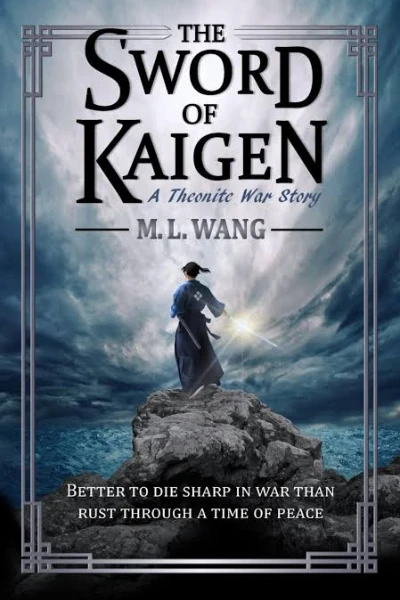
The Sword of Kaigen
The Sword of Kaigen — Chapter 22: The Soldiers
CHAPTER 22: THE SOLDIERS
The Imperial troops had not come alone. As in Ishihama, they had Yammanka soldiers with them. It had been a long time since Misaki had seen Yammankalu—or any non-Kaigenese people for that matter. For some residents of Takayubi, the sight of a foreigner was a complete novelty.
Women and children gathered to gawk and murmur, though they hovered a careful distance from the Yammanka lines as if worried the fire-wielding soldiers might spontaneously combust.
“I didn’t know they’d be so tall,” one woman marveled.
“They’re beautiful,” another woman sighed. “Such dark skin! Like in the movies!”
“And their hair looks so… fluffy,” Mizumaki Fuyuko added, scrunching up her nose. “Do you think I could get one of them to let me touch it?”
“Don’t be stupid, Fuyu-chan,” another teenage girl said. “It would burn your fingers off.”
Fuyuko cocked her head. “I thought they had to be on fire to do that.”
“No. I’m pretty sure the fire is inside them, under their skin, like we’ve got blood inside us.”
“And—wait a dinma—are those women?” Mizumaki Fuyuko gaped as if that was somehow more outlandish than the idea of people with fire for blood.
“They can’t be,” her mother said dismissively. “They have spears.”
“They’ve also got breasts, Mizumaki-san,” Setsuko said in amusement.
“I’m pretty sure they’re women.”
“Nonsense. Women can’t—”
“Look!” Setsuko said, seemingly delighted at the opportunity to scandalize her already traumatized neighbors. “That one has really big breasts!” She pointed to a nearby Yammanka.
The soldier in question looked toward the chattering Kaigenese women and rolled her eyes with a long-suffering sigh. Being stationed in Kaigen had to be a tiring experience for a female soldier. Misaki was ready to feel sorry for her until she saw the patterns on the woman’s uniform—pilot patterns. This
woman and the tajakalu standing around her were responsible for bombing Takayubi to pieces.
In the darkness and confusion of the previous night’s airstrike, it had been impossible to tell which country the planes belonged to, but it didn’t surprise Misaki that the Yammankalu had responded faster than the Imperial army.
Yamma had military bases scattered across the Kaigenese Empire, and they were famously quick to respond to crises. Still, it was unsettling that the Emperor would allow foreign planes to rain bombs on his own land.
“They all look rather upset,” one woman commented, looking down the line of Yammanka soldiers.
“They’re tajakalu,” Misaki said. “It’s the middle of winter and they’re up here on a freezing mountain.”
The dark-skinned tajakalu shivered in their bogolan uniforms, looking determined but deeply miserable in the shin-deep snow. At least they hadn’t shown up in forty-year-old uniforms, which was more than Misaki could say of the Kaigenese troops. They wore the same blue and tan hanboks they had since the Keleba.
The first person to address Takeru was a stocky Kaigenese officer with a bit of a belly, who introduced himself as Colonel Song. He was accompanied by a Kaigenese jaseli wearing the robes of a military translator, which annoyed Misaki slightly. How uneducated did these men think they were?
“I’m told you’re the head of the village?” Colonel Song said in Kaigengua.
“Yes, sir,” Takeru answered slowly, the Imperial standard more awkward on his tongue than his native Shirojima Dialect, “as of some time yesterday evening.”
“Really?” Colonel Song raised his eyebrows. “Yesterday?” Misaki didn’t care for the note of condescension in his voice. “Can you explain to me how that came to be?”
“The mayor is presumed dead, as we have not yet found many survivors from the western village where he lived. I was his accountant, administrative assistant, and the person responsible for running his office whenever he had to report to provincial headquarters. So, for the time being, I will assume his responsibilities until he is found or replaced. My brother, the head of the resident ruling warrior house, was confirmed dead a few waatinu before you arrived, so I take his place as the leading—”
“I see,” Colonel Song said, evidently growing bored with Takeru’s slow,
over-pronounced Kaigengua. “So, these people will all answer to you?”
“Those who live here in Takayubi, sir, yes.”
“You can keep them under control?”
Misaki didn’t like how Song referred to them as if they were a troublesome herd of livestock. She liked it less when Takeru responded with an unhesitating, “Yes, sir.”
“Very good. The first thing I am going to need is for your people to bring all the bodies to the remains of the settlement southwest of this village.”
“You mean the blacksmith village?”
“Oh, is that what it was?” Colonel Song said, with an amused quirk of his mouth that made Misaki want to punch the teeth out of it. “Then, yes, the uh… blacksmith village. Our Yammanka allies have begun to set up their equipment there.”
“Their… equipment?” Takeru repeated slowly.
“Their equipment,” the translator said in Shirojima Dialect and Takeru favored him with a cold look.
“The Yammankalu are conducting an important forensic investigation for our Emperor,” Song said. “You and everyone in this village are to give them your full cooperation.”
“Of course, General,” Takeru said, though this was the first order that seemed to give him pause.
The Yammankalu might have been Kaigen’s allies since the Keleba, but they were still foreigners, and villages as ancient and isolated as Takayubi didn’t take well to foreigners interfering in their affairs. This was a village where the mere presence of Kaigenese outsiders like the Kwangs could cause a stir.
“I understand you’ve been having your people transport bodies to this building?”
“Only the bodies of our own,” Takeru said, “those with friends and family who need to lay them to rest. We’ve been waiting for finawu to arrive from the neighboring mountain to administer the proper rites.”
“I understand,” Colonel Song said, “but we will need all the bodies brought to the Yammankalu at your blacksmith village—Kaigenese and Ranganese.”
There was a pause. “You… what?” Takeru said blankly.
The translator, who was either extremely determined to condescend or just
extremely bad at his job, piped up, “The colonel said, ‘all the bodies, Kaigenese and Ranganese.’”
Takeru was still staring at Song. “I don’t understand.”
“You will direct your people to bring the bodies of every person killed during the attack to the Yammankalu. That includes the bodies they mistakenly brought here.” He jerked his head toward Mamoru’s covered corpse. “In cases where only pieces of a body remain, they will need whatever can be recovered.”
Misaki didn’t blame Takeru for standing in shock.
“Have I said something confusing to you, Matsuda?”
“You want me to take the dead from their grieving families?” Takeru’s voice was as emotionless as ever, but more than that, it was empty.
“This is the will of the Emperor.”
“I apologize, sir. I just…” Takeru had started to stumble over the Kaigengua he rarely used. “I don’t understand.”
“The colonel says ‘This is the will of the—’”
“Are you stupid?” Misaki snapped at the translator. “He clearly knows the phrase ‘will of the Emperor.’ We have a TV.” Getting a chance to use her fluent Kaigengua after so many years of speaking Dialect should have been a pleasant experience, but she found herself baring her teeth around the syllables. “Learn to read the situation, you moron.”
All three men stopped, staring at her.
Oh Misaki, you idiot.
“Chou, you may go,” Song said after a moment. As the embarrassed translator bowed and took his leave, the colonel turned to Takeru. “You said you could control this village. Would you mind controlling your wife?”
“Yes, sir. I apologize.” Takeru said, placing himself between Misaki and the colonel. “She is suffering from shock and a mild concussion.”
“I’m sure all of you have suffered greatly, but take comfort knowing it is all
in service of the Empire.”
“Of course.”
“Now that we understand each other, I’ll have my soldiers start collecting the bodies.” Misaki felt her world splinter as the colonel turned toward Mamoru and put a hand on him. “We’ll start with this one.”
“That’s Mamoru,” Takeru said as Colonel Song motioned some of his men forward. “That’s my son.” There was no protest in his tone, but there was
something. Misaki had to believe there was something. There was no way he could allow this… “Very good then. We’ll start with your son.”
“Yes, sir.” Takeru bent and took the sheathed sword from beside Mamoru, just as the soldiers lifted the body. “Glory to Kaigen. Long live the Emperor.”
Rage pulsed through Misaki, driving her forward. “No,” she growled through gritted teeth, “You can’t—”
Kazu moved shockingly fast, catching her around the waist before Takeru or the soldiers seemed to have noticed her advancing.
“Nee-san, don’t!” he hissed hauling her back.
“Let go!” Misaki lunged to break free, but Kazu’s grip held, jolting her back again. Nami, when had her little brother gotten so strong? “They can’t do this! They can’t—”
Takeru’s jiya slammed down over hers, a freezing shockwave through her blood and bone marrow. Her husband hadn’t touched her—he had barely even moved—but the impact left her stunned. It was common knowledge that a strong theonite could force his power over that of a weaker one, neutralizing it, but Misaki had never come up against jiya so devastatingly stronger than her own.
“Matsuda-dono!” Kazu’s voice said very far away, sounding startled and a little horrified.
Dimly, Misaki felt her husband’s nyama, so much colder than her brother’s, push in between her and Kazu, enveloping her like the waters of a frigid lake closing over her head. The sensation left her so dazed that she didn’t register what was happening until Takeru’s cold hands were guiding her onto her knees on singed tatami. She was inside the compound, in the room where Kotetsu Katashi was resting.
The blacksmith’s children and her own huddled together on the nearby futon.
“He can’t come back,” Atsushi was struggling to explain to a crying Nagasa and his own younger siblings.
“Why not?” his little sister, Naoko, demanded.
“People don’t come back from the Laaxara. I mean—they do sometimes, but…” Atsushi shuddered, pulling Naoko closer. “Not in a good way. They don’t come back as… them. They’re something different, something bad.”
“My brother is not bad,” Nagasa said.
“No, he’s not,” Atsushi agreed, “or—he wasn’t. That’s why we’re not going to see him again.”
“It’s good that you were at least able to keep his sword, Matsuda-dono,”
Katashi was saying to Takeru.
“It would have been wasteful not to,” Takeru said. “It’s an excellent weapon.”
“It is a hero’s weapon, Matsuda-dono,” the swordsmith said. “It should be kept in your family for future generations to wield and admire. Its name should be repeated proudly alongside the likes of Kurokouri and Kumokei.”
“My son’s sword doesn’t have a name.”
“Of course it does, Matsuda-dono,” Kotetsu said in his singularly gentle, rumbling voice. “It gave its maker and wielder to earn it. That is Mamoriken,” he nodded to the sword, “the Protector.”
For a moment, something almost like an emotion flickered across Takeru’s features. Almost. Misaki wondered why trying to find emotion on that man’s face felt like trying to grab the thread of a spider web, like trying to remember a dream… “Thank you, Kotetsu Kama.” Takeru bowed.
Before he left the room, he paused where Misaki knelt and crouched down to her level to whisper, “Your behavior has been disgraceful. You will rest here in silence until you are able to conduct yourself in a respectable manner.
Do you understand?”
“Of course, sir,” Misaki slurred, mocking Takeru’s low voice and Shirojima accent. “Glory to Kaigen. Long live the Emperor.”
If he was going to kill her, he might as well do it now. After all, it seemed that the loss of his closest family members meant precisely nothing to him.
But he didn’t raise a hand to her. He simply pressed one down on her shoulder, as if to confirm that she would stay.
“You are not well,” he said. “Rest.”
Then he left, as he had the day of Misaki’s first miscarriage, as he always did. She watched him go, wishing he had hit her.