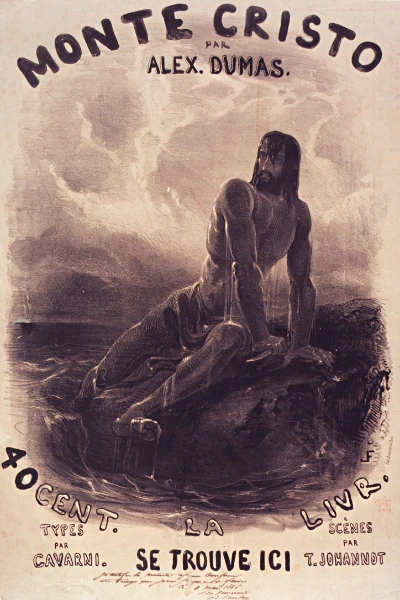
The Count of Monte Cristo
The Count of Monte Cristo — FOOTNOTES:

“Who can say whether we shall ever see them again?” said Morrel with tearful eyes.
“Darling,” replied Valentine, “has not the count just told us that all
human wisdom is summed up in two words: “‘Wait and hope (Fac et spera)!’”
FOOTNOTES:
(return) [ “The wicked are great drinkers of water; As the flood proved once
for all.”]
(return)
[ $,, in .]
(return)
[ Knocked on the head.]
(return)
[ Beheaded.] (return) [ Scott, of course: “The son of an ill-fated sire, and the father of a yet more unfortunate family, bore in his looks that cast of inauspicious melancholy by which the physiognomists of that time pretended to distinguish those who were predestined to a violent and unhappy
death.”—The Abbot, ch. xxii.]
(return)
[ Guillotine.] (return) [ Dr. Guillotin got the idea of his famous machine from witnessing an
execution in Italy.]
(return) [ Brucea ferruginea.]
(return) [ ‘Money and sanctity, Each in a moiety.’] (return) [ Elisabeth de Rossan, Marquise de Ganges, was one of the famous women of the court of Louis XIV. where she was known as “La Belle Provençale.” She was the widow of the Marquis de Castellane when she married de Ganges, and having the misfortune to excite the enmity of her new brothers-in-law, was forced by them to take poison; and they finished her off with pistol and dagger.—Ed.] (return) [ Magistrate and orator of great eloquence—chancellor of France
under Louis XV.] (return) [ Jacques-Louis David, a famous French painter (-).] (return) [ Ali Pasha, “The Lion,” was born at Tepelini, an Albanian village at the foot of the Klissoura Mountains, in . By diplomacy and success in arms he became almost supreme ruler of Albania, Epirus, and adjacent territory. Having aroused the enmity of the Sultan, he was proscribed and put to death by treachery in , at the age of
eighty.—Ed.] (return) [ Greek militiamen in the war for independence.—Ed.] (return) [ A Turkish pasha in command of the troops of a province.—Ed.] (return) [ The god of fruitfulness in Grecian mythology. In Crete he was supposed to be slain in winter with the decay of vegetation and to revive in the spring. Haydée’s learned reference is to the behavior of an actor in the Dionysian festivals.—Ed.]
(return)
[ The Genoese conspirator.]
(return)
[ Lake Maggiore.] (return) [ In the old Greek legend the Atreidae, or children of Atreus, were
doomed to punishment because of the abominable crime of their father. The Agamemnon of Aeschylus is based on this legend.] (return) [ The performance of the civil marriage.]
(return)
[ In Molière’s comedy, Le Misanthrope.] (return) [ Literally, “the basket,” because wedding gifts were originally
brought in such a receptacle.] (return) [ Germain Pillon was a famous French sculptor (-). His best known work is “The Three Graces,” now in the Louvre.] (return) [ Frédérick Lemaître—French actor (-). Robert Macaire is the hero of two favorite melodramas—“Chien de Montargis” and “Chien d’Aubry”—and the name is applied to bold criminals as a term
of derision.] (return) [ The Spahis are French cavalry reserved for service in Africa.]
(return)
[ Savate: an old shoe.] (return) [ Guilbert de Pixérécourt, French dramatist (-).] (return) [ Gaspard Puget, the sculptor-architect, was born at Marseilles in
.] (return) [ The Carolina—not Virginia—jessamine, gelsemium sempervirens (properly speaking not a jessamine at all) has yellow blossoms. The reference is no doubt to the Wistaria frutescens.—Ed.] (return) [ The miser in Molière’s comedy of L’Avare.—Ed.]
This book has been downloaded from www.aliceandbooks.com.
You can find many more public domain books in our website
End of book
You finished The Count of Monte Cristo
by Alexandre Dumas