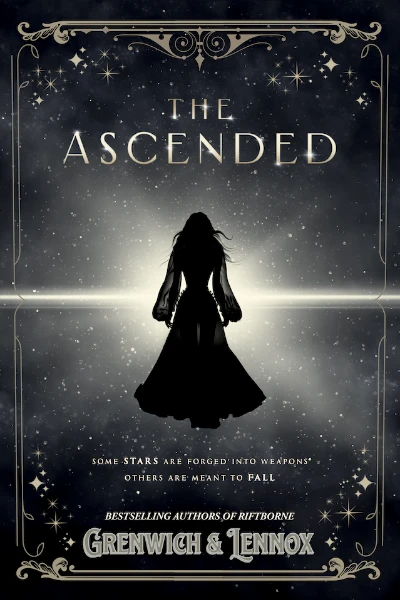
The Ascended
The Ascended — Chapter no 39
Chapter 39
Echoes of the Forgotten
I WOKE TO SILENCE AND EMPTY CHAMBERS. THE COVERS ON THE OTHER SIDE of the bed were disturbed, pulled back as if someone had quietly slipped out of them. I blinked in surprise, taking in the implication. He had slept here?
Next to me?
Dawn was beginning to filter through the high windows, casting the room in a pale light that made the dark furnishings seem less imposing.
For a moment, I remained still, cataloging the sensations in my body.
The burning in my lungs had subsided to a dull ache. My throat felt raw but functional. The fever that had consumed me for the last few days had broken, leaving me wrung out but clear-headed.
Moving to the edge of the bed, I tested my legs. They trembled but held my weight as I stood. A silk robe had been draped over a nearby chair— black, of course, embroidered with silver thread. I pulled it over his shirt.
I walked to the window, looking out over the bleak landscape of Draknavor. The blood-red sky was just beginning to lighten, revealing the twisted shapes of the forest and the dark shore beyond. It was beautiful in its way—stark and honest about its nature.
Where had he gone? Had there been a summons from the Eternal City again? Some divine crisis that required the Prince of Death's attention? Or had he simply grown tired of playing nursemaid?
When I tried the door, it was locked.
"You've got to be kidding me," I muttered, rattling the handle.
Kneeling, I extracted one of the long pins from my hair and bent it into the shape I needed. The lock gave way with a satisfying click, and I allowed myself a small smile of triumph. Take that, Death Prince.
The corridor outside was empty, silent save for the soft whisper of the draft that seemed to permeate the Bone Spire. I padded barefoot down the hall, following the route I'd memorized during my explorations. The fortress was always quiet at this hour.
A thin line of light beneath a door halfway down the eastern corridor drew me like a beacon. Xül's study door stood partially open, spilling warm amber light into the hallway.
He stood with his back to me, examining something held carefully between his long fingers. It looked like a shard of crystal, similar to those we'd seen at the ruins. The sight of it sparked memories of that day—the ancient battlefield, the remnants of a war between beings beyond comprehension. Questions I'd been too cautious to ask then still burned in my mind.
His confession about the priests had emboldened me.
I stepped into the room, deliberately making enough noise to announce my presence, though I suspected he'd known I was there all along.
"You’re up early." I said, trying to keep my tone balanced.
Xül didn't turn, but I saw the slight rise and fall of his shoulders as he drew breath. "Immortals don't require much sleep."
"Convenient excuse."
That earned me a glance over his shoulder, one eyebrow raised.
"Feeling better, I see. Your temperament has certainly recovered."
I moved further into the room, drawn to the crystal in his hand. "What is that?"
"Arcanite," he said, turning it so the light caught its facets.
I hesitated, weighing the risk of my next question. Days ago, he'd shared one dangerous truth with me. Today I would push for more.
"Those ruins we visited," I began, watching his face carefully. "How did it happen? Before Moros and Vivros were the last ones standing? You showed me their battlefield, but what preceded it?"
He finally turned, setting the crystal down on his desk. His expression shifted, a flicker of surprise—either at my question or my audacity in asking it.
"The Sundering," he said, testing the words. "That's a dangerous topic, starling."
"Seems like a natural progression to me." I shrugged, leaning against the side of his desk.
He smirked, but it seemed more curious than mocking. "I suppose that's true."
His eyes stayed on me a beat longer before he sighed and moved to a chest tucked against the far wall, unlocking it with a key he withdrew from inside his coat. From within, he retrieved a round case that was cracked and stained.
"The Primordials numbered thirteen originally," he continued, carefully extracting a scroll made of yellowed parchment. "They existed in a state of perfect equilibrium. Until they didn't, of course."
He unrolled the scroll on his desk, revealing diagrams and script in a language I'd never seen. At the center was an illustration of thirteen interconnected symbols arranged in a perfect circle.
"The Sundering wasn't a single battle," Xül continued, his voice lowering. "It was a slow death. A centuries-long decay."
"Sounds riveting."
"For some." He tilted his head. Observing me. "For others, something to be forgotten."
"Well, I'm intrigued now. Continue, please."
"How polite you're being this morning," he teased, hand tracing delicate lines over the parchment.
"You haven't pissed me off yet." I smiled sweetly.
“It’s important to understand the dynamics of the Primordials to grasp
how everything ultimately occurred.”
“I’m listening.” I said, biting my lip.
“While most Primordials existed in communion, Moros and Vivros had long ago separated themselves from the collective. Moros lurked in shadows. Vivros…" He paused. "Well, none of the texts pinpoint any specific location for Vivros. He simply couldn't be found. So most stopped
looking."
“Why did they separate themselves?”
“Vivros was never particularly interested in ruling, or being a part of something bigger than himself. He preferred isolation,” Xül leaned against the desk. “At least, that is what I’ve gathered.”
“And Moros?”
Xül simply shook his head and drew a deep breath. "Moros was the weakest of the Primordials," he said, indicating a symbol that appeared darker than those surrounding it. A circle with a crack splitting it. "He isolated himself not because he preferred it, but because the darkest deeds are most efficiently enacted from the shadows. He had a thirst for power.
For strength. A hunger that was never satisfied."
A chill traced its way down my spine.
"Do you know what Moros consumed most voraciously, starling?" He asked, eyes flickering up to meet mine.
I shook my head, unable to look away from his penetrating gaze.
"Memories," he said. "The very essence of experience, of identity. Of self."
"Memories?" I repeated, trying to force my mind to understand. "He… fed on them?"
"Like you might consume bread or wine," Xül confirmed. "But for Moros, it wasn't sustenance—it was power. The more he consumed, the more he became."
He gestured to different areas of the scroll, where the symbols seemed arranged in a hierarchy.
"Over centuries, Moros fed on the memories of the other Primordials.
So subtle at first that they didn't notice what was happening. A missing moment here, a blurred recollection there. By the time they realized, it was too late—their minds were already half-devoured, their powers diminished by forgetting what they once were."
"He wanted to be the only one," I breathed. "To consume everything until nothing remained to challenge him."
"Yes. And in their weakened state, the Primordials turned to their descendants for help. But they had miscalculated."
The scroll showed smaller symbols clustered around the original thirteen.
"The Twelve saw opportunity where their creators saw salvation. And they struck—not against Moros, but against the rest of them."
I stared at him, my mouth dry. "You mean…the Twelve killed them?"
The words felt impossible, yet they left my lips all the same.
"The war was devastating beyond comprehension," Xül said, his voice quiet but clear. "Even now, millennia later, the consequences of that
betrayal ripple through the cosmos."
"Gods." It was all I could say.
"When most had fallen," he continued, rolling the scroll closed with careful hands, "only the two outliers remained. Moros and Vivros."
"Outliers," I repeated, catching the word.
"Brothers, if some legends are to be believed," Xül said. “Born from the same cosmic event.”
"So when the Twelve moved against the Primordials—”
"Vivros wasn't present. Moros didn't care. Perhaps he'd even been counting on it." His smile was cold. "Vivros was unaware of the slaughter until it was over. It was only after the cosmic balance cracked that Moros turned his hunger toward his brother. The last source of primordial power left to consume."
"And Vivros emerged from his isolation to face him," I said, understanding dawning.
"Not by choice. Moros forced the confrontation. He was now stronger
than he’d ever been before."
“But Vivros killed Moros, in the end.”
“Yes. He was the last living Primordial until the Twelve decided it was time to finish what they started. So they descended upon him when he was still weak.” Xül paused, tilting his head as his gaze dragged across the room. “They had to act fast, I suppose. It was once believed that all descendants, even working together, could never defeat him. So the Twelve couldn’t exactly miss the opportunity for an upper hand.”
His phrasing caught my attention. "All descendants?" I asked. "You mean the Aesymar?"
Xül's eyes flickered with surprise, whether at my perception or his own slip, I couldn't tell. He moved to a drawer in his desk, withdrawing a different scroll, this one bound with four distinct colors of thread: gold, silver, black, and a strange greenish-blue.
"The Aesymar as you know them now," he said, his voice dropping even lower, "were not the only divine beings to rise against the Primordials in the Sundering."
He unrolled the scroll, revealing a map unlike any I had seen before— not of land or sea, but of realms, connected by pathways that formed a complex network. Four distinct worlds, each rendered in one of the thread colors, arranged in a perfect quatrefoil pattern.
"Before the first primordials were slain, four pantheons existed in harmony, all descendants of the Primordials in their various aspects." His finger traced the golden section. "The Aesymareans." Then the silver. "The Esprithe." The greenish-blue. "The Ehlistrea." Finally, the black section.
"And the Vaerhuun."
I leaned over him.
"Each ruled their own mortal realms according to their nature," Xül continued. "The Aesymar with order and hierarchy, the Esprithe through harmony and balance, the Ehlistrea through passion and transformation."
His finger lingered on the black section. "And the Vaerhuun through fear and domination.”
My eyes remained fixed on that shadowed quadrant. "The Vaerhuun— that seems like a party."
"Not a party I'd recommend," he said. "While all pantheons descended from multiple Primordials, the Vaerhuun shared Moros's affinity for the darker aspects of existence."
"And they all agreed to stand against the Primordials?"
"All four pantheons united, yes," Xül confirmed. "Despite their differences, their thirst for power connected them. I suppose Vaerhuun joined because Moros wasn't the intended target of this particular coup."
I stared at the map, at the four realms connected by those pathways.
"But now there's only the Aesymareans," I said slowly. "What happened to the others?"
Xül cleared his throat. "When the Primordials fell, something… fractured. The very foundations of reality cracked. Then, with the final confrontation between Moros and Vivros, the pathways between realms collapsed." He traced one of the lines connecting the realms. "Some believe the other pantheons were destroyed in the cataclysm. Others," he added, his voice falling low, "believe they're simply waiting to be found, adrift in the
Abyss."
“The Abyss?”
“The fabric of nothingness beyond the realms of Elaren and Voldaris.
Inaccessible to all.”
When he fell silent, I found myself gripping the edge of his desk, steadying myself against the implications of what he'd revealed. The gods I'd been raised to fear had risen through treachery and opportunism, not divine right. And their greed had ripped the universe apart.
“How do you know all of this?” I asked.
“My father’s collection of texts from that period is extensive. You’ve seen the library. He never sheltered me from that knowledge—only taught me about the consequences of knowing it.”
"Why tell me?" I finally asked, meeting his gaze directly. "I assume this information could be considered treasonous."
"Consider it a gesture of faith."
"Faith in what, exactly?"
"In your ability to understand implications beyond what most would grasp." He began methodically reorganizing the materials on his desk.
"Most ascension candidates are taught only what they need to know.
Enough to function within the divine realm, but not enough to question it."
Xül was testing boundaries. "The Aesymar don't exactly advertise their origins. The overthrow of the Primordials."
"The Aesymar want the Primordials forgotten." Cynicism edged his voice. "They want history rewritten to suggest they themselves have always
been. Unchanging. All-powerful."
"A convenient narrative."
"Most successful mythologies are." He smiled. "The truth remains buried in places like those ruins, in texts like these—kept from mortals and divine beings alike."
I traced the edge of his desk. "Why are they so determined to keep all of this a secret?”
His eyes flashed with silent warning, reminding me that for all our sudden alignment, Xül remained the Prince of Draknavor, heir to Death itself.
"The Aesymar fear what all rulers fear—the realization that their power is neither absolute nor eternal. That they too ascended and thus could theoretically be replaced." He paused, watching me. "Think of what would happen if mortals truly understood that divinity isn't an inherent state, but one that can be achieved. Or stolen."
I met his gaze, recognition burning between us. "The Trials are containment," I said simply, not bothering to phrase it as a question. "They always have been."
"Most contestants cling to the delusion of divine benevolence," he said, his voice dropping to match mine.
A bitter sigh escaped me before I could contain it. "I've known it for a long time. That they don't elevate mortals out of generosity," I continued, the words falling from my lips like a dark secret. "They do it because the alternative is worse. Divine power bleeds into Elaren whether they will it or not. Better to gather up those who manifest it and control them than allow potential rivals to develop unchecked.”
Especially," Xül added quietly, "when so few of the Aesymar possess true gifts themselves. Imagine their terror—immortal but essentially powerless beyond their extraordinary senses and strength, watching mortals manifest abilities they themselves lack.
“And those that cannot be controlled are eliminated before they become true threats. Every contestant who dies in the Trials is just another loose end tied off. Another potential usurper neutralized."
The brutal economy of it had always been clear to me. I had grown up in the shadow of this understanding, had breathed it in with my father's fear and exhaled it with my own cautious restraint.
What struck me now was not the revelation. It was the audacity of its scale. The systematic way the divine realm had maintained its dominance over eons.
"And mortals never see it," I said, a new thread of anger weaving through my words. "Generation after generation, we worship the very beings who cull us. They present the Trials as divine blessing while they're really just… pest control."
Xül's eyes gleamed. "The greatest triumph of the Aesymar was convincing mortals to revere the very system designed to keep them in their place."
Understanding wove itself between us. To hear such thoughts acknowledged by one of their own, to have confirmation of what had always been shadow and suspicion, kindled a dangerous fire in my blood.
He turned away first, breaking the moment. "The sun rises. The Bone Spire will soon awaken."
Indeed, the quality of light had changed, dawn's silver giving way to the scarlet hue of early morning.
"I should go," I said, already walking from his desk. "Before someone notices I picked your lock."
A look of mild amusement crossed his face. "So that's how you got out.
I should have known."
"You shouldn't have locked me in," I countered.
"I was trying to ensure you rested." There was no apology in his voice.
"A wise decision." I mimicked his usual tone with a small smile.
"Thais."
“Yes?”
"What you've learned here—it cannot leave this room." His expression was deadly serious. "There are ears everywhere in Voldaris. And it seems you’ve already painted a rather large target on your back."
I nodded, understanding the warning beneath his words.