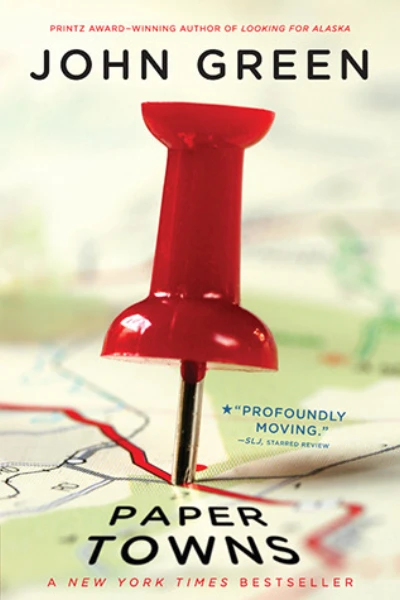
Paper Towns
Paper Towns — Chapter no 5
5.
“Part Six,” Margo said once we were driving again. She was waving her
fingernails through the air, almost like she was playing piano. “Leave
flowers on Karin’s doorstep with apologetic note.”
“What’d you do to her?”
“Well, when she told me about Jase, I sort of shot the messenger.”
“How so?” I asked. We were pulled up to a stoplight, and some kids in a
sports car next to us were revving their engine—as if I was going to race the
Chrysler. When you floored it, it whimpered.
“Well, I don’t remember exactly what I called her, but it was something
along the lines of ‘sniveling, repulsive, idiotic, backne-ridden,
snaggletoothed, fat-assed bitch with the worst hair in Central Florida—and
that’s saying something.’”
“Her hair is ridiculous,” I said.
I know. That was the only thing I said about her that was “true. When
you say nasty things about people, you should never say the true ones,
because you can’t really fully and honestly take those back, you know? I
mean, there are highlights. And there are streaks. And then there are skunk
stripes.”
As I drove up to Karin’s house, Margo disappeared into the way-back and
returned with the bouquet of tulips. Taped to one of the flowers’ stems was
a note Margo’d folded to look like an envelope. She handed me the bouquet
once I stopped, and I sprinted down a sidewalk, placed the flowers on
Karin’s doorstep, and sprinted back.
“Part Seven,” she said as soon as I was back in the minivan. “Leave a
fish for the lovely Mr. Worthington.”
“I suspect he won’t be home yet,” I said, just the slightest hint of pity in
my voice.
“I hope the cops find him barefoot, frenzied, and naked in some
roadside ditch a week from now,” Margo answered dispassionately.
“Remind me never to cross Margo Roth Spiegelman,” I mumbled, and
Margo laughed.
“Seriously,” she said. “We bring the fucking rain down on our enemies.”
“Your enemies,” I corrected.
“We’ll see,” she answered quickly, and then perked up and said, “Oh,
hey, I’ll handle this one. The thing about Jason’s house is they have this
crazy good security system. And we can’t have another panic attack.”
“Um,” I said.
Jason lived just down the road from Karin, in this uber-rich subdivision
called Casavilla. All the houses in Casavilla are Spanish-style with the red-
tile roofs and everything, only they weren’t built by the Spanish. They were
built by Jason’s dad, who is one of the richest land developers in Florida.
“Big, ugly homes for big, ugly people,” I told Margo as we pulled into
Casavilla.
“No shit. If I ever end up being the kind of person who has one kid and
seven bedrooms, do me a favor and shoot me.”
We pulled up in front of Jase’s house, an architectural monstrosity that
looked generally like an oversize Spanish hacienda except for three thick
Doric columns going up to the roof. Margo grabbed the second catfish from
the backseat, uncapped a pen with her teeth, and scrawled in handwriting
that didn’t look much like hers:
MS’s love For you: it Sleeps With the Fishes “Listen, keep the car on,”
she said. She put Jase’s WPHS baseball hat on backward.
“Okay,” I said.
“Keep it in drive,” she said.
“Okay,” I said, and felt my pulse rising. In through the nose, out through
the mouth. In through the nose, out through the mouth. Catfish and spray
paint in hand, Margo threw the door open, jogged across the Worthingtons’
expansive front lawn, and then hid behind an oak tree. She waved at me
through the darkness, and I waved back, and then she took a dramatically
deep breath, puffed her cheeks out, turned, and ran.
She’d only taken one stride when the house lit up like a municipal
Christmas tree, and a siren started blaring. I briefly contemplated
abandoning Margo to her fate, but just kept breathing in through the nose
and out through the mouth as she ran toward the house. She heaved the fish
through a window, but the sirens were so loud I could barely even hear the
glass breaking. And then, just because she’s Margo Roth Spiegelman, she
took a moment to carefully spray-paint a lovely M on the part of the
window that wasn’t shattered. Then she was running all out toward the car,
and I had a foot on the accelerator and a foot on the brake, and the Chrysler
felt at that moment like a Thoroughbred racehorse. Margo ran so fast her
hat blew off behind her, and then she jumped into the car, and we were gone
before she even got the door closed.
I stopped at the stop sign at the end of the street, and Margo said, “What
the hell? Go go go go go,” and I said, “Oh, right,” because I had forgotten
that I was throwing caution to the wind and everything. I rolled through the
three other stop signs in Casavilla, and we were a mile down Pennsylvania
Avenue before we saw a cop car roar past us with its lights on.
“That was pretty hardcore,” Margo said. “I mean, even for me. To put it
Q-style, my pulse is a little elevated.”
“Jesus,” I said. “I mean, you couldn’t have just left it in his car? Or at
least at the doorstep?”
“We bring the fucking rain, Q. Not the scattered showers.”
“Tell me Part Eight is less terrifying.”
“Don’t worry. Part Eight is child’s play. We’re going back to Jefferson
Park. Lacey’s house. You know where she lives, right?” I did, although God
knows Lacey Pemberton would never deign to have me over. She lived on
the opposite side of Jefferson Park, a mile away from me, in a nice condo
on top of a stationery store— the same block the dead guy had lived on,
actually. I’d been to the building before, because friends of my parents lived
on the third floor. There were two locked doors before you even got to the
condos. I figured even Margo Roth Spiegelman couldn’t break into that
place.
“So has Lacey been naughty or nice?” I asked.
“Lacey has been distinctly naughty,” Margo answered. She was looking
out the passenger window again, talking away from me, so I could barely
hear her. “I mean, we have been friends since kindergarten.”
“And?”
“And she didn’t tell me about Jase. But not just that. When I look back
on it, she’s just a terrible friend. I mean, for instance, do you think I’m fat?”
“Jesus, no,” I said. “You’re—” And I stopped myself from saying not
skinny, but that’s the whole point of you; the point of you is that you don’t
look like a boy. “You should not lose any weight.”
She laughed, waved her hand at me, and said, “You just love my big
ass.” I turned from the road for a second and glanced over, and I shouldn’t
have, because she could read my face and my face said: Well, first off I
wouldn’t say it’s big exactly and second off, it is kind of spectacular. But it
was more than that. You can’t divorce Margo the person from Margo the
body. You can’t see one without seeing the other. You looked at Margo’s
eyes and you saw both their blueness and their Margo-ness. In the end, you
could not say that Margo Roth Spiegelman was fat, or that she was skinny,
any more than you can say that the Eiffel Tower is or is not lonely. Margo’s
beauty was a kind of sealed vessel of perfection—uncracked and
uncrackable.
“But she would always make these little comments,” Margo continued.
“‘I’d loan you these shorts but I don’t think they’d fit right on you.’ Or,
‘You’re so spunky. I love how you just make guys fall in love with your
personality.’ Constantly undermining me. I don’t think she ever said
anything that wasn’t an attempt at undermination.”
“Undermining.”
“Thank you, Annoying McMasterGrammician.”
“Grammarian,” I said.
“Oh my God I’m going to kill you!” But she was laughing.
I drove around the perimeter of Jefferson Park so we could avoid driving
past our houses, just in case our parents had woken up and discovered us
missing. We drove in along the lake (Lake Jefferson), and then turned onto
Jefferson Court and drove into Jefferson Park’s little faux downtown, which
felt eerily deserted and quiet. We found Lacey’s black SUV parked in front
of the sushi restaurant. We stopped a block away in the first parking spot we
could find not beneath a streetlight.
“Would you please hand me the last fish?” Margo asked me. I was glad
to get rid of the fish because it was already starting to smell. And then
Margo wrote on the paper wrapper in her lettering: your Friendship with ms
Sleeps with The fishes We wove our way around the circular glow of the
streetlights, walking as casually as two people can when one of them
(Margo) is holding a sizable fish wrapped in paper and the other one (me) is
holding a can of blue spray paint. A dog barked, and we both froze, but then
it was quiet again, and soon we were at Lacey’s car.
“Well, that makes it harder,” Margo said, seeing it was locked. She
reached into her pocket and pulled out a length of wire that had once been a
coat hanger. It took her less than a minute to jimmy the lock open. I was
duly awed.
Once she had the driver’s-side door open, she reached over and opened
my side. “Hey, help me get the seat up,” she whispered. Together we pulled
the backseat up. Margo slipped the fish underneath it, and then she counted
to three, and in one motion we slammed the seat down on the fish. I heard
the disgusting sound of catfish guts exploding. I let myself imagine the way
Lacey’s SUV would smell after just one day of roasting in the sun, and I’ll
admit that a kind of serenity washed over me. And then Margo said, “Put an
M on the roof for me.”
I didn’t even have to think about it for a full second before I nodded,
scrambled up onto the back bumper, and then leaned over, quickly spraying
a gigantic M all across the roof. Generally, I am opposed to vandalism. But
I am also generally opposed to Lacey Pemberton—and in the end, that
proved to be the more deeply held conviction. I jumped off the car. I ran
through the darkness—my breath coming fast and short—for the block back
to the minivan. As I put my hand on the steering wheel, I noticed my
pointer finger was blue. I held it up for Margo to see. She smiled, and held
out her own blue finger, and then they touched, and her blue finger was
pushing against mine softly and my pulse failed to slow. And then after a
long time, she said, “Part Nine— downtown.”
It was 2:49 in the morning. I had never, in my entire life, felt less tired.