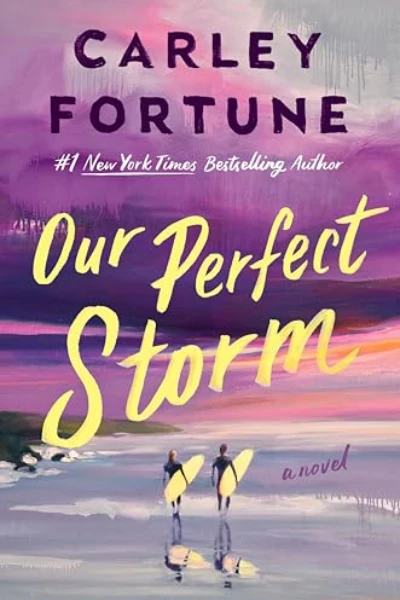
Our Perfect Storm
Our Perfect Storm — Chapter no 33
CHAPTER THIRTY-TWO
ain pelts the car so loudly I have to raise my voice.R “Should we go back?” I ask. We’re wearing the yellow waterproof jackets from the resort, but it’s raining so heavily I can barely make out the mouth of the trail through the windshield.
“Let’s just give it a minute,” George suggests.
I haven’t been able to meet his eyes since we were on the hammock. I’m terrified that as soon as I do, he’s going to see I’m panicking. My mind is a tornado.
How is this happening? Why is this happening? Maybe the mountains and the mist and the rose petals are messing with my head. George and I have been friends for most of our lives—wouldn’t I have felt something
before now?
But I have, haven’t I?
He says something, but I’m distracted and miss it.
“Sorry. What was that?”
“The rain has let up a bit. Do you want to chance it?”
I glance his way, and it’s gobsmacking how good he looks in a yellow anorak. No one looks good in a yellow anorak. He’s far too close to me. I don’t care how wet it is, I need to get out of this car.
“You bet!” I say. “Let’s go for a hike!”
George looks at me like I may have lost it, and yes, I absolutely have.
I pull my hood over my head, but the rain isn’t so bad. It’s little more than a drizzle now. The plant life is so thick that after a few paces, we’re
engulfed by some of the oldest and largest trees in Canada—giants that have survived for hundreds of years. Moss creeps along the wooden railing, and lichen climbs the tree trunks, embroidering the forest in green. George points out the various types of trees—western red cedars, grand firs, and hemlocks. He tells me about how nurse logs support the rainforest ecosystem, but otherwise, we walk in silence. With each turn, we’re presented with an even more staggering sight, another kaleidoscope of emerald, olive, and lime. It doesn’t take long before the beauty drowns out my frantic thoughts.
The rain falls more steadily, but the canopy is so thick, the full extent of the downpour doesn’t reach us. We walk until we reach a fork, where we can take a set of steep stairs into a valley or continue on flat ground. We go down, stopping at the bottom to look up.
The trees are so tall we can’t see their tops. Water drips onto my face. I open my mouth and shut my eyes, tipping my head back and extending my arms, stretching like one of the mighty firs.
I stay that way for a solid minute, and when I open my eyes, I’m awed all over again. The young trees struggling up to the light. The ferns and mosses and bunchberries. The lichen that hangs from the branches like discarded scraps of lace—nature’s unworn wedding gowns.
But I’m also struck by the sight of George. He’s taken off his glasses and has his eyes closed, his face tilted to the sky. He catches a droplet of rain on his tongue, and all I can think about is how much I want to taste him and how badly I want to dig my fingers into his hair. He takes a deep breath and then lets it out with a guttural sigh. I need to swallow that sound.
“I’m having one of those moments,” he says. Beads of water cling to the ends of his curls. One loses its grip and rolls down his nose.
“What kind of moment?” My blood is rushing so loudly, my voice sounds muffled.
“The best kind,” he says, opening his eyes and looking around us. His smile is effervescent. I want to reach out and touch it, to make sure it’s real.
“The kind that makes me grateful to be alive, right here, right now, on this spectacular planet.”
He’s near enough that when he turns to face me, his hand brushes mine.
It’s the most innocent of touches, but my heart thumps wildly. Then George sets his eyes on me, and I know.
It’s not the rose petals or the rainforest. It’s him. My wondrous best
friend.
George.
“But most of all,” he says, “I feel lucky to be here with you.”
I stare into his eyes—they’re as deep and blue as the ocean, and for a moment, I get lost in them. George stops talking, and I know it’s because of
the way my breath is sawing out of me.
“Frankie?”
George isn’t smiling anymore. He’s watching me, his gaze darting across my face. I think he’s figuring it out. Then he blinks, giving his head the smallest shake, like maybe he’s wrong.
I take a step closer. “I’m sorry,” I tell him. “I once made you a promise, but I can’t keep it.”
George’s eyes land on mine as understanding crashes over him.
“I promised I wouldn’t kiss you.”
I reach for the collar of his jacket, taking it in my shaking hands. I stare at his mouth, rising on my toes, giving him an opportunity to pull back.
When I lift my eyes to his, the longing I find in them steals my breath.
“You did,” he says, his voice rough. He looks down at me, a tempest in his eyes. “But I never promised you the same thing.”
And then, as quick as a lightning strike, George’s lips are on mine, devouring my gasp. It’s not a hesitant kiss—it’s demanding, needy. He opens his mouth with the first sweep of my tongue across his bottom lip, and when I get my first real taste of him, I moan. George growls in response, and his hands find mine, looping them around his neck. Then he sets his palms on my hips to urge me closer. Every lash of our tongues feels like an argument, a fight I’m surely losing. His teeth nip at my mouth, and I bite back, sharper. We laugh, but we don’t stop. The rain falls harder, and I can taste it on his lips.
I’m bombarded with memories of George—all the times when I’ve fought my attraction to him.
Our fourteenth birthday party, when he stood on the edge of the diving board. The night he climbed through my bedroom window and looked at me in a way he never had before. The morning in our apartment after we got our tattoos. The night I heard him having sex. And this week. I’ve been fighting it almost every moment we’ve shared since we arrived.
The kiss is like opening a secret compartment in my soul—it’s more intense than anything I’ve experienced. It feels like our lives are at stake.
“Frankie.” George groans out my name, and it hurtles me back to reality.
Our lives may not be on the line, but our friendship is. What the hell are we thinking? George must sense it at the same time I do. When I pause, he takes a full step back. We watch each other, breathing heavily.
“That was…” I shake my head in disbelief. Incredible. Stupid. So
fucking hot. A very bad idea.
“I know,” George says.
“We’ve never done that before.”
“Once,” George says. “We’ve done that once.”
“Not like that.”
He stares at my mouth. “No, not like that.”
“It was…”
George’s eyebrows lift.
“Volcanic,” I say. It felt like we were meant to be kissing all along.
George really knows how to use his mouth. “Do you always kiss like that?”
He shakes his head. “I was going to ask you the same thing.”
“But it was a mistake, wasn’t it?” I ask, thinking out loud. “The last thing I want is to damage our relationship.”
George is nodding along. “Yeah,” he says, but he sounds unsure.
George’s focus returns to my lips. When his gaze finds mine, it’s leaden with want. Something powerful is stirring between us—a force of nature we will only withstand if we’re vigilant.
“You were supposed to be here with someone else.” His voice is hoarse.
“You were supposed to be married.”
“Yeah,” I say, pressing my fingers to my swollen mouth. “There is that.”
But Nate is the last thing on my mind. Nate might as well exist in another galaxy.
“And you’re also just getting out of a relationship,” I say. It’s all I can do not to launch myself at him.
“I kind of forgot about that, to be honest.”
“I kind of forgot about everything,” I say. “Including my name.”
George chuckles, and I find myself smiling back at him.
“So to be clear,” I go on, “that was a lapse in good judgment, yes?
We’re us.”
“Yeah.” He grips the back of his neck, hesitating. “With everything… and the wedding…” He’s usually much more articulate. “This is not the right time.”
I tilt my head. “Would there be a right time?”
George gives me a long look before he answers. “I really don’t know.”
And neither do I. “Should we head back, then?” I ask. This might be less awkward if we’re walking.
The route is a loop, and it’s only another ten minutes before we hear the sound of tires on the wet highway. We’ve hardly said a word to each other, but every time I glance at George, he’s already looking at me. My lips are still tingling when we reach the car.
I take the driver’s seat, worried that if I have free rein to look at George, I may not be able to stop myself from climbing over the console and onto his lap. And if I do that, I doubt I’ll be able to stop myself at all. My body is humming. I’m aware of every breath he takes, every inch of space between us. I smell the forest on his skin as he unzips his jacket. I do the same and then start the engine and turn up the heater, because now that I’ve stopped moving, I’m growing cold. My legs are slick, and the water from my wet hair is soaking into my T-shirt.
“So we should try to forget about it?” George asks.
I nod, then risk peeking at him. My eyes go straight to his lips—lips I was just kissing!—while his slide down to my chest, where the hard buds of
my nipples push against the fabric of my shirt. His gaze drags up to my throat, then my mouth, landing on my eyes.
“We should probably erase it from our memory,” I say.
We can come back from one kiss. We’ve done it before.
“We probably should.”
“But I’m not sure I’m going to be able to,” I admit.
“You called the kiss volcanic,” George murmurs.
“Would you describe it differently?”
“No.” He takes a breath. “That pretty much sums it up.”