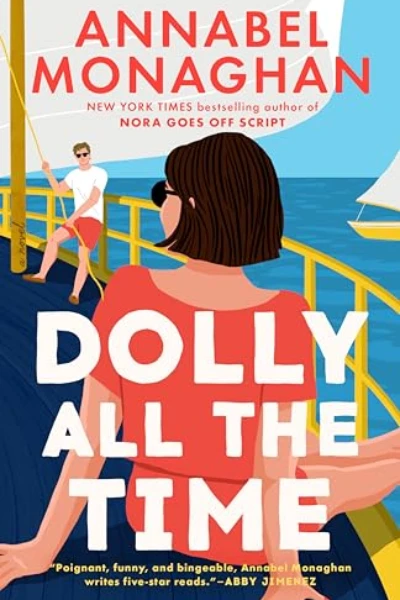
Dolly All the Time
Dolly All the Time — Chapter 24
CHAPTER 24
E’RE TRAVELING BY HELICOPTER TO Boston. I’m assuming this has to doW with weeknight traffic, but I suspect he travels by helicopter on Saturdays too. I think it goes without saying that I have never been in a helicopter before, and I am a swirling cocktail of anxious, excited, and giddy. A black car picks me up on Goose Lane and takes me to the heliport.
Stewart got tied up on a call, so he’ll meet me there. Henry has been working out of the Boston office all week and will meet us at the restaurant.
The clients, the CEO, his son, and his son’s girlfriend all together to evaluate whether Stewart’s vision for the future of Whitfield Industries is worth pursuing. This is actually the sixty-thousand-dollar meal.
I’m in the black dinner dress with the scoop neck and red-soled black pumps. I googled these shoes because the box didn’t have a price tag on it, and I briefly considered returning them in exchange for a month’s rent. I finger my dahlia necklace nervously as we drive.
We pull up right next to the helicopter, blades whirring so loudly that the driver doesn’t hear me thank him. He motions toward the helicopter just as Stewart is ducking out and walking toward me. He’s in a dark blue suit and a crisp white shirt with a green silk tie flying over his shoulder. He looks like he’s coming to claim me, throw me over his shoulder, and steal me away.
He smiles when he’s close and takes my hand without breaking eye contact. He says something under the din of the blades. I can’t hear what it is, but I see it in his eyes, so I mouth, “Thank you.”
He leads me by the hand to the helicopter and gives me a headset. It’s infinitely quieter and I smile at him, excited. “You ready?” I hear it in my
ears and realize our headsets are connected. His voice in my ear is so close, as close as when we were in his galley kitchen, and I feel it meander through my body.
“Yes,” I say, meaning no, and turn toward the window. He lets go of my hand and turns toward his.
I blink and we’re high over Boston. I can see down to the seaport and all the way across the Charles. I look for my place in the distance and think that this is a true miracle of money, the ability to make Boston and Whitfield just minutes apart.
We land on the roof of the Whitfield building and when the blades cut, I take off my headset and hear the sounds of the city below. A few horns honking, the rush of traffic. Stewart thanks the pilot and tells him he’ll be in touch in the morning. We head into the building and into the elevator. He presses Lobby.
“Do we have time to go to your office?” I ask. I’ve pictured it, all very Mad Men in décor, and I’d love to see the view from there. Everything through Stewart’s eyes has a little more possibility.
He looks at his watch. “Sure. Not much to see, but we have time.” He presses thirty, and we woosh back up to the top.
The doors open and a receptionist drops her phone. “Good evening, Mr. Whitfield.”
“Hello,” he says. “We’re just popping in for a bit.”
We head through a sea of charcoal-gray cubicles. Heads pop up in lightly veiled horror at seeing the heir apparent to the C-suite arriving unannounced. He nods in greeting but doesn’t slow down until we reach his office. A man working off two monitors is seated at a desk outside.
“Surprise,” says Stewart, with absolutely no ta-da in his voice.
The man looks up and is immediately on his feet. “Why are you here?
They didn’t cancel. I just confirmed with”—he glances down at his phone —“someone in their office named Patrice. Your dad went home to change.”
“We just had some time. Damion, this is Dolly. Dolly, Damion.” I shake his hand because we are definitely doing business right now. Damion
is dressed in a navy blazer and a red bow tie, giving all the Smithers from The Simpsons vibes.
“Well, hello,” he says, relieved. “Sorry to be such a mess about this dinner tonight. I know the heavy lifting is on you, but I’ve confirmed and reconfirmed this thing six times because if it goes haywire, I don’t want it on me.”
“Anything that goes haywire is on me,” says Stewart, leading me by the arm into his office. It’s the corner, of course, with floor-to-ceiling windows looking out on the Seaport and Boston Harbor. I run my hand along the edge of his leather-topped desk. There’s a wet bar to the left, exactly the Mad Men detail I was expecting. A telescope faces the other window, pointing in the opposite direction, and I walk over to it.
“Who do you spy on?” I ask.
He looks into the telescope, adjusting a few things and then lowering it a bit. “Have a look.”
He steps away and I look into the scope. It takes me a second to focus, but when I do I laugh. “It’s Fenway Park!”
“It is. Home game tonight. If we didn’t have this to do, we could have gone.”
“That sounds so much more relaxing,” I say.
Stewart reaches for my arm and turns me toward him. “Listen, I’m the one under pressure tonight. You’ve already done everything you needed to
do.”
“What did I do?”
“You showed up, looking like a knockout. You just need to seem like you like me.” He laughs a little and looks away, out the window.
I run my hands down the sides of my dress, smoothing imaginary wrinkles. “You’re doing great with the compliment thing.”
He turns back to me. “It’s coming pretty naturally. Must be all the method acting.” He holds me there with his eyes. I am terrified of the unsaid thing, so I walk over to the other window and look out at the
Seaport.
“It’s so pretty,” I say.
“I sure hope so,” he says.
“Why?”
“We own a lot of those buildings. And I suspect we’re a little too concentrated in this area right now.” He stops a deliberate two feet away from me and it feels unnatural. “Which is another reason why tonight matters. The Kramer deal would be a low-risk way to diversify to the West Coast.”
I’m trying to imagine owning a whole building. “Which ones do you own?”
He points at the low skyline. “That,” he says over my shoulder. “And those. The tall one. And everything to the right of that.”
I turn to him. “Seriously?”
He nods.
“Do you own Fenway Park?”
He laughs an actual laugh. “I’ve been trying to buy Fenway Park my
entire adult life. It’s my Moby Dick.”
“This is very disappointing,” I tease.
Damion is in the doorway. “You should head out,” he says.
“Right,” Stewart says.
“Are you okay to walk?” he asks when we’re on the street. “It’s about four blocks.”
“Of course,” I say. Though I’m not exactly wearing sneakers. “Are you nervous about this? How do these things usually go?”
“A little. My dad being here is sort of a formality, a show of our commitment. But I hate having him looking over my shoulder. I just need to get this done. They’ve got a huge amount of money to put into this project, we have the reputation and the experience. They’re basically buying my grandfather’s name and the idea that I inherited his good judgment.”
“Oh God, what if they think you picked the wrong woman?”
“Dolly, you’re probably the first woman I’ve ever picked that wasn’t all wrong. And you were an accident.”
I smile at the sidewalk. “Is that my second compliment? It’s a good one.”
“Third. I gave you one when I first saw you.”
“I couldn’t hear.”
He looks at me and smiles. “Well, I’m not saying it again.”
The restaurant is elegant, with silver-leafed walls and starched white linens. Henry is already at the table and stands as we approach. Stewart’s holding my hand, and I see Henry note it.
“Dolly, so nice that you could join us,” he says.
“We thought it would be fun to get away for the night,” Stewart says, and I busy myself with my napkin. This sounds like sex. Sex is what you do when you are having fun getting away for the night. Stewart and me all tangled up in each other between impossibly soft sheets. The Kramer people arrive and save me from the thought. They are a Nick and Hillary, both in their forties, I’d guess. He’s in a charcoal-gray suit, a pale blue shirt, and no tie. She’s also in a charcoal-gray suit.
“Dolly, thank you for coming,” Hillary says. “Keep this from being a solid meal of deal talk.”
“I don’t mind. If the food’s good, I’ll listen to all the deal talk you’ve got.” No. Weird. Too casual. I eye the bread, whole-wheat buns that I suspect are a little sweet, right next to a big crock of soft butter and a little bowl of sea salt. I am not going to be the first to grab it.
They talk business for a bit, and Stewart takes the lead. He has the artist’s renderings of the restored buildings. A fountain fills a dead space in a courtyard, and an old movie theater is reimagined as a concert venue.
They pass around a summary of the financials everyone has seen before.
Henry asks about permitting issues, and Stewart talks through the design decisions to preserve the historic integrity of the architecture in the area. He talks generally about preservation and his grandfather’s commitment to building things that will last. I hate to admit it, but it’s all very sexy. His mastery of the subject matter, his confidence in his ability to get this done.
The way he listens and responds like he has all the time in the world. He does business exactly like he kisses, actually.
Henry’s looking at the numbers. “It will be a beautiful restoration. No doubt.”
“If we can get all the permitting done quickly, we could start before Thanksgiving,” Nick says.
“It could move to January,” Stewart says. “But not beyond that.”
“I assume you’re all okay with the numbers?” Henry asks, casually.
“We are,” Stewart says, less casually.
“Just seems like you’re going to an awful lot of trouble for not such a great return. Why do you all feel it’s worth the time?”
Stewart places both hands on the table and takes a moment before handing his dad the rendering of the restored buildings. “To make this,” he says. “To make some money, keep the lights on, as you say, while also preserving something beautiful and honoring the largely forgotten craftsmanship that went into building it all. It’s history we can keep walking through.”
Nick nods. “It’s going to do wonders for the neighborhoods around
downtown.”
“Which none of us own,” Henry says.
“We don’t need to own everything,” Stewart says. There’s a bite to his voice.
Hillary says, “We’ve been through this at length with our board. Same conversation. Where we’ve landed is that this project is great for our reputation. What we’re not getting in stellar returns, we are definitely getting in goodwill.”
“Great,” Henry says. “Because that’s where we could all end up
shopping.”
“Dad,” Stewart says, sharp.
The waiter comes with our food, giving us all a pause. I have fettuccine, and Stewart has ravioli. We remark on how lovely it all looks.
When he’s gone, Stewart goes on. “In the long term, we are all going to be proud of what we built. We’re giving people back their history and showing them the best of themselves.”
Henry doesn’t say anything. He’s just looking at Stewart.
“Have you ever been to Addie’s ice cream?” I ask Henry.
“Of course,” he says.
“It’s the old ice cream parlor in Whitfield,” I say to Nick and Hillary.
“Small, with a hand-painted sign hanging on a rusty chain. When my brother was little, he got a chocolate cone there and the scoop fell off outside on the sidewalk. He was so upset, and my dad went in to get him another one. When he came out, he was carrying that huge banana split they sell, the one with the sparklers and the flags and everything? And my brother laughed so hard at the surprise of it all. It’s one of my happiest childhood memories, and when I pass by that old, shingled building with the bad yellow trim, I can still hear it. It’s like I walk right back into that moment, you know? I think Stewart likes doing that for people, by preserving the best of our old things.”
Henry looks at me for a beat. “My dad was the one who invented that sundae. He had a hard time convincing Addie to use the sparklers, but it was Ellen’s birthday and he was adamant.”
“Does Ellen still go there?” I ask.
“She does,” he says. “Every year on her birthday.”
“There you go,” I say. “I go back to Whitfield to see my family, but even if they weren’t there, I’d go to visit my memories.”
“That’s what I’m trying to say,” Stewart says, leaning back and placing his arm on the back of my chair. I feel him relax next to me, and the tips of his fingers graze my neck. “The movie theater alone feels like time travel.
The original brass doors with the big glass panels and the marquee sign surrounded by incandescent bulbs. It’s a moment in time. The hand-carved wood. No one’s building that way anymore, so once it’s gone, it’s gone. It’s exactly the kind of thing your dad would have wanted to preserve.”
Henry says to Nick and Hillary, “I suppose you know Stewart drives a thirty-year-old car.”
“As soon as they build a better one, I’ll buy it,” Stewart says. He raises his glass to his dad with a smile. And then to Nick and Hillary, “I suppose you know my dad lives in a two-hundred-year-old house?”
Henry laughs. “All right, touché.”
“I’d love to see it sometime,” says Nick.
“We should have a closing dinner at Eight Oaks when this is done,”
Stewart says. Everyone loves this idea, and they talk for a while about the timeline for moving forward. I’m wondering if they’ll serve lobster and if my dad will get the order when I have a sinking feeling that this closing dinner will happen in post-Dolly time. They’ll get together to celebrate, and Stewart will have that thirty-something model on his arm. There is no time to sulk over this, because Hillary is asking me where I live.
“Near Boston College,” I say.
“Oh, are you in education?”
“Well, yes. But not at Boston College. I teach kindergarten at Abigail Adams Elementary.” The name of the school lends, I hope, a little gravitas.
“Parking’s terrible around there,” Nick says.
“It is,” I say. I can feel the smile spread across my face. Finally, an area of my expertise. “But I use it to my advantage.” I lean in and tell them about my parking scheme. I actually use the word “arbitrage.”
“Seriously?” Stewart asks. “How did I not know this?”
“Genius,” Henry says, pouring me a bit more wine.
“I’m surprised I haven’t mentioned it,” I say. “It’s currently my favorite thing about my life.”
“Ouch,” Stewart says with a laugh. I love the sound of his laugh and the way it lightens his eyes, so I smile back at him in a way that certainly reassures our dinner partners that he’s my favorite thing about my life. I spear one of Stewart’s ravioli while I can.
Hillary raises her glass to me. “I feel so seen.” I nod like we’re comrades and raise mine back.
“How does this make you feel seen?” Nick asks. “Are you a biker?”
“No,” she says. “But I still hang on to small financial wins like that.
Even after all these years and all this.” She gestures with her hand to the roasted vegetable napoleon and ice-cold Chablis. “My grocery store has BOGO on ground beef on Tuesdays, and as hard as I try, I can’t pass it up.”
“They do that because of Taco Tuesday,” I say, twirling my pasta.
Everyone knows this, but I throw it out there anyway.
“What’s BOGO?” Stewart asks.
I can’t help but laugh. “Come on. It’s buy one, get one.” It’s not registering with him, and this makes me laugh harder. “Free. The get one is free.”
Stewart nods appreciatively. “That does sound like a good deal.”
“BOGO,” Henry says, like he’s trying the word out. “Buy one, get one.”
We’re all laughing now, including Henry, and Hillary confesses that her freezer is packed with single packages of ground beef because she can’t ever pass up a BOGO.
“Dad, we’ve got to get in on this,” Stewart says, laughing.
“I’m taking you to the grocery store on Tuesday,” I say. I rest my hand on his thigh, a gesture I haven’t made before. It’s intimate and I feel his muscles tense under his suit pants. I am about to pull it away when he places his hand on mine to keep it there.