CHRONOLOGY OF VIKTOR
FRANKL’S LIFE AND OF THE
HOLOCAUST
1905 Viktor E. Frankl is born on March 26 in Vienna, Austria.
1928–9 Frankl organizes free counseling for teenagers in Vienna and six other cities. Begins working at the Psychiatric University Clinic.
1930 Frankl is awarded his doctorate in medicine.
1933 Frankl is put in charge of the ward for suicidal women at the psychiatric clinic. On January 30 of this year, Adolf Hitler becomes chancellor of Germany; on April 1, Nazis organize a nationwide boycott of Jewish-owned businesses; on May 10, Nazi supporters burn books written by Jews and political opponents during public rallies across Germany.
1935 The Nazi government decrees the Reich Citizenship Law, which stripped Jews of their German citizenship, and the Law for the Protection of German Blood and Honor, prohibiting intermarriage between Jews and “persons of German or related blood.”
1937 Frankl opens his own practice in neurology and psychology.
1938 German troops enter Austria; Austria is incorporated into the German Reich. During the nationwide Kristallnacht (“Night of Broken Glass”), Nazis and their collaborators burn down synagogues and loot Jewish homes and businesses. At least ninety-one people are killed; approximately thirty thousand Jewish men are arrested and imprisoned in the Dachau, Sachsenhausen, Buchenwald, and Mauthausen concentration camps.
1939 Frankl obtains a visa to the United States but, concerned for his elderly parents, lets it expire and remains in Austria.
On March 15, German troops occupy Czech lands; on September 1, German troops invade Poland, precipitating the beginning of World War II.
1940 Frankl is made head of the neurological department of Rothschild Hospital, the only hospital for Jews in Vienna during the Nazi regime, for the next two years.
1941 Frankl marries his first wife, Tilly Grosser. On June 22, Germany and its Axis forces invade the Soviet Union.
German killing squads called Einsatzgruppen are assigned to identify and kill Jews between the front lines.
Schutzstaffel or SS groups perform their first gassing experiments at Auschwitz.
1942 Frankl is arrested with his wife, father, mother, and brother and taken to the concentration camp at Theresienstadt in German-occupied Czechoslovakia. His father dies of starvation. On January 20, senior Nazi officials meet to discuss plans for the “Final Solution,” their plan for the genocide of Jews across Europe.
1944 Frankl is transported with Tilly to Auschwitz. His mother is sent a week later and is immediately murdered in the gas
chamber; Tilly is moved to the Bergen-Belsen concentration camp in Germany, where she dies at the age of twenty-four.
Frankl is later transported, via Vienna, to the Kaufering and Türkheim concentration camps.
1945 Frankl’s camp is liberated and he returns to Vienna, only to discover the deaths of his loved ones. On April 30, Hitler commits suicide in Berlin; on September 2, World War II is officially ended. The Nuremberg Trials begin, and many Nazi leaders are prosecuted for the crimes of the Holocaust.
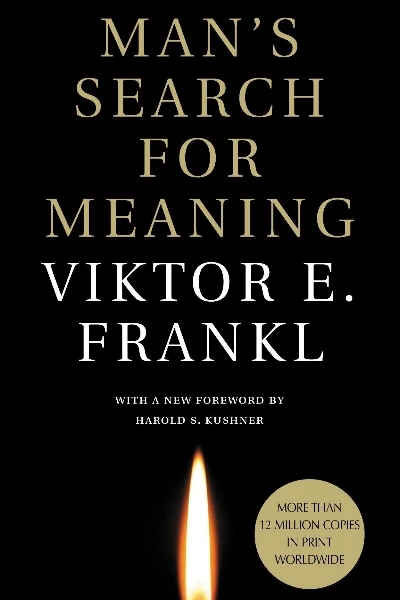
1946 Frankl becomes director of the Vienna Neurological Policlinic, where he stays for twenty-five years. He publishes the German edition of From Death-Camp to Existentialism, the book that would later be titled Man’s Search for Meaning.
1947 Frankl marries Eleonore “Elly” Schwindt, and they have a daughter, Gabriele.
1948 Frankl receives his PhD in philosophy and is made associate professor of neurology and psychiatry at the University of Vienna.
1954 Universities in London, Holland, and Argentina invite Frankl to give lectures. Prominent psychologists in the United States promote Frankl and his works.
1959 From Death-Camp to Existentialism is published in English.
1960 Frankl becomes a guest professor at Harvard University.
1963 From Death-Camp to Existentialism is published under the new title Man’s Search for Meaning.
1966–72 Frankl accepts several guest professorships and teaches across the United States.
1988 On the Memorial Day observing the fiftieth anniversary of Hitler’s invasion, Frankl gives an influential speech in Vienna.
1997 Frankl dies of heart failure at age ninety-two.