Nineteen
TOMATO DAY.
Oh God, if anyone ever found out about it I’d die. There we sat last Saturday in my grandmother’s backyard cutting the bad bits off overripe tomatoes and squeezing them.
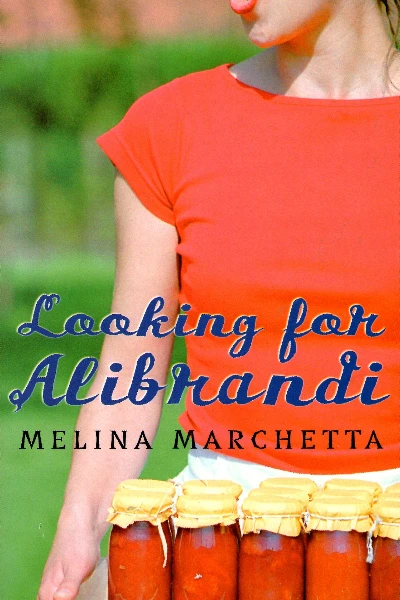
After doing ten crates of those, we boiled them, squashed them, then boiled them again. That in turn made spaghetti sauce. We bottled it in beer bottles and stored it in Nonna’s cellar.
I can’t understand why we can’t go to Franklin’s and buy Leggo’s or Paul Newman’s special sauce. Nonna had heart failure at this suggestion and looked at Mama.
“Where is the culture?” she asked in dismay. “She’s going to grow up, marry an Australian and her children will eat fish-and-chips.”
Robert and I call this annual event “Wog Day” or “National Wog Day.”
We sat around wondering how many other poor unfortunates our age were doing the same, but we were sure we’d never find out because nobody would admit to it.
His grandmother and mother and father and brothers and sisters came over as well and we all sat around like Sicilian peasants. My Zio Ricardo had a hanky on his head with each of the four sides tied in a knot. By the end of the day all the little kids had the same type of headpiece.
“We have been doing this for over forty years, Guiseppina,” my Zia Patrizia told me, wiping her hands on a polka-dot apron (the same apron as every other woman in the yard because my second cousin Rita had once bought ten meters of material on sale).
Nonna and Zia Patrizia were sitting side by side, beaming at me. They look very similar except Zia Patrizia isn’t as vain as Nonna and has done nothing about her graying hair. I looked over to where Mama was with Zio
Ricardo, wishing she would look my way. I wanted her to save me from Zia Patrizia and Nonna Katia. From their reminiscing and gossip.
“Remember the year Marcus Sandford helped us, Katia? An Australiano squeezing tomatoes wit us.”
“Marcus Sandford?” I asked, looking at Nonna. “He came back on the scene?”
“Who’s Marcus Sandford?” Robert asked, wiping his hands on my T- shirt.
“He was an Australian policeman who helped Katia and me when Nonno Ricardo and your Zio Francesco were in camp.”
“What camp?” Robert asked.
“During the war Zio Ricardo was working with Nonno Francesco in the sugar fields, so I had to look after Patrizia because she was pregnant again,”
Nonna explained to us.
“One day,” Zia Patrizia interrupted, “they came wit the truck. They started from the north of Queensland and drove down. They took every Italian man. Even the boys. It was because of that bastardo Mussolini.”
“Aliens, they called us,” Nonna Katia said. “They caught Francesco in the first truckload, but it took them days to find Zio Ricardo.”
“Ah, Madonna mia,” Zia Patrizia said, waving the knife in her hand around. “We cried and cried. What were we going to do? we asked ourselves. Where is Ricardo? Is he dead?”
She was fanning herself and Robert patted her hand.
“It’s okay, Nonna, you know he’s not dead. Don’t get worked up.”
We exchanged looks, grinning at their theatrics.
“An Australian family down the road was hiding him.” Nonna tried to get in before Zia Patrizia. “Zio Ricardo was one of the very few Italians who went out and mingled wit the Australians. He learned the language and demanded that everyone spoke it. Nonno Francesco refused to and wouldn’t let me learn, but Zio Ricardo was strong and taught Patrizia, so she taught me during the day.”
“Did they ever find him?” Robert asked.
“Ah, Dio mio,” Zia Patrizia prayed.
Robert and I rolled our eyes again.
“He snuck around during the night to be wit us, but one day those people next door, Turner . . . Thompson, whatever their stupid name was, they told on him. If I saw them today I would spit on their faces.”
They both swore in Italian, agreeing with each other.
“There we were, Giuseppina, two defenseless women on our own. Me, wit one little boy and a baby on the way. Katia wit her garden ruined because nobody could look after it. We had no money. Snakes came into our house, Roberto, snakes!”
“So one day I said enough is enough,” Nonna butted in, whipping her hands in the air dramatically. “I went to speak to the army.”
“We all were hysterical,” Zia Patrizia said. “ ‘No, Katia,’ we pleaded.
The other Italian women went crazy. We thought that the army was going to come around and take us or our children next, but Katia said ‘enough.’ ”
“I thought that maybe if I spoke to someone they would feel sorry for us and send us back one man. Maybe all our husbands.”
“But they didn’t,” Zia Patrizia hissed. “So she is walking out and this big tall Australiano stops her. ‘Katia?’ he says. We all look at her. How could Katia know this man?”
“It was Marcus Sandford,” Nonna giggled to me. “He was in the army. It had been two years since I had seen him. He was pleased to see me. Pleased that my English was better, and when he heard about our problems, he did all he could to have one of the men released. But it was impossible. All he could do was reassure us that they were treated well. But we didn’t want reassurance. We needed an extra pair of hands.
“So Marcus Sandford became our extra pair of hands. He squeezed the tomatoes wit us, he helped us grow our spinach, he fixed the garden, everyting.
“But the other women,” Nonna Katia groaned. “Remember, Patrizia, Signora Grenaldo? Talk talk talk. ‘What is a man doing in Katia Alibrandi’s house?’ she would ask. Stickybeak.”
“But we did not care. It was all innocent,” Zia Patrizia defended. “He helped us. He loved my little Roberto and he even helped deliver your Zio Salvatore, Roberto.”
“Is little Roberto the one who died?” I asked.
They both made the sign of the cross and kissed their fingers.
“Oh, my gioia Robertino. I still cry for him, Katia. I still cry.”
“One day when we couldn’t find him, everybody started looking. Italian, Australian, Spanish . . . everyone,” Nonna Katia said. “For one whole day we looked for little Robertino. Marcus? He never stopped.
“Even the Australian women came around wit tea and sandwiches while we prayed and cried. Later that night while we sat on the veranda watching the searchlights through the trees, Marcus walked through holding someting in his arms. He was crying. I was crying. Patrizia was crying. We walked toward him looking at what he had in his arms.”
“It was my little Robertino. He had drown in the creek,” Zia Patrizia said quietly.
“He put Robertino in my arms, still crying.”
“And I yelled and yelled,” Nonna Katia said, looking at Zia Patrizia.
“Screamed wit such anger. I blamed Marcus Sandford. I blamed this country. If the men hadn’t been away we would have been able to see what Roberto was doing, but we were too busy being the men of the house because the Australians had our men in their camps.”
“Everyone in the town came to the funeral. Remember, Katia? But we never saw Marcus Sandford again.”
I looked at Nonna Katia, but she turned away. Somehow I doubted that she never saw him again.
“Enough of old stories. How about you, Giuseppina? Do you have a boyfriend?” Zia Patrizia asked me.
“I’ve got one hundred boyfriends, Zia,” I said, kissing her, picking up the tub full of tomatoes and taking them to where Mama and Zio Ricardo were.
Like all tomato days we had spaghetti that night. Made by our own hands. A tradition that we’ll never let go. A tradition that I probably will never let go of either, simply because like religion, culture is nailed into you so deep you can’t escape it. No matter how far you run.