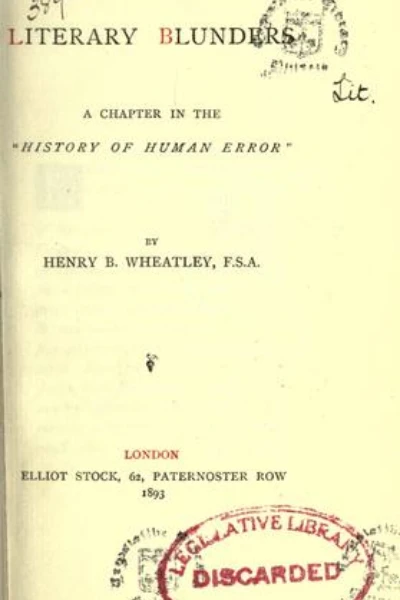
Literary Blunders is an incredibly charming, deeply entertaining non-fiction text cleanly compiled by British editor Henry B. Wheatley effectively in 1893. Operating as a fascinating exploration of historical textual errors, it humorously documents famously massive misprints, terrible translation accidents, funny grammatical mistakes, and severe editorial blunders that completely transformed classic historic books. It uniquely perfectly highlights exactly the incredible absurdity accompanying human literary production exactly before advanced widespread technological digitization.
Subjects
Non-FictionLiterary HistoryHenry B. Wheatley BooksBook Editing HistoryTextual Criticism19th Century ResearchHumorous Non-FictionFree Texts
GenreNon-Fiction
ReleasedN/A
LanguageEnglish
LicensePublic domain in the USA.
AuthorHenry B. Wheatley
Rating
0.0
0 reviews
Customer Reviews
0.0
0 Ratings
No reviews yet. Be the first to review!
, <!>, , <'>, <'m>, <u>, <?>, <:>, , , and "Larsen EB-11" encodes are used. Comments in {brackets} need stripped. <?> is a special encode for unknown/non ASCII characters. Greek characters are in the Adobe symbol font delimited by italics and may be transposed ?? (they look alike to me.) Footnotes are moved from end of page to end of paragraph position. They are renumbered sequentially as well. (No. [14] is obtrusive) Uncertain characters are marked ?? No "emphasis" italics_ marked.
A bit of latin, greek, french, and olde englishe need spellchecked. this whole etext NEEDS spellchecked too!! Index needs checked! There is a
on "pages" 110-111 that have LOTS of non-ascii characters. Many have the correct encode, but layout needs work!!!
Scanned by Charles Keller with
OmniPage Professional OCR software
donated by Caere Corporation, 1-800-535-7226.
Contact Mike Lough
LITERARY BLUNDERS
A CHAPTER IN THE
``HISTORY OF HUMAN ERROR''
BY HENRY B. WHEATLEY, F.S.A.
PREFACE.
----
EVERY reader of The Caxtons
_will remember the description,
in that charming novel,
of the gradual growth of Augustine
Caxton's great work ``The History
of Human Error,'' and how, in fact,
the existence of that work forms the
pivot round which the incidents turn.
It was modestly expected to extend to
five quarto volumes, but only the first
seven sheets were printed by Uncle
Jack's Anti-Publishers' Society, ``with
sundry unfinished plates depicting the
various developments of the human
skull (that temple of Human Error),''
and the remainder has not been heard
of since.
In introducing to the reader a small
branch of this inexhaustible subject, I
have ventured to make use of Augustine
Caxton's title; but I trust that
no one will allow himself to imagine
that I intend, in the future, to produce
the thousand or so volumes which will
be required to complete the work.
A satirical friend who has seen the
proofs of this little volume says it
should be entitled ``Jokes Old and New'';
but I find that he seldom acknowledges
that a joke is new, and I hope, therefore,
my readers will transpose the
adjectives, and accept the old jokes for
the sake of the new ones. I may claim,
at least, that the series of answers to
examination questions, which Prof.
Oliver Lodge has so kindly supplied
me with, comes within the later class.
I trust that if some parts of the
book are thought to be frivolous, the
chapters on lists of errata and misprints
may be found to contain some
useful literary information.
I have availed myself of the published
communications of my friends
Professors Hales and Skeat and Dr.
Murray on Literary Blunders, and
my best thanks are also due to several
friends who have helped me with some
curious instances, and I would specially
mention Sir George Birdwood,
K.C.I.E., C.SI.., Mr. Edward Clodd,
Mr. R. B. Prosser, and Sir Henry
Trueman Wood.<p >
CONTENTS.
----
CHAPTER
BLUNDERS IN GENERAL.
PAGE
Distinction between a blunder and a mistake-- Long life of a literary blunder --Professor Skeat's ``ghost words''-- Dr. Murray's ``ghost words''--Marriage Service--Absurd etymology-- Imaginary persons--Family pride-- Fortunate blunders--Misquotations-- Bulls from Ireland and elsewhere . . . . . . . . . . . . . . . .1
``Translators are traitors''--Amusing translations--Translations of names-- Cinderella--``Oh that mine adversary had written a book''--Perversions of the true meaning . . . . . . . . . . . . . . . . . . . . . . . . . 47
Early use of errata--Intentional blunders-- Authors correct their books--Ineffectual attempts to be immaculate--Misprints never corrected. . . . . . . . . . . . . . . . . . . . . . . . 78
CHAPTER VI.
MISPRINTS.
Misprints not always amusing--A Dictionary of Misprints--Blades's Shakspere and Typography--Upper and lower cases--Stops--Byron--Wicked Bible--Malherbe--Coquilles--Hood's lines--Chaucer--Misplacement of type . . . . . . . . . . . . .100
PAGE CHAPTER VII.
SCHOOLBOYS' BLUNDERS.
Cleverness of these blunders-- Etymological guesses--English as she is Taught--Scriptural confusions-- Musical blunders--History and geography-- How to question--Professor Oliver Lodge's specimens of answers to examination papers . . . . . . . . . . . . . . . . . . . . . .157
CHAPTER VIII.
FOREIGNERS ENGLISH.
Exhibition English--French Work on the Societies of the World--Hotel keepers' English--Barcelona Exhibition--Paris Exhibition of 1889--How to learn English-- Foreign Guides in so called English --Addition to God save the King-- Shenstone. . . . . . . . . . . . . . . . . . . . . . . . . . .188
THE words ``blunder'' and ``mistake''
are often treated as
synonyms; thus we usually
call our own blunders mistakes, and
our friends style our mistakes blunders.
In truth the class of blunders is a sub-
division of the genus mistakes. Many
mistakes are very serious in their
consequences, but there is almost always some
sense of fun connected with a blunder,
which is a mistake usually caused by some
mental confusion. Lexicographers state
that it is an error due to stupidity and
carelessness, but blunders are often caused
by a too great sharpness and quickness.
Sometimes a blunder is no mistake at all,
as when a man blunders on the right
explanation; thus he arrives at the right goal,
but by an unorthodox road. Sir Roger
L'Estrange says that ``it is one thing to
forget a matter of fact, and another to blunder upon the reason of it.''
Some years ago there was an article in
the Saturday Review on ``the knowledge
necessary to make a blunder,'' and this
title gives the clue to what a blunder really
is. It is caused by a confusion of two
or more things, and unless something is
known of these things a blunder cannot
be made. A perfectly ignorant man has
not sufficient knowledge to make a blunder.
An ordinary blunder may die, and do
no great harm, but a literary blunder often
has an extraordinary life. Of literary
blunders probably the philological are the
most persistent and the most difficult to
kill. In this class may be mentioned (1)
Ghost words, as they are called by Professor
Skeat--words, that is, which have been
registered, but which never really existed;
(2) Real words that exist through a mis
take;
and (3) Absurd etymologies, a large
division crammed with delicious blunders.
1. Professor Skeat, in his presidential
address to the members of the Philological
Society in 1886, gave a most interesting
account of some hundred ghost words, or
words which have no real existence. Those
who wish to follow out this subject must
refer to the Philological Transactions, but
four specially curious instances may be
mentioned here. These four words are
``abacot,'' ``knise,'' ``morse,'' and ``polien.'' Abacot is defined by Webster as ``the cap
of state formerly used by English kings,
wrought into the figure of two crowns'';
but Dr. Murray, when he was preparing
the New English Dictionary, discovered
that this was an interloper, and unworthy
of a place in the language. It was found
to be a mistake for by-cocket, which is the
correct word. In spite of this exposure
of the impostor, the word was allowed
to stand, with a woodcut of an abacot,
in an important dictionary published
subsequently, although Dr. Murray's
remarks were quoted. This shows how
difficult it is to kill a word which has
once found shelter in our dictionaries. Knise is a charming word which first
appeared in a number of the _Edinburgh
Review_ in 1808. Fortunately for the fun
of the thing, the word occurred in an
article on Indian Missions, by Sydney
Smith. We read, ``The Hindoos have
some very strange customs, which it would
be desirable to abolish. Some swing on
hooks, some run knises through their
hands, and widows burn themselves to
death.'' The reviewer was attacked for
his statement by Mr. John Styles, and he
replied in an article on Methodism printed
in the Edinburgh in the following year.
Sydney Smith wrote: ``Mr. Styles is
peculiarly severe upon us for not being more
shocked at their piercing their limbs with knises . . . it is for us to explain the plan
and nature of this terrible and unknown
piece of mechanism. A knise, then, is
neither more nor less than a false print in
the Edinburgh Review for a knife; and
from this blunder of the printer has Mr.
Styles manufactured this Ddalean instrument
of torture called a knise.'' A similar
instance occurs in a misprint of a passage
of one of Scott's novels, but here there is
the further amusing circumstance that the
etymology of the false word was settled to
the satisfaction of some of the readers. In
the majority of editions of The Monastery,
chapter x., we read: ``Hardened wretch
(said Father Eustace), art thou but this
instant delivered from death, and dost thou
so soon morse thoughts of slaughter?''
This word is nothing but a misprint of nurse; but in Notes and Queries two
independent correspondents accounted for the
word morse etymologically. One explained
it as ``to prime,'' as when one primes a
musket, from O. Fr. amorce, powder for the
touchhole (Cotgrave), and the other by ``to
bite'' (Lat. mordere), hence ``to indulge
in biting, stinging or gnawing thoughts of
slaughter.'' The latter writes: ``That the
word as a misprint should have been
printed and read by millions for fifty
years without being challenged and altered
exceeds the bounds of probability.'' Yet
when the original MS. of Sir Walter Scott
was consulted, it was found that the word
was there plainly written nurse.
The Saxon letter for th () has long
been a sore puzzle to the uninitiated, and
it came to be represented by the letter y.
Most of those who think they are writing
in a specially archaic manner when they
spell ``ye'' for ``the'' are ignorant of this,
and pronounce the article as if it were the
pronoun. Dr. Skeat quotes a curious instance
of the misreading of the thorn ()
as p, by which a strange ghost word is
evolved. Whitaker, in his edition of Piers
Plowman, reads that Christ ``polede for
man,'' which should be tholede, from tholien, to suffer, as there is no such
verb as polien.
Dr. J. A. H. Murray, the learned editor
of the Philological Society's _New English
Dictionary_, quotes two amusing instances
of ghost words in a communication to Notes and Queries (7th S., vii. 305). He
says: ``Possessors of Jamieson's Scottish
Dictionary will do well to strike out the
fictitious entry cietezour, cited from Bellenden's Chronicle in the plural cietezouris,
which is merely a misreading of cietezanis
(i.e. with Scottish z = = y), cieteyanis or
citeyanis, Bellenden's regular word for citizens. One regrets to see this absurd
mistake copied from Jamieson (unfortunately
without acknowledgment) by the
compilers of Cassell's Encyclopdic Dictionary.''
``Some editions of Drayton's Barons Wars, Bk. VI., st. xxxvii., read--
`` `And ciffy Cynthus with a thousand birds,'
which nonsense is solemnly reproduced in
Campbell's Specimens of the British Poets,
iii. 16. It may save some readers a needless
reference to the dictionary to remember
that it is a misprint for cliffy, a favourite
word of Drayton's.''
2. In contrast to supposed words that
never did exist, are real words that exist
through a mistake, such as apron and adder,
where the n, which really belongs to the
word itself, has been supposed, mistakenly,
to belong to the article; thus apron should
be napron (Fr. naperon), and adder should
be nadder (A.-S. nddre). An amusing
confusion has arisen in respect to the
Ridings of Yorkshire, of which there are
three. The word should be triding, but
the t has got lost in the adjective, as West
Triding became West Riding. The origin of
the word has thus been quite lost sight of,
and at the first organisation of the Province
of Upper Canada, in 1798, the county of
Lincoln was divided into four ridings and
the county of York into two. York was
afterwards supplied with four.
Sir Henry Bennet, in the reign of
Charles II., took his title of Earl of
Arlington owing to a blunder. The proper
name of the village in Middlesex is
Harlington.
A curious misunderstanding in the
Marriage Service has given us two words
instead of one. We now vow to remain
united till death us do part, but the
original declaration, as given in the first
Prayer Book of Edward VI., was: ``I, N.,
take thee N., to my wedded wife, to have
and to hold from this day forward, for
better, for worse, for richer, for poorer, in
sickness and in health, to love and to
cherish, till death us depart [or separate].''
It is not worth while here to register the
many words which have taken their present
spelling through a mistaken view of their
etymology. They are too numerous, and
the consideration of them would open up a
question quite distinct from the one now
under consideration.
3. Absurd etymology was once the rule,
because guessing without any knowledge
of the historical forms of words was
general; and still, in spite of the modern
school of philology, which has shown us
the right way, much wild guessing continues
to be prevalent. It is not, however,
often that we can point to such a brilliant
instance of blundering etymology as that
to be found in Barlow's English Dictionary
(1772). The word porcelain is there
said to be ``derived from pour cent annes,
French for a hundred years, it having been
imagined that the materials were matured
underground for that term of years.''
Richardson, the novelist, suggests an
etymology almost equal to this. He
writes, ``What does correspondence mean?
It is a word of Latin origin: a compound
word; and the two elements here brought
together are respondeo, I answer, and cor,
the heart: i.e., I answer feelingly, I reply
not so much to the head as to the heart.''
Dr. Ash's English Dictionary, published
in 1775, is an exceedingly useful work, as
containing many words and forms of words
nowhere else registered, but it contains
some curious mistakes. The chief and
best-known one is the explanation of the
word curmudgeon--``from the French
cur, unknown, and mechant, a correspondent.''
The only explanation of this
absurdly confused etymology is that an
ignorant man was employed to copy from
Johnson's Dictionary, where the authority
was given as ``an unknown correspondent,''
and he, supposing these words to be a
translation of the French, set them down
as such. The two words esoteric and exoteric were not so frequently used in the
last century as they are now; so perhaps
there may be some excuse for the following
entry: ``Esoteric (adj. an incorrect
spelling) exoteric.'' Dr. Ash could not
have been well read in Arthurian literature,
or he would not have turned the noble
knight Sir Gawaine into a woman, ``the
sister of King Arthur.'' There is a story
of a blunder in Littleton's Latin Dictionary,
which further research has proved to be
no mistake at all. It is said that when
the Doctor was compiling his work, and
announced the word concurro to his
amanuensis, the scribe, imagining from the
sound that the six first letters would give
the translation of the verb, said ``Concur,
sir, I suppose?'' to which the Doctor
peevishly replied, ``Concur--condog!''
and in the edition of 1678 ``condog'' is
printed as one interpretation of concurro.
Now, an answer to this story is that, however
odd a word ``condog'' may appear,
it will be found in Henry Cockeram's English Dictionarie, first published in
1623. The entry is as follows: ``to agree,
concurre, cohere, condog, condiscend.''
Mistakes are frequently made in respect
of foreign words which retain their original
form, especially those which retain their
Latin plurals, the feminine singular being
often confused with the neuter plural. For
instance, there is the word animalcule
(plural animalcules), also written _animalculum (plural animalcula_). Now, the
plural animalcula is often supposed to be
the feminine singular, and a new plural is
at once made--animalcul. This blunder
is one constantly being made, while it is
only occasionally we see a supposed plural
strat in geology from a supposed singular
strata, and the supposed singular formulum
from a supposed plural formula will probably
turn up some day.
In connection with popular etymology,
it seems proper to make a passing mention
of the sailors' perversion of the Bellerophon
into the Billy Ruffian, the Hirondelle
into the Iron Devil, and La Bonne
Corvette into the Bonny Cravat. Some
of the supposed changes in public-house
signs, such as Bull and Mouth from
``Boulogne mouth,'' and Goat and Compasses
from ``God encompasseth us,'' are
more than doubtful; but the Bacchanals
has certainly changed into the Bag o' nails,
and the George Canning into the George
and Cannon. The words in the language
that have been formed from a false analogy
are so numerous and have so often been
noted that we must not allow them to
detain us here longer.
Imaginary persons have been brought
into being owing to blundering misreading.
For instance, there are many saints
in the Roman calendar whose individuality
it would not be easy to prove. All
know how St. Veronica came into being,
and equally well known is the origin of
St. Ursula and her eleven thousand virgins.
In this case, through the misreading of
her name, the unfortunate virgin martyr
Undecimilla has dropped out of the
calendar.
Less known is the origin of Saint Xynoris,
the martyr of Antioch, who is noticed in
the Martyrologie Romaine of Baronius.
Her name was obtained by a misreading
of Chrysostom, who, referring to two
martyrs, uses the word <gr xunwrs> (couple or
pair).
In the City of London there is a church
dedicated to St. Vedast, which is situated
in Foster Lane, and is often described as
St. Vedast, alias Foster. This has puzzled
many, and James Paterson, in his _Pietas
Londinensis_ (1714), hazarded the opinion
that the church was dedicated to ``two
conjunct saints.'' He writes: ``At the
first it was called St. Foster's in memory
of some founder or ancient benefactor,
but afterwards it was dedicated to St.
Vedast, Bishop of Arras.'' Newcourt
makes a similar mistake in his Reper
torium
, but Thomas Fuller knew the
truth, and in his Church History refers to
``St. Vedastus, anglice St. Fosters.'' This
is the fact, and the name St. Fauster or
Foster is nothing more than a corruption
of St. Vedast, all the steps of which we
now know. My friend Mr. Danby P. Fry
worked this out some years ago, but his
difficulty rested with the second syllable
of the name Foster; but the links in the
chain of evidence have been completed
by reference to Mr. H. C. Maxwell Lyte's
valuable Report on the Manuscripts of the
Dean and Chapter of St. Paul's. The
first stage in the corruption took place in
France, and the name must have been
introduced into this country as Vast.
This loss of the middle consonant is in
accordance with the constant practice in
early French of dropping out the consonant
preceding an accented vowel, as reine from regina. The change of Augustine to Austin is an analogous
instance. Vast would here be pronounced Vaust, in the same way as the word vase
is still sometimes pronounced vause. The
interchange of v and f, as in the cases of
Vane and Fane and fox and vixen, is too
common to need more than a passing
notice. We have now arrived at the form
St. Faust, and the evidence of the old
deeds of St. Paul's explains the rest,
showing us that the second syllable has grown
out of the possessive case. In one of
8 Edward III. we read of the ``King's
highway, called Seint Fastes lane.'' Of
course this was pronounced St. Fausts,
and we at once have the two syllables.
The next form is in a deed of May 1360,
where it stands as ``Seyn Fastreslane.''
We have here, not a final r as in the latest
form, but merely an intrusive trill. This
follows the rule by which thesaurus became treasure, Hebudas, Hebrides, and _culpatus,
culprit_. After the great Fire of London,
the church was re-named St. Vedast (alias
Foster)--a form of the name which it
had never borne before, except in Latin
deeds as Vedastus.[1] More might be said
of the corruptions of names in the cases
of other saints, but these corruptions are
more the cause of blunders in others than
blunders in themselves. It is not often
that a new saint is evolved with such an
English name as Foster.
[1] See an article by the Author in The Athenum,
January 3rd, 1885, p. 15; and a paper by the
Rev. W. Sparrow Simpson in the _Jourral of
the British Archological Association_ (vol. xliii.,
p. 56).
The existence of the famous St. Vitus
has been doubted, and his dance (_Chorea
Sancti Vit_) is supposed to have been
originally chorea invita. But the strangest
of saints was S. Viar, who is thus accounted
for by D'Israeli in his _Curiosities of
Literature_:--
``Mabillon has preserved a curious
literary blunder of some pious Spaniards
who applied to the Pope for consecrating a
day in honour of Saint Viar. His Holiness
in the voluminous catalogue of his saints
was ignorant of this one. The only proof
brought forward for his existence was this
inscription:--
S. VIAR.
An antiquary, however, hindered one more
festival in the Catholic calendar by
convincing them that these letters were only
the remains of an inscription erected for
an ancient surveyor of the roads; and he
read their saintship thus:--
[PREFECTV]S VIAR[VM].''
Foreign travellers in England have
usually made sad havoc of the names of
places. Hentzner spelt Gray's Inn and
Lincoln's Inn phonetically as Grezin and
Linconsin, and so puzzled his editor that he
supposed these to be the names of two
giants. A similar mistake to this was that
of the man who boasted that ``not all the
British House of Commons, not the whole
bench of Bishops, not even Leviticus himself,
should prevent him from marrying his
deceased wife's sister.'' One of the jokes
in Mark Twain's Huckleberry Finn
(ch. xxiii.) turns on the use of this same
expression ``Leviticus himself.''
The picturesque writer who draws a
well-filled-in picture from insufficient data
is peculiarly liable to fall into blunders,
and when he does fall it is not surprising
that less imaginative writers should
chuckle over his fall. A few years ago
an American editor is said to have received
the telegram ``Oxford Music Hall
burned to the ground.'' There was not
much information here, and he was ignorant
of the fact that this building was in
London and in Oxford Street, but he was
equal to the occasion. He elaborated a
remarkable account of the destruction
by fire of the principal music hall of
academic Oxford. He told how it was
situated in the midst of historic colleges
which had miraculously escaped destruction
by the flames. These flames, fanned
into a fury by a favourable wind, lit up
the academic spires and groves as they
ran along the rich cornices, lapped the
gorgeous pillars, shrivelled up the roof
and grasped the mighty walls of the
ancient building in their destructive
embraces.
In 1882 an announcement was made
in a weekly paper that some prehistoric
remains had been found near the Church
of San Francisco, Florence. The note
was reproduced in an evening paper and
in an antiquarian monthly with words in
both cases implying that the locality of
the find was San Francisco, California.
It is a common mistake of those who
have heard of Grolier bindings to suppose
that the eminent book collector was a
binder; but this is nothing to that of the
workman who told the writer of this that
he had found out the secret of making
the famous Henri II. or Oiron ware. ``In
fact,'' he added, ``I could make it as well
as Henry Deux himself.'' The idea of the
king of France working in the potteries
is exceedingly fine.
Family pride is sometimes the cause
of exceedingly foolish blunders. The
following amusing passage in Anderson's Genealogical History of the House of Yvery
(1742) illustrates a form of pride ridiculed
by Lord Chesterfield when he set up on
his walls the portraits of Adam de Stanhope
and Eve de Stanhope. The having a
stutterer in the family will appear to most
readers to be a strange cause of pride.
The author writes: ``It was usual in ancient
times with the greatest families, and is by
all genealogists allowed to be a mighty
evidence of dignity, to use certain nicknames
which the French call sobriquets . . .
such as `the Lame' or `the Black.'. . .
The house of Yvery, not deficient in any
mark or proof of greatness and antiquity,
abounds at different periods in instances
of this nature. Roger, a younger son of
William Youel de Perceval, was surnamed
Balbus or the Stutterer.''
Sometimes a blunder has turned out
fortunate in its consequences; and a
striking instance of this is recorded in the
history of Prussia. Frederic I. charged
his ambassador Bartholdi with the mission
of procuring from the Emperor of Germany
an acknowledgment of the regal
dignity which he had just assumed. It
is said that instructions written in cypher
were sent to him, with particular directions
that he should not apply on this subject
to Father Wolff, the Emperor's confessor.
The person who copied these instructions,
however, happened to omit the word not
in the copy in cypher. Bartholdi was
surprised at the order, but obeyed it and
made the matter known to Wolff; who,
in the greatest astonishment, declared that
although he had always been hostile to
the measure, he could not resist this
proof of the Elector's confidence, which
had made a deep impression upon him.
It was thought that the mediation of the
confessor had much to do with the
accomplishment of the Elector's wishes.
Misquotations form a branch of literary blunders which may be mentioned here.
The text ``He may run that readeth
it'' (Hab. ii. 2) is almost invariably
quoted as ``He who runs may read'';
and the Divine condemnation ``In the
sweat of thy face shalt thou eat bread'
(Gen. iii. 19) is usually quoted as ``sweat
of thy brow.''
The manner in which Dr. Johnson
selected the quotations for his Dictionary
is well known, and as a general rule
these are tolerably accurate; but under
the thirteenth heading of the verb to
sit will be found a curious perversion
of a text of Scripture. There we read,
``Asses are ye that sit in judgement-- Judges,'' but of course there is no such
passage in the Bible. The correct reading
of the tenth verse of the fifth chapter is:
``Speak, ye that ride on white asses, ye
that sit in judgment, and walk by the
way.''
From misquotations it is an easy step
to pass to mispronunciations. These are
mostly too common to be amusing, but
sometimes the blunderers manage to hit
upon something which is rather comic.
Thus an ignorant reader coming upon a
reference to an angle of forty-five degrees
was puzzled, and astonished his hearers
by giving it out as angel of forty-five
degrees. This blunderer, however, was
outdone by the speaker who described a
distinguished personage ``as a very
indefatgable young man,'' adding, ``but even
he must succmb'' (suck 'um) at last.
As has already been said, blunders are
often made by those who are what we
usually call ``too clever by half.'' Surely
it was a blunder to change the time-
honoured name of King's Bench to
Queen's Bench. A queen is a female
king, and she reigns as a king; the
absurdity of the change of sex in the
description is more clearly seen when
we find in a Prayer-book published soon
after the Queen's accession Her Majesty
described as ``our Queen and Governess.''
Editors of classical authors are often
laughed at for their emendations, but
sometimes unjustly. When we consider
the crop of blunders that have gathered
about the texts of celebrated books, we
shall be grateful for the labours of brilliant
scholars who have cleared these away
and made obscure passages intelligible.
One of the most remarkable emendations
ever made by an editor is that of
Theobald in Mrs. Quickly's description of
Falstaff's deathbed (King Henry V., act ii.,
sc. 4). The original is unintelligible:
``his nose was as sharp as a pen and a
table of greene fields.'' A friend suggested
that it should read `` 'a talked,'' and
Theobald then suggested `` 'a babbled,'' a reading
which has found its way into all texts,
and is never likely to be ousted from its
place. Collier's MS. corrector turned the
sentence into ``as a pen on a table of
green frieze.'' Very few who quote this
passage from Shakespeare have any notion
of how much they owe to Theobald.
Sometimes blunders are intentionally
made--malapropisms which are understood
by the speaker's intimates, but often
astonish strangers--such as the expressions
``the sinecure of every eye,'' ``as white
as the drivelling snow.''[2] Of intentional
mistakes, the best known are those which
have been called cross readings, in which
the reader is supposed to read across the
page instead of down the column of a
newspaper, with such results as the following:--
[2] See Spectator, December 24th, 1887, for specimens of family lingo.
``A new Bank was lately opened at Northampton-- no money returned.''
``The Speaker's public dinners will
commence next week--admittance, 3/- to
see the animals fed.''
As blunders are a class of mistakes, so
``bulls'' are a sub-class of blunders. No
satisfactory explanation of the word has
been given, although it appears to be
intimately connected with the word
blunder. Equally the thing itself has not
been very accurately defined.
The author of A New Booke of Mistakes,
1637, which treats of ``Quips,
Taunts, Retorts, Flowts, Frumps, Mockes,
Gibes, Jestes, etc.,'' says in his address to
the Reader, ``There are moreover other
simple mistakes in speech which pass
under the name of Bulls, but if any man
shall demand of mee why they be so
called, I must put them off with this
woman's reason, they are so because they
bee so.'' All the author can affirm is
that they have no connection with the
inns and playhouses of his time styled
the Black Bulls and the Red Bulls.
Coleridge's definition is the best: ``A
bull consists in a mental juxtaposition of
incongruous ideas with the sensation but
without the sense of connection.''[3]
[3] Southey's Omniana, vol. i., p. 220.
Bulls are usually associated with the
Irish, but most other nations are quite
capable of making them, and Swift is said
to have intended to write an essay on
English bulls and blunders. Sir Thomas
Trevor, a Baron of the Exchequer 1625-49,
when presiding at the Bury Assizes, had a
cause about wintering of cattle before him.
He thought the charge immoderate, and
said, ``Why, friend, this is most unreasonable;
I wonder thou art not ashamed, for
I myself have known a beast wintered one
whole summer for a noble.'' The man at
once, with ready wit, cried, ``That was a bull, my lord.'' Whereat the company
was highly amused.[4]
[4] Thoms, Anecdotes and Traditions, 1839, p 79
One of the best-known bulls is that
inscribed on the obelisk near Fort William
in the Highlands of Scotland. In this
inscription a very clumsy attempt is made
to distinguish between natural tracks and
made roads:--
``Had you seen these roads before they were made, You would lift up your hands and bless General Wade.''
The bulletins of Pope Clement XIV.'s
last illness, which were announced at the
Vatican, culminated in a very fair bull.
The notices commenced with ``His Holiness
is very ill,'' and ended with ``His
Infallibility is delirious.''
Negro bulls have frequently been
reported, but the health once proposed by
a worthy black is perhaps as good an
instance as could be cited. He pledged
``De Gobernor ob our State! He come
in wid much opposition; he go out wid
none at all.''
Still, in spite of the fact that all nations
fall into these blunders, and that, as it
has been said of some, _Hibernicis ipsis
Hibernior_, it is to Ireland that we look
for the finest examples of bulls, and we
do not usually look in vain.
It is in a Belfast paper that may be
read the account of a murder, the result
of which is described thus: ``They fired
two shots at him; the first shot killed
him, but the second was not fatal.''
Connoisseurs in bulls will probably say that
this is only a blunder. Perhaps the
following will please them better: ``A man
was run down by a passenger train and
killed; he was injured in a similar way a
year ago.''
Here are three good bulls, which fulfil
all the conditions we expect in this branch
of wit. We know what the writer means,
although he does not exactly say it. This
passage is from the report of an Irish
Benevolent Society: ``Notwithstanding
the large amount paid for medicine and
medical attendance, very few deaths
occurred during the year.'' A country
editor's correspondent wrote: ``Will you
please to insert this obituary notice? I
make bold to ask it, because I know the
deceased had a great many friends who
would be glad to hear of his death.'' The
third is quoted in the Greville Memoirs:
``He abjured the errors of the Romish
Church, and embraced those of the
Protestant.''
It is said that the Irish Statute Book
opens characteristically with, ``An Act
that the King's officers may travel by sea
from one place to another within the land
of Ireland''; but one of the main objects
of the Essay on Irish Bulls, by Maria
Edgeworth and her father, Richard Lovell
Edgeworth, was to show that the title of
their work was incorrect. They find the
original of Paddy Blake's echo in Bacon's
works: ``I remember well that when I
went to the echo at Port Charenton, there
was an old Parisian that took it to be the
work of spirits, and of good spirits; `for,'
said he, `call Satan, and the echo will not
deliver back the devil's name, but will
say, ``Va-t'en.'' ' '' Mr. Hill Burton found
the original of Sir Boyle Roche's bull of
the bird which was in two places at once
in a letter of a Scotsman--Robertson of
Rowan. Steele said that all was the effect
of climate, and that, if an Englishman were
born in Ireland, he would make as many
bulls. Mistakes of an equally absurd
character may be found in English Acts
of Parliament, such as this: ``The new
gaol to be built from the materials of
the old one, and the prisoners to remain
in the latter till the former is ready''; or
the disposition of the prisoner's punishment
of transportation for seven years--
``half to go to the king, and the other half
to the informer.'' Peter Harrison, an
annotator on the Pentateuch, observed of
Moses' two tables of stone that they were
made of shittim wood. This is not unlike
the title said to have been used for a useful
little work--``Every man his own Washer-
woman.'' Horace Walpole said that the
best of all bulls was that of the man who,
complaining of his nurse, said, ``I hate
that woman, for she changed me at
nurse.'' But surely this one quoted by
Mr. Hill Burton is far superior to Horace
Walpole's; in fact, one of the best ever
conceived. Result of a duel--``The one
party received a slight wound in the
breast; the other fired in the air--and
so the matter terminated.''
After this the description of the wrongs
of Ireland has a somewhat artificial look:
``Her cup of misery has been overflowing,
and is not yet full.''
CHAPTER II.
BLUNDERS OF AUTHORS.
MACAULAY, in his life of
Goldsmith in the _Encyclopdia
Britannica_, relates that that
author, in the History of England, tells
us that Naseby is in Yorkshire, and that
the mistake was not corrected when the
book was reprinted. He further affirms
that Goldsmith was nearly hoaxed into
putting into the History of Greece an
account of a battle between Alexander the
Great and Montezuma. This, however,
is scarcely a fair charge, for the backs of
most of us need to be broad enough to
bear the actual blunders we have made
throughout life without having to bear
those which we almost made.
Goldsmith was a very remarkable
instance of a man who undertook to write
books on subjects of which he knew
nothing. Thus, Johnson said that if he
could tell a horse from a cow that was
the extent of his knowledge of zoology;
and yet the History of Animated Nature
can still be read with pleasure from the
charm of the author's style.
Some authors are so careless in the
construction of their works as to contradict in
one part what they have already stated in
another. In the year 1828 an amusing
work was published on the clubs of
London, which contained a chapter on
Fighting Fitzgerald, of whom the author
writes: ``That Mr. Fitzgerald (unlike his
countrymen generally) was totally devoid
of generosity, no one who ever knew him
will doubt.'' In another chapter on the
same person the author flatly contradicts
his own judgment: ``In summing up the
catalogue of his vices, however, we ought
not to shut our eyes upon his virtues; of
the latter, he certainly possessed that one
for which his countrymen have always
been so famous, generosity.'' The scissors-
and-paste compilers are peculiarly liable
to such errors as these; and a writer in
the Quarterly Review proved the _Mmoires
de Louis XVIII_. (published in 1832) to
be a mendacious compilation from the Mmoires de Bachaumont by giving examples
of the compiler's blundering. One
of these muddles is well worth quoting,
and it occurs in the following passage:
``Seven bishops--of Puy, Gallard de
Terraube; of Langres, La Luzerne; of Rhodez, Seignelay-Colbert; of Gast, Le
Tria; of Blois, Laussiere Themines; of Nancy, Fontanges; of Alais, Beausset;
of Nevers, Seguiran.'' Had the compiler
taken the trouble to count his own list,
he would have seen that he had given
eight names instead of seven, and so have
suspected that something was wrong; but
he was not paid to think. The fact is
that there is no such place as Gast, and
there was no such person as Le Tria. The
Bishop of Rhodez was Seignelay-Colbert
de Castle Hill, a descendant of the Scotch
family of Cuthbert of Castle Hill, in
Inverness-shire; and Bachaumont misled
his successor by writing Gast Le Hill for
Castle Hill. The introduction of a stop
and a little more misspelling resulted in
the blunder as we now find it.
Authors and editors are very apt to take
things for granted, and they thus fall into
errors which might have been escaped if
they had made inquiries. Pope, in a note
on Measure for Measure, informs us that the
story was taken from Cinthio's novel Dec. 8 Nov. 5, thus contracting the words decade
and novel. Warburton, in his edition of
Shakespeare, was misled by these contractions,
and fills them up as December 8
and November 5. Many blunders are
merely clerical errors of the authors, who
are led into them by a curious association
of ideas; thus, in the _Lives of the
Londonderrys_, Sir Archibald Alison, when
describing the funeral of the Duke of
Wellington in St. Paul's, speaks of one of
the pall-bearers as Sir Peregrine Pickle,
instead of Sir Peregrine Maitland. Dickens,
in Bleak House, calls Harold Skimpole
Leonard throughout an entire number,
but returns to the old name in a subsequent one.
Few authors require to be more on their
guard against mistakes than historians,
especially as they are peculiarly liable to
fall into them. What shall we think of
the authority of a school book when we
find the statement that Louis Napoleon
was Consul in 1853 before he became
Emperor of the French?
We must now pass from a book of small
value to an important work on the history
of England; but it will be necessary first to
make a few explanatory remarks. Our
readers know that English kings for several
centuries claimed the power of curing
scrofula, or king's evil; but they may not be
so well acquainted with the fact that the
French sovereigns were believed to enjoy
the same miraculous power. Such, however,
was the case; and tradition reported
that a phial filled with holy oil was sent
down from heaven to be used for the
anointing of the kings at their coronation.
We can illustrate this by an anecdote of
Napoleon. Lafayette and the first Consul
had a conversation one day on the government
of the United States. Bonaparte
did not agree with Lafayette's views, and
the latter told him that ``he was desirous
of having the little phial broke over his
head.'' This sainte ampulle, or holy
vessel, was an important object in the
ceremony, and the virtue of the oil was to
confer the power of cure upon the anointed
king. This the historian could not have
known, or he would not have written:
``The French were confident in themselves,
in their fortunes; in the special
gifts by which they held the stars.'' If
this were all the information that was
given us, we should be left in a perfect
state of bewilderment while trying to
understand how the French could hold
the stars, or, if they were able to hold
them, what good it would do them; but
the historian adds a note which, although
it contains some new blunders, gives the
clue to an explanation of an otherwise
inexplicable passage. It is as follows:
``The Cardinal of Lorraine showed Sir
William Pickering the precious ointment
of St. Ampull, wherewith the King of
France was sacred, which he said was sent
from heaven above a thousand years ago,
and since by miracle preserved, through
whose virtue also the king held _les
estroilles_.'' From this we might imagine
that the holy Ampulla was a person; but
the clue to the whole confusion is to be
found in the last word of the sentence.
As the French language does not contain
any such word as estroilles, there can be
no doubt that it stands for old French escroilles, or the king's evil. The change
of a few letters has here made the mighty
difference between the power of curing
scrofula and the gift of holding the stars.
In some copies of John Britton's Descriptive Sketches of Tunbridge Wells
(1832) the following extraordinary passage
will be found: ``Judge Jefferies, a man
who has rendered his name infamous in
the annals of history by the cruelty and
injustice he manifested in presiding at the
trial of King Charles I.'' The book was
no sooner issued than the author became
aware of his astonishing chronological
blunder, and he did all in his power to set
the matter right; but a mistake in print
can never be entirely obliterated. However
much trouble may be taken to suppress
a book, some copies will be sure to
escape, and, becoming valuable by the
attempted suppression, attract all the more
attention.
Scott makes David Ramsay, in the
Fortunes of Nigel (chapter ii.), swear ``by
the bones of the immortal Napier.'' It
would perhaps be rank heresy to suppose
that Sir Walter did not know that
``Napier's bones'' were an apparatus for
purposes of calculation, but he certainly
puts the expression in such an ambiguous
form that many of his readers are likely
to suppose that the actual bones of
Napier's body were intended.
Some of the most curious of blunders
are those made by learned men who without
thought set down something which at
another time they would recognise as a
mistake. The following passage from
Mr. Gladstone's Gleanings of Past Years
(vol. i., p. 26), in which the author confuses
Daniel with Shadrach, Meshech, and
Abednego, has been pointed out: ``The
fierce light that beats upon a throne is
sometimes like the heat of that furnace in
which only Daniel could walk unscathed,
too fierce for those whose place it is to
stand in its vicinity.'' Who would expect
to find Macaulay blundering on a subject
he knew so well as the story of the Faerie Queene! and yet this is what he
wrote in a review of Southey's edition
of the Pilgrim's Progress: ``Nay, even
Spenser himself, though assuredly one of
the greatest poets that ever lived, could
not succeed in the attempt to make allegory
interesting. . . . One unpardonable
fault, the fault of tediousness, pervades
the whole of the Fairy Queen. We become
sick of Cardinal Virtues and Deadly
Sins, and long for the society of plain men
and women. Of the persons who read
the first Canto, not one in ten reaches the
end of the first book, and not one in a
hundred perseveres to the end of the
poem. Very few and very weary are
those who are in at the death of the
Blatant Beast.''[5] Macaulay knew well
enough that the Blatant Beast did not
die in the poem as Spenser left it.
[5] Edinburgh Review, vol. liv. (1831), p. 452.
The newspaper writers are great sinners,
and what with the frequent ignorance and
haste of the authors and the carelessness
of the printers a complete farrago of
nonsense is sometimes concocted between
them. A proper name is seldom given
correctly in a daily paper, and it is a
frequently heard remark that no notice of
an event is published in which an error in
the names or qualifications of the actors
in it ``is not detected by those acquainted
with the circumstances.'' The contributor
of the following bit of information to the Week's News (Nov. 18th, 1871) must
have had a very vague notion of what a
monosyllable is, or he would not have
written, ``The author of _Dorothy, De
Cressy_, etc., has another novel nearly
ready for the press, which, with the writer's
partiality for monosyllabic titles, is named Thomasina.'' He is perhaps the same
person who remarked on the late Mr.
Robertson's fondness for monosyllables
as titles for his plays, and after instancing Caste, Ours, and School, ended his list with Society. We can, however, fly at higher
game than this, for some twenty years ago
a writer in the Times fell into the mistake
of describing the entrance of one of the
German states into the Zollverein in terms
that proved him to be labouring under
the misconception that the great Customs-
Union was a new organisation. Another
source of error in the papers is the hurry
with which bits of news are printed
before they have been authenticated. Each
editor wishes to get the start of his
neighbour, and the consequence is that they
are frequently deceived. In a number of
the Literary Gazette for 1837 there is a
paragraph headed ``Sir Michael Faraday,''
in which the great philosopher is
congratulated upon the title which had been
conferred upon him. Another source of
blundering is the attempt to answer an
opponent before his argument is thoroughly
understood. A few years ago a
gentleman made a note in the _Notes and
Queries_ to the effect that a certain custom
was at least 1400 years old, and was probably
introduced into England in the fifth
century. Soon afterwards another gentleman
wrote to the same journal, ``Assuredly
this custom was general before A.D. 1400'';
but how he obtained that date out of the
previous communication no one can tell.
The Times made a strange blunder in
describing a gallery of pictures: ``Mr.
Robertson's group of `Susannah and the
Elders,' with the name of Pordenone,
contains some passages of glowing colour
which must be set off against a good deal
of clumsy drawing in the central figure of
the chaste maiden.'' As bad as this was
the confusion in the mind of the critic of
the New Gallery, who spoke of Mr Hall's Paolo and Francesca as that masterly
study and production of the old Adam
phase of human nature which Milton
hit off so sublimely in the Inferno.
A writer in the Notes and Queries
confused Beersheba with Bathsheba, and
conferred on the woman the name of the
place.
It has often been remarked that a
thorough knowledge of the English Bible
is an education of itself, and a
correspondence in the Times in August 1888
shows the value of a knowledge of the
Liturgy of the Church of England. In a
leading article occurred the passage, ``We
have no doubt whatever that Scotch
judges and juries will administer indifferent
justice.'' A correspondent in Glasgow,
who supposed indifferent to mean inferior,
wrote to complain at the insinuation
that a Scotch jury would not do its
duty. The editor of the Times had little
difficulty in answering this by referring to
the prayer for the Church militant, where
are the words, ``Grant unto her [the
Queen's] whole Council and to all that
are put in authority under her, that they
may truly and indifferently minister justice,
to the punishment of wickedness and vice,
and to the maintenance of Thy true
religion, and virtue.''
The compiler of an Anthology made
the following remarks in his preface: ``In
making a selection of this kind one sails
between Scylla and Charybdis--the hackneyed
and the strange. I have done my
best to steer clear of both these rocks.''
A leader-writer in a morning paper a
few months ago made the same blunder
when he wrote: ``As a matter of fact, Mr.
Gladstone was bound to bump against
either Scylla or Charybdis.'' It has
generally been supposed that Scylla only was
a rock.
A most extraordinary blunder was made
in Scientific American eight or ten years
ago. An engraving of a handsome Chelsea
china vase was presented with the
following description: ``In England no
regular hard porcelain is made, but a
soft porcelain of great beauty is produced
from kaolin, phosphate of lime,
and calcined silica. The principal works
are situated at Chelsea. The export of
these English porcelains is considerable,
and it is a curious fact that they are
largely imported into China, where they
are highly esteemed. Our engraving
shows a richly ornamented vase in soft
porcelain from the works at Chelsea.''
It could scarcely have been premised
that any one would be so ignorant as
to suppose that Chelsea china was still
manufactured, and this paragraph is a
good illustration of the evils of journalists
writing on subjects about which they know
nothing.
Critics who are supposed to be immaculate
often blunder when sitting in judgment
on the sins of authors. They are
frequently puzzled by reprints, and led into
error by the disinclination of publishers
to give particulars in the preface as
to a book which was written many
years before its republication. A few
years ago was issued a reprint of the
translation of the Arabian Nights, by
Jonathan Scott, LL.D., which was first
published in 1811. A reviewer having
the book before him overlooked this
important fact, and straightway proceeded
to ``slate'' Dr. Scott for his supposed
work of supererogation in making a new
translation when Lane's held the field, the
fact really being that Scott's translation
preceded Lane's by nearly thirty years.
Another critic, having to review a
reprint of Galt's Lives of Players, complained
that Mr. Galt had not brought his book
down to the date of publication, being
ignorant of the fact that John Galt died
as long ago as 1839. The reviewer of
Lamb's Tales from Shakespeare committed
the worst blunder of all when he wrote
that those persons who did not know
their Shakespeare might read Mr.
Lamb's paraphrase if they liked, but for
his part he did not see the use of such
works. The man who had never heard
of Charles Lamb and his Tales must have
very much mistaken his vocation when he
set up as a literary critic.
These are all genuine cases, but the
story of Lord Campbell and his criticism
of Romeo and Juliet is almost too good to
be true. It is said that when the future
Lord Chancellor first came to London
he went to the editor of the _Morning
Chronicle_ for some work. The editor
sent him to the theatre. ``Plain John''
Campbell had no idea he was witnessing
a play of Shakespeare, and he therefore
set to work to sketch the plot of _Romeo
and Juliet_, and to give the author a little
wholesome advice. He recommended a
curtailment in parts so as to render it
more suitable to the taste of a cultivated
audience. We can quite understand that
if a story like this was once set into
circulation it was not likely to be allowed to
die by the many who were glad to have a
laugh at the rising barrister.
CHAPTER III.
BLUNDERS OF TRANSLATORS.
THE blunders of translators are so
common that they have been
made to point a moral in popular
proverbs. According to an Italian saying translators are traitors (``I traduttori sono
traditori''); and books are said to be done
into English, traduced in French, and overset
in Dutch. Colton, the author of Lacon,
mentions a half-starved German at Cambridge
named Render, who had been long
enough in England to forget German, but
not long enough to learn English. This
worthy, in spite of his deficiencies, was a
voluminous translator of his native
literature, and it became a proverbial saying
among his intimates respecting a bad
translation that it was Rendered into
English.
The Comte de Tressan translated the
words ``capo basso'' (low headland) in a
passage from Ariosto by ``Cap de Capo
Basso,'' on account of which translation
the wits insisted upon calling him ``Comte
de Capo Basso.''
Robert Hall mentions a comical stumble
made by one of the translators of Plato,
who construed through the Latin and not
direct from the Greek. In the Latin
version hirundo stood as hirdo, and the
translator, overlooking the mark of
contraction, declared to the astonished world
on the authority of Plato that the _horse-
leech_ instead of the swallow was the harbinger
of spring. Hoole, the translator of
Tasso and Ariosto, was as confused in his
natural history when he rendered ``I
colubri Viscontei'' or Viscontian snakes,
the crest of the Visconti family, as ``the
Calabrian Viscounts.''
As strange as this is the Frenchman's
notion of the presence of guns in the
canons' seats: ``L'Archevque de Cantorbery
avait fait placer des canons dans
les stalles de la cathdrale.'' He quite
overlooked the word chanoines, which he
should have used. This use of a word
similarly spelt is a constant source of
trouble to the translator: for instance,
a French translator of Scott's _Bride of
Lammermuir_ left the first word of the
title untranslated, with the result that he
made it the Bridle of Lammermuir, ``La
Bride de Lammermuir.''
Thevenot in his travels refers to the
fables of Damn et Calilve, meaning the Hitopodesa, or Pilpay's Fables. His
translator calls them the fables of the damned
Calilve. This is on a par with De
Quincey's specimen of a French Abb's
Greek. Having to paraphrase the Greek
words ``'' (Herodotus
even while Ionicizing), the Frenchman
rendered them ``Herodote et aussi Jazon,''
thus creating a new author, one Jazon.
In the Present State of Peru, a compilation
from the Mercurio Peruano, P. Geronymo
Roman de la Higuera is transformed into
``Father Geronymo, a Romance of La
Higuera.''
In Robertson's History of Scotland the
following passage is quoted from Melville's Account of John Knox: ``He was so active
and vigorous a preacher that he was like
to ding the pulpit into blads and fly out
of it.'' M. Campenon, the translator of
Robertson into French, turns this into the
startling statement that he broke his pulpit
and leaped into the midst of his auditors.
A good companion to this curious ``fact''
may be found in the extraordinary trope
used by a translator of Busbequius, who
says ``his misfortunes had reduced him to
the top of all miseries.''
We all know how Victor Hugo transformed
the Firth of Forth into the First of
the Fourth, and then insisted that he was
right; but this great novelist was in the
habit of soaring far above the realm of
fact, and in a work he brought out as an
offering to the memory of Shakespeare he
showed that his imagination carried him
far away from historical facts. The author
complains in this book that the muse of
history cares more for the rulers than for
the ruled, and, telling only what is pleasant,
ignores the truth when it is unpalatable
to kings. After an outburst of bombast
he says that no history of England tells us
that Charles II. murdered his brother the
Duke of Gloucester. We should be sur
prised
if any did do so, as that young man
died of small-pox. Hugo, being totally
ignorant of English history, seems to have
confused the son of Charles I. with an
earlier Duke of Gloucester (Richard III.),
and turned the assassin into the victim.
After these blunders Dr. Baly's mention
of the cannibals of Nova Scotia instead
of New Caledonia in his translation of
Mller's Elements of Physiology seems
tame.
One snare that translators are constantly
falling into is the use of English words
which are like the foreign ones, but
nevertheless are not equivalent terms, and
translations that have taken their place
in literature often suffer from this cause;
thus Cicero's Offices should have been
translated Duties, and Marmontel never
intended to write what we understand by Moral Tales, but rather tales of manners
or of fashionable life. The translators of
Calmet's Dictionary of the Bible render the
French ancien, ancient, and write of ``Mr.
Huet, the ancient Bishop of Avranch.''
Theodore Parker, in translating a work by
De Wette, makes the blunder of con
verting
the German word Wlsch, a
foreigner (in the book an equivalent for
Italian), into Welsh.
Some men translate works in order to
learn a language during the process, and
they necessarily make blunders. It must
have been one of these ignoramuses who
translated tellurische magnetismus
(terrestrial magnetism) as the magnetical qualities
of Tellurium, and by his blunder caused
an eminent chemist to test tellurium in
order to find these magnetical qualities.
There was more excuse for the French
translator of one of Sir Walter Scott's
novels who rendered a welsh rabbit (or
rarebit, as it is sometimes spelt) into _un
lapin du pays de Galles_. Walpole states
that the Duchess of Bolton used to divert
George I. by affecting to make blunders,
and once when she had been to see Cibber's
play of Love's Last Shift she called it _La
dernire chemise de l'amour_. A like
translation of Congreve's Mourning Bride is
given in good faith in the first edition of
Peignot's Manuel du Bibliophile, 1800,
where it is described as _L'pouse de
Matin_; and the translation which Walpole
attributes to the Duchess of Bolton the
French say was made by a Frenchman
named La Place.
The title of the old farce Hit or Miss
was turned into Frapp ou Mademoiselle,
and the Independent Whig into _La
Perruque Indpendante_.
In a late number of the _Literary
World_ the editor, after alluding to the
French translator of Sir Walter Scott
who turned ``a sticket minister'' into
``le ministre assassin,'' gives from the Bibliothque Universelle the extraordinary
translation of the title of Mr. Barrie's
comedy, Walker, London, as _Londres qui
se promne_.
Old translators have played such tricks
with proper names as to make them often
unintelligible; thus we find La Rochefoucauld
figuring as Ruchfucove; and in an
old treatise on the mystery of Freemasonry
by John Leland, Pythagoras is described
as Peter Gower the Grecian. This of
course is an Anglicisation of the French
Pythagore (pronounced like Peter Gore).
Our versions of Eastern names are so
different from the originals that when the
two are placed together there appears
to be no likeness between them, and the
different positions which they take up in
the alphabet cause the bibliographer an
infinity of trouble. Thus the original of
Xerxes is Khshayarsha (the revered king),
and Averrhoes is Ibn Roshd (son of
Roshd). The latter's full name is Abul
Walid Mohammed ben Ahmed ben Mohammed.
Artaxerxes is in old Persian
Artakhshatra, or the Fire Protector, and
Darius means the Possessor. Although
all these names--Xerxes, Artaxerxes, and
Darius--have a royal significance, they
were personal names, and not titles like
Pharaoh.
It is often difficult to believe that
translators can have taken the trouble to read
their own work, or they surely would not
let pass some of the blunders we meet
with. In a translation of Lamartine's Girondins some courtly people are
described as figuring ``under the vaults'' of
the Tuileries instead of beneath the arched
galleries (sous ses voutes). This, however,
is nothing to a blunder to be found
in the _Secret Memoirs of the Court of
Louis XIV. and of the Regency_ (1824).
The following passage from the original
work, ``Deux en sont morts et on dit
publiquement qu'ils ont t empoisonns,'' is
rendered in the English translation to the
confusion of common sense as ``Two of
them died with her, and said publicly that
they had been poisoned.''
This is not unlike the bull of the young
soldier who, writing home in praise of the
Indian climate, said, ``But a lot of young
fellows come out here, and they drink
and they eat, and they eat and they drink,
and they die; and then they write home
to their friends saying it was the climate
that did it.''
Some authors have found that there is
peril in too free a translation, thus Dotet
was condemned on Feb. 14th, 1543, for
translating a passage in Plato's Dialogues
as ``After death you will be nothing _at
all.'' Surely he who translated Dieu dfend
l'adultre as God defends adultery_ more
justly deserved punishment! Guthrie,
the geographical writer, who translated
a French book of travels, unfortunately
mistook neuvime (ninth) for neuvelle or
neuve, and therefore made an allusion to
the twenty-sixth day of the new moon.
Moore quotes in his Diary (Dec.
30th, 1818) a most amusing blunder of
a translator who knew nothing of the
technical name for a breakwater. He
translated the line in Goldsmith's _Deserted
Village_,
``As ocean sweeps the labour'd mole away,
into
``Comme la mer dtruit les travaux de la taupe.''
D'Israeli records two comical translations
from English into French. ``Ainsi
douleur, va-t'en ``for woe begone is almost
too good; and the man who mistook the
expression ``the officer was broke'' as
meaning broke on a wheel and translated
it by rou made a very serious matter of
what was possibly but a small fault.
In the translation of The Conscript by
Erckmann-Chatrian, the old botcher is
turned into the old butcher.
Sometimes in attempting to correct a
supposed blunder of another we fall into
a very real one of our own. Thus a few
years ago, before we knew so much about
folk-lore as we do now, we should very
probably have pointed out that Cinderella's
glass slipper owed its existence to a
misprint. Fur was formerly so rare and so
highly prized that its use was restricted
by sumptuary laws to kings, princes, and
persons holding honourable offices. In
these laws sable is called vair, and it has
been asserted that Perrault marked the
dignity conferred upon Cinderella by the
fairy's gift of a slipper of vair, a privilege
confined to the highest rank of princesses.
It is further stated that by an error of the
printer vair was changed into verre. Now,
however, we find in the various versions
which have been collected of this favourite
tale that, however much the incidents may
differ, the slipper is almost invariably made
of some rigid material, and in the earliest
forms the unkind sisters cut their feet to
make them fit the slipper. This unpleasant
incident was omitted by Perrault, but he
kept the rigid material and made the glass
slipper famous.
The Revisers of the Old Testament
translation have shown us that the famous
verse in Job, ``Oh that mine adversary
had written a book,'' is wrong; but it
will never drop out of our language
and literature. The Revised Version is
certainly much more in accordance with
our ideas of the time when the book was
written, a period when authors could not
have been very common:--
``Oh that I had one to hear me!
(Lo, here is my signature, let the Almighty answer me;)
And that I had the indictment which mine adversary hath written!
Surely I would carry it upon my shoulder;
I would bind it unto me as a crown.''
Silk Buckingham drew attention to the
fact that some translations of the Bible
had been undertaken by persons ignorant
of the idioms of the language into which
they were translating, and he gave an
instance from an Arabic translation where
the text ``Judge not, that ye be not
judged'' was rendered ``Be not just to
others, lest others should be just to
you.''
The French have tried ingeniously to
explain the difficulty contained in _St.
Matthew_ xix. 24, ``It is easier for a camel
to go through the eye of a needle than
for a rich man to enter into the kingdom
of God,'' by affirming that the translators
mistook the supposed word <gr kmilos>, a rope,
for <gr kmhlos>, a camel.
The humours of translation are numerous,
but perhaps the most eccentric
example is to be found in Stanyhurst's
rendering of Virgil, published in 1583.
It is full of cant words, and reads like
the work of a madman. This is a fair
specimen of the work:--
``Theese thre were upbotching, not shapte, but partlye wel onward, A clapping fierbolt (such as oft, with rownce robel-hobble, Jove to the ground clattreth) but yeet not finished holye.''
M. Guyot, translating some Latin epigrams
under the title of _Fleurs, Morales, et
pigrammatiques_, uses the singular forms
Monsieur Zole and Mademoiselle Lycoris.
The same author, when translating the
letters of Cicero (1666), turns Pomponius
into M. de Pomponne.
Pitt's friend, Pepper Arden, Master of
the Rolls, Lord Chief Justice of the
Common Pleas and Lord Alvanley, was
rather hot-tempered, and his name was
considered somewhat appropriate, but to
make it still more so his friends translated
it into ``Mons. Poivre Ardent.''
This reminds one of the Frenchman who
toasted Dr. Johnson, not as Mr. Rambler,
but as Mr. Vagabond.
Tom Moore notices some amusing mis-
translations in his Diary. Major
Cartwright, who was called the Father of
Reform (although a wit suggested that
Mother of Reform would have been a
more appropriate title), supposed that
the Brevia Parliamentaria of Prynne
stood for ``short parliaments.'' Lord
Lansdowne told Moore that he was with
Lord Holland when the letter containing
this precious bit of erudition arrived.
Another story of Lord Lansdowne's is
equally good. His French servant
announced Dr. Mansell, the Master of
Trinity, when he called, as ``Matre des
Crmonies de la Trinit.''
Moore also relates that an account
having appeared in the London papers
of a row at the Stock Exchange, where
some strangers were hustled, it appeared
in the Paris papers in this form: ``Mons.
Stock Exchange tait chauff,'' etc.
There is something to be said in favour
of the humorous translation of _Magna est
veritas et prevalabit_--``Great is truth,
it will prevail a bit,'' for it is probably
truer than the original. He who construed
Csar's mode of passing into Gaul summa diligentia, ``on the top of the
diligence,'' must have been of an imaginative
turn of mind. Probably the time will
soon come when this will need explanation,
for a public will arise which knows
not the dilatory ``diligence.''
The translator of _Inter Calicem
supremaque labra_ as Betwixt Dover and
Calais gave as his reason that Dover was Angli suprema labra.
Although not a blunder nor apparently
a joke, we may conclude this chapter with
a reference to Shakespeare's remarkable
translation of Finis Coronat opus. Helena
remarks in All's well that Ends well (act
iv., sc. 4):--
``All's well that ends well: still the fine's the crown.''
In the Second Part of King Henry VI.
(act v., sc. 2) old Lord Clifford, just before
he dies, is made to use the French translation
of the proverb:--
``La fin couronne les uvres.''
In the first Folio we read:--
``La fin corrone les eumenes.''
CHAPTER IV.
BIBLIOGRAPEIICAL BLUNDERS.
THERE is no class that requires
to be dealt with more leniently
than do bibliographers, for pitfalls
are before and behind them. It is
impossible for any one man to see all the
books he describes in a general bibliography;
and, in consequence of the necessity
of trusting to second-hand information,
he is often led imperceptibly into gross
error. Watt's Bibliotheca Britannica is a
most useful and valuable work, but, as
may be expected from so comprehensive
a compilation, many mistakes have crept
into it: for instance, under the head of
Philip Beroaldus, we find the following
title of a work: ``A short view of the
Persian Monarchy, published at the end
of Daniel's Works.'' The mystery of the
last part of the title is cleared up when we
find that it should properly be read, ``_and
of Daniel's Weekes_,'' it being a work on
prophecy. The librarian of the old
Marylebone Institution, knowing as little of
Latin as the monk did of Hebrew when
he described a book as having the beginning
where the end should be, catalogued
an edition of sop's Fables as ``sopiarum's
Phdri Fabulorum.''
Two blunders that a bibliographer is
very apt to fall into are the rolling of
different authors of the same name into
one, and the creation of an author who
never existed. The first kind we may
illustrate by mentioning the dismay of the
worthy Bishop Jebb, when he found himself
identified in Watt's Bibliotheca with
his uncle, the Unitarian writer. Of the
second kind we might point out the
names of men whose lives have been
written and yet who never existed. In
the Zoological Biography of Agassiz,
published by the Ray Society, there is an
imaginary author, by name J. K. Broch,
whose work, Entomologische Briefe, was
published in 1823. This pamphlet is
really anonymous, and was written by
one who signed himself J. K. Broch, is
merely an explanation in the catalogue
from which the entry was taken that it
was a brochure. Moreri created an author,
whom he styled Dorus Basilicus, out of
the title of James I.'s <gr Dron basilikn>,
and Bishop Walton supposed the title of
the great Arabic Dictionary, the Kamoos
or Ocean, to be the name of an author
whom he quotes as ``Camus.'' In the
article on Stenography in Rees's Cyclopdia
there are two most amusing blunders.
John Nicolai published a _Treatise on the
Signs of the Ancients_ at the beginning of
the last century, and the writer of the
article, having seen it stated that a certain
fact was to be found in Nicolai, jumped
to the conclusion that it was the name of
a place, and wrote, ``It was at Nicolai
that this method of writing was first
introduced to the Greeks by Xenophon
himself.'' Tn another part of the same
article the oldest method of shorthand
extant, entitled ``Ars Scribendi Characteris,''
is said to have been printed about
the year 1412--that is, long before printing
was invented. In the Biographie Univer
selle
there is a life of one Nicholas Donis,
by Baron Walckenaer, which is a blundering
alteration of the real name of a
Benedictine monk called Dominus Nicholas.
This, however, is not the only time that
a title has been taken for a name. An
eminent bookseller is said to have
received a letter signed George Winton,
proposing a life of Pitt; but, as he did not
know the name, he paid no attention to
the letter, and was much astonished when
he was afterwards told that his
correspondent was no less a person than
George Pretyman Tomline, Bishop of
Winchester. This is akin to the mistake
of the Scotch doctor attending on the
Princess Charlotte during her illness, who
said that ``ane Jean Saroom'' had been
continually calling, but, not knowing the
fellow, he had taken no notice of him.
Thus the Bishop of Salisbury was sent
away by one totally ignorant of his
dignity. A similar blunder was made by a
bibliographer, for in Hotten's _Handbook
to the Topography and Family History of
England and Wales_ will be found an entry
of an ``Assize Sermon by Bishop Wigorn,
in the Cathedral at Worcester, 1690.''
This was really Bishop Stillingfleet. There
is a reverse case of a catalogue made by
a worthy bookseller of the name of William
London, which was long supposed to be
the work of Dr. William Juxon, the Bishop
of London at the time of publication.
The entry in the Biographie Moderne of
``Brigham le jeune ou Brigham Young''
furnishes a fine instance of a writer
succumbing to the ever-present temptation
to be too clever by half. A somewhat
similar blunder is that of the late Mr.
Dircks. The first reprint of the Marquis
of Worcester's Century of Inventions was
issued by Thomas Payne, the highly
respected bookseller of the Mews Gate, in
1746; but in Worcesteriana (1866) Mr.
Dircks positively asserts that the notorious
Tom Paine was the publisher of it, thus
ignoring the different spelling of the two
names.
In a French book on the invention of
printing, the sentence ``Le berceau de
l'imprimerie'' was misread by a German,
who turned Le Berceau into a man{.??}
D'Israeli tells us that Mantissa, the title
of the Appendix to Johnstone's _History
of Plants_, was taken for the name of an
author by D'Aquin, the French king's
physician. The author of the _Curiosities
of Literature_ also relates that an Italian
misread the description _Enrichi de deux
listes_ on the title-page of a French book
of travels, and, taking it for the author's
name, alluded to the opinions of
Mons. Enrichi De Deux Listes; but
really this seems almost too good to be
true.
If we searched bibliographical literature
we should find a fair crop of authors who
never existed; for when once a blunder
of this kind is set going, it seems to bear
a charmed life. Mr. Daydon Jackson
mentions some amusing instances of
imaginary authors made out of title-pages
in his Guide to the Literature of Botany.
An anonymous work of A. Massalongo,
entitled _Graduale Passagio delle Crittogame
alle Fanerogame_ (1876), has been entered
in a German bibliography as written by
G. Passagio. In an English list Kelaart's Flora Calpensis: Reminiscences of Gibraltar
(1846) appears as the work of a lady--
Christian name, Flora; surname, Calpensis.
In 1837 a Botanical-Lexicon was published
by an author who described himself as
``The Rev. Patrick Keith, Clerk, F.L.S.''
This somewhat pedantic form deceived a
foreign cataloguer, who took Clerk for the
surname, and contracted ``Patrick Keith''
into the initials P.K. More inexcusable
was the blunder of an American who, in
describing J. E. H. Gordon's work on Electricity, changed the author's degree
into the initials of a collaborator, one
Cantab. The joint authors were stated
to be J. E. H. Gordon and B. A. Cantab.
A very amusing, but a quite excusable
error, was made by Allibone in his Dictionary of English Literature, under
the heading of Isaac D'Israeli. He
notices new editions of that author's
works revised by the Right Hon. the
Chancellor of the Exchequer, of course
Isaac's son Benjamin, afterwards Prime
Minister and Earl of Beaconsfield; but
unfortunately there were two Chancellors
in 1858, and Allibone chooses the wrong
one, printing, as useful information to the
reader, that the reviser was Sir George
Cornewall Lewis. An instance of the
danger of inconsiderate explanation will
be found in a little book by a German
lady, Fanny Lewald, entitled _England
and Schottland_. The authoress, when in
London, visited the theatre in order to
see a play founded on Cooper's novel The Wept of Wish-ton Wish; and being
unable to understand the title, she calls
it the ``Will of the Whiston Wisp,'' which
she tells us means an ignis fatuus.
A writer in a German paper was led
into an amusing blunder by an English
review a few years ago. The reviewer,
having occasion to draw a distinction
between George and Robert Cruikshank,
spoke of the former as the real Simon
Pure. The German, not understanding
the allusion, gravely told his readers that
George Cruikshank was a pseudonym,
the author's real name being Simon Pure.
This seems almost too good to be equalled,
but a countryman of our own has blundered
nearly as grossly. William Taylor,
in his Historic Survey of German Poetry
(1830), prints the following absurd
statement: ``Godfred of Berlichingen is one
of the earliest imitations of the Shakspeare
tragedy which the German school has
produced. It was admirably translated into
English in 1799 at Edinburg by William
Scott, advocate, no doubt the same person
who, under the poetical but assumed name
of Walter, has since become the most
extensively popular of the British writers.''
The cause of this mistake we cannot explain,
but the reason for it is to be found
in the fact which has lately been announced
that a few copies of the translation, with
the misprint of William for Walter in the
title, were issued before the error was
discovered.
Jacob Boehm, the theosophist, wrote
some Reflections on a theological treatise
by one Isaiah Stiefel,[6] the title of which
puzzled one of his modern French
biographers. The word Stiefel in German
means a boot, and the Frenchman therefore
gave the title of Boehm's tract as
``Reflexions sur les Bottes d'Isaie.''
[6] ``Bedencken ber Esai Stiefels Buchlein:
von dreyerley Zustandt des Menschen unnd dessen
newen Geburt.'' 1639.
It is scarcely fair to make capital out
of the blunders of booksellers' catalogues,
which are often printed in a great hurry,
and cannot possibly possess the advantage
of correction which a book does. But
one or two examples may be given without
any censure being intended on the
booksellers.
In a French catalogue the works of
the famous philosopher Robert Boyle
appeared under the following singular
French form: BOY (le), Chymista scepticus
vel dubia et paradoxa chymico-physica, &c.
``Mr. Tul. Cicero's Epistles'' looks
strange, but the mistake is but small.
The very natural blunder respecting the
title of Shelley's Prometheus Unbound
actually did occur; and, what is more, it
was expected by Theodore Hook. This is
an accurate copy of the description in the
catalogue of a year or two back:--
``Shelley's Prometheus Unbound.
---- another copy, in whole calf.'' and these are Hook's lines:--
``Shelley styles his new poem `Prometheus Unbound,' And 'tis like to remain so while time circles round;
For surely an age would be spent in the finding A reader so weak as to pay for the binding.''
When books are classified in a catalogue
the compiler must be peculiarly on his
guard if he has the titles only and not
the books before him. Sometimes instances
of incorrect classification show
gross ignorance, as in the instance quoted
in the Athenum lately. Here we have
a crop of blunders: ``Title, Commentarii
De Bello Gallico in usum Scholarum
Liber Tirbius. Author, Mr. C. J.
Caesoris. Subject, Religion.'' Still better
is the auctioneer's entry of P. V. Maroni's The Opera. Authors, however, are usually
so fond of fanciful ear-catching titles, that
every excuse must be made for the cataloguer,
who mistakes their meaning, and
takes them in their literal signification.
Who can reprove too severely the classifier
who placed Swinburne's _Under the
Microscope in his class of Optical
Instruments, or treated Ruskin's Notes on the
Construction of Sheetfolds_ as a work on
agricultural appliances? A late instance
of an amusing misclassification is reported
from Germany. In the _Orientalische
Bibliographie_, Mr. Rider Haggard's
wonderful story King Solomon's Mines is
entered as a contribution to
``Alttestamentliche Litteratur.''
The elaborate work by Careme, _Le
Patissier Pittoresque_ (1842), which
contains designs for confectioners, deceived
the bookseller from its plates of pavilions,
temples, etc., into supposing it to be a
book on architecture, and he accordingly
placed it under that heading in his
catalogue.
Mr. Daydon Jackson gives several
instances of false classification in his _Guide
to the Literature of Botany_, and remarks
that some authors contrive titles seemingly
of set purpose to entrap the unwary. He
instances a fine example in the case of
Bishop Alexander Ewing's _Feamainn
Earraghaidhiell: Argyllshire Seaweeds_
(Glasgow, 1872. 8vo). To enhance the
delusion, the coloured wrapper is
ornamented with some of the common marine
alg, but the inside of the volume
consists solely of pastoral addresses. Another
example will be found in _Flowers from
the South, from the Hortus Siccus of an
Old Collector_. By W. H. Hyett, F.R.S.
Instead of a popular work on the
Mediterranean flora by a scientific man, as
might reasonably be expected, this is a
volume of translations from the Italian
and Latin poets. It is scarcely fair to
blame the compiler of the _Bibliotheca
Historio-Naturalis_ for having ranked
both these works among scientific treatises.
The English cataloguer who treated as a
botanical book Dr. Garnett's selection
from Coventry Patmore's poems, entitled Florilegium Amantis, could claim less
excuse for his blunder than the German
had. These misleading titles are no new
invention, and the great bibliographer
Haller was deceived into including the
title of James Howell's _Dendrologia, or
Dodona's Grove (1640), in his Bibliotheca
Botanica_. Professor Otis H. Robinson
contributed a very interesting paper on the
``Titles of Books'' to the _Special Report
on Public Libraries in the United States of
America_ (1876), in which he deals very
fully with this difficulty of misleading titles,
and some of his preliminary remarks are
very much to the point. He writes:--
``No act of a man's life requires
more practical common sense than the
naming of his book. If he would make
a grocer's sign or an invoice of a cellar
of goods or a city directory, he uses no
metaphors; his pen does not hesitate for
the plainest word. He must make himself
understood by common men. But
if he makes a book the case is different.
It must have the charm of a pleasing
title. If there is nothing new within, the
back at least must be novel and taking.
He tortures his imagination for something
which will predispose the reader in its
favour. Mr. Parker writes a series of
biographical sketches, and calls it _Morning
Stars of the New World_. Somebody prepares
seven religious essays, binds them
up in a book, and calls it _Seven Stormy
Sundays_. Mr. H. T. Tuckerman makes
a book of essays on various subjects, and
calls it The Optimist; and then devotes
several pages of preface to an argument,
lexicon in hand, proving that the
applicability of the term optimist is `obvious.'
An editor, at intervals of leisure, indulges
his true poetic taste for the pleasure of his
friends, or the entertainment of an
occasional audience. Then his book appears,
entitled not Miscellaneous Poems, but Asleep in the Sanctum, by A. A. Hopkins.
Sometimes, not satisfied with one enigma,
another is added. Here we have _The
Great Iron Wheel; or, Republicanism
Backwards and Christianity Reversed_, by J. R.
Graves. These titles are neither new nor
scarce, nor limited to any particular class
of books. Every case, almost every shelf,
in every library contain such. They are as
old as the art of book-making. David's
lamentation over Saul and Jonathan was
called The Bow. A single word in the
poem probably suggested the name. Three
of the orations of schines were styled _The
Graces, and his letters The Muses_.''
The list of bibliographical blunders
might be indefinitely extended, but the
subject is somewhat technical, and the
above few instances will give a sufficient
indication of the pitfalls which lie in the
way of the bibliographer--a worker who
needs universal knowledge if he is to
wend his way safely through the snares
in his path.
CHAPTER V.
LISTS OF ERRATA.
THE errata of the early printed
books are not numerous, and
this fact is easily accounted for
when we recollect that these books were
superintended in their passage through
the press by scholars such as the Alduses,
Andreas, Bishop of Aleria, Campanus
Perottus, the Stephenses, and others.
It is said that the first book with a printed
errata is the edition of Juvenal, with notes
of Merula, printed by Gabriel Pierre, at
Venice, in 1478; previously the mistakes
had been corrected by the pen. One of
the longest lists of errata on record, which
occupies fifteen folio pages, is in the
edition of the works of Picus of Mirandula,
printed by Knoblauch, at Strasburg,
in 1507. A worse case of blundering will
be found in a little book of only one
hundred and seventy-two pages, entitled Miss ac Missalis Anatomia, 1561,
which contains fifteen pages of errata.
The author, feeling that such a gross case
of blundering required some excuse or
explanation, accounted for the misprints
by asserting that the devil drenched
the manuscript in the kennel, making it
almost illegible, and then obliged the
printer to misread it. We may be allowed
to believe that the fiend who did all the
mischief was the printer's ``devil.''
Cardinal Bellarmin tried hard to get
his works printed correctly, but without
success, and in 1608 he was forced to
publish at Ingolstadt a volume entitled
_Recognitio librorum omnium Roberti
Belarmini_, in which he printed eighty-eight
pages of errata of his Controversies.
Edward Leigh, in his thin folio volume
entitled On Religion and Learning, 1656,
was forced to add two closely printed
leaves of errata.
Sometimes apparent blunders have been
intentionally made; thus, to escape the
decree of the Inquisition that the words
fatum and fata should not be used in
any work, a certain author printed facta
in his book, and added in the errata ``for
facta read fata.''
In dealing with our own older literature
we find a considerable difference in degree
of typographical correctness; thus the old
plays of the sixteenth and seventeenth
centuries are often marvels of inaccuracy,
and while books of the same date are
usually supplied with tables of errata,
plays were issued without any such helps
to correction. This to some extent is to
be accounted for by the fact that many of
these plays were surreptitious publications,
or, at all events, printed in a hurry, without
care. The late Mr. Halliwell Phillipps, in
his curious privately printed volume (_A
Dictionary of Misprints_, 1887), writes:
``Such tests were really a thousandfold
more necessary in editions of plays, but
they are practically non-existent in the
latter, the brief one which is prefixed
to Dekker's Satiro-Mastix, 1602, being
nearly the only example that is to be
found in any that appeared during the
literary career of the great dramatist.''
In other branches of literature it is
evident that some care was taken to escape
misprints, either by the correction of the
printer's reader or of the author. Some
of the excuses made for misprints in our
old books are very amusing. In a little
English book of twenty-six leaves printed
at Douay in 1582, and entitled _A true
reporte of the death and martyrdome of
M. Campion Jesuite and Preiste, and M.
Sherwin and M. Bryan Preistes, at Tiborne
the first of December_ 1581, is this notice
at the end:--
``Good reader, pardon all faultes escaped
in the printing and beare with the
woorkmanship of a strainger.''
Many of Nicholas Breton's tracts were
issued surreptitiously, and he protested
that many pieces which he had never
written were falsely ascribed to him. _The
Bower of Delights_ was published without
the author's sanction, and the printer
(or publisher) Richard Jones made the
following address ``to the Gentlemen
Readers'' on the blunders which had
been made in the book:--
``Pardon mee (good Gentlemen) of my
presumption, & protect me, I pray you,
against those Cavellers and findfaults, that
never like of any thing that they see
printed, though it be never so well
compiled. And where you happen to find
fault, impute it to bee committed by the
Printers negligence, then (otherwise) by
any ignorance in the author: and
especially in A 3, about the middest of
the page, for LIME OR LEAD I pray you
read LINE OR LEAD. So shall your poore
Printer haue just cause hereafter to be
more carefull, and acknowledge himselfe
most bounden (at all times) to do your
service to the utmost of his power.
``Yours R. J., PRINTER.''
A little scientific book, entitled _The
Making and use of the Geometricall Instrument
called a Sector . . . by Thomas Hood_,
1598, has a list of errata headed _Faultes
escaped_, with this note of the author
or printer:--
``Gentle reader, I pray you excuse
these faults, because I finde by experience,
that it is an harder matter to
print these mathematicall books trew,
then bookes of other discourse.''
Arthur Hopton's _Baculum Geodticum
sive Viaticum or the Geodeticall Staffe_
(1610), contains the following quaint lines
at the head of the list of errata:--
``The Printer to the Reader.
``For errours past or faults that scaped be,
Let this collection give content to thee:
A worke of art, the grounds to us unknowne,
May cause us erre, thoughe all our skill be showne.
When points and letters, doe containe the sence,
The wise may halt, yet doe no great offence.
Then pardon here, such faults that do befall,
The next edition makes amends for all.''
Thomas Heywood, the voluminous dramatist,
added to his Apology for Actors
(1612) an interesting address to the
printer of his tract, which, besides drawing
attention to the printer's dislike of his
errors being called attention to in a table
of errata, is singularly valuable for its
reference to Shakespeare's annoyance at
Jaggard's treatment of him by attributing
to his pen Heywood's poems from _Great
Britain's Troy_.
``To my approved good Friend,
``MR. NICHOLAS OKES.
``The infinite faults escaped in my
booke of Britaines Troy by the negligence
of the printer, as the misquotations,
mistaking the sillables, misplacing halfe lines,
coining of strange and never heard of
words, these being without number, when
I would have taken a particular account
of the errata, the printer answered me, hee
would not publish his owne disworkemanship,
but rather let his owne fault lye
upon the necke of the author. And being
fearefull that others of his quality had
beene of the same nature and condition,
and finding you, on the contrary, so
carefull and industrious, so serious and
laborious to doe the author all the rights
of the presse, I could not choose but
gratulate your honest indeavours with
this short remembrance. Here, likewise,
I must necessarily insert a manifest injury
done me in that worke, by taking the
two epistles of Paris to Helen, and Helen
to Paris, and printing them in a lesse
volume under the name of another, which
may put the world in opinion I might
steale them from him, and hee, to doe
himselfe right, hath since published them
in his owne name; but as I must
ac
knowledge my lines not worthy his
patronage under whom he hath publisht
them, so the author, I know, much offended
with M. Jaggard (that altogether unknowne
to him) presumed to make so bold with
his name. These and the like dishonesties
I knowe you to bee cleere of; and I could
wish but to bee the happy author of so
worthy a worke as I could willingly commit
to your care and workmanship.
``Yours ever, THOMAS HEYWOOD.''
In the eighteenth century printers and
authors had become hardened in their
sins, and seldom made excuses for the
errors of the press, but in the seventeenth
century explanations were frequent.
Silvanus Morgan, in his _Horologiographia
Optica. Dialling Universall and
Particular, Speculative and Practicall,
London_ 1652, comes before his readers
with these remarks on the errata:--
``Reader I having writ this some years
since, while I was a childe in Art, and by
this appear to be little more, for want of
a review hath these faults, which I desire
thee to mend with thy pen, and if there
be any errour in art, as in chap. 17
which is only true at the time of the
Equinoctiall, take that for an oversight,
and where thou findest equilibra read
equilibrio, and in the dedication (in some
copies) read Robert Bateman for Thomas,
and side for signe and know that _Optima
prima cadunt, pessimus ve manent_.''
The list of errata in Joseph Glanvill's
_Essays on several important subjects in
Philosophy and Religion_ (1676) is prefixed
by this note:--
``The Reader is desired to take notice
of the following Errours of the Press, some
of which are so near in sound, to the
words of the author, that they may easily
be mistaken for his.''
The next two books to be mentioned
were published in the same year--1679.
The noble author referred to in the first is
that Roger Palmer who had the dishonour
of being the husband of Charles II.'s
notorious mistress, the Countess of
Castlemaine. Fortunately for the Earl she no
longer bore his name, as she was created
Duchess of Cleveland in 1670. Professor
De Morgan was inclined to doubt Lord
Castlemaine's authorship, but the following
remarks by Joseph Moxon seem to prove
that the peer did produce a rough draft of
some kind:--
``Postscript concerning the Erratas and
the Geographical part of this Globe,''
prefixed to The English Globe . . . by
the Earl of Castlemaine:--
``The Erratas of the Press being many,
I shall not set them down in a distinct
Catalogue as usually, least the sight of them
should more displease, than the particulars
advantage, especially since they are not so
material or intricate, but that any man may
(I hope) easily mend them in the reading.
I confess I have bin in a manner the occasion
of them, by taking from the noble
author a very foul copy, when he desir'd
me to stay till a fair one were written over,
so that truly 'tis no wonder, if workmen
should in these cases not only sometimes
leave out, but adde also, by taking one line
for another, or not observing with exactness
what words have bin wholly obliterated
or dasht out.''
John Playford, the music publisher
and author, makes some remarks on the
subject of misprints in the preface to
his Vade Mecum, or the Necessary Companion
(1679), which are worth quotation
here:--
``My profession obliging me to be
conversant with mathematical Books (the
printing whereof and musick, has been
my chiefest employment), I have observ'd
two things many times the cause why
Books of this nature appear abroad not
so correct as they should be; either 1
Because they are too much hastened from
the Press, and not time enough allowed
for the strict and deliberate examination
of them; which in all books ought to be
done, especially in these, for as much as
one false figure in a Mathematical book,
may prove a greater fault than a whole
word mistake in books of another kind.
Or, 2 Because Persons take Tables upon
trust without trying them, and with them
transcribe their errors, if not increase
them. Both these I have carefully avoided,
so that I have reason to believe (and think
I may say it without vanity) there never
was Tables more exactly printed than in
this Book, especially those for money and
annuities, for not trusting to my first
calculation of them, I new calculated every
Table when it was in print, by the first
printed sheet, and when I had so done
I strictly compared it with my first calculation.''
De Morgan registers the nineteenth
edition of this book, dated 1756, in his Arithmetical Books, and he did not apparently
know that it was originally published
so early as 1679.
In Morton's _Natural History of
Northamptonshire_ (1712), is a list headed ``Some
Errata of the press to be corrected''; and
at the end of the list is the following
amusing note: ``There is no cut of the
Hen of the lesser Py'd Brambling in Tab.
13 tho' 'tis referred to in p. 423 which
omission was owing to an accident and is
really not very material, the hen of that
bird differing but little from the cock
which is represented in that Table under
fig. 3.''
There is a very prevalent notion that
authors did not correct the proofs of their
books in the sixteenth and seventeenth
centuries, but there is sufficient evidence
that this is altogether a mistake. Professor
De Morgan, with his usual sagacity, alludes
to this point in his Arithmetical Books
(1847): ``A great many circumstances induce
me to think that the general fashion
of correcting the press by the author came
in with the seventeenth century or
thereabouts.'' And he instances this note on
the title-page of Richard Witt's _Arithmetical
Questions_ (1613): ``Examined also
and corrected at the Presse by the author
himselfe.''
The late Dr. Brinsley Nicholson raised
this question in Notes and Queries in 1889,
and by his research it is possible to
antedate the practice by nearly forty years.
For several of the following quotations I
am indebted to that invaluable periodical.
In Scot's Hop-Garden (1574) we find the
following excuse:--
``Forasmuch as M. Scot could not
be present at the printing of this his
booke, whereby I might have used his
advice in the correction of the same, and
especiallie of the Figures and Portratures
conteyned therein, whereof he
delivered unto me such notes as I
being unskilfull in the matter could
not so thoroughly conceyve, nor so
perfectly expresse as . . . the authour
or you.''
In The Droomme of Doomes Day. By George Gascoigne (1576) is:--
``An Aduertisement of the Prynter to the Reader.
``Understand (gentle Reader) that whiles
this worke was in the presse it pleased
God to visit the translatour thereof with
sicknesse. So that being unable himselfe
to attend the dayly proofes, he apoynted
a seruaunt of his to ouersee the same.
Who being not so well acquainted with
the matter as his maister was, there haue
passed some faultes much contrary unto
both our meanings and desires. The which
I have therefore collected into this Table.
Desiring every Reader that wyll vouchsafe
to peruse this booke, that he will firste
correct those faultes and then judge accordingly.''
A particularly interesting note on this
point precedes the list of errata in Stanyhurst's
Translation of Virgil's neid (1582),
which was printed at Leyden. Mr. F. C.
Birkbeck Terry, who pointed this out in Notes and Queries, quoted from Arber's
reprint, p. 157:--
``John Pates Printer to thee Corteous
Reader, I am too craue thy pacience and
paynes (good reader) in bearing wyth such
faultes as haue escapte in printing: and
in correcting as wel such as are layd downe
heere too thy view, as all oother whereat
thou shalt hap too stumble in perusing
this treatise. Thee nooueltye of imprinting
English in theese partes and thee absence
of the author from perusing soome proofes
could not choose but breede errours.''
Certainly Scot, Gascoigne, and Stanyhurst
did not correct the proofs, but it
would not have been necessary to make
an excuse if the practice was not a pretty
general one among authors.
Bishop Babington's _Exposition of the
Lord's Prayer_ (1588) contains an excuse
for the author's inability to correct the
press:--
``If thou findest any other faultes either
in words or distinctions troubling a perfect
sence (Gentle Reader) helpe them by thine
owne judgement and excuse the presse by
the Authors absence, who best was acquainted
to reade his owne hande.''
In the Bobleian Library is preserved
the printer's copy of Book V. of Hooker's Ecclesiastical Polity (1597), with Whitgift's
signature and corrections in Hooker's
handwriting. On one of the pages is the
following note by the printer:--
``Good Mr. Hooker, I pray you be so
good as to send us the next leaf that
followeth this, for I know not by what
mischance this of ours is lost, which
standeth uppon the finishing of the
book.''[7]
[7] Notes and Queries, 7th Series, viii. 73.
Another proof of the general practice
will be found in N. Breton's _The Wit of
Wit_ (1599):--
``What faultes are escaped in the printing,
finde by discretion, and excuse the
Author by other worke that let him from
attendance to the Presse; non h che non
s. N. B. Gent.''
At the end of Nash's dedication ``To
his Readers,'' Lenten Stuffe (1599), is this
interesting statement: ``Apply it for me
for I am called away to correct the faults
of the press, that escaped in my absence
from the printing house.''
Richard Brathwaite, when publishing
his Strappado for the Divell (1615), made
an excuse for not having seen all the
proofs. The whole note is well worthy
of reproduction:--
``Upon the Errata.
``Gentlemen (humanum est errare), to
confirme which position, this my booke
(as many other are) hath his share of
errors; so as I run _ad prlum tanquam
ad prlium, in typos quasi in scippos_; but
my comfort is if I be strappadoed by the
multiplicite of my errors, it is but
answerable to my title: so as I may seem to
diuine by my style, what I was to indure
by the presse. Yet know judicious disposed
gentlemen, that the intricacie of the
copie, and the absence of the author from
many important proofes were occasion of
these errors, which defects (if they bee
supplied by your generous convenience
and curtuous disposition) I doe vowe to
satisfie your affectionate care with a
more serious surueigh in my next
impression. . . . For other errors as the
misplacing of commaes, colons, and
periods (which as they are in euerie
page obvious, so many times they invert
the sence), I referre to your discretion
(judicious gentle-men) whose lenity may
sooner supply them, then all my industry
can portray them.''
In _The Mastive, or Young Whelpe of
the Olde Dogge, Epigrams and Satyres
_(1615), an anonymous work of Henry
Peacham, we read:--
``The faultes escaped in the Printing
(or any other omission) are to be excused
by reason of the authors absence from the
Presse, who thereto should have given
more due instructions.''
Dr. Brinsley Nicholson brought forward
two very interesting passages on the
correcting of proofs from old plays. The
first, which looks very like an allusion to
the custom, is from the 1601 edition of
Ben Jonson's Every Man in his Humour
(act. ii., sc. 3), where Lorenzo, junior,
says, ``My father had the proving of your
copy, some houre before I saw it.'' The
second is from Fletcher's The Nice Valour
(1624 or 1625), act. iv., sc. 1. Lapet
says to his servant (the clown Goloshio),
``So bring me the last proof, this is
corrected''; and Goloshio having gone
and returned, the following ensues:--
Lap. What says my Printer now? Clown. Here's your last Proof, Sir.
You shall have perfect Books now in a twinkling.[8]
[8]2 Notes and Queries, 7th Series, viii. 253.
The following address, which contains
a curious excuse of Dr. Daniel Featley for
not having corrected the proofs of his
book _The Romish Fisher Caught in his own
Net_ (1624), is very much to the point:--
``I entreat the courteous reader to
understand that the greater part of the
book was printed in the time of the great
frost; when by reason that the Thames
was shut up, I could not conveniently
procure the proofs to be brought unto
mee, before they were wrought off; whereupon
it fell out that many very grosse
escapes passed the press, and (which was
the worst fault of all) the third part is left
unpaged.''
As a later example we may cite from
Sir Peter Leycester's Historical Antiquities
(1673), where we find this note: ``Reader,
By reason of the author's absence, several
faults have escaped the press: those which
are the most material thou art desir'd to
amend, and to pardon them all.''
Printed mistakes are usually considered
by the sufferers matters of somewhat
serious importance; and we picture to
ourselves an author stalking up and down
his room and tearing his hair when
he first discovers them; but Benserade,
the French poet, was able to make a joke
of the subject. This is the rondeau which
he placed at the end of his version of _Les
Metamorphoses d'Ovide_:--
``Pour moi, parmi des fautes innombrables,
Je n'en connais que deux considrables,
Et dont je fais ma dclaration,
C'est l'entreprise et l'excution;
A mon avis fautes irrparables
Dans ce volume.''
According to the Scaligerana, Cardan's
treatise De Subtilitate, printed by Vascosan
in 1557, does not contain a single
misprint; but, on the whole, it may be very
seriously doubted whether an immaculate
edition of any work ever issued from the
press. The story is well known of the
serious attempt made by the celebrated
Glasgow printers Foulis to free their edition
of Horace from any chance of error. They
caused the proof-sheets after revision to
be hung up at the gate of the University,
with the offer of a reward to any one who
discovered a misprint. In spite of all this
care there are, according to Dibdin, six
uncorrected errors in this edition.
According to Isaac Disraeli, the goal
of freedom from blunders was nearly
reached by Dom Joze Souza, with the
assistance of Didot in 1817, when he
published his magnificent edition of _As
Lusiadas_ of Camoens. However, an
uncorrected error was discovered in some
copies, occasioned by the misplacing of
one of the letters in the word Lusitano.
A like case occurred a few years ago at an
eminent London printer's. A certain book
was about to be printed, and instructions
were issued that special care was to be
taken with the printing. It was read over
by the chief reader, and all seemed to
have gone well, when a mistake was discovered
upon the title-page.
It may be mentioned here, with respect
to tables of errata, that they are frequently
neglected in subsequent books. There are
many books in which the same blunders
have been repeated in various editions,
although they had been pointed out in an
early issue.
CHAPTER VI.
MISPRINTS.
OF all literary blunders misprints
are the most numerous, and no
one who is conversant with the
inside of a printing-office will be surprised
at this; in fact, he is more likely to be
struck with the freedom from error of the
innumerable productions issued from the
press than to be surprised at the blunders
which he may come across. The possibilities
of error are endless, and a frequent
cause is to be found in the final correction,
when a line may easily get transposed.
On this account many authors will prefer
to leave a trivial error, such as a wrong
stop, in a final revise rather than risk the
possibilities of blundering caused by the
unlocking of the type. Of course a large
number of misprints are far from amusing,
while a sense of fun will sometimes be
obtained by a trifling transposition of
letters. Authors must be on the alert for
misprints, although ordinary misspellings
should not be left for them by the printer's
reader; but they are usually too intent on
the structure of their own sentences to
notice these misprints. The curious point
is that a misprint which has passed through
proof and revise unnoticed by reader and
author will often be detected immediately
the perfected book is placed in the author's
hands. The blunder which has hitherto
remained hidden appears to start out from
the page, to the author's great disgust.
One reason why misprints are overlooked
is that every word is a sort of pictorial
object to the eye. We do not spell the
word, but we guess what it is by the first
and last letters and its length, so that a
wrong letter in the body of the word is
easily overlooked.
It is an important help to the editor of
a corrupt text to know what misprints are
the most probable, and for this purpose
the late Mr. Halliwell Phillipps printed
for private circulation _A Dictionary of
Misprints, found in printed books of the
sixteenth and seventeenth centuries, compiled
for the use of verbal critics and especially
for those who are engaged in editing the
works of Shakespeare and our other early
Dramatists_ (1887). In the note at the
end of this book Mr. Phillipps writes:
``The readiest access to those evidences
will be found in the old errata, and it will
be seen, on an examination of the latter,
that misprints are abundant in final and
initial letters, in omissions, in numerals,
and in verbal transpositions; but
unquestionably the most frequent in pronouns,
articles, conjunctions, and prepositions.
When we come to words outside the
four latter, there is a large proportion of
examples that are either of rare occurrence
or unique. Some of the blunders that are
recorded are sufficiently grotesque: _e.g.,
Ile starte thence poore for Ile starve their
poore,--he formaketh what for the fire
maketh hot_. It must, indeed, be confessed
that the conjectural emendator, if he
dispenses with the quasi-authority of
contemporary precedents, has an all but
unlimited range for the exercise of his
ingenuity, the unsettled spellings of our
ancestors rendering almost any
emendation, however extravagant, a typographical
possibility. A large number of their
misprints could only have been perpetrated
in the midst of the old orthographies.
Under no other conditions could ice have
been converted into ye, air into time, home
into honey, attain into at any, sun into sinner, stone into story, deem into deny, dire into dry, the old spellings of the
italicised words being respectively, yce,
yee, ayre, tyme, home, honie, attaine, att
anie, sunne, sinner, stone, storie, deeme,
denie, dire, drie. The form of the long s
should also be sometimes taken into
consideration, for it could only have been
owing to its use that such a word as some
could have been misprinted four, niece for wife, prefer for preserve, find for fifth, the
variant old spellings being foure, neese,
preferre.''
Among the instances of misprints given
in this Dictionary may be noticed the
following: actions for axioms, agreement for argument, all-eyes for allies, aloud for
allowed, banish'd for ravish'd, cancel for
cantel, candle for caudle, culsedness
for ourselves, eye-sores for oysters, felicity for facility, Hector for nectar, intending for indenting, John for Jehu, Judges for
Indies, scene for seene, sixteen for sexton,
and for sixty-one, tops for toy, Venus for Venice.
In connection with this work may be
mentioned the late Mr. W. Blades's
_Shakspere and Typography, being an
attempt to show Shakspere's personal
connection with, and technical knowledge of
the Art of Printing, also Remarks upon
some common typographical errors with
especial reference to the text of Shakspere_
(1872), a small work of very great interest
and value. Mr. Blades writes: ``Now
these typographical blunders will, in the
majority of cases, be found to fall into
one of three classes, viz.:--
``Errors of the ear;
``Errors of the eye; and
``Errors from what, in printers' language, is called `a foul case.'
``I. Errors of the Ear.--Every compositor
when at work reads over a few
words of his copy, and retains them in
his mind until his fingers have picked
up the various types belonging to them.
While the memory is thus repeating to
itself a phrase, it is by no means
unnatural, nor in practice is it uncommon,
for some word or words to become
unwittingly supplanted in the mind by others
which are similar in sound. It was simply
a mental transposition of syllables that
made the actor exclaim,--
`My Lord, stand back and let the parson cough '
instead of
`My Lord, stand back and let the coffin pass' Richard III., i. 2.
And, by a slight confusion of sound, the
word mistake might appear in type as
must take:--
`So you mistake your husbands.' Hamlet, iii. 2.
Again, idle votarist would easily become idol votarist--
`I am no idle votarist.'--Timon, iv. 3;
and long delays become transformed to longer days--
`This done, see that you take no long delays. Titus, iv. 2.
From the time of Gutenberg until now
this similarity of sound has been a fruitful
source of error among printers.
``II. Errors of the Eye.--The eye often
misleads the hand of the compositor,
especially if he be at work upon a crabbed
manuscript or worn-out reprint. Take
out a dot, and This time goes manly
becomes
`This tune goes manly.' Macbeth, iv. 3.
So a clogged letter turns What beast was't then? into What boast was't then?--
`Lady M. What beast was't then,
That made you break this enterprise to me?' Macbeth, i. 7.
Examples might be indefinitely multiplied
from many an old book, so I will quote
but one more instance. The word preserve
spelt with a long s might without
much carelessness be misread preferre
(I Henry VI., iii. 2), and thus entirely
alter the sense.
``III. Errors from a `foul case.'--This
class of errors is of an entirely different
kind from the two former. They came
from within the man, and were from the
brain; this is from without, mechanical in
its origin as well as in its commission. As
many readers may never have seen the
inside of a printing office, the following
short explanation may be found useful:
A `case' is a shallow wooden drawer,
divided into numerous square receptacles
called `boxes,' and into each box is put
one sort of letter only, say all a's, or b's,
or c's. The compositor works with two of
these cases slanting up in front of him,
and when, from a shake, a slip, or any
other accident, the letters become
misplaced the result is technically known as
`a foul case.' A further result is, that the
fingers of the workman, although going to
the proper box, will often pick up a wrong
letter, he being entirely unconscious the
while of the fact.
``Now, if we can discover any law which
governs this abnormal position of the types
--if, for instance, we can predicate that the
letter o, when away from its own, will be
more frequently found in the box appropriated
to letter a than any other; that b
has a general tendency to visit the l box,
and l the v box; and that d, if away
from home, will be almost certainly found
among the n's; if we can show this, we
shall then lay a good foundation for the
re-examination of many corrupt or disputed
readings in the text of Shakspere,
some of which may receive fresh life from
such a treatment.
``To start with, let us obtain a definite
idea of the arrangement of the types in
both `upper' and `lower' case in the
time of Shakspere--a time when long s's,
with the logotypes ct, ff, fi, ffi, ffl, sb, sh, si, sl, ss, ssi, ssl, and others, were in daily
use.''
Mr. Blades then refers to Moxon's Mechanical Exercises, 1683, which contains
a representation of the compositors'
cases in the seventeenth century, which
may be presumed to be the same in form
as those used in Shakespeare's day.
Various alterations have been made in
the arrangement of the cases, with the
object of placing the letters more
conveniently. The present form is shown
on pp. 110, 111.
Mr. Blades proceeds: ``The chief cause
of a `foul' case was the same in Shakspere's
time as now; and no one interested
in the subject should omit visiting
a printing office, where he could personally
inspect the operation. Suppose a
compositor at work `distributing'; the upper
and lower cases, one above the other,
slant at a considerable angle towards him,
and as the types fall quickly from his
fingers they form conical heaps in their
respective boxes, spreading out in a
manner very similar to the sand in the
lower half of an hour-glass. Now, if the
compositor allows his case to become too
full, the topmost letters in each box will
certainly slide down into the box below,
and occasionally, though rarely, into one
of the side boxes. When such letters
escape notice, they necessarily cause
erroneous spelling, and sometimes entirely
change the whole meaning of a sentence.
But now comes the important question:
Are errors of this kind ever discovered,
and especially do they occur in Shakspere?
Doubtless they do, but to what extent a
long and careful examination alone can
Several misprints are always recurring,
such as the mixture of the words
Topography and Typography, and Biography
with Bibliography. In the prospectus of
an edition of the Waverley Novels we
read: ``The aim of the publishers has
been to make it pre-eminent, by beauty
of topography and illustration, as an _dition
de luxe_.''
Andrew Marvell published a book which
he entitled The Rehearsal Transprosed; but
it is seldom that a printer can be induced
to print the title otherwise than as _The
Rehearsal Transposed_.
It must be conceded in favour of printers
that some authors do write an execrable
hand. One sometimes receives a letter
which requires about three readings before
it can be understood. At the first time of
reading the meaning is scarcely intelligible,
at the second time some faint glimpse of the
writer's object in writing is obtained, and
at the third time the main point of the
letter is deciphered. Such men may be
deemed to be the plague of printers. A
friend of Beloe ``the Sexagenarian'' was
remonstrated with by a printer for being
the cause of a large amount of swearing
in his office. ``Sir,'' exclaimed Mr. A.,
``the moment `copy' from you is divided
among the compositors, volley succeeds
volley as rapidly and as loudly as in one
of Lord Nelson's victories.''
There is a popular notion among authors
that it is not wise to write a clear hand; and
Mnage was one of the first to express it.
He wrote: ``If you desire that no mistakes
shall appear in the works which you publish,
never send well-written copy to the
printer, for in that case the manuscript is
given to young apprentices, who make a
thousand errors; while, on the other hand,
that which is difficult to read is dealt with
by the master-printers.'' It is also related
that the late eminent Arabic scholar, Mr.
E. W. Lane, who wrote a particularly good
hand, asked his printer how it was that
there were always so many errors in his
proofs. He was answered that such clear
writing was always given to the boys, as
experienced compositors could not be
spared for it. The late Dean Hook held
to this opinion, for when he was asked to
allow a sermon to be copied out neatly for
the press, he answered that if it were to
be printed he would prefer to write it
out himself as badly as he could. This
practice, if it ever existed, we are told by
experienced printers does not exist now.
It must, one would think, have been
the badness of the ``copy'' that induced
the compositors to turn ``the nature and
theory of the Greek verb'' into _the native
theology of the Greek verb_; ``the conser
vation
of energy'' into the _conversation of
energy_; and the ``Forest Conservancy
Branch'' into the _Forest Conservatory
Branch_.
Some printers go out of their way to
make blunders when they are unable to
understand their ``copy.'' Thus, in the Times, some years ago, among the contributors
to the Garibaldi Fund was a bookbinder
who gave five shillings. The next
down in the list was one ``A. Lega
Fletcher,'' a name which was printed as _A
Ledger stitcher_.
Some very extraordinary blunders have
been made by the ignorant misreading
of an author's contractions. It is said
that in a certain paper which was sent
to be printed the words Indian Government
were contracted as Indian Govt.
This one compositor set up throughout
his turn as Indian goat. A writer in
one of the Reviews wrote the words ``J. C.
first invaded Britain,'' and a worthy
compositor, who made it his business to fill
up all the abbreviations, printed this as Jesus Christ instead of Julius Csar.
Here it may be remarked that some of
the most extraordinary misprints never
get farther than the printing office or the
study; but although they may have been
discovered by the reader or the author,
they were made nevertheless.
Sometimes the fun of a misprint consists
in its elaborateness and completeness,
and sometimes in its simplicity
(perhaps only the change of a letter).
Of the first class the transformation of
Shirley's well-known lines is a good
example:--
``Only the actions of the just Smell sweet and blossom in the dust.''
is scarcely recognisable as
``All the low actions of the just Swell out and blow Sam in the dust.''
The statement that ``men should work
and play Loo,'' obtained from ``men should
work and play too,'' illustrates the second
class.
The version of Pope which was quoted
by a correspondent of the Times about a
year ago is very charming:--
``A little learning is a dangerous thing; Drink deep, or taste not the aperient spring.'
The reporter or printer who mistook the
Oxford professor's allusion to the
Eumenides, and quoted him as speaking of
``those terrible old Greek goddesses--the
Humanities,'' was still more elaborate in
his joke.
Horace Greeley is well known to have
been an exceedingly bad writer; but when
he quoted the well-known line (which is
said to be equal to a florin, because there
are four tizzies in it)--
`` 'Tis true, 'tis pity, pity 'tis 'tis true,''
one might have expected the compositor
to recognise the quotation, instead of
printing the astonishing calculation--
`` 'Tis two, 'tis fifty and fifty 'tis, 'tis five.''
This is as bad as the blunder of the
printer of the Hampshire paper who is
said to have announced that Sir Robert
Peel and a party of fiends were engaged
shooting peasants at Drayton Manor.
It is perhaps scarcely fair to quote too
many blunders from newspapers, which
must often be hurriedly compiled, but
naturally they furnish the richest crop.
The point of a leader in an American
paper was lost by a misprint, which reads
as follows: ``We do battle without shot or
charge for the cause of the right.'' This
would be a very ineffectual battle, and the
proper words were without stint or change.
A writer on Holland in one of the
magazines quoted Samuel Butler's well-
known lines--
``A country that draws fifty foot of water,
. . . . . . .
In which they do not live, but go aboard,''
which the printer transformed into
``In which they do not live, but cows abound.''
It is of course easy to invent
misprints, and therefore one feels a little
doubtful sometimes with respect to those
which are quoted without chapter and
verse.
One of the most remarkable blunders
ever made in a newspaper was connected
with the burial of the well-known literary
man, John Payne Collier. In the Standard
of Sept. 21st, 1883, it was reported
that ``the remains of the late Mr.
John Payne Collier were interred yesterday
in Bray Churchyard, near Maidenhead,
in the presence of a large number of
spectators.'' The paragraph maker of the Eastern Daily Press had never heard of
Payne Collier, so he thought the last name
should be printed with a small C, and
wanting a heading for his paragraph he
invented one straight off, and this is what
appeared in that paper:--
``The Bray Colliery Disaster. The
remains of the late John Payne, collier,
were interred yesterday afternoon in the
Bray Churchyard, in the presence of a
large number of friends and spectators.''
This was a brilliant stroke of
imagination, for who would expect to find a
colliery near Maidenhead?
Mr. Sala, writing to Notes and Queries
(Third Series, i. 365), says: ``Altogether I
have long since arrived at the conclusion
that there are more `devils' in a printing
office than are dreamt of in our philosophy--
the blunder fiends to wit--ever
busy in peppering the `formes' with errors
which defy the minutest revisions of
reader, author, sub-editor, and editor.''
Mr. Sala gives an instance which occurred
to himself. He wrote that Dr.
Livingstone wore a cap with a tarnished gold
lace band; but the printer altered the
word tarnished into famished, to the serious
confusion of the passage.
Some of the most amusing blunders
occur by the change of a single letter.
Thus, in an account of the danger to an
express train by a cow getting on the line
in front, the reporter was made to say that
as the safest course under the circumstances
the engine driver ``put on full
steam, dashed up against the cow, and
literally cut it into calves.'' A short time
ago an account was given in an address of
the early struggles of an eminent portrait
painter, and the statement appeared in
print that, working at the easel from eight
o'clock in the morning till eight o'clock
at night, the artist ``only lay down on the
hearthrug for rest and refreshment between
the visits of his sisters.'' This is
not so bad, however, as the report that
``a bride was accompanied to the altar by tight bridesmaids.'' A very odd blunder
occurred in the World of Oct. 6th, 1886,
one which was so odd that the editor
thought it worthy of notice by himself in
a subsequent number. The paragraph in
which the misprint occurred related to the
filling up of the vicarage of St. Mary's,
Islington, which it was thought had been
unduly delayed. The trustees in whose
gift the living is were informed that if they
had a difficulty in finding a clergyman of
the proper complexion of low churchism
there were still Venns in Kent. Here
the natural confusion of the letters u and n came into play, and as the paragraph
was printed it appeared that a Venus of
Kent was recommended for the vicarage
of St. Mary's.
The compositor who set up the account
of a public welcome to a famous orator
must have been fresh from the study of
Porson's Catechism of the Swinish Multitude
when he set up the damaging statement
that ``the crowd rent the air with
their snouts.''
Sometimes the blunder consists not in
the misprint of a letter, but in a mere
transposition, as when an eminent herald
and antiquary was dubbed Rogue Croix
instead of Rouge Croix. Sometimes a
new but appropriate word results by the
thrusting into a recognised word of a
redundant letter, as when a man died from
eating too much goose the verdict was
said to have been ``death from stuffocation.''
Many of these blunders, although
amusing to the public, cannot have been
altogether agreeable to the subjects of them.
Mr. Justice Wightman could not have
been pleased to see himself described
as Mr. Justice Nightman; and the right
reverend prelate who was stated ``to be
highly pleased with some ecclesiastical iniquities shown to him'' must have been
considerably scandalised.
Professor Hales is very much of the
opinion of Mr. Sala respecting the labours
of the ``blunder fiend,'' and he sent an
amusing letter to the Athenum, in which
he pointed out a curious misprint in one
of his own books. As the contents of the
letter is very much to the point, readers
will perhaps not object to seeing it
transferred in its entirety to these pages:--
``The humour of compositors is apt to be
imperfectly appreciated by authors, because
it rather interferes with what the author
wishes to say, although it may often say
something better. But there is no reason
why the general reader should not
thoroughly enjoy it. Certainly it ought to
be more generously recognised than it is.
So many persons at present think of it
as merely accidental and fortuitous, as if
there was no mind in it, as if all the
excellent things loosely described as errata, all
the curios felicitates of the setter-up of
texts, were casual blunders. Such a view
reminds one of the way in which the last-
century critics used to speak of Shakspere
--the critics who give him no credit for
design or selection, but thought that somehow
or other he stumbled into greatness.
However, I propose now not to attempt
the defence, or, what might be worth the
effort, the analysis of this species of Wit,
but only to give what seemed an admirable
instance of it.
``In a note to the word limboes in the
Clarendon Press edition of Milton's Areopagitica, I quoted from Nares's Glossary
a list of the various limbi believed
in by the `old schoolmen,' and No. 2
was `a limbus patrum where the fathers
of the Church, saints, and martyrs, awaited
the general resurrection.' Will any one
say it was not a stroke of genius in some
printing-office humourist to alter the last
word into `insurrection'?
``Like all good wit, this change is so
suggestive. It raises up a cloud of new
ideas, and reduces the hearer to a delightful
confusion. How strangely it revises
all our popular notions! If even beyond
the grave the great problems that keep
men here restless and murmuring are not
solved! If even there the rebellious spirit
is not quieted! Nay, if those whom we
think of as having won peace for themselves
in this world, do in that join the
malcontents, and are each one biding their
time--
<gr s tn Dis turannd' kp<rswn ba>.
``May we not conceive this bold jester,
if haply he were a stonemason, chiselling
on some tombstone `Insurgam'?''
Allusion has already been made to the
persistency of misprints and the difficulty
of curing them; but one of the most
curious instances of this may be found in
a line of Byron's beautiful apostrophe to
the ocean in Childe Harold (Canto iv.).
The one hundred and eighty-second
stanza is usually printed:--
``Thy shores are empires, changed in all save thee--
Assyria, Greece, Rome, Carthage, what are they?
Thy waters wasted them while they were free,
And many a tyrant since . . .''
Not many years ago a critic, asking
himself the question when the waters
wasted these countries, began to suspect
a misprint, and on consulting the
manuscript, it was found that he was right.
The blunder, which had escaped Byron's
own eyes, was corrected, and the third
line was printed as originally written:--
``Thy waters wash'd them power while they were free.
The carelessness of printers seems to
hare culminated in their production of
the Scriptures. The old editions of the
Bible swarm with blunders, and some of
them were supposed to have been made
intentionally. It was said that the printer
Field received 1500 from the
Independents as a bribe to corrupt a text which
might sanction their practice of lay-
ordination, and in Acts vi. 3 the word ye is
substituted for we in several of his editions
of the Bible. The verse reads: ``Wherefore,
brethren, look ye out among ye seven
men of honesr report, full of the Holy
Ghost and wisdom, whom ye may appoint
over this business.'' To such forgeries
Butler refers in the lines:--
``Religion spawn'd a various rout
Of petulant capricious sects,
The maggots of corrupted texts.'' Hudibras, Part III., Canto 2.
Dr. Grey, in his notes on this passage,
brings forward the charge against Field,
and quotes Wotton's Visitation Sermon
(1706) in support of it. He also quotes
from Cowley's Puritan and Papist as to
the practice of corrupting texts:--
``They a bold pow'r o'er sacred Scriptures take, Blot out some clauses and some new ones make.''
Pope Sixtus the Fifth's Vulgate so
swarmed with errors that paper had to
be pasted over some of the erroneous
passages, and the public naturally laughed
at the bull prefixed to the first volume
which excommunicated any printer who
altered the text. This was all the more
annoying to the Pope, as he had intended
the edition to be specially free from errors,
and to attain that end had seen all the
proofs himself. Some years ago a copy
of this book was sold in France for 1210
francs.
The King's Printers, Robert Barker and
Martin Lucas, in the reign of Charles I.
were not excommunicated, but, what perhaps
they liked less, were fined 300
by the Court of High Commission for
leaving the not out of the seventh
commandment in an edition of the Bible
printed in 1631. Although this story has
been frequently quoted it has been
disbelieved, and the great bibliographer of
Bibles, the late Mr. George Offer, asserted
that he and his father searched diligently
for it, and could not find it. Now, six
copies are known to exist. The late Mr.
Henry Stevens gives a most interesting
account of the first discovery of the book
in his Recollections of Mr. James Lennox.
He writes:--
``Mr. Lennox was so strict an observer
of the Sabbath that I never knew of his
writing a business letter on Sunday but
once. In 1855, while he was staying at
Hotel Meurice in Paris, there occurred to
me the opportunity one Saturday afternoon,
June 16th, of identifying the long lost
octavo Bible of 1631 with the negative
omitted in the seventh commandment,
and purchasing it for fifty guineas. No
other copy was then known, and the
possessor required an immediate answer.
However, I raised some points of inquiry,
and obtained permission to hold the little
sinner and give the answer on Monday.
By that evening's post I wrote to Mr.
Lennox, and pressed for an immediate
reply, suggesting that this prodigal though
he returned on Sunday should be
bound. Monday brought a letter `to
buy it,' very short, but tender as a fatted
calf. On June 21st I exhibited it at a
full meeting of the Society of Antiquaries
of London, at the same time nicknaming
it The Wicked Bible, a name that stuck to
it ever since, though six copies are now
known. . . . Lord Macaulay was present
at the meeting, but did not at first credit
the genuineness of the typographical
error. Lord Stanhope, however, on
borrowing the volume, convinced him
that it was the true wicked error.''
Curiously enough, when Mr. Stevens
took the Bible home on Saturday night
he overhauled his pile of octavo Bibles,
and found an imperfect duplicate of the
supposed unique ``wicked'' Bible. When
the owner came for his book on Monday
morning he was shown the duplicate, and
agreed, as his copy was not unique, to
take 25 for it. The imperfect copy
was sold to the British Museum for
eighteen guineas, and Mr. Winter Jones
was actually so fortunate as to obtain
subsequently the missing twenty-three
leaves. A third copy came into the
hands of Mr. Francis Fry, of Bristol,
who sold it to Dr. Bandinel for the
Bodleian Library. A fourth copy is in
the Euing Library, at Glasgow; a fifth
fell into the hands of Mr. Henry J.
Atkinson, of Gunnersbury,in 1883; and
a sixth copy was picked up in Ireland
by a gentleman of Coventry In 1884.
In a Bible of 1634 the first verse of
the 14th Psalm is printed as ``The fool
hath said in his heart there is God''; and
in another Bible of 1653 worldly takes
the place of godly, and reads, ``In order
that all the world should esteem the
means of arriving at worldly riches.''
If Field was not a knave, as hinted
above, he was singularly unfortunate in
his blunders; for in another of his Bibles
he also omitted the negative in an important
passage, and printed I Corinthians
vi. 9 as, ``Know ye not that the unrighteous
shall inherit the kingdom of God?''
It is recorded that a printer's widow
in Germany once tampered with the
purity of the text of a Bible printed in
her house, for which crime she was burned
to death. She arose in the night, when
all the workmen were in bed, and going
to the ``forme'' entirely changed the
meaning of a text which particularly
offended her. The text was Gen. iii. 16
(``Thy desire shall be to thy husband,
and he shall rule over thee'').
This story does not rest on a very firm
foundation, and as the recorder does not
mention the date of the occurrence, it
must be taken by the reader for what it is
worth. The following incident, vouched
for by a well-known author, is, however,
very similar. James Silk Buckingham
relates the following curious anecdote in
his Autobiography:--
``While working at the Clarendon
Printing Office a story was current among
the men, and generally believed to be
authentic, to the following effect. Some
of the gay young students of the University,
who loved a practical joke, had made
themselves sufficiently familiar with the
manner in which the types are fixed in
certain formes and laid on the press, and
with the mode of opening such formes for
correction when required; and when the
sheet containing the Marriage Service was
about to be worked off, as finally
corrected, they unlocked the forme, took out
a single letter v, and substituted in its
place the letter k, thus converting the
word live into like. The result was that,
when the sheets were printed, that part
of the service which rendered the bond
irrevocable, was so changed as to make it
easily dissolved--as the altered passage
now read as follows:--The minister asking
the bridegroom, `Wilt thou have this
woman to be thy wedded wife, to live
together after God's ordinance in the holy
state of matrimony? Wilt thou love her,
comfort her, honour, and keep her in
sickness and in health; and forsaking all
other, keep thee only unto her, so long as
ye both shall like?' To which the man
shall answer, `I will.' The same change
was made in the question put to the
bride.''
If the culprits who left out a word
deserved to be heavily mulcted in damages,
it is difficult to calculate the liability of
those who left out whole verses. When
Archbishop Ussher was hastening to
preach at Paul's Cross, he went into a
shop to purchase a Bible, and on turning
over the pages for his text found it was
omitted.
Andrew Anderson, a careless, faulty
printer in Edinburgh, obtained a monopoly
as king's printer, which was exercised on
his death in 1679 by his widow. The
productions of her press became worse and
worse, and her Bibles were a standing
disgrace to the country. Robert
Chambers, in his _Domestic Annals of
Scotland_, quotes the following specimen
from an edition of 1705: ``Whyshouldit-
bethougtathingincredi ble w you, y
God should raise the dead?'' Even this
miserable blundering could not have been
much worse than the Pearl Bible with
six thousand errata mentioned by Isaac
Disraeli.
The first edition of the English Scriptures
printed in Ireland was published at
Belfast in 1716, and is notorious for an
error in Isaiah. Sin no more is printed Sin on more. In the following year was
published at Oxford the well-known
Vinegar Bible, which takes its name from
a blunder in the running title of the
twentieth chapter of St. Luke's Gospel,
where it reads ``The parable of the
vinegar,'' instead of ``The parable of the
vineyard.'' In a Cambridge Prayer Book
of 1778 the thirtieth verse of Psalm cv. is
travestied as follows: ``Their land brought
forth frogs, yea seven in their king's
chambers.'' An Oxford Bible of 1792
names St. Philip instead of St. Peter as
the disciple who should deny Christ
(Luke xxii. 34); and in an Oxford New
Testament of 1864 we read, ``Rejoice,
and be exceeding clad'' (Matt. v. 12).
To be impartial, however, it is necessary to
mention a Cambridge Bible of 1831,
where Psalm cxix. 93 appears as ``I will
never forgive thy precepts.'' A Bible
printed at Edinburgh in 1823 contains
a curious misprint caused by a likeness in
pronunciation of two words, Esther being
printed for Easter, ``Intending after
Esther to bring him forth to the people''
(Acts xii. 4). A misprint of the old
hundredth Psalm (do well for do dwell) in
the Prayer Book might perhaps be
considered as an improvement,--
``All people who on earth do well.''
Errors are specially frequent in figures,
often caused by the way in which the
characters are cut. The aim of the
founder seems to be to make them as
much alike as possible, so that it
fre
quently requires a keen eye to discover
the difference between a 3 and a 5. In
one of Chernac's Mathematical Tables
a line fell out before going to press, and
instead of being replaced at the bottom
of the page it was put in at the top, thus
causing twenty-six errors. Besides these,
however, only ten errors have been found
in the whole work of 1020 pages, all full
of figures. Vieta's Canon Mathematicus
(1579) is of great rarity, from the author
being discontented with the misprints
that had escaped his notice, and on that
account withdrawing or repurchasing all
the copies he could meet with. Some
mathematicians, to ensure accuracy, have
made their calculations with the types in
their own hands. In the _Imperial
Dictionary of Universal Biography_ there is a
misprint in a date which confuses a whole
article. William Ayrton, musical critic,
is said to have been born in London
about 1781, but curiously enough his
father is reported to have been born three
years afterwards (1784); and still more
odd, that father was appointed gentleman
of the Chapel Royal in 1764, twenty
years before he is stated to have been
born.
In connection with figures may be
mentioned the terrible confusion which
is caused by the simple dropping out
of a decimal point. Thus a passage
in which 6.36 is referred to naturally
becomes utter nonsense when 636 is
printed instead. Such a misprint is as
bad as the blunder of the French compositor,
who, having to set up a passage
referring to Captain Cook, turned de Cook
into de 600 kilos. An amusing blunder
was quoted a few years ago from a German
paper where the writer, referring to Prince
Bismarck's endeavours to keep on good
terms with all the Powers, was made
to say, ``Prince Bismarck is trying to
keep up honest and straightforward relations with all the girls.'' This blunder was
caused by the substitution of the word
Mdchen (girls) for Mchten (powers).
The French have always been interested
in misprints, and they have registered a
considerable number. One of the happiest
is that one which was caused by Malherbe's
bad writing, and induced him to
adopt the misprint in his verse in place
of that which he had originally written.
The lines, written on a daughter of Du
Perrier named Rosette, now stand thus:--
``Mais elle tait du monde o les plus belles choses
Ont le pire destin,
Et rose, elle a vcu ce que vivent les roses
L'espace d'un matin.''
Malherbe had written,--
``Et Rosette a vcu ce que vivent les roses;''
but forgetting ``to cross his tees'' the
compositor made the fortunate blunder
of printing rose elle, which so pleased the
author that he let it stand, and modified
the following lines in accordance with the
printer's improvement.
Rabelais nearly got into trouble by
a blunder of his printer, who in several
places set up asne for me. A council
met at the Sorbonne to consider the
case against him, and the doctors formally
denounced Rabelais to Francis I.,
and requested permission to prosecute
him for heresy; but the king after
consideration refused to give the permission.
Rabelais then laughed at his accusers for
founding a charge of heresy against him
on a printer's blunder, but there were
strong suspicions that the misprints were
intentional.
These misprints are styled by the
French coquilles, a word whose derivation
M. Boutney, author of _Dictionnaire
de l'Argot des Typographes_, is unable
to explain after twenty years' search. A
number of Longman's Magazine contains
an article on these coquilles, in which
very many amusing blunders are quoted.
One of these gave rise to a pun which is
so excellent that it is impossible to resist
the temptation of transferring the anecdote
from those pages to these:--
``In the Rue Richelieu there is a statue
of Corneille holding a roll in his hand,
on which are inscribed the titles of his
principal works. The task of incising
these names it appears had been given
to an illiterate young apprentice, who
thought proper to spell avare with two
r's. A wit, observing this, remarked
pleasantly, _Tiens, voil an avare qui a un
air misanthrope_ (un r mis en trop).''
The Germans find the same difficulty
with English titles that the French do,
and confuse the Sir at the commencement
of our letters with Herr or Monsieur.
Thus, they frequently address Englishmen
as Sir, instead of mister or esquire. We
have an instance of this in a publication
of no less a learned body than the Royal
Academy of Sciences of Munich, who
issued in 1860 a ``Rede auf Sir Thomas
Babington Macaulay.''
An hotel-keeper at Bale translated
``limonade gazeuse'' as ``gauze lemonads";
and the following delightful entry
is from the Travellers' Book of the Drei
Mohren Hotel at Augsburg, under date
Jan. 28th, 1815: ``His Grace Arthur
Wellesley, Duke of Wellington, &c., &c.,
&c. Great honour arrived at the beginning
of this year to the three Moors. This
illustrious warrior, whose glorious
atchievements which cradled in Asia have filled
Europe with his renown, descended in it.''
It may be thought that, as this is not
printed, but only written, it is scarcely fair
to preserve it here; but it really is too
good to leave out.
The keepers of hotels are great sinners
in respect to the manner in which they
murder the English language. The following
are a few samples of this form of
literature, and most readers will recall
others that they have come across in their
travels.
The first is from Salzburg:--
``George Nelbck begs leave to recommand
his hotel to the Three Allied, situated vis--vis of the birth house of Mozart, which
offers all comforts to the meanest charges.
The next notice comes from Rastadt:--
``ADVICE OF AN HOTEL.
``The underwritten has the honour of
informing the publick that he has made
the acquisition of the hotel to the Savage,
well situated in the middle of this city.
He shall endeavour to do all duties which
gentlemen travellers can justly expect;
and invites them to please to convince
themselves of it by their kind lodgings at
his house.
``BASIL ``JA. SINGESEM.
``Before the tenant of the Hotel to the Stork in this city.''
Whatever may be the ambition of mine
host at Pompeii, it can scarcely be the
fame of an English scholar:--
``Restorative Hotel Fine Hok,
Kept by Frank Prosperi,
Facing the military quarter
at Pompei.
That hotel open since a very few days is
renowned for the cheapness of the Apart
ments
and linen, for the exactness of the
service, and for the excellence of the true
French cookery. Being situated at proximity
of that regeneration, it will be propitious
to receive families, whatever, which
will desire to reside alternatively into that
town to visit the monuments now found
and to breathe thither the salubrity of the
air. That establishment will avoid to all
travellers, visitors of that sepult city and
to the artists (willing draw the antiquities)
a great disorder occasioned by tardy and
expensive contour of the iron whay people
will find equally thither a complete sortment
of stranger wines and of the kingdom,
hot and cold baths, stables, coach houses,
the whole at very moderated prices. Now
all the applications and endeavours of the
Hoste will tend always to correspond to
the tastes and desires of their customers
which will require without doubt to him
into that town the reputation whome, he
is ambitious.''
On the occasion of the Universal
Exhibition of Barcelona in 1888 the _Moniteur
de l'Exposition_ printed a description of
Barcelona in French, German, Spanish,
and English. The latter is so good that
it is worthy of being printed in full:--
``Then there will be in the same Barcelona
the first universal Exposition of
Spain. It was not possible to choose a
more favorable place, for the capital-
town of Catalonia is a first-rate city open
to civilization.
``It is quite out of possibility to deny it
to be the industrial and commercial capital
of the peninsula and a universal Exposition
could not possibly meet in any other
place a more lively splendour than in this
magnificent town.
``Indeed what may want Barcelona to
deserve to be called great and handsome?
Are here not to be found archeological
and architectural riches, whose specimens
are inexhaustible?
``What are then those churches whose
style it is impossible to find elsewhere,
containing altars embellished with truly
spanish magnificence, and so large and
imposing cloisters, that there feels any
man himself exceedingly small and little?
What those shaded promenades, where
the sun cannot almost get through with
the golden tinge of its rays? what this
Rambla where every good citizen of
Barcelona must take his walk at least
once every day, in order to accomplish the
civic pilgrimage of a true Catalanian?
``And that Paseo Colon, so picturesque
with its palmtrees and electric light,
which makes it like, in the evening, a
theatrical decoration, and whose ornament
has been very happily just finished?
``And that statue of Christopher
Colomb, whose installation will be
accomplished in a very short time, whose price
may be 500,000 francs?
``Are not there still a number of proud
buildings, richly ornamented, and splendid
theaters? one of them, perhaps the
most beautiful, surely the largest (it
contains 5000 places) the Liceo, is truly
a master-pice, where the spectators are
lost in admiration of the riches, the
ornaments, the pictures and feel a true
regret to turn their eyes from them to
look at the stage.
``You will see coffee houses, where have
been spent hundreds of thousands to
change their large rooms in enchanted
halls with which it would be difficult to
contest even for the palaces of east.
``And still in those little streets, now
very few, so narrow that the inhabitants
of their opposite houses can shake hands
together, do you not know that doors
may be found which open to yards and
staircases worthy of palaces?
``Do you not know there are plenty of
sculptures, every one of them masterpieces,
and that, especially the town
and deputation house contain some halls
which would make meditate all our great
masters?
``If we walk through the Catalonia-
square to reach the Ensanche, our
astonishment becomes still greater.
``In this Ensanche, a newly-born, but
already a great town, there are no streets:
there are but promenades with trees on
both sides, which not only moderate the
rays of the sun through their follage, but
purify the surrounding atmosphere and
seem to say to those who are walking
beneath their shade: You are breathing
here the purest air!
``There display the houses plenty of
the rarest sorts of marble. Out and
indoors rules marble, the ceilings of the
halls, the staircases, the yards command
and force admiration to the spectator,
who thought to see only houses and finds
monumental buildings.
``Join to that a Paseo de Gracia with
immense perspective; the promenade of
Cortes, 10 kil. long; some free squares
by day- and night-time, in which the rarest
plants and the sweetest flowers enchant
the passengers eyes and enbalm his
smell.
``Join lastly the neighbourhoods, but a
short way from the town and put on all
sides in communication with it by means
of tramways-lines and steam-tramways
too; those places show a very charming
scenery for every one who likes natural
beauties mingled with those which are
created by the genius of man.
``After that all there is Monjuich, whose
proud fortress seems to say: I protect
Barcelona: half-way the slope of the
mountain, there are Miramar, Vista
Alegre, which afford one of the grandest
panorama in the world: on the left side,
the horizon skirting, some hills which
form a girdle, whose indented tops detach
them selves from an ever-blue sky; at
the foot of those mountains, the suburbs
we have already mentioned, created for
the rest and enjoyment of man after his
accomplished duty and finished work;
on the lowest skirt Barcelona in a flame
with its great buildings, steeples, towers,
houses ornamented with flat terraces, and
more than all that, its haven, which had
been, to say so, conquered over the
Mediterranean and harbors daily in itself
a large number of ships.
``All this ideal Whole is concentrated
beneath an enchanting sky, almost as
beautiful as the sky of Italy. The climate
of Barcelona is very much like Nice, the
pretty.
``Winter is here unknown; in its place
there rules a spring, which allows every
plant to bud, every most delicate flower
to blossom, orangetrees and roses, throughout
the whole year.
``In one word, Barcelona is a magnificent
town, which is about to offer to the
world a splendid, universal Exposition,
whose success is quite out of doubt
determined.''
At the Paris Exhibition of 1889 a Practical Guide was produced for the
benefit of the English visitor, which is
written throughout in the most astonishing
jargon, as may be seen from the
opening sentences of the ``Note of the
Editor,'' which run as follows: ``The
Universal Exhibition, for whom who comes
there for the first time, is a true chaos
in which it is impossible to direct and
recognize one's self without a guide.
What wants the stranger, the visitor who
comes to the Exhibition, it is a means
which permits him to see all without
losing uselessly his time in the most part
vain researches.''
This is the account of the first
conception of the Exhibition: ``Who was
giving the idea of the Exhibition? The
first idea of an Exhibition of the
Centenary belongs in reality not to anybody.
It was in the air since several years, when
divers newspapers, in 1883, bethought
them to consecrate several articles to it,
and so it became a serious matter. The
period of incubation (brooding) lasted
since 1883 till the month of March 1884;
when they considered the question they
preoccupied them but about a National
Exhibition. Afterwards the ambition
increased. The ministery, then presided
by Mr. Jules Ferry, thought that if they
would give to this commercial and industrial
manifestation an international character
they would impose the peace not
only to France, but to the whole world.''
The Eiffel Tower gives occasion for
some particularly fine writing: ``In order
to attire the stranger, to create a great
attraction which assured the success of
the Exhibition, it wanted something
exceptional, unrivalled, extraordinary. An
engineer presented him, Mr. Eiffel, already
known by his considerable and keen
works. He proposed to M. Locroy to
erect a tower in iron which, reaching the
height of three hundred metres, would
represent, at the industrial sight, the
resultant of the modern progresses. M.
Locroy reflected and accepted. Hardly
twenty years ago, this project would have
appeared fantastic and impossible. The
state of the science of the iron
constructions was not advanced enough, the
security given by the calculations was not
yet assured; to-day, they know where
they are going, they are able to count the
force of the wind. The resistance which
the iron opposes to it. Mr. Eiffel came
at the proper time, and nevertheless how
many people have prophetized that the
tower would never been constructed.
How many critics have fallen upon this
audacious project! It was erected,
however, and one perceives it from all Paris;
it astonishes and lets in extasy the
strangers who come to contemplate it.''
The figures attached to the fountain
under the tower are comically described
as follows:--
``Europe under the lines of a woman,
leaned upon a printing press to print and
a book, seems deeped in reflections.
``America is young woman, energetic and
virginal however, characterising the youth
and the audacies of the American people.
``Asia, the cradle of the human kind,
represents the volupty and the sensualism.
Her posture, the expression of her figure,
render well the abandonment of the passion
with the oriental people.
``Africa represented by a figure of a
woman in a timid attitude, is well the
symbol of the savage people enslaved by
the civilisation.
``Australia finally is figured by a woman
buttressed on herself, like an animal not
yet tamed, ready to throw itself on its
prey, without waiting to be attacked. . . .
``Above Asia and Africa, the Love and
the Sleep, in the shade of a floating
drapery. Finally, between Europe and
America, a young girl symbolises the
History.''
The author commences the account
of his first walk as follows: ``Thus we
begin, at present as we have let him see
these two wonderworks which fly at the
eyes, the Tower and the fountain, to return
on his steps to retake with order this walk
of recognition which will permit him,
thanks to our watchfulness, to see all in
a short time.''
``The History of the human dwelling''
is introduced thus: ``It is the moment
or never to walk among the surprising
restitution, of which M. Garnier the
eminent architect of the Opera has made
him the promoter. On our left going
along the flower-beds from the Tower till
here, the constructions of the History of
the human Dwelling is unfolded to our
eyes. The human Dwelling in all countries
and in all times, there is certainly
an excellent subject of study. Without
doubt the great works do not fail, where
conscientious plates enable us to know
exactly in which condition where living
our ancestors, how their dwellings where
disposed in the interior. But nothing
approaches the demonstration by the
materiality of the fact, and it is struck
with this truth that the organisators of
the Exhibition resolved to erect an
improvisated town, including houses of all
countries and all latitudes.''
The author finishes up his little work
in the same self-satisfied manner, which
shows how unconscious he was that he
was writing rubbish:--
``There is finished our common walk,
and in a happy way, after six days which
we dare believe it did not seem to you
long, and tiresome, your curiosity finding
a constant aliment at every step which we
made you do, in this exhibition without
rivalry, where the beauties succeed to
the beauties, where one leaves not one
pleasure but for a new one. As for us,
our task of cicerone is too agreeable
to us, that we shall do our best to
retain you still near us, in efforcing us
to discover still other spectacles, and to
present you them after all those you
know already.''
If it be absurd to give information to
Englishmen in a queer jargon which it is
difficult for him to understand, what must
be said of those who attempt to teach a
language of which they are profoundly
ignorant? Most of us can call to mind
instances of exceedingly unidiomatic
sentences which have been presented to
our notice in foreign conversation books;
but certainly the most extraordinary of
this class of blunders are to be found in
the _New Guide of the Conversation in
Portuguese and English_, by J. de Fonseca
and P. Carolino, which created some
stir in the English press a few years
ago.[14] The authors do not appear to
have had even the most distant acquaintance
with either the spoken or written
language, so that many of the sentences
are positively unintelligible, although
the origin of many of them may be
found in a literal translation of certain
French sentences. One chapter of this
wonderful book is devoted to Idiotisms,
which is a singularly appropriate title
for such odd English proverbs as the
following:--
[14] A selection from this book was printed by
Messrs. Field & Tuer under the title of _English
as she is spoke_.
``The necessity don't know the low.''
``To build castles in Espaguish.''
``So many go the jar to spring, than at last rest there.''
(A little further on we find another
version of this well-known proverb: ``So
much go the jar to spring that at last it
break there.'')
``The stone as roll not heap up not foam.''
``He is beggar as a church rat.''
``To come back at their muttons.''
``Tell me whom thou frequent, I will tell you which you are.''
The apparently incomprehensible sentence
``He sin in trouble water'' is explained
by the fact that the translator
confused the two French words pcher,
to sin, and pcher, to fish.
The classification adopted by the
authors cannot be considered as very
scientific. The only colours catalogued
are white, cray, gridelin, musk and red;
the only ``music's instruments''--_a
flagelet, a dreum, and a hurdy-gurdy_.
``Common stones'' appear to be _loadstones,
brick, white lead, and gumstone_.
But probably the list of ``Chastisements''
is one of the funniest things in this Guide
to Conversation. The list contains _a fine,
honourable fine, to break upon, to tear off
the flesh, to draw to four horses_.
The anecdotes chosen for the instruction
of the unfortunate Portuguese youth are
almost more unintelligible than the rest
of the book, and probably the following
two anecdotes could not be matched in
any other printed book:--
``The Commander Forbin of Janson,
being at a repast with a celebrated
Boileau, had undertaken to pun upon
her name:--`What name, told him, carry
you thither? Boileau: I would wish
better to call me Drink wine.' The poet
was answered him in the same tune:--
`And you, sir, what name have you choice?
Janson: I should prefer to be named
John-meal. The meal don't is valuable
better than the furfur.'''
The next is as good:--
``Plato walking one's self a day to the
field with some of their friends. They
were to see him Diogenes who was in
water untill the chin. The superficies
of the water was snowed, for the rescue
of the hole that Diogenes was made.
Don't look it more told them Plato, and
he shall get out soon.''
A large volume entitled Poluglssos was
published in Belgium in 1841, which is
even more misleading and unintelligible
than the Portuguese School Book. The
English vocabulary contains some amazing
words, such as _agridulce, ales of troops,
ancientness sign, bivacq fire, breast's pellicule,
chimney black money, infatuated compass,
iug (vocal), window, umbrella_, etc. At
the end of this vocabulary are these
notes:--
``Look the abridged introduction
exeptless for the english editions, foregoing
the french postcript, next after the title
page. Just as the numbers, the names
of cities, states, seas, mountains and
rivers, the christian names of men and
woman, and several synonimous, who
enter into the composition of many
english words, suppressed in the former
vocabulary, are explained by the respective
categorys and appointed at the general
index, look also by these, what is not
found here above.''
``Version alternative. See for the shorter
introduction exeptless for the english
editions, foregoing the french postscript
next after the title page. Just as the
numbers &c. . . . their expletives are
be given by the respective categorys, and
appointed at the general index, to wich
is sent back!''
We are frequently told that foreigners
are much better educated than we are,
and that the trade of the world is slipping
through our fingers because we are not
taught languages as the foreigners are.
This may be so, but one cannot help
believing that the dullest of English
clerks would be able to hold his own
in competition with the ingenious youths
who are taught foreign languages on the
system adopted by Senhors Fonseca
and Carolino, and by the compiler of Poluglssos.
Guides to a foreign town or country
written in English by a foreigner are
often very misleading; in fact, sometimes
quite incomprehensible. A contributor
to the Notes and Queries sent to that
periodical some amusing extracts from a
Guide to Amsterdam. The following few
lines from a description of the Assize
Court give a fair idea of the language:--
``The forefront has a noble and sublime
aspect, and is particularly characteristical
to what it ought to represent. It
is built in a division of three fronts in
the corinthic order, each of them consists
of four raising columns, resting upon a
general basement from the one end of
the forefront to the other, and supporting
a cornish, equalling running all over the
face.''[15]
[15] Notes and Queries, First Series, iii 347.
When it was known that Louis XVIII.
was to be restored to the throne of France,
a report was circulated that the Duke of
Clarence (afterwards William IV.) would
take the command of the vessel which was
to convey the king to Calais. The people
of that town were in a fever of expectation,
and having decided to sing _God save
the King_ in honour of their English visitor,
they thought that it would be an additional
compliment if they supplemented it with
an entirely new verse, which ran as
follows:--
``God save noble Clarnce,
Who brings our King to France,
God save Clarnce;
He maintains the glor
Of the British nav,
Oh God, make him happ,
God save Clarnce.''[16]
[16] Ibid., iv. 131.
In continuation of the story, it may be
said that the Duke did not go to Calais,
and that therefore the anthem was not
sung.
The composer of this strange verse
succeeded in making pretty fair English,
even if his rhymes were somewhat deficient
in correctness. This was not the case
with a rather famous inscription made by
a Frenchman. Monsieur Girardin, who
inscribed a stone at Ermenonville in
memory of our once famous poet Shenstone,
was not stupid, but rather preternaturally
clever. This inscription is
above all praise for the remarkable manner
in which the rhymes appeal to the eye
instead of the ear; and moreover it shows
how world-famous was that charming
garden at Leasowes, near Halesowen,
which is now only remembered by the
few:--
``This plain stone
To William Shenstone.
In his writings he display's
A mind natural.
At Leasowes he laid
Arcadian greens rural.''
Dr. Moore, having on a certain occasion
excused himself to a Frenchman for using
an expression which he feared was not
French, received the reply, ``Bon monsieur,
mais il mrite bien de l'tre.'' Of these
lines it is impossible to paraphrase this
polite answer, for we cannot say that they
deserve to be English.
INDEX.
Adder for nadder, 7. Afghan for Anglican, 148. Agassiz, Zoological Biography, blunder in, 64. Alison's (Sir Archibald) blunder, 34. Ampulle (Sainte), 35 Amsterdam, Guide to, 210. Anderson (Andrew), his disgraceful printing of the Bible, 141. Apostrophe, importance of an, 121. Apron for napron, 7. Arabian Nights, translations of, 45. Arden (Pepper), 60. Arlington (Lord), his title taken from the village of Harlington, 8. Artaxerxes, 54. Ash's Dictionary, 9, 10. Averrhoes, 54.
Babington's (Bishop) Exposition of the Lord's Prayer, 92. Bachaumont, Mmoires de, 33.
Baly's (Dr.) translation of Mller's Physiology, 51.
Barcelona Exhibition (1883), 194
Barker (Robert) and Martin Lucas fined for
leaving not out of the Seventh Commandment, 136.
Bellarmin, misprints in his works, 79.
Benserade's joke, 97.
Bible, blunders in the printing of the, 135.
----incorrect translations of passages in, 58.
----the ``Wicked'' Bible, 136. Bibliographical Blunders 63 - 77
Bismarck's (Prince) endeavours to keep on good
terms with all the Powers, 145.
Blades's (W.) Shakspere and Typography, 104.
Blunder, knowledge necessary to make a, 2.
Blunders, amusing mistakes, 1. Blunders in General, 1-30.
----of Authors, 31 -46.
----of Translators, 47-62.
----(Bibliographical), 63-77.
----(Schoolboys'), 157-187.
Boehm's tract on the Boots of Isaiah, 71.
Boyle (Robert) becomes Le Boy, 72.
Brandenburg (Elector of) and Father Wolff, 20.
Brathwaite's (R.) Strappado for the Divell, 94.
Breton's (Nicholas) tracts, 81.
----Wit of Wit, 93. Bride (La) de Lammermuir, 49.
Brigham le jeune for Brigham Young, 67.
Britton's Tunbridge Wells, 37.
Broch (J. K.), an imaginary author, 64.
Buckingham's (J. Silk) anecdote of a wilful
misprint, 140.
Bulls, a sub-class of blunders, 24.
----made by others than Irishmen, 25.
----(Negro), 26.
Burton (Hill) on bulls, 29.
Butler's (S.) allusion to corrupted texts, 135.
----misprints in his lines, 127.
Byron's Childe Harold, persistent misprint in, 134.
Csoris (Mr. C. J.), 73.
Calamities for Calamites, 116
Calpensis (Flora) not an authoress, 68.
Campbell's (Lord) supposed criticism of Romeo and Juliet, 46. Campion, Death and Martyrdom of, 81.
Camus, an imaginary author, 65.
Canons for chanoines, 48.
Capo Basso, 48.
Cardan's treatise De Subtilitate without a misprint, 97
Careme, Le Patissier Pittoresque, 74.
Cartwright (Major), 60.
Castlemaine's (Lord) English Globe, 87.
Chaucer's works, misprints in, 153.
Chelsea porcelain, 43.
Chernac's Mathematical Tables, 144.
Cicero's (Mr. Tul.) Epistles, 72.
----Offices, 51.
Cinderella and the glass slipper, 57.
Classification, blunders in, 73.
Clement XIV. (Pope), 26.
Clerk (P. K.) for Rev. Patrick Keith, 69.
Cockeram's English Dictionarie, 11.
Collier (John Payne), blunder made in a
newspaper account of his burial, 127.
Contractions, ignorant misreading of, 124.
Coquilles, specimens of, 147.
Correspondence, etymology of, 9.
Cow cut into calves, 129.
Cowley's allusion to corrupted texts, 135,
Cromwells, confusion of the two, 169.
Cross readings, 24.
Cruikshank's (George) real name supposed to be
Simon Pure, 70.
Curmudgeon, etymology of, 10.
Damn et Calive, 49.
Darius, 54
Dekker's Satiro-Mastix, errata to, 80.
Deleted for delited in Shakespeare, 115.
De Morgan, on authors correcting their own
proofs, 89.
D'Israeli's Curiosities of Literature, 68, 69.
Do part for depart, 8.
Donis (Nicholas), an imaginary author, 66.
Dorus Basilicus, an imaginary author, 65.
Dotet in trouble, 55.
Drayton, misreading of, 6.
Edgeworth's Essay on Irish Bulls, 28.
Emendations of editors, 23. English as she is Spoke, 206. English as she is Taught, 160.
Enrichi de Deux Listes (Mons.), 68.
Erekmann-Chatrian's Conscript, 56.
Errata (lists of), 78-99.
Estienne's (Henri) joke over a misprint, 152.
Etymologies (absurd), 9.
Ewing's (Bishop) Argyllshire Seaweeds, 74.
Examined, blunders of the, 157.
Faith, definition of, 158
Faraday (Sir Michael), 41.
Featley's (Dr. Daniel) _Romish Fisher Caught in
his own Net_, 96.
Field the printer's blunders, 139. Finis Coronat opus, 61.
Fitzgerald (Fighting), 32.
Fletcher's The Nice Valour, 96.
Fonseca and Carolino, Guide of the Conversation, 205. Foreigners' English, 188-213.
Foulis's edition of Horace, 98.
French kings, anointing of the, 35.
Galt's Lives of the Players, 45
Garnett's Florilegium Amantis, 75.
Gascoigne's (George) Droomme of Doomes Day, 91.
Ghost words, 2.
Girardin's epitaph on Shenstone at Ermenonville, 212.
Gladstone's (Mr.) Gleanings of Past Years, 38.
Glanvill's (Joseph) Essays, 86.
``God save the King,'' new verse by a Frenchman, 211.
Goldsmith's blunders, 31,
Goldsmith's Deserted Village, translation of a line in, 56.
Gordon (J. E. H.) and B. A. Cantab, 69.
Greatrakes (Valentine), blunder in his name, 118.
Greeley's (Horace) bad writing, 126.
Grolier not a binder, 19.
Haggard 's (Rider) King Solomon's Mines, 74.
Hales's (Prof.) observations on misprints, 131.
Hall's (John) Hor Vaciv, 117.
Halliwell-Phillipps' Dictionary of Misprints, 80, 101.
Harrison's (Peter) bull, 29.
Henri II. not a potter, 19.
Herodote et aussi Jazon, 49.
Heywood's (Thomas) Apology for Actors, 83.
Hirudo for hirundo, 48. Hit or Miss, 53.
Holy Gruel for Holy Grail, 149.
Homeric poems, author of the, 158.
Hood's lines on misprints, 151.
Hood (Thomas), Geometricall Instrument called a Sector, 82.
Hook's (Dean) bad writing, 123.
Hooker's Ecclesiastical Polity, corrections by the author, 93.
Hopton's (Arthur) Baculum Geodticum Viaticum, 83.
Horse-shoeing husbandry for horse hoeing, 149.
Hotel-keepers' English, 192.
Howell's (J.) Deudrologia, 75.
Huet, ``ancient'' Bishop of Avranch, 51.
Hugo's (Victor) translation, 50.
Hunt's (Leigh) specimens of misprints, 148.
Hyett s{sic} Flowers from the South, 74.
Ibn Roshd = Averrhoes, 54
Immoral for immortal, 120. Independent Whig, 53.
``Indifferent justice,'' 42.
Insurrection for resurrection, 133.
Jefferies (Judge) said to have presided at the trial
of Charles I., 37.
Job's wish that his adversary had written a book, 58.
Jonson's (Ben) Every Man in his Humour, 95.
Juvenal, edition of, with the first printed errata, 78.
Lamartine's Girondins, translation of, 54.
Lamb's Tales from Shakespeare, 45.
Lane's (E. W.) good writing, 123.
La Rochefoucauld as Ruchfucove, 53.
Layamon's Brat for Brut, 149.
Le Berceau, an imaginary author, 67
Leigh's (Edward) table of errata, 79.
Leviticus supposed to be a man, 17.
Leycester's (Sir Peter) Historical Antiquities, 97.
Littleton's Latin Dictionary, 10.
Lodge's (Prof. Oliver) series of examination papers 174
Logotypes, 113.
London (William) not a bishop, 67.
Louis XIV., blunder of, 171.
----Secret Memoirs of the Court of, blunder in 55 Louis XVIII., Mmoires de, blundes in, 33. Love's Last Shift, 52.
Macaulay's blunder as to the Faerie Queene, 39.
----opinion of Goldsmith's blunders, 31.
Malherbe's epitaph on Rosette, 145.
Mantissa, an imaginary author, 67.
Marmontel's Moral Tales, 51.
Maroni's (P. V.) The Opera, 73.
Marriage Service, misprint in, 8.
Marvell's Rehearsal Transprosed, 122. Men of the Time, misFrint in, 155.
Mnage on bad writirlg, 122.
Mephistopheles, 151.
Milton said to have written the Inferno, 42 Misprints, 100-156.
----(intentional), 155.
Mispronunciations, 22.
Misquotations, 21. Miss ac Misselis Anatomia, 1561, book with
fifteen pages of errata, 79. Mistakes, A New Booke of, 1637, 24.
Monosyllabic titles, 40.
Morgan's (Silvanus) Horologiographia Optica, 85.
Morton's Natural History of Northamptonshire, 89. Mourning Bride, 52.
Murray's (Dr.) ghost words, 6.
Murrell's Cookery, 1632, 112.
Musical Examinations, blunders in, 164
Napier's bones, 38.
Napoleon III. said to be Consul in 1853, 35
Nash's Lenten Stuffe, 93.
Nicholson (Dr. Brinsley) on authors correcting
their own proofs, go, 95.
Nicolai a man not a place, 65.
Nova Scotia for New Caledonia, 51.
Oxford Music Hall supposed to be at Oxford, 17.
Paine (Tom) confused with Thomas Payne, 67.
Paris Exhibition 1889, English guide to, 200.
Passagio (G.) not an author, 68.
Peacham's (Henry) The Mastive, 95.
Pickle (Sir Peregrine), 34.
Picus of Mirandula, edition of his works has the
longest list of errata on record, 78.
Playford's John) Vade Mecum, 87.
Poluglossos, 208.
Pope's lines, misprint in, 125.
Porcelain, etymology of, 9.
Porson's Catechism of the Swinish Multitude, 130.
Printers' upper and lower cases, 110, 111.
Proofs corrected by authors in the sixteenth and
seventeenth centuries, 89.
Prynne's Brevia Parliamentaria, 60. Pythagoras as Peter Gower, {no page #}
Rabelais' blunder, 146.
Raleigh (Sir Walter), 171.
Ray's (John) Remains, 118.
Render, a bad translator; 47.
Richardson's (S.) etymology of correspondence, 9
Ridings of Yorkshire, 7, 191.
Robertson's Scotland, translation of, 49.
Robinson (Otis H.), on ``Titles of Books,'' 75.
Roche's (Sir Boyle) bull of the bird that was in
two places at once, 29.
Rogue Croix for Rouge Croix, 130.
Ruskin's Notes on Sheepfolds, 73.
Saints (Imaginary), 13.
Sala's (Mr.) opinion on misprints, 128.
San Francisco, Florence, mistaken for San
Francisco, California, 18.
Saroom (Jean), 66. Schoolboys' Blunders, 157-187,
Scot's Hop-Garden, 90.
Scott (Sir Walter), ghost word. 5.
----his real name said to be William, 71.
Scylla and Charybdis, 43.
Shakespeare's text improved by attention to the
technicalities of printing, 105, 113.
Sharp's (William) misprint, 120.
Shelley's Prometheus Unbound, a copy in whole calf, 72.
Shenstone, epitaph on, by a Frenchman, 212.
Shirley's lines, misprints in, 125.
Sinclair's (Archdeacon) anecdote of an examination, 172.
Sixtus V. (Pope), misprints in his edition of the
Vulgate, 135.
Skeat's (Prof.) ghost words, 2.
----On misprints in Chaucer's works, 153.
Skimpole (Harold), 34.
Smith's (Sydney) ghost word, 4.
Souza's edition of Camoens, 98.
Stanyhurst's translation of Virgil (1582), 59, 91.
Stevens (Henry) on the ``Wicked'' Bible, 136.
Susannah called a maiden, 41.
Swinburne's Under the Microscope, 73.
Tellurium, supposed magnetic qualities of, 52.
``Thisms'' for this MS., 119.
Tongs, strife of, 150.
Topography for typography, 121.
Translations, humorous, 61.
Translators said to be traitors, 47
Tressan (Comte de), 47.
Trinity (Master of), 60.
Twain (Mark) on schoolboys' blunders, 160.
Unite for untie, 149. Ussher (Archbishop), 141.
Vagabond (Mr.) for Mr. Rambler, 60.
Vedast (St.), alias Foster, 13.
Venus for Venns, 130.
Viar (S.), 16.
Vieta's Canon Mathematicus, 144.
Virtuous Rocks for Vitreous Rocks, 150.
Viscontian snakes, 48.
Ye for the, 6.
Yonge's Dynevor Terrace, misprint in, 120. Yvery, History of the House of, 19.
Zoile (Mons.) et Mdlle. Lycoris, 59. Zollverein, 40.
Frequently Asked Questions
Common questions about this book
The historically charming text completely features an incredibly amusing, incredibly detailed catalog exploring famous severe grammatical mistakes, misprints, and historic editorial errors accidentally published.
The beloved non-fiction book sits cleanly available securely to read free online on Book Renzo at bookrenzo.com.
The massive classic research was effectively collected firmly by Henry B. Wheatley.
Yes, the historic text securely resides actively inside the United States public domain.
The text performs identically strictly perfectly as Non-Fiction.