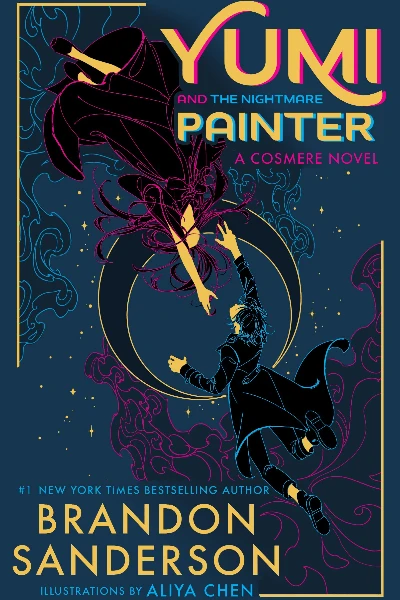
“MAYBE IT’S TIME travel,” Yumi said, half walking, half floating as she paced in the cold spring. Strange how she’d begun finding the cool water refreshing instead of shocking.
“Time travel?” Painter said, skeptical where he sat in the cold spring with arms out along the stones, resting back, toes peeking from the water.
“You have an advanced level of technology,” she said, ticking things off on her fingers. “While we are just beginning to build machines, you have ones that can travel to the stars. Our languages are close. Even without the strange gift of the spirits that lets us understand one another, I can see it in the familiar way your writing looks. We are both human. Maybe we’re from the same planet during different times.”
“Yumi,” he said, beads of water glistening on his bare chest, “this is not my planet. The ground is scalding, the sky is too high, and there’s no shroud. Your plants float. I think I’d know if plants floated on my world.”
“It could be the distant past,” she said. “A lot can change over time, Painter. We should at least consider the possibility.”
He frowned, but nodded. She paced back the other direction, water chill as it washed across her thighs and waist with each too-light step.
Her theory frightened her. If she was right, the distance between her and Painter would change from incredible to impossible. Another world was daunting. Another time… He met her eyes, and seemed to be thinking the same thing.
Perhaps there was another possibility, and she tried to send her mind that way instead. How bizarre that she’d come to relish this time in the cold spring—the renewing water, mixed with the familiar sun and its comfortable warmth. The quiet time alone with Painter. That should have been unremarkable, with how Connected they were, but it felt like every other moment was filled with things they should be doing.
Or…she admitted to herself…maybe that sense of anxiety at other times was just her. Feeling guilty for not being of use when Painter would have preferred to simply relax.
Either way, the bath was a peaceful time for her. Hair wet against her back, the tips trailing in the water behind her, skin prickling as the top half of her dried while her legs remained in the water—which somehow felt warm by contrast. The most surreal part—the part that only struck her when she stopped to think about it—was how natural it felt.
The last few days, she’d hardly considered the fact that she was bare. Painter seemed to react the same way, no longer staring, no longer embarrassed. He merely floated comfortably, thoughtful as he gazed at the sky and the spinning flowers high above. What had once been the single most stressful moment of her entire life was now just…normal.
“Maybe we’re still from different planets,” Painter said, “but they’re farther apart. Design is from somewhere else. You could be too.”
“Maybe,” she said, trailing her fingers in the water as she walked.
“But Design said she thought that was unlikely. If you think about it, we decided on a whim that we were from two different planets.”
“I was looking at the star when the strange event happened.”
“Which was completely coincidental. If you’d been looking at a bowl of noodles, would that imply that I came from the land of the noodle people?”
“That’s a perfect explanation for you.” He raised a finger. “Stiff and
rigid until you soak her in water.”
She gave him a flat stare.
“Come on, Yumi,” he said. “How long did you spend in the shower yesterday?”
She clasped her hands behind her back and turned away, strolling lightly on her tiptoes, buoyant in the water. “You’re right about Mrs.
Shinja,” she said. “She really gets mad about running out of hot water. Why do you suppose I like cold springs in my world and near- scalding warmth on yours?”
“Variety, I guess,” Painter said. Then in a lower yet dramatic voice: “Cold noodles with ice for hot days, warm noodles with broth on cool ones. The noodle princess must be master of both realms.”
She splashed a huge wave of water at him, and it was satisfying how he cringed—even though it was spirit water and flew straight through him. She smiled, then continued her strolling.
“I’m trying,” she said, “to solve our problem. Please make an effort to pay attention.”
“But we’ve solved it. Nightmare is dealt with.”
“And if the nightmare isn’t what caused the spirits to reach out to me? It could still be the machine.”
Those scholars were suspicious. She wanted to be wrong—she wanted it all to be over now, finished as soon as the Dreamwatch did their jobs—but she was afraid she was right. She couldn’t let go, not until she knew.
“I suppose,” he said, resting back, the tips of his feet popping up out of the water again. “I guess we can solve the problem no matter if we’re from different times or different planets. Nothing changes except…”
She slowed, then met his eyes and again saw the unspoken tragedy he acknowledged in them. Neither of them dared say the words. That they didn’t want this to end. How crazy was it that they would rather live in limbo like this, disorienting though it was, so long as it meant they could be together?
Why couldn’t she form the words? Why didn’t she dare speak them? Was it because she was afraid if she acknowledged what she felt, she would somehow ruin it? Send whatever it was that was growing between them flying off, like flower petals in a thermal?
Or was it something worse? Something that terrified her more than a nightmare? The worry that maybe he didn’t feel the same way.
What if her assumptions when looking in his eyes were untrue? What if he wanted this to be finished so that he could have his life back, no longer forced to deal with the imperious demands of a yoki-hijo who didn’t know how to person correctly?
She struggled to say something. But all she could think of was waking up one day alone, not knowing where he was.
It’s going to end poorly, isn’t it? she thought with mounting dread.
There’s no way for it to work out. It can’t work out, not for the yoki- hijo.
Her life, as Liyun had always promised, was not one of joy. Her life
was not her own.
Her life was service.
The two eventually climbed out of the spring to begin dressing.
“How long do you think it will take,” she asked him, “before my people invent bras? It’s difficult to return to this time, wrap a band underneath my chest, and pretend that’s good enough.”
“I don’t know,” he said. “You’ll need elastic for bras first, right?”
“How should I know?” Maybe she could invent them. Sketch it out, tell everyone that the spirits had shown the garment to her in a vision —which, in comparison to some of the ways she’d been forced to distort the facts recently, would be remarkably close to the truth.
They finished and then followed the attendants out to the shrine.
There they found a small line of people—as per Painter’s morning request. By this point, Liyun had given up on trying to bully him into doing things the proper way.
The townspeople shuffled, confused, as Painter called the first of them forward. Then, looking to Yumi for support and getting a nod in return, he started painting. He kept the art simple, like he’d done other days in the shrine, but he now had models to use—and so even these simple paintings were more skillful, more realistic. More a test
of his talents, even if these weren’t the powerful, dynamic paintings she hoped he’d someday return to.
She was satisfied as he became absorbed by the work. This was a form of meditation for him. She could say the prayers for both of them, and she did so, kneeling and whispering quietly. Like a chorus to accompany the soft sounds of brush on canvas. Music of the most personal variety.
Whatever else happened, this was an accomplishment. A brush in his hand, creating something other than bamboo.
She finished her basic prayers and moved on to meditation.
Clearing her mind. Yet when she soothed away everything else, she was left with a sense of dread. None of her usual tricks—counting her breaths, repeating a phrase over and over, humming to herself— banished it. Each time she sank toward the deep waters of nothingness, she found that same sensation of doom. Impenetrable.
As if it were the natural state. The color and texture of the canvas, once the paint had been washed away.
Something was still profoundly wrong. Solving the trouble with the nightmare was not nearly enough. And their time was running out.
She wasn’t certain how, but as she beat her mind against the dread,
she knew it to be the case.
“Painter,” she said, opening her eyes.
“Hmm?” he asked as a townswoman bowed to him and moved on, carrying a bemused expression and his painting of her.
“What’s beyond the shroud?” Yumi asked.
“I don’t think anything’s beyond it,” he said as the next townsperson
stepped up. “It covers everything.”
“Are you sure?”
“I…I guess I’m not. And Design wasn’t that certain either. We learned geography in school, but it talked only about Nagadan. There are some other nations out beyond ours, smaller. Around a dozen of them, and they’re always squabbling. I didn’t learn much about them.
Beyond those…well, we never actually covered that in classes.”
“What if there’s an end to the shroud?” she said, scooting closer to him, excited. “What if Design is wrong and this is what’s beyond? You have bamboo in your land, Painter. And rice. Where does rice come from?”
“Plants with four leaves,” he said. “I’ve seen them in fields.”
“Same as ours.”
“But not flying.”
“So the vegetation of our lands is similar,” she said. “You could merely have a…a strain of it that was made by the spirits to live without the heat of the ground.”
“It’s possible, I suppose,” he said. “Maybe we could get some maps in my world? See if maybe those have holes or blank spaces that could hold your land? How big is Torio?”
She didn’t know, although the fact that she traveled it in a loop— visiting villages all along the way—made him think it was smaller than his nation. However, it all seemed farfetched. Two societies like theirs living side by side for centuries, never discovering one another?
But…maybe there was one of those oceans he mentioned in the way? Or some other natural feature?
The possibility comforted her. She closed her eyes and focused on the sound of brush on paper, the occasional tapping as he dipped in the ink jar… She sank down and pushed through the sense of dread at last, entering a state of utter stillness. A nothingness where all time, self, and nature were one.
Then, as if placed there deliberately from outside, an idea struck her.
She cracked her eyes, hurled out of her meditative state to find the line of townspeople gone and Painter cleaning up his tools. The entire hour had passed just like that, which wasn’t uncommon when she meditated.
That thought, that idea, was remarkable.
“I know what to do,” she whispered, then looked at Painter. “I know
something we can try!”
“Okay…” he said, frowning.
“We can’t wait for you to get good enough at stacking. I’m sorry, Painter, but it’s true. Your progress is remarkable, but we have to
move faster.”
“I don’t understand.”
“I’ll show you.” She reached her hand toward his—then, remembering she couldn’t touch him, simply waved instead. She hopped down off the altar onto the spirit of her clogs, then waited
impatiently as he tied his on. They soon emerged from the orchard, passing Chaeyung and Hwanji, who jumped to follow. Yumi felt only the smallest stab of guilt at not remaining in the shrine until she was fetched, as was proper.
They passed through the now-familiar town. It was the first time since her childhood training that she’d stayed in one place long enough to learn where everything was. One might have assumed this would make the place feel kind of like home. Yet as Yumi thought about it, the word “home” conjured images of a cluttered little room with a futon, lit by the hion lights outside. It was alien, and yet it was the place where she’d learned what she actually liked. Dramas on the viewer. Clothing that was her own. Noodle soup, light on the salt, chicken broth with a single egg and a pinch of pepper.
Here she was the yoki-hijo. There she was Yumi.
And because of who she was, she felt guilty at that realization. It was exactly what she’d feared would happen. She had grown accustomed to the delights of his world. She did not regret—could not regret—letting herself indulge. But she would pay for that indulgence once this was all done and she lost not only Painter, but her home, her friends, and even her newly discovered sense of self.
You cannot let yourself be happy, a part of her warned. Because happiness is far, far too dangerous.
Perhaps that was why she felt such an urgency to finish this before the break became too painful to endure.
As they rounded the steamwell, the air wet and misty from a recent eruption, Yumi was distracted by a farmer fiddling with his flyer— which, like a giant insect with wings outstretched to the sides, buzzed and hovered in front of him, then dropped. The farmer grabbed it before it hit the ground. Then he finally got it moving, soaring up toward the crops above.
Painter walked on past, but she hesitated, bothered. “Painter,” she said, “would you ask Hwanji and Chaeyung if something is wrong with that man’s flyer?”
The two women appeared embarrassed at the question. “It’s nothing, Chosen,” Chaeyung said.
“Chaeyung,” Yumi said through Painter, “you’ve known me for years. You can talk to me. It’s all right.”
They shared a look, then Chaeyung leaned in and spoke softly. “It’s the creations of those scholars,” she hissed. “They don’t work as well, Chosen One.”
Hwanji nodded. “Far be it from us to speak poorly of such honored guests of the town. But something’s wrong with their creations. That’s fact, Chosen.”
The way they talked—there was an eagerness. Not only because of the topic. They seemed excited by the idea of talking to her, now that she’d given them leave. And…why not? They’d been companions for years, yet they didn’t chat. She’d never considered whether that would be painful for them, serving a woman they never truly got to know.
They continued on to the place of ritual, where—right outside—the machine was set up, chugging away and stacking its stones. It worked all day to draw one single spirit; but as the scholars promised, it could work all the time. It might not beat a yoki-hijo, but a hundred of them would far, far surpass what the women could create.
Still, Yumi folded her arms—rumpling her tobok—and glared at the machine. Painter stopped beside her and said softly, “It’s not bad just because it’s technology, Yumi.”
“Conversely,” she said, her eyes narrowed, “it’s not good just because it’s technology. Disliking this machine doesn’t have to mean I’m against progress or the wonderful things of your world. I simply think that this machine in this situation is wrong.”
He rested on the fence that encircled the place of ritual. “You’re right,” he said. “I’m sorry I generalized.” He stepped into the place of ritual, Yumi trailing behind. “So, do I get to hear this grand idea now?”
“Pick a rock to begin a stack,” she said, pointing.
He shrugged and put on the kneepads and gloves, then settled down near a pile of stones of a variety of sizes. He did a good job picking his foundational stone, then set it on the ground in a shallow nook—one that was practically invisible, but able to add stability.
He had learned. In fact, in the last thirty days he’d managed to learn a good portion of what it took to be a yoki-hijo. Unfortunately, perfecting that took years. Like the stone, all he had for now was a solid foundation.
He picked up a second rock at Yumi’s urging, but before he could place it she stopped him. Then she took the soul of the rock from his hands and weighed it, tested it, knew it. She set it down in place, then
looked at him, smiling.
“Match that,” she said.
He paused, then smiled as well and set his real rock over the spirit one—moving it, twisting it—until they aligned perfectly. Again his training was invaluable. He didn’t know enough to be a master, but he now had the basic training necessary to imitate one.
Excited, Yumi placed a third stone, then a fourth—with him matching her exactly. Together they built high. Up. Out. Into a sculpture of stone, carefully balanced, beyond anything Painter had managed on his own. At thirty stones, he looked to her with a grin on his face.
“You’re not ashamed,” she said, “to need help?”
“One of the first things you learn in art school,” he said, “is how to imitate the styles of the great masters. It’s only once you can keep up with them that you develop your own. I’m just glad I can keep up here.” He met her eyes. “This is going to work, Yumi. Let’s do it.”
They dove into the task, and sculptures grew around them—guided by Yumi, but she let him choose the stones. Let him place the first of each stack. He started placing stones on his own, then looking to her as she adjusted her version in roughly the same position—except better.
If only I could have been trained this way, she thought, feeling as if she could see his skill increasing moment to moment. Working together, their fingers occasionally brushing.
This was her meditation. This was something she had missed. She realized that over the weeks, she’d lost this—this connection to the stones, the spirits, and even her own heart. She might have been made a yoki-hijo, but the art was hers. Or together, theirs.
The scholars noticed, as did the townspeople. At one point she heard a gasp, and glanced to see Liyun outside the fence, hand to her lips and tears in her eyes. Liyun had been looking more haggard lately, worn down, exhausted. It was encouraging to see her so happy today. It probably seemed like a miracle from the spirits to suddenly have her yoki-hijo back. Perhaps it was.
The scholars started arguing. Their machine then started stacking more quickly. They moved frantically, except for the lead one—who was holding the boxy device Yumi had seen last time. The one that
let him detect a spirit.
He was staring directly at her.
He knows, she thought. Somehow. He knows.
Beside her, Painter had gone stiff. She first thought maybe one of their stacks—they’d done a dozen already—was about to fall. But now his eyes were on the ground, where a glowing red-and-blue teardrop was rising.
Immediately the spirit began to distort. The scholars shouted, and their machine moved even faster. The colors swirling in the spirit agitated, and it began to be stretched and pulled toward the machine.
“No,” Yumi said, bowing her head. “Please. Please. We have summoned you, spirit. I am your yoki-hijo. Tell me. What do you need? What must we do?”
It forcibly pulled back—like a glop of liquid metal, pooling the bulk of itself near her and Painter as one end was stretched out an impossible length toward the scholars.
“Please,” it whispered, the word vibrating through her. Painter’s eyes went wide. He could hear it too. “Please. Freedom. Please.”
“How?” Yumi begged. “How.”
“Stop,” it whispered, “the machine.”
Then it was pulled away, gathered in by the scholars’ device. They called for a supplicant to receive the boon, though the lead scholar remained where he was, hands clutching his nefarious box. He didn’t look pleased or self-satisfied for having stolen her spirit. Instead he looked concerned.
Behind him, the scholars made the spirit into a pair of repelling statues for lifting a home. They were smaller than the ones Yumi had made in the past.
The machine, she thought, keeps a piece of the spirit’s soul. That’s why the gifts the scholars create don’t work as well. It was collecting strength. To maintain its power. Or…for some other purpose?
“Yumi!” Painter cried. “You were right!”
She shook herself and tore her eyes away from the lead scholar, focusing on Painter. Right?
She’d been right. About the machine. About the needs of the spirits. After all that doubting, after all that uncertainty, she’d…been
right?
She’d been right.
This would all end when she and Painter destroyed that machine.