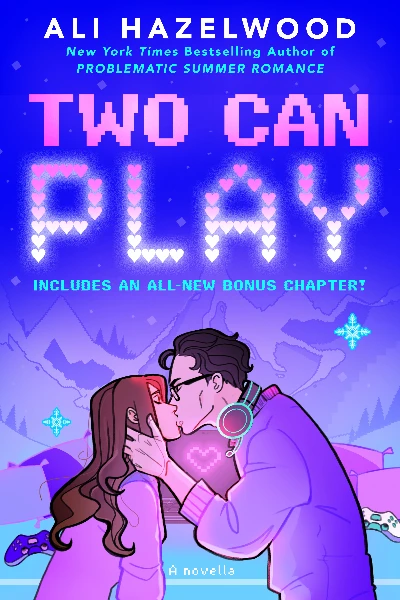
Chapter 2
VERYTHING’S SHIT. EVERYTHING’S THE WORST. And nothing, absolutelyE nothing is peachy.
Because here’s the deal: If I had to transcribe the list of interpersonal issues between Nephilim and FlyButter employees, I’d use up one of those forever toilet paper rolls—and fill an interaction graph worthy of a Dostoyevsky novel.
Otto once called our tools programmer a “nincompoop” in front of an audience of thousands.
Mila used to be engaged to one of their 3D artists.
Ethan quit three months into his tenure at Nephilim because of differences of opinion on what constitutes “humane working conditions”; Shannon got drunk at GameCon and provoked a physical fight with an AI programmer who called her a “spaghetti coder”; Kai—one of our programmers—saw his mail start to mysteriously disappear when a Nephilim producer moved into his apartment complex, and this overview is not even remotely comprehensive of the varicolored ways in which our studios are pretty-feuding.
For instance, it pointedly disregards what happened between me and Jesse fucking Andrews.
Then again…did anything happen? As the days count down to the skiing retreat, I try to talk myself into believing that the reason behind the tension between Jesse and me is just some good old competition. After all, he and I are both video game designers, both damn good ones. About the same age, trying to bring new, creative stuff to the industry. We’ve won awards, gotten
to lead teams, made names for ourselves. It would be weird if there weren’t a touch of rivalry.
Except, that’s not it. As much as I’d love to pretend that the awkwardness between us is born of joy-thieving comparison, Jesse’s specialty is action and adventure, while I shine at creating characters and storylines. We occupy different places in the industry, and if I’m aware of that, so is Mr. Point and Click.
We originally met six or seven years ago, when I was up for my first industry position. As far as I can recall, that interaction wasn’t bad. All I remember is being fresh out of college and walking into the last phase of an interview for a small software company here in Seattle. Jesse was already working there as a developer, and he stood to shake my hand the second I entered the conference room.
Initially, I barely paid attention to him, registering nothing more than a fuzzy impression of dark hair and thick-framed glasses. I had a migraine from staying up all night to prep, and Jesse’s role seemed to be assisting the company CEO, who asked all the questions. I was there to prove to my mom that it was indeed possible to make a living, as she liked to put it, “playing Mario Kart,” so I did my best to charm Jesse’s boss, which did not work.
And ultimately, I didn’t care. Not after the asshole said something about my portfolio being too “girly” to get me anywhere, gave a good chuckle, and then asked if I really enjoyed video games, or if I was just trying to impress my boyfriend.
Jesse, to his credit, stuck up for me. “This is unprofessional. And unnecessary,” he told his boss firmly, speaking for the first time since the interview had started. But I was already standing to leave, and a gift of the golden wool shed by thirty magic llamas would not have persuaded me to stay and work for this shitty, shitty man.
So I walked out. And Jesse followed—I do recall that. He jogged after me, quick and long-legged, and once he caught up, he stood over me with concerned eyes. He made sure that I was okay and apologized on behalf of… men, presumably? I accepted—and may have vented at him for the next twenty minutes. But Jesse took it in stride, giving me some great advice about
my portfolio and pointing me in the direction of this new game studio that was hiring at the time—FlyButter. A decent human being in this blighted industry, I told myself. I thanked him, said goodbye, and didn’t think of him again until a year or so later, when we crossed paths at a local game expo.
By that point, the company I’d interviewed for had gone bankrupt— proof that a just god might, in fact, be milling about. I was now with FlyButter, while Jesse had gone on to become lead designer at Nephilim, with a growing reputation as a third-person action-adventure superstar. On the second day of the con, I spotted him at a panel on backward compatibility. Watched him rise from his chair to offer the seat to an older
man in the audience.
Immediately recognized him.
The glasses were still there, with the same dark, square frames. His black hair, though, was styled in a shorter, low-maintenance cut. He was tall, even taller than I remembered, wearing jeans and a dark hoodie—the uniform of every other guy in attendance. He stood in the back of the room with his arms crossed, and as I studied him, I realized something that I hadn’t been in the position to pay attention to during our first meeting.
Jesse Andrews was cute.
Very cute.
Handsome, really.
I resent the stereotype that most of us gamers are basement-dwelling trolls with pee buckets under their desks—eldritch horrors with no choice but to find refuge in computers. We tend to be perfectly normal-looking. Jesse, though, might have been a bit more exceptional than that.
In my couple of years in the gaming industry I’d seen enough relationships dissolve into emotionally dysregulated drama to know that any kind of workplace entanglement should be strenuously avoided. And yet… “Why are you smiling dopily in the direction of Jesse Andrews?” Mila asked, elbowing closer to me. “Is he like, your drug dealer?”
“I’m not…” I frowned. “Was I really doing that?”
“Yup.”
“Damn,” I muttered. I glanced at the stage, where someone was doing a mic check ahead of the panel.
Mila leaned in. “Should I introduce you?”
“Oh, no…I already met him. Once.”
“Cool. I went to high school with him. Same homeroom during senior year.”
“Really?” I couldn’t help asking, “How was he?”
“Really nice, actually. He was the captain of the soccer team, so you’d expect some douchiness, but he was a great guy. The first time I got drunk he held my hair while I puked and then sat down with me to play Grand Theft Auto while I sobered up. And he always let me copy his trig homework.”
“Yeah.” I nodded, unsurprised. “When I met him, he was really lovely to…Mila, what are you—”
“I haven’t talked with him in a while, let’s go say hi!” She pulled me by the forearm, tugging me toward Jesse. “I need to ask him how he came up with the emu Easter egg in Forbidden Forest!”
“I’m not sure…” But we were already there, by Jesse’s side, and he was bending down to hug Mila and greet her warmly, making her laugh as he explained—with a healthy dose of self-deprecation—that he hadn’t gone to their five-year reunion because he wasn’t ready to find out whether he’d peaked in high school. Then she pulled back, and his gaze fell on me, the silent friend loitering nearby, and… For a second, he went so incredibly still, I thought, Thank god he remembers me. It was, paradoxically, in the way his eyes didn’t widen, his lips didn’t curl, his posture didn’t shift. It was all too absent to indicate anything but recognition. And yet, when Mila said, “And you know Viola, right?” his too-handsome, square-jawed face arranged into something blank.
A tense pause followed. Eventually, Jesse opened his mouth to say who knows what, but Mila must have picked up on his hesitation, because she added, “At least, that’s what Viola told me.” Mila lifted an accusatory eyebrow at me, as though lying about being acquainted with rising industry celebrities was a notorious pastime of mine, and I wished for the underworld to swallow me and for its dwellers to stab me.
“Yeah. We met at that interview for…You know what, never mind.” I waved a hand, like it didn’t matter that I was the opposite of memorable. My heart was racing. Why was my heart racing? “I’m Viola Bowen. From FlyButter. Which you recommended I apply to when—”
I got interrupted when a serious redhead (Otto, I’d later find out) came to fetch Jesse for something or other of international tactical importance. Jesse left quickly, with a last smile for Mila, a promise to get coffee with her soon, and not a single ounce of attention paid to me. I stared at his straight back as he walked away, wondering whether I was self-centered enough to be offended, and didn’t tear my eyes away until Mila began making weird noises.
I turned around and found her sniffing me. “What are you doing?”
“I was just curious.”
“About what?”
“Whether you smell.”
“Why would I—”
“Jesse sure seemed to not like something about you. Maybe you stink?”
She shrugged, joking, yes, but…maybe not fully.
Part of me was glad to have confirmation. The other…the other didn’t want to admit to being disliked. “What? No. We just got interrupted.”
“Uh-huh. The other time you guys met—was that by any chance when
you ran him over?”
“What? No.”
“His dog?”
“No.”
“His mother?”
“No!”
“Okay. I bet I imagined it. I’m sure he does not want to staple your forehead.”
I was sure, too. Mila had a flair for the dramatic, but the truth is, assuming that someone dislikes you based on a one-second interaction requires a degree of narcissism that I’d rather avoid. So I moved on, put the
whole incident out of my mind, and managed to never think about Jesse again.
Just kidding. What actually happened, in the following months, was that I became hyperaware of him. All of a sudden, I saw him everywhere. Not only at conferences, but in the credits of games I played, giving an interview to my favorite YouTube channel, winning indie designer of the year awards. I realized that we had industry friends in common, that he’d graduated from my college three years ahead of me, that he was very active in the labor rights group trying to unionize us at the national level.
And the more I knew about him, the more I realized that he was a pretty great guy, and—I’m not proud of it, but denying it would be a Pinocchio- worthy lie—I developed a tiny, nanoscopic, itty-bitty crush on him.
To be clear, what embarrasses me is not my fascination with Jesse Andrews, but the fact that it persisted for years, even in the face of his treatment of me. Or maybe I should say, lack of treatment? If he had been rude, or mean, he’d have lost his charm, and it would have been so easy to write him off as another Gamergate dudebro convinced that women’s master plan was to pollute the shades of his beloved industry. But no: Jesse’s primary sentiment, when it came to me, seemed to be indifference. He never approached me of his own volition. Whenever I approached him, he was graceful, friendly, collegial, and aggressively apathetic. He’s an introvert, I told myself. Except, he was clearly capable of extroverting with our shared acquaintances.
Am I the problem? I wondered. Just in case, I doubled my friendship overtures—and found that my attempts at conversation were met with remarkable politeness and profound disinterest. Whenever our paths crossed, not once did I notice Jesse’s eyes voluntarily land on me. To be clear, he never gave me reason to believe that he wanted to, say, cut me into pieces and stuff me in an all-purpose trash bag, or even that he’d pretend not to see me if I were hitching on the side of the road in the middle of the night. In fact, I never got a hint that he actively disliked me. The truth was obvious, though: I existed, and he couldn’t have cared less.
And yet, I still liked him. A good old case of “wanting what you cannot have,” maybe. Or it’s possible that I require the help of professionals with numerous and varied medical degrees. Either way, about three years after our first meeting, following an industry dinner in which we sat across from each other but did not exchange a word past hello—because he was too busy chatting with some girl from Nintendo—it finally happened.
I had a sex dream.
And it starred Jesse fucking Andrews.
I woke up bathed in sweat and had to stifle a truly obscene sound with my palm, because clearly my subconscious’s opinion of his skills in that area was very high. And it didn’t stop there. In the next couple of years, always in the wake of Jesse sightings, chance encounters, or even simple mentions of his name, the aforementioned subconscious presented me with thirteen more versions of that dream. Seven of them, to my horror and guilt, occurred while I was still seeing my ex.
So I resigned myself. I was into Jesse, and Jesse wasn’t into me.
Whatever. Not a problem. It was my first unrequited crush, and it smarted a little that I’d once seen him hand a piece of croissant to a pigeon and sustain longer eye contact with it than he ever did with me, but I could deal. As time went on, the relationship between FlyButter and Nephilim soured because of dozens of reasons that had nothing to do with me and Jesse. Everyone in the industry knew about the constant squabbling, and as they made a point of keeping the two studios apart to avoid conflict, I came across him less and less—and, blessedly, dreamt of him less and less.
And then, last winter, about six years after our first meeting, I had to finally face the truth, and it was arrestingly ugly—much uglier than I’d ever suspected.
Up until that point, all our meetings had been through work events. I’d never interacted with him in a purely social situation, mostly because I barely interacted socially with anyone. As a lead, I worked ten-hour days, more during crunch periods, and at night I wanted nothing beyond the welcoming embrace of my couch. Prying myself from my pajamas was a feat—one that
required the promise of something particularly exciting—or, more often, something mandatory.
And that’s how I finally ran into Jesse Andrews in the wild: His college roommate—now a PE teacher—was about to get married to my cousin—a baker. Not too shocking a coincidence, considering that we’d all gone to the same school. It meant that we were both invited to the engagement party they held just before the holidays—and that outing, I definitely could not skip.
I noticed him the second I stepped into the private room they’d rented at the restaurant—not hard, since he was a head taller than pretty much everyone else. He didn’t have the same luxury, since I was average height, with long, wavy brown hair and few features that’d make me pop in a crowd.
And in hindsight, I should have taken advantage. I should have faked a pneumothorax, or fulminating dysentery, and gotten the hell out.
Unfortunately, I was pulled in by my Aunt Selene and subjected to the passive-aggressive line of questioning perfected by the Bowen family through generations. Had I gained some weight? It looked great on me, but I should watch my diet from now on. Was I seeing someone? There were upsides to being forever alone. Were the bags under my eyes a fashion statement? Was I any closer to finding legitimate employment? Did I know that a woman’s eggs were the first thing to age?
After Aunt Selene, it was Aunt Millie. Then Uncle Max. Then a cousin thrice removed whose name I never learned. Then Mom, who tormented me with the totally not made-up tale of an unnamed friend’s son, who had recently lost his nonspecified gaming job, become unhoused, and been eaten by crocodiles while sleeping under a bridge. Then three of my siblings, who all gave me noogies and demonstrated that in their minds I’ll always be twelve years old.
It’s tough, being the last of five children. My brothers and sisters are great, and I am as certain of their love as I am of the binary code, but the youngest takes plenty of shit, plenty of times. If there’s a prank to be pulled, a wedgie to be given, a diary to be read out loud, I’m the one they default to.
My entire life has been a study in patience and sharing—food, toys, clothes,
attention, my parents’ energy—which is probably why now that I’m an adult I love solitude so much.
By the time my siblings were done toying with me, nearly two hours had passed. I decided to make my way to the bride and the groom, give them my well wishes, and get the hell out. Easier said than done, since most Bowens were either buzzed or straight-up drunk.
I wove my way through the crowded room toward the exit, wondering at my family’s reproductive prowess, until a large structure bumped into me.
When I turned to glare at what stood between me and freedom, I discovered something surprisingly familiar.
Jesse held a beer in his hand and blinked down at me, perhaps wondering whether his least favorite industry acquaintance had turned into a stalker. Something peeked out from behind his head, something green and
leafy and…mistletoe.
He was under it.
So was I.
And everything unraveled. Before I had a chance to explain myself, or run away, or steal Jesse’s bottle, smash it against the wall, and use its jagged remains to keep my family at bay, approximately ten people related to me by blood began chanting for us to kiss.
“Mistletoe!” my cousin, the blushing bride, yelled. “Kissing plant!” I glanced at her tiara and briefly wondered what she’d do if I broke it over my
knee and forced her to eat it.
“You gotta kiss!” Uncle Evan said.
“Viola, did you know”—my brother Victor interjected—“that the mistletoe—Viscum album, order Santalales, family Santalaceae—is an obligate hemiparasitic plant? But yes, you two should kiss.”
I glanced at my surroundings as a somewhat inebriated commotion brewed around us, wondering whether someone would bring up the sheer inappropriateness of the situation. Why did families not have HR departments? I’d file the shit out of a complaint. Or ten.
But no one said anything. There were a couple of cheers, some mutterings about tradition, and I took a deep, resigned breath.
Okay. Whatever. Fine. It was going to be a kiss. A small one. On the cheek, probably. And while the indignity of having my family act like a frat house did make me want to guzzle a bottle of fungal ointment, this could have been worse. After all, I liked Jesse. I was reasonably sure he had decent personal hygiene. Plus, after the kiss, we could laugh together over this shitshow. It might even tip us over from indifference into…something warmer. Something nice.
So I looked up to meet his gaze, meaning to offer him my best We’re in this together smile. Except that it never materialized, because I was immediately confronted with the expression on his face, and it could be described only as disgusted.
And that was before he said: “I don’t think so.”
This time, he wasn’t friendly, or graceful, or cordial. He was abrupt and unwavering, as though the idea of kissing me—a known carrier of mono and the chicken pox—was so revolting to him, he could not bring himself to fake politeness.
And people around us picked up on it, because after a moment of silence, that was that. A handful of disappointed, “Oh, come on, man,” and buzzkill comments, but soon enough the bride and the groom were pushed in our places, and had their tongues down each other’s throats, and it was over.
Kind of.
My cheeks were aflame—from the public rejection, from how quickly it had all happened, from Jesse’s eyes on me, full of something that…It wasn’t contempt, was it? It couldn’t possibly be.
Or maybe it could. Because fifteen minutes later, as I picked up my jacket before leaving, I overheard my cousin’s voice down the hallway. “You could have kissed her on the cheek,” he was saying.
I stopped in my tracks. He and Jesse were looking out the window, facing the other way. Jesse’s broad back moved up, then down in a careless shrug.
“I mean,” my cousin said, “even if you don’t like her, you could have
been nicer about it.”
“No. I couldn’t.”
“Why, though?”
A pause. “I don’t want anything to do with her. It’s better that way.”
This happened nearly twelve months ago, but the frustrated sigh that followed is still crystal clear in my head, a split-second moment that I’ll never erase from the cortex of my brain.
Even now—after hours, the last one lingering in the office, as I stare at my blank screen—even now I can hear it. Two days before leaving for the winter retreat.
“You may not want anything to do with me,” I say out loud to the empty, open-plan room, “but I want the Limerence 3 project. Where does that leave us?”
I tip my head back, stare up at the wall, and wonder whether I could ever work alongside Jesse Andrews—and vice versa.