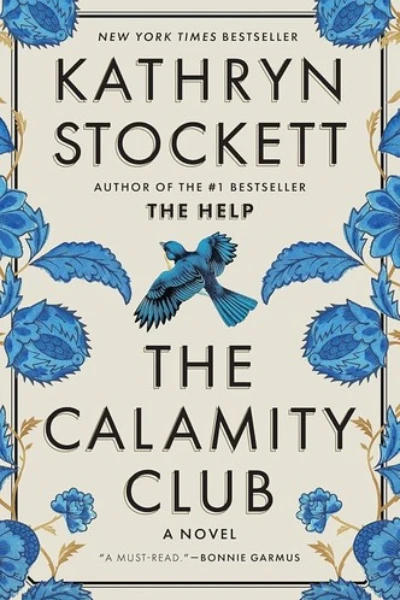
The Calamity Club
The Calamity Club — Prologue
[Section opener]
Prologue
Birdie
September 1933
Downtown Drugstore had a bell on the door that made a single tink sound when you opened it.
Oxford Pharmacy had two bells on its door so it was more of a ta-tink, though nothing to startle
over. But the Gathright-Reed Drug Co. door bore a foot-long strip of brass sleigh bells on its
knob, which, when turned, sent metal balls clanging to announce, Somebody’s coming in the
dang store so you better turn around and look see who it is. And if you did, you’d see me.
At the pay counter just inside to my right, a heavy woman was buying something. Pripp,
the nosiest of my sister Frances’s many friends. Her blond bobbed hair headed more left and
right than down on this humid September morning. Naturally, she turned and looked at me.
“Birdie, hadn’t seen you in a while,” she said. I saw she was paying for a pair of rayons sized,
I’m sure, extra-know-it-all.
“Hey, Pripp,” I said and kept walking straight on past her.
I went to the back of the store and stood myself behind the most human-sized rack I
could find and picked up whatever thing was closest. It was a tin of men’s Brylcreem, and I held
it close to my face, hoping it would make me less talkable to. Why the heck do I have to do this—
and at a store on the square, when all the other girls got to go to the other side of town to buy
bedsheets or race records? Deep down I knew perfectly well why, though: because no one
6
would ever suspect me of such a thing. I was Birdie Calhoun, twenty-four years old, churchy and
chinless, kind to all animals and people. I’d never do anything even close to what I was doing.
“I’m just saying,” Pripp said up at the counter, though I could hear her all the way back
here, “I don’t think it’s fair for y’all to charge thirty-five cents for my size when you only charge
thirty for the regular—” I heard her clicking nickels and pennies at the older lady on the other
side of the counter.
“Well, it is near double the rayon,” the lady said. “’Nother way to look at it is it’s a
bargain for what you’re getting.”
Behind the display, I waited on Pripp to leave, and also a pimply boy up front who was
flipping through a book at the lending library rack. Up every wall of the place, products filled the
shelves, colored boxes and tins with signs explaining what they could do for you: For That
Movie Star Look, For That Annoying Itch, For the Picky College Gentleman, but what about For
the Unmarried Lady Who Does Not Want to Be Doing This One Bit? Where was the little sign
for that? The sleigh bells clanged, and I leaned over to see. The boy at the lending rack had
walked out. One down, one to go.
At the counter, Pripp hitched her yellow purse strap up on her shoulder, and I held my
breath. But instead of walking out, she was looking around—evidently for me—so I put the
Brylcreem down. There was no logical reason for me to be holding that.
“There you are, Birdie,” Pripp said. She had a smarty-looking smile, close-lipped. Full of
guarantee that whatever I said, she would be repeating. “Noticed y’all missed church on Sunday,
your spot up front was empty, and Frances has been short on her volunteer hours, I tell you
Garnett Pittman is not pleased about that, Frances ought to let us know—”
7
“She took a trip. Frances and Mrs. Tartt are on a trip.” With Pripp it was all one sentence,
so you had to wedge it in when you could. “They went down to Jackson to see about some
family.”
Pripp frowned, looking almost offended. “Well, she didn’t mention any traveling trip to
me, and Chairlady Garnett needs to know who’s coming in the Orphan so she can adjust up the
schedule, after so many little girls got adopted all we got are big girls now, not to mention—”
“I got to do something, Pripp.” My heart felt like it was trying to hammer its way out of
my chest. “I need to get somewhere.”
“Well. Don’t forget to tell Frances what I said,” and she stood there until she realized all
she was getting was a nod from me. Finally, she turned around and walked out, sending the strip
of bells clanging for the third time.
I was the only customer left in the store now. Just me and the lady at the counter up front,
and the pharmacist, who was standing in the back, wearing his judgy white coat up on his judgy
high pedestal, grinding something in a bowl. Lord, don’t make me have to talk to that man. I
approached the older lady at the glass-topped counter.
She was around sixty, wearing a white ruffled pinafore, glasses nestled atop a bed of gray
hair. I said it fast and low. “I need to purchase some Merry Widows please, ma’am.”
She dropped her chin at me, said, “Oh.” Then she leaned up and looked all the way down
at the pharmacist standing in the back. “Well, I—Mr. Castel generally does these type
transactions, but it don’t require a doctor’s note no more . . .” She reached under the counter and
set a round, silver-dollar-sized tin down, protecting it with her hand. “’At’ll be fifty cents.”
In the mirror behind her, I could see my own chin-length brown hair, flat and damp in the
heat. “I’m going to need more.”
8
She nodded and reached down and set another silver disk on the counter, covering both
with her spotty, veined hand now. “Alright, ’at’ll be one dollar.”
I didn’t want to have to go to any more drugstores and do this with any more ladies, or
worse, men. I’d already been to the two other stores first, the ones my sister and Mrs. Tartt didn’t
frequent, but they didn’t carry the right brand.
“You know they’s three come to a package,” she whispered to me.
I nodded. I knew that. A warm spongy thing slid down my back. “Yes, ma’am. I still
need more.” I hadn’t even told her the worst part yet.
She wrinkled her already wrinkly forehead and pushed aside a clump of damp gray hair.
“Exactly how many you looking to buy in total?” she asked and eyed my plain blue dress that my
meemaw had made me, with plain buttons to match a plain unmarried woman. When I whispered
the number, the glasses on top of her head perked up, like little ears.
“That is a unusual amount.”
I know, lady, I know. I wiped my damp forehead with my dress sleeve. Her eyes had
stopped on my unringed finger. Dang it, I should’ve worn gloves.
“I don’t know if I’m allowed to—” She glanced over at the pharmacist but he was gone
now, and for all I knew he was weaving through the racks, headed this way. She whispered, “It
might be against the law to sell ninety-nine prophylactics to a unmarried lady, I’ll have to check
on that—”
“No, you don’t, it’s alright because—they’re not for me, they’re for somebody that’s
allowed to . . . administer them.” That these were not for me was completely true, I’d never even
had a proper boyfriend before, which was fine, but the second part, that “allowed to” part, that
was most definitely not true.
9
“She really needs them,” I said.
She tapped her ink-stained fingers against her lips, negotiating that number, ninety-nine,
in her head and figuring it would be thirty-three containers since they held three apiece or maybe
I needed to tell her that math. I was pretty sure she got it though.
“Well, I can certainly understand a . . . woman’s plight,” she said and shook her head as
if recalling a time when she could’ve used a few of these herself. “But if I sell these to you, I’m
s’posed to ask—she understands they’re for disease prevention use only?”
“Yes ma’am, she understands that.”
“Not to stop a lady from . . .” She stared at me. “It ain’t legal for that other reason.”
“Yes, ma’am.”
“Well then I—guess I got to ask, does he? Have himself a disease?”
I looked her straight in the eye and said, “It is very, very likely, ma’am.”
She nodded and worked her tongue across her teeth.
Saying something so true gave me a jolt of urgency—this needed to happen now and it
needed to happen quick before somebody else walked in the store, and I guess she sensed it too
because with a hard snap she shook open a white paper bag that I could tell already was going to
be too small. She slid the two silver disks on the counter in there and then, under the counter,
dropped in the other thirty-one. When she tried to fold down the top of the bag, the edges
wouldn’t meet, so I took it from her and shoved it down in a sack half full of groceries. I moved
a box of Uneeda Biscuit on top of it and slid three fives, a one and two quarters across the
counter.
She looked at the money. “One more thing.” She set a little blue book on the counter,
already open to a page. “You got to sign here who they’re for, that’s Mr. Castel’s rule.”
10
I took the pencil and let it hover a second. Should I make up a name? Would that draw
more attention? But then the bells on the front door cla-clanged so I scratched the name of the
first married woman who came into my head, shut the book, and headed for the door. “Thank ya,
goodbye,” I called, moving by a lady holding a little boy by the hand.
Lord, my sister was going to kill me.
11