
Preface for the Twenty-fifth
Anniversary Edition
by Robert McAfee Brown
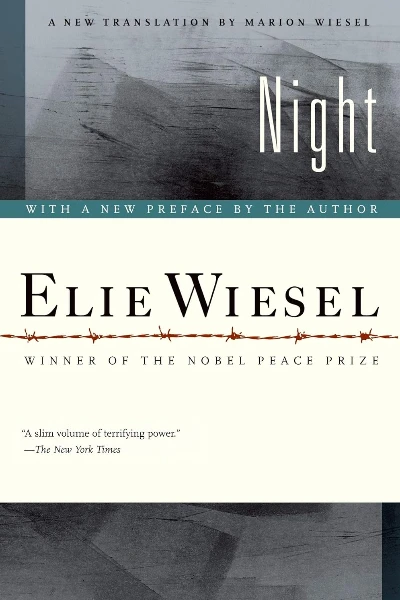
When Elie Wiesel was liberated from Buchenwald in 1945, having also been in Birkenau, Auschwitz, and Buna, he imposed a ten-year vow of silence upon himself before trying to describe what had happened to him and over six million other Jews. When he finally broke that silence, he had trouble finding a publisher. Such depres sing subject matter.
When Night was finally published, over twenty-five years ago, few people wanted to read about the Holocaust. Such depressing subject matter.
But we cannot indefinitely avoid depressing subject matter, particularly if it is true, and in the subsequent quarter century the world has had to hear a story it would have preferred not to hear-the story of how a cultured people turned to genocide, and how the rest of the world, also composed of cultured people, remained silent in the face of genocide.
Night has been the most influential book in forcing that confron tation. Lean, taut, and sparse in style, employing no tricks, but providing no avenues of escape for its readers, it remains today a book we must read and reread if we are to accept responsibility for our past and to learn from that past for the sake of our future.
Having confronted the story. we would much prefer to disbe lieve, treating it as the product of a diseased mind, perhaps. And there are those today who-feeding on that wish, and on the anti Semitism that lurks near the surface of the lives of even cultured people--are trying to persuade the world that the story is not true, urging us to treat it as the product of diseased minds, indeed. They are committing the greatest indignity human beings can inflict on one
v
Prefacevi
another: telling people who have suffered excruciating pain and loss that their pain and loss were illusions. Perhaps there is a greater indignity; it is committed by those who believe them. Night, with its understated eloquence, stands as the permanent refutation of both kinds of baseness.
In it we learn the geography of "the valley of the shadow of death," about which the psalmist wrote-save that this was a valley in which people "fear[ed] evil," for it was a valley in which "the shadow of death" took on substance ... six million times. Among the few who survived the onslaught of that formidable shadow turned substance, was Elie Wiesel, whose deliverance condemned him to tell the story to an unbelieving and uncaring world.But because of his telling, many who did not believe have come to believe, and some who did not care have come to care. He tells the story, out of infinite pain, partly to honor the dead, but also to warn the living-to warn the living that it could happen again and that it must never happen again. Better that one heart be broken a thousand times in the retelling, he has decided, if it means that a thousand other hearts need not be broken at all.
At the end of Night, the immediate devastation has ended: the war is over, the camps are liberated, the author is alive. But the ongoing devastation has only begun, the devastation that will never end: the devastation imposed by memory that makes the line between life and death a thin line indeed.The descriptive term imaging the author at the books end is that of a corpse.
It takes many further volumes for Wiesel to discern even vestiges of life being breathed into that corpse.Most readers, having read Night, will want to continue with Wiesel on his painful journey through the darkness, through false dawns and false days, until there are hints that tiny shafts of light can pierce the seemingly unending night that Auschwitz has imposed upon the earth.
But we must not make that journey too quickly.We must linger with this starting point and not rush on too soon, seeking relief from its horror. How long must we linger? An eternity, perhaps-Wiesels chronometer for measuring the time between Auschwitz and the first emergence of hope.
Those who hope for hope-after an eternity-are entitled to do so only if they have measured that which has the power to obscure hope, only if they have lived in the shadow of utter denial. The rest of us, who have not inhabited the innermost circle of hell, can never know what it was like to be there. But between us and the fiery furnaces where they burned babies alive stands the presence of Elie Wiesel; his presence casts a shadow from within which we can see, in dimmest outline, the reality he saw and touched and tasted directly.
It must be the prayer of our generation that with his help we can recapture enough of that reality so .that it will never be repeated.