20th October—evening
After Krystjan left, I barred the door with the plank that must have been set against the wall for that purpose, and which, like the damned wood box, I had failed to note before. Then I spent an entirely unproductive twenty minutes scrabbling about with the wood and the matches, until there came another knock.
I opened the door, praying that this visitor’s relative politeness boded well for my survival.
“Professor Wilde,” said the young man on the threshold in that faintly awed tone I have encountered before in rural villages, and I nearly melted with relief. Finn Krystjanson was a near–mirror image of his father, though narrower of midsection and with a pleasant set to his mouth.
He shook my hand eagerly and tiptoed into the cottage, starting a little at the sight of Shadow. “What a handsome beast,” Finn said. His English was more heavily accented than that of his father, though still perfectly fluent.
“He’ll give the wolves something to think about.”
“Mm,” I said. Shadow takes little interest in wolves, seeming to place them in the same category as cats. I can’t imagine what he’d do if a wolf ever challenged him, other than yawn and give it a swat with one of his dinnerplate paws.
Finn eyed the cold fireplace and debitage of snapped matches without surprise, and I suspected that his father had already warned him of my capabilities. Indoors type still smarted.
In a few short moments, he had a hearty fire crackling and a pot of water set upon the stove to boil. He chattered as he worked, directing me to the stream behind the cottage, which I understood to be my only source of
water, the cottage not being plumbed; the outdoor privy; and a shop in town where I could purchase supplies. My host would provide my breakfast, and dinner could be had at the local tavern. I was on my own for the midday meal only, which suited me well, as I am accustomed to spending my days in the field when conducting research and would pack my own light repast.
“Father says you’re writing a book,” he said, heaping logs by the fire.
“About our Hidden.”
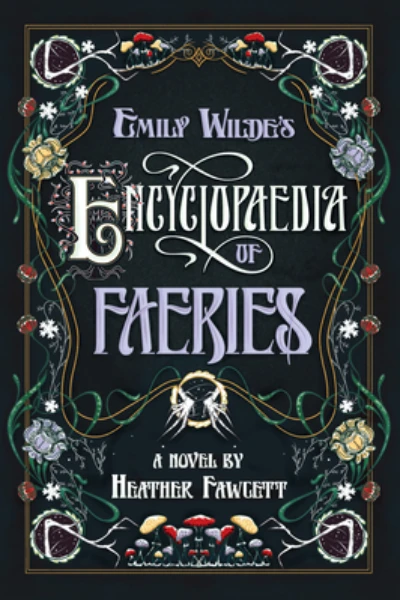
“Not just the Hidden,” I said. “The book is about all known species of Folk. We have learned much about their kind since the dawning of this era of science, but no one has yet ventured to assemble this information into a [*1]comprehensive encyclopaedia.”
He gave me a look that was both dubious and impressed. “My, but that sounds like a lot of work.”
“Yes.” Nine years of it, to be specific. I have been working on my encyclopaedia since earning my doctorate. “I hope to complete my fieldwork here by spring—the chapter on your Hidden Ones is the very last piece. My publisher is eagerly awaiting the manuscript.”
The mention of a publisher seemed to impress him all over again, though the furrow in his brow remained. “Well. We have plenty of stories. I don’t know, though, that they’ll be any use to you.”
“Stories are of great use,” I said. “Indeed, they are the foundation of dryadology. We would be lost without them, as astronomers cut off from the sky.”
“They’re not all true, though,” he said with a frown. “Can’t be. All storytellers embellish. You should listen to my grandmother when she gets going—she’ll have us hanging on every word, yes, but a visitor from the next village will say they don’t know the tale, though it’s the same one their own amma tells at her hearth.”
“Such variation is common. Nevertheless, when it comes to the Folk, there is something true in every story, even the false ones.”
I could have gone on about faerie stories—I’ve written several articles on the subject—but I didn’t know how to talk to him about my scholarship, if what I said would be nonsense to his ears. The truth is that, for the Folk,
stories are everything. Stories are part of them and their world in a fundamental way that mortals have difficulty grasping; a story may be a singular event from the past, but—crucially—it is also a pattern that shapes their behaviour and predicts future events. The Folk have no system of laws, and while I am not saying stories are as law to them, they are the [*2]closest thing their world has to some form of order.
I finished simply, “My research generally consists of an amalgam of oral accounts and hands-on investigation. Tracking, observations in the field, that sort of thing.”
If anything, the furrow had deepened. “And you—you’ve done this before? You’ve met them, I mean. The Folk.”
“Many times. I would say that your Hidden Ones would be unable to surprise me, but that is a talent universally held by the Folk, is it not? The ability to surprise?”
He smiled. I believe he thought me half akin to the Folk at that point, a strange magician of a woman conjured into his midst in a village little touched by the outside world. “That I couldn’t say,” he replied. “As I’ve only known our Folk. That’s enough for one man, I’ve always thought.
More than enough.”
His tone had darkened a little, but in a grim rather than an ominous way, the sort of voice one uses when speaking of those hardships that are a fact of life. He set a loaf of dark bread upon the table, which he informed me quite casually had been baked in the ground via geothermal heat, along with enough cheese and salted fish for two. He was quite cheery about it, and seemed intent on joining me for the humble feast.
“Thank you,” I said, and we gazed at each other awkwardly. I suspected that I was supposed to say something else—perhaps enquire about his life or duties, or joke about my helplessness—but I’ve always been useless at that sort of amiable chatter, and my life as a scholar affords me few opportunities for practice.
“Is your mother about?” I said finally. “I would thank her for the bread.”
I may be a poor judge of human feeling, but I have had plenty of experience with putting my feet wrong to know that it was the worst
possible thing to say. His handsome face closed, and he replied, “I made it.
My mother passed a year and more ago.”
“My apologies,” I said, putting on a show of surprise in an attempt to cover the fact that Egilson had included this information in one of our early letters. What a thing to forget about, you idiot. “Well, you’ve quite a talent for it,” I added. “I expect your father is proud of your skill.”
Unfortunately, this inept rejoinder was met with a wince, and I guessed that his father was not in fact proud of his son’s skill in the kitchen, perhaps even viewing it as a degradation of his manhood. Fortunately, Finn seemed kindhearted at the core, and he said with some formality, “I hope you enjoy it. If you need anything else, you can send word to the big house. Will half seven suit for breakfast?”
“Yes,” I said, regretting the change from his former easy conversation.
“Thank you.”
“Oh, and this arrived for you two days ago,” he said, withdrawing an envelope from his pocket. “We get mail deliveries every week.”
From the way he said it, he saw this as a source of local pride, so I forced a smile as I thanked him. He smiled back and departed, murmuring something about the chickens.
I glanced at the letter, and found myself confronted with a florid script that read The Office of Dr. Wendell Bambleby, Cambridge in the upper left corner, and in the middle, Dr. Emily Wilde, Abode of Krystjan Egilson,
Farmer, Village of Hrafnsvik, Ljosland.
“Bloody Bambleby,” I said.
I set the letter aside, too hungry to be vexed just then. Before I tucked into my own refreshments, I took the time to prepare Shadow’s, as was our custom. I collected a mutton steak from the outdoor cellar—to which I had been directed by Finn—and set it on a plate beside a bowl of water. My dear beast devoured his meal without complaint, while I sat by the crackling fire with my tea, which was strong and smoky, but good.
I felt some regret at having poorly repaid Finn’s kindness, but I didn’t mourn the absence of his company—I had not been expecting it.
I gazed out the window. The forest was visible, starting a little higher up the slope and giving off the inauspicious impression of a dark wave about to come cresting down on me. Ljosland has little in the way of trees, as its mortal inhabitants denuded much of the sub-Arctic landscape. However, a few forests remain—those claimed, or believed to be claimed, by their Hidden Ones. These are largely comprised of the humble downy birch, along with a few rowans and shrub willows. Nothing grows to a great height in such a cold place, and what trees I could see were stunted, tucking themselves ominously into the shadow of the mountainside. Their appearance was mesmerizing. The Folk are as embedded in their [*3] environmentsas the deepest of taproots, and I was all the more eager to meet the creatures who called such an inhospitable place home.
Bambleby’s letter sat upon the table, somehow conspiring to give off a kind of negligent ease, and so finally, once I had finished the bread (good, tasting of smoke) as well as the cheese (also good, also tasting of smoke), I took it up and slid my nail through the seam.
My dear Emily, it began. I hope you’re settled comfortably in your snowbound fastness, and that you are merry as you pore over your books and collect a variety of inkstains upon your person, or as close to merry as you can come, my friend. Though you’ve been gone only a few days, I confess that I miss the sound of your typewriter clack- clacking away across the hall while you hunch there with the drapes drawn like a troll mulling some dire vengeance under a bridge. So woebegone have I been without your company that I drew you a small portrait—enclosed.
I glared at the sketch. It showed what I considered a highly unfaithful rendering of me in my Cambridge office, my dark hair pinned atop my head but terribly dishevelled (that part, I admit, is true—I have a bad habit of playing with my hair whilst I work), and a fiendish expression on my face as I scowled at my typewriter. Bambleby had even had the gall to make me pretty, enlarging my deep-set eyes and giving my round face a look of
focused intelligence that sharpened its unexceptional profile. No doubt he lacked the ability to imagine a woman he would find unattractive, even if he had seen said woman before.
I was certainly not amused by the caricature. No, I was not.
Bambleby then went on at length about the most recent meeting of the dryadology department faculty, to which I would not have been invited, being only an adjunct professor and not a tenured one, including many entertaining observations about how prettily the light caught at Professor Thornthwaite’s new hairpiece and asking whether I would agree with his theory that Professor Eddington’s relative silence at such convocations suggested a mastery of the open-eyed nap. I did find myself smirking a little as he rambled on—it is hard not to be entertained by Bambleby. It is one of the things I resent most about him. That and the fact that he considers himself my dearest friend, which is only true in the sense that he is my sole friend.
Part of my reason in writing, my dear, is to remind you I am worried for your safety. I speak not of whatever unusual species of ice-encrusted faerie you may encounter, as I know you can handle yourself in that regard, but of the harshness of the climate. Though I must confess a secondary motive in writing—a fascination with the legends you’ve uncovered about these Hidden Ones. I urge you to write to me with your findings—although, if certain plans I’ve set in motion come to fruition, this may prove redundant.
I sat frozen in my chair. Good God! Surely he was not thinking of joining me here? Yet what else could he have meant by such a remark?
My fear ebbed somewhat, though, as I sat back and imagined Bambleby actually venturing to such a place as this. Oh, Bambleby has done extensive work in the field, to be sure, most recently organizing an expedition to investigate reports of a miniature species of Folk in the Caucasus, but Bambleby’s method of fieldwork is one of delegation more than anything else; he settles himself at the nearest thing that passes for a hotel and from
there provides directives to the small army of graduate students constantly trailing in his wake. He is much praised at Cambridge for deigning to provide co-author credit to his students in his many publications, but I know what those students put up with, and the truth is that it would be monstrous if he did not.
I was unable to convince even one of my students to accompany me to Hrafnsvik, and I very much doubt that Bambleby, despite his charms, would have much better luck. And so, he will not come.
The remainder of the letter consisted of assurances of his intention to provide the foreword to my book. I felt a little ill at this—a combination of relief and resentment—for though I do not want his assistance, particularly after he scooped me on the gean-cannah changeling discovery, I cannot deny its value. Wendell Bambleby is one of the foremost dryadologists at Cambridge, which is to say that he is one of the foremost dryadologists in the world. The one paper we co-authored, a straightforward but comprehensive meta-analysis of the diet of Baltic river fae, earned me invitations to two national conferences and remains my most cited work.
I tossed the letter into the fire, determined to think no more of Bambleby until the arrival of his next letter, which would no doubt be swift if I did not reply with a haste sufficient to his self-regard.
I turned to Shadow, curled at my feet. The beast had been watching me with solemn dark eyes, concerned for my well-being in the wake of my panic. I discovered another chilblain upon his paw and fetched the salve I had purchased specially for him. I also took the time to comb through his long fur until his eyes drooped with pleasure.
I removed my manuscript from my suitcase, carefully unfolding the protective wrapping, then laid it upon the table. I flicked through the pages, savouring the crisp sound of the heavily inked paper, ensuring they were still in order.
It is a heavy thing, presently totalling some five hundred pages, not inclusive of the appendices, which will likely be extensive. Yet within these pages, like specimens threaded with pins and trapped behind glass in a museum display, is every species of faerie yet encountered by Man, from
the mist-dwelling bogban of the Orkneys to the ghoulish thief known as
l’hibou noir by those inhabiting the Mediterranean country of Miarelle.
They have been alphabetized, cross-referenced, and paired with figures
where available as well as a phonetic guide to pronunciation.
I let my hand rest briefly on the stack of pages. I then set atop the [*4] manuscript a paperweight, one of my faerie stones—devoid of magic
now, of course. Beside it, at a right angle, I placed my favourite pen—it
bears the Cambridge crest; a gift from the university when I was hired—
ruler, and inkwell. I surveyed the tableau with satisfaction.
Now, with the world swathed in the total darkness of provincial villages,
and my eyelids growing heavy, I am off to bed.
SKIP NOTES
*1 There are, of course, detailed compendia pertaining to specific regions, e.g., Vladimir Foley’s Guide to Russian Folklore. And Windermere Scott has her I’ll Take the Iron Road: A Rail Journey Through the Otherlands, but this is a narrative account of her travels and highly selective in nature (Scott also undermines her credibility by including ludicrous accounts of ghosts).
*2 Esther May Halliwell’s Essays on Meta-Folklore includes an overview of how our thinking has evolved on this subject, from the scepticism of the Enlightenment, in which faerie stories were viewed as secondary to empirical evidence in understanding the Folk—if not completely irrelevant —to the modern view of such tales as elemental to Faerie itself.
*3 Here of course I refer to Wilson Blythe’s Wilderfolk Theory, widely accepted by dryadologists and often referred to as the Blythian school of thought. Numerous guides have been written on the subject, but essentially Blythe views the Folk as elements of the natural world that have gained consciousness through unknown processes. According to Blythian thought, then, they are tied to their home environments in ways we humans can barely hope to grasp.
*4 Faerie stones can be found in a variety of regions, being particularly common in Cornwall and the Isle of Man. They are unimpressive in appearance and hard to recognize with the untrained eye; their most distinguishing feature is their perfect roundness. They seem primarily to be used to store enchantments for later use or perhaps for the purposes of gift-giving. Danielle de Grey’s 1850 Guide to Elfstones of Western Europe is the definitive resource on the subject. (I am aware that many dryadologists today ignore de Grey’s research on account of her many scandals, but whatever else she was, I find her a meticulous scholar.) A faerie stone with a crack down it has been spent and is thus harmless. An intact stone should be left untouched and reported to ICAD, the International Council of Arcanologists and Dryadologists.