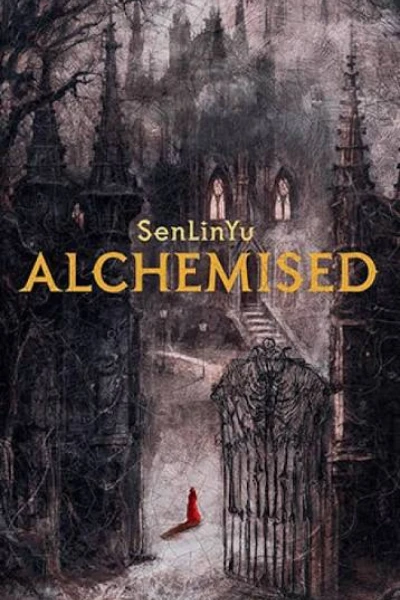
Alchemised by SenLinYu
Alchemised by SenLinYu — Chapter no 8
CHAPTER 8
LUC HOLDFAST SAT ON THE ROOFTOP OF the Alchemy Tower, hunched back against the tilt of the tiles as he absently spun an opium pipe in his fingers.
The spire of the Tower, lit with the Eternal Flame, burned above him, a beacon of white light.
The sun was setting, the world hued with bronze shadows as Helena clambered across to join him.
He was so gaunt, he already looked older than his father. The war had chewed him down to the bone. The tendons along his neck stood out like cords when he swallowed, looked over, and then away again.
“What happened to us, Hel?” he asked as she crouched down beside him.
She stared at the horizon, past all the towers, towards the south.
“A war,” she said.
“You used to believe in me. What did I do to make you stop?” His voice was faraway.
“I still believe in you, Luc,” she said. “But we have to win this war; we can’t make choices because we want a certain story to tell later. There’s too much at stake.”
“No,” he said. “This is how we win. This is how we’ve always won. My father, my grandfather, all the Principates going all the way back to Orion.
They won by trusting that good would triumph over evil, and I have to do the same.”
His thumb flicked against his index finger, ignition rings sparking. Pale flames flared to life, filling his palm, a light like a small sun. His fingers closed around them, leaving only a tongue of fire along a fingertip as he tucked the opium pipe between his lips and brought the flame close to the bowl.
Helena looked away, listening to him inhale.
“What if it’s not that simple, though?” she said. “Everyone who wins says they were good, but they’re the ones who tell the story. They get to choose
how we’ll remember it. What if it’s never that simple?”
He shook his head. “Orion became sun-blessed because he refused to break his faith.”
Helena exhaled, burying her face in her hands.
She heard his rings spark, and the pipe hissed as the opium vaporised.
“Luc—please, let me help you.” She tried to reach towards him.
He flinched away. “Don’t—touch me.”
He was teetering dangerously close to that immense fall, as if the Abyss still called to him. She didn’t know how to draw him back anymore, what to say that he’d still hear.
“Do you remember what I promised you, Luc, that night you came out here?” she asked, her voice pleading.
He gave no response. His gaze had settled back into a dim stupor, the sunset limning his gaunt features as though gilding him.
“I promised I’d do anything for you.” She curled her fingers into a fist.
“Maybe you didn’t realise how far I was willing to go.”
THE MEMORY OF LUC LINGERED in Helena’s mind when she woke in the morning.
She lay in bed, replaying it. It was a forgotten memory, which should have frightened her, but there seemed to be no information in it that Ferron could find useful, and she missed Luc desperately, even if it was a memory bitter as seawater.
He’d been smoking opium. How had that happened? He must have been horrifically injured to be allowed drugs like that. His great-aunt Ilva, who’d acted as steward for the Principate when Luc was at the front, had always been reluctant to allow him drugs, preferring to utilise Helena’s abilities than to risk addiction.
But he wouldn’t even let Helena touch him.
She lay in bed, turning the memory over and over, taking note of every detail. The evening light, the way it bronzed his features and illuminated his eyes. The nervous, intense way his fingers moved as he’d sparked his rings, bringing the flames to life.
She’d loved his pyromancy. It always felt more like magic than alchemy, the way he could make fire an extension of himself with those sun-bright flames.
The Holdfasts were always depicted wreathed in fire. The creation of sacred fire and the alchemisation of gold were the two unique gifts which Sol bestowed upon the Holdfasts.
Alchemisation, the transformation of one metal into another, was the most difficult form of alchemy. Prior to Orion Holdfast’s founding of the Institute, early alchemical writing was more entwined with mythological ideas than science.
The mythical Cetus, often called the first Northern alchemist, was credited with hundreds, even thousands of the earliest alchemical writings, which spanned centuries. Scholars had speculated that Cetus was the name of a school or an alchemical sect. The mystery was later revealed to be a consequence of superstition. Early alchemists were forced to write pseudonymously, initially to avoid persecution, while later novice alchemists used the names of more famous alchemists in their attempts to legitimise their theories and discoveries. As a result, “Cetus” had written almost all the surviving alchemy texts.
While the works of Cetus were considered historically seminal, they were highly inaccurate, and it was doubted that any alchemist by the name had even existed, but with no one else to credit, almost all early alchemical theories and discoveries prior to Paladia’s founding remained attributed to him.
It was Cetus’s early writings that established the alchemical principle that a mory bitter asmetal could only be alchemised into a less noble form, often in keeping with the planetary hierarchy.
Later, Orion Holdfast discovered the modern principles of alchemisation, overturning Cetus’s claims and laying forth the methods and array principles needed to transform the ignoble metals into those less corruptible.
In Orion’s work, alchemisation was predicated upon spiritual purity; only an alchemist with a soul as pure as the metal they sought to create could alchemise it.
It was Sol’s own light and purity bestowed in blessing upon the Holdfasts that endowed them with the divine ability to turn lead into pure gold.
However, Luc had always preferred pyromancy. There were strict rules the family had to abide by when alchemising gold. The heavenly metal could not be abused or used for selfish purposes; after all, the neighbouring countries’ and Paladia’s own currency had to be respected. There were rules about fire, too, but not nearly so elaborate as those involving gold production.
She remembered the first time Luc showed her his fire. She’d been sure the ts which Solflames would burn him, but they simply danced across the surface of his fingers, shining like a star in his hand.
Even without the flames, she’d always felt warm near Luc; even the cold Paladian winters were thawed by his presence. All alone now, she missed him so intensely, her bones and skin ached for the familiarity and comfort of a hug.
HELENA HAD FINISHED WITH HER exploration of the second-floor wing and resolved to explore the downstairs next.
She stood staring down the shadowy twist of the stairs as the windowpanes rattled like chattering teeth, the wind moaning through the corridor.
Her fingers curled tight around the banister, smooth as bone against hergitimise their palm. She squeezed until she could feel the wood grain, wrist twinging against the manacle.
She refused to let her eyes sink into the shadows as she stepped forward.
She thought about the cliffs on Etras, the endless roar of the sea. In her memory, she was a child again, scrambling among tide pools during the summer Abeyance when Lumithia waned and the sea retreated, leaving its bed laid bare and full of treasures. The brilliant summer sun radiating across her skin.ple that a Helena would go south. Run away and follow the river from the mountains all the way to the sea and sail home.
She reached the bottom of the stairs and found a necrothrall waiting, all the amber lights already aglow. Ferron’s wordless reminder that she could do nothing and go nowhere without his knowledge.
She swallowed hard, letting go of the fantasy. She would die in Spirefell.
The rooms on the main floor flowed from one to the next. Spirefell seemed to have more rooms than the Ferrons had ever known what to do with.
“Come back here, I’m not done with you.” A harsh voice made Helena freeze before she realised it was not directed at her.
“There’s nothing more to say,” came Ferron’s voice. “I’m not interested.”rict rules the “Don’t walk away from me! Disobey me and I’ll have you disowned, yourtal could not name stricken from the guild!”
Helena peeked out into the corridor to see Ferron turning to face the lich that she’d seen with Stroud at Central, the one using Crowther’s body.
been sure the“You’re dead, Father. Perhaps you forgot. That corpse has no claim to my estate or my inheritance. And”—Ferron’s voice grew pointed—“you have no iron resonance inside that body. Regardless of the titles the guild indulges you with, you have no real power. It took nearly a year before anyone even remembered you, and longer before they wanted you back. The only reason I let you continue as guildmaster is because I have better things to do with my time than dealing with the minutiae of factory management.”
The lich’s face darkened until it was almost purple with rage. Helena would never have guessed this was Atreus Ferron. Crowther was a different build entirely, so slight he was needle-like and more than half a head shorter than Ferron. windowpanes“I should have refused your mother’s pleas and had you killed in the womb,” Atreus said, his face contorted with rage. “You deserve none of the suffering we endured for you.”
Ferron seemed unfazed, even slightly bored.
“A pity you didn’t, if it would have spared me this tedious conversation.”
He turned away, his grey eyes still alight with scorn. “Get out of this house, Father, before I have it throw you out.”
Helena ducked back out of sight, dreading discovery. The necrothrall tailing her blinked placidly.
“You’ll regret this. The High Necromancer will remember that you did not volunteer yourself.” he mountains“The High Necromancer knows exactly where I am and what I’m doing. If he wants something, he won’t have it relayed by the likes of you. After all, aiting, all thehow many times did you manage to fail him to be banned from receiving a corpse with iron resonance? Was it the second time or the third?”
There was a snarl, followed by the sudden scream of metal and a thud. She peeked out again. Atreus was on the ground; one of the bars of iron in the efell seemedfloor had caught around his leg, pulling him back towards the main wing of the house.
He was clawing at the ground, scrabbling, trying to escape but only succeeding in nearly ripping his fingers off. Atreus screamed with rage, mouth frothing, the noises practically animal.
Ferron idly followed. “I’d be careful with that corpse. Pyromancy is a rare ability, you know. Give yourself a few more months, and I’m sure you’ll manage a spark.”
HELENA SCUTTLED BACK TO HER room once they were gone; just a glimpse of the house in action had made her far more wary. She’d understood in theory that it was malleable, but seeing the reality of it turned every bit of wrought- iron filigree ominous.
It was not her imagination: The house was almost alive.
And so was Atreus—or reanimated. She would have sworn he’d been executed before the Undying had appeared.
She kept trying to piece together the bits and pieces of her missing memories, but it was difficult to know if she’d forgotten something or never been informed in the first place. After all, a healer didn’t merit much in the way of security clearance. Her only knowledge of the battles and military strategy was trying to staunch the sea of blood that followed.
Despite knowing how dangerous it was, she couldn’t help but try to unravel the mystery of what she’d forgotten. Her mind itched for context. Yet she was playing a cat-and-mouse game with Ferron, and her ignorance was her only defence. But it didn’t feel protective. It felt like walking blind, with her skin sheared off.
Her mind circled relentlessly, treating every new piece of information as a potential clue, turning it one way and then the other, trying to see if it fit into any of the gaps. What could she have possibly known that would need to be t you did nothidden like this?
Stop thinking. She slotted her feet under the wardrobe and began doing sit- I’m doing. Ifups until her abdominal muscles burned. Lila used to do it in their room when she was anxious and off duty.
Helena needed to focus on Ferron, on finding some way to provoke him into killing her. d a thud. SheHe had to have some kind of weakness she could exploit.
Kaine Ferron, where is the chink in your perfect armour?
As if on cue, the door opened, and he walked in.
He stared down at where her feet were tucked under the wardrobe and the way she was laid out, panting from exertion.
“You’ve found something to do with yourself, I see.”
She forced herself to roll over and stand, biting back a wince when she pushed herself up.
He was early for their walk, and this aberration in the daily routine made her suspicious.
“Come here,” he said, withdrawing a vial containing several small white tablets, watching her reaction to it.
“What are those?” she asked when he unscrewed the top and tapped one out.
He raised an eyebrow. “I’ll tell you if you swallow it like a good girl.”
Helena pressed her lips tightly together.
Despite healers generally lacking formal medical training, Helena was intimately acquainted with medicine. She knew very well the power and danger in something as innocuous as a small white tablet.
“You know I’m not going to kill you,” Ferron said, his eyes glittering with amusement. “After all, if I were, you’d feel obliged to come running.”
Helena glowered at him. Poison was only one of the innumerable possibilities. context. YetFerron didn’t give her an opportunity to choose between compliance and resistance. His resonance settled in her bones and pried her mouth open. He lifted her chin with a finger and dropped the tablet onto the back of her tongue, forcing her to swallow.
It slid like a pebble down her oesophagus.
She expected him to release her immediately, but instead he pulled off his gloves and took her face in his hands, fingertips pressing along her jaw.
The hairs on the back of her neck stood on end, and she kicked him an doing sit-violently in the shin. r room whenHis jaw twitched, but he didn’t let go. Her legs simply stopped moving.
“I hate you,” she forced out between her clenched teeth.
He paid her no mind as his eyes went out of focus.
She could tell that he was doing some kind of complex transmutation to her. Something was happening. She should have been panicking, trying to resist as Ferron’s resonance sank into her biochymistry. Instead, she became completely calm.
She could feel him altering her as if she were an instrument he was tuning; tampering, adjusting, manipulating her until she felt empty.
He let go.
She jerked away, expecting the feelings to come rushing back. Vivimancy of that type was practically useless because it required a constant resonance
connection to maintain.
Yet her emotions didn’t come back.
They were somewhere else. Present but distant. Removed.
Ferron watched as she stood there, left intellectualising her confusion.
It was as though a piece of glass had been slotted between them. She was aware she hated him. This was a piece of information that seemed of utmost importance, and yet she couldn’t feel it. Hatred was a construct rather than an emotion.
“How do you feel?” His sharp eyes were cataloguing her every detail.
Her skin prickled with awareness of his scrutiny, a shiver running down her spine, but she didn’t feel the corresponding wash of fear. Just awareness.
Her hands had stopped spasming.
“I feel cold,” she said. “Numb. What are those tablets?”
“They were developed during the war. It’s a sort of holding effect on physiological transmutations that would otherwise be temporary.”
Helena blinked, wondering at how that could work. It must have been developed using chymiatria in tandem with vivimancy; developed in stages, addressing each of the various hormones and— Ferron snapped his fingers in front of her face. “The purpose of this is to acclimate you to the house so I don’t have to waste my time escorting you everywhere, not so you can have something to reverse-engineer. Out.”
Helena was unfazed. It was bizarre how empty she felt. Scarcely human.
As if nothing meant anything or had any consequences. The tablets took away the good feelings as much as the bad. She was carved out and empty.
An abyss instead of a human.
“Is this what it’s like to be you?”
He gave a dry laugh. “Like it?”
She considered. It was certainly easier to be near Ferron now that she didn’t feel overwhelmed by how much she hated him, and afraid of his capacity to hurt her. She was still excruciatingly aware of how dangerous he was, but without the sickening physical reaction of that knowledge.
“It feels like I’m dead,” she said.
He made an odd sound. “Well, the effect is temporary. It’ll only last a few hours.”
He gestured towards the door, but Helena remained where she was, eyes narrowing.
“You’re being different to me now. You’re less mean.” She furrowed her eyebrows in confusion—a feeling she was still, apparently, capable of experiencing.
He stepped towards her and leaned so close, his breath ran along the length of her neck.
“Why would I torture you when you won’t react?” he asked softly in her ather than anear.
He straightened, raising an eyebrow. “See? Nothing. No elevated pulse, no pounding heart. I could bring in one of your little friends, and peel their skin off right here in front of you, and you wouldn’t react.” He shook his head.
“There’s no fun in that.”
Helena nodded, her own ideas developing. This would be the perfect state to be in to finally kill herself without any sense of self-preservation holding her back.
“Outside,” he said again, a look of irritation flashing across his face as if somehow reading her intentions. Helena retrieved her cloak with a sigh. The lights in the hall were all off, only the dim illumination of daylight trickling through the windows, but she was unafraid. She knew they were only shadows.
She descended the stairs and went to the veranda, standing in the doorway for a moment, but the courtyard was of no interest to her.
She turned to explore the house. She couldn’t help but wonder at Ferron’s choice to drug her. Wasn’t it more convenient for her to be afraid?
He had to have some kind of fail-safe, some trick of keeping an eye on her that she hadn’t realised yet.
She stopped in her tracks, a sudden thought occurring to her, one which had never entered her mind when she’d been consumed by thoughts of shadows.
She turned around and walked back towards the west wing. Ferron was on the veranda, reading a book. He glanced through the open door, but she ignored him, ascending the stairs, scanning every corner as she went towards her room.
She’d rarely looked up. The ceilings were shadowy, the darkness always pressing down on her when she looked too long. She’d focused on her most immediate surroundings, the walls within reach, the next place she’d step, the space between the shadows. She didn’t look up.
There were two dead maids in her room, turning down the bed, the windows thrown open. They dropped the duvet and instantly snapped the windows shut, locking them as Helena entered.
ng the lengthShe ignored them, seizing hold of the armchair and dragging it over to the far corner of the room as the manacles bumped against the bones inside her wrist. She stood on the chair and finally resorted to tilting it against the wall, clambering up the back so she could get a good look at the high-up corner ted pulse, nonearest the door.
Tucked into the shadow was an eye encased in glass. It swivelled, the pupil contracting, as if it were still alive, and stared straight at her.
The iris was a beautiful, deep blue.
They’re offering a lot of money for eyes, Grace had said.
The upholstery of the chair was slick. Helena slid back, and it thunked onto
four legs as Ferron walked in.
“Took you long enough,” he said.
“Are you always watching me?” she finally asked, still staring at the corner. The eye was so cleverly concealed that she could scarcely make it out. How many did he have in the house? It couldn’t be the only one if the speed at which the necrothralls found her was anything to go by.
He scoffed. “Hardly. You’re terribly boring.”
She should be horrified. She would be—but it would have to happen later.
In the moment, all she felt was curiosity. She looked at him. He had a book on poisonous plants in hand, index finger marking his page.
“How does that work? I didn’t know you could—reanimate parts.”
“It’s actually easier than thralls,” he said, coming to stand beside her.
“Reanimation is like electricity. Just channelling the right kind of energy to where it needs to go and keeping it there. It takes barely anything to maintain something so small once it’s encased in the proper preservatives.”
That was less interesting than she’d hoped. She turned to watch the maids, who were finishing with the room.
They were remarkably reanimated. A person might not notice they were dead. They were agile and precise in their tasks and without any signs of decomposition. It was undeniable that Ferron had a horrific talent for necromancy. he’d step, theIt had to take a tremendous amount of mental resources to maintain and independently monitor them to behave like that. There was a reason necrothralls were mostly used for repetitive labour and battle hordes: Complex tasks were beyond their limited mental capacity.
How was that possible?
She looked at Ferron, scrutinising him.
“You’re not a homunculus, are you?” She felt ridiculous asking the question. Artificial humans were considered as mythical as chimaeras or philosopher stones. One of the many ideas attributed to Cetus in the prescientific era.
Of the three, homunculi were a particularly enduring concept. The idea led, the pupilwas that by placing a man’s seed in a cucurbit with the proper environment of stable warmth, it could come to life on its own. After being fed distilled blood, it could grow into a human of limitless alchemical potential and utterly without flaws because it was unspoiled by the inferior environment and thunked ontocontributions of a female womb—the source of all humanity’s flaws.
Ferron stared. “Pardon?”
“Never mind,” she said quickly. Obviously, he wasn’t; she’d known him as an ordinary boy, and a “flawless” human would not be a mass murderer. “I’m just trying to figure you out.”
He laughed. “I suppose I should be flattered that that’s what you came up with, but no, I’m not a homunculus.” There was a pause. “Although Bennet did spend years trying to grow one. All he ended up with was a lot of
cucurbits of putrefied sperm.”
She grimaced but eyed him again.
There was undeniably something done to Ferron. With Morrough in his monstrous and distorted form, it made sense that he’d have unnatural abilities as a result of whatever transmutations he’d performed on himself, but Ferron looked mostly human. g to maintainWhere did the power come from? She studied him.
Supposedly there were crystals and precious stones with properties useful for resonance. In early myths of Orion Holdfast, Sol’s blessing was described as a huge celestial stone. Amulets featuring crystals had been long popular as a result. Necklaces and brooches had been sold in Paladian shops and stands to visiting pilgrims who considered the city-state as particularly sacred to the Faith, often with promises that they would strengthen or expand an alchemist’s resonance or repertoire, ensuring admission to the Institute.
Many students wore heirloom jewellery, and the official figures of the Faith often wore items set with sunstones.
She studied Ferron for any jewellery or signs of an amulet. Guild families usually wore signet rings and a variety of pins and brooches to indicate their orders and exclusive clubs, but in stark contrast with his wife and father,
Ferron usually wore nothing, not even a wedding band. The only piece visible was a slender, dark metal ring on his right hand.
Her eyes narrowed as she studied it.
“What kind of ring is that?” she asked.
He looked down. “This?” he asked, as if there were any other rings she vironment ofcould have been referring to. He turned his hand. “Just an old piece.”
He slipped it off and tossed it to her. She caught it reflexively, al and utterlydisappointed to discover that it wasn’t an unusual black metal at all, but a severely tarnished silver ring, as if he never took it off to care for it. It was hand-forged rather than transmutationally crafted; she could see the hammer marks that had beaten a scaled, almost geometric pattern onto it. known him asA bizarre thing for an iron alchemist to wear. urderer. “I’mShe could feel him watching and wondered what he’d do if she swallowed
it.
“Don’t swallow it.”
She looked up.
He gave her a sidelong look. “You’re lucky the national exam never tested for an ability to lie. You have a transparent face.”
He held out his hand for the ring. Helena debated popping it into her mouth solely to provoke him. tural abilitiesIrritation flickered in his eyes. “Try it, and I’ll bring it back up again. All you’ll get is a sore throat.”
She dropped the ring into his palm, and he slid it back onto his finger.
“Why all this sudden interest in me?” he asked.
She shrugged. “You don’t make sense.” was describedHe raised an eyebrow. “Oh, is that all? And here I was hoping you were
g popular asplotting to seduce me.”
She stared at him blankly.
He gave a mocking smile. “Steal my heart with your wit and charms.”
Helena scoffed.
“Who knows, perhaps I have a proclivity for—” He paused, studying her,
trying to find something.
Helena walked away. “Maybe tomorrow.”
ON HER OWN, IT WAS nice, feeling like a functioning person again. Helena had forgotten how easy it was to exist when her mind and body couldn’t betray
her.
She was determined not to waste the effects of the tablet and moved through the house quickly, puzzling over the drug’s composition as she went.
Her parents had practised medicine. Her mother as an apothecary, and her father as a traditional surgeon trained in Khem. Helena had grown up surrounded by herbs and tinctures and medical procedures. It wasn’t formal training, but it was enough that she’d been a quick study as a healer, much to the distaste of her religious superior, Falcon Matias.
She’d once tried to tell him that the principles of healing followed the same rules as any form of medicine, citing her parents’ work. It was like manual versus alchemical metallurgy: The use of resonance did not alter the fundamental principles.
He’d been so incensed, he’d made Helena spend two days in a chantry offering penance for daring to compare her corrupted resonance to that of the Noble Art.
According to Matias’s stringent understanding of the Faith, necromancy, in addition to its violation of the dead, was also a violation of the natural cycle and natural law, and vivimancy stemmed from the same corrupt form of nto her mouthresonance.
Healing was permitted within limits because it was categorised as a spiritual intercession, something selfless and divinely led.
Helena had never understood why, but the Institute, which generally treated science and the Faith as complementary to each other, strictly banned the study of vivimancy even for healing. Most healers tended to appear in remote places in the Novis Mountains and were only taught to work by intuition, their success or failure left to the will of Sol. No “science” about it.
Helena learned to hold her tongue and pretend that her unusual talent for healing was divine and not because she understood the systems and functions of the human body.
The tablet Ferron had forced down her throat was a clear demonstration of the potential if healing were allowed to be scientific. It seemed to have some kind of vasoconstriction component. A glycoside, perhaps synthesised from foxglove. She tried to remember if she’d noticed anything that might have indicated mineral acids, and maybe … “Awful, aren’t they?” Aurelia’s voice floated down the hallways from the foyer. “They were inside at first, but it doesn’t matter how much they’re
doused, they just reek. I told Kaine I’d set them on fire if they stayed inside another day.” as she went.“He won’t just get you new ones?” It was a man’s voice.
“No.” Aurelia’s tone was petulant. “I’ve asked and asked, but they’re Central’s, so we must keep them. Everyone else has new thralls all the time, but Kaine never wants to change them. Then he finally brings some new
ones, and they’re those awful things.”
“For the prisoner, I suppose.” wed the same“Of course.” Aurelia’s voice turned sour. “The whole house has been turned upside down because of her. Just look at the banisters. They make the foyer look like some giant birdcage, but Kaine insists we keep them like this now. He bites my head off if I even leave a door open, and the thralls are never around when I need them. It’s so embarrassing. I saw Lotte Durant the other day. Her husband gets her new thralls as soon as the old ones start getting ugly. Lets her pick them out and everything. They do whatever she cromancy, intells them. Even awful things sometimes—it’s so funny. One of the girl ones scorched Lotte’s new silk, and you should have seen what Lotte had all the rest of them do to it. Chills just thinking about it. I wanted to punish one of mine once, and Kaine showed up saying they’re his and if I want to torture any, I’d have to make my own … Well, I would if I could.”
Helena followed Aurelia’s voice and discovered that the foyer had been transformed since she’d last seen it. The rails had been reshaped into iron bars stretching all the way up to the ceiling, making it impossible to jump from the landings or from the stairs. Ferron was clearly taking no risks.
Down below, Aurelia and her companion walked into the next room, still discussing how unfair and unsympathetic Ferron was as a husband.
The details of the ouroboros on the foyer floor showed up better from the nd functionsthird floor, even with the bars. Helena stared down, studying the wings, the spines, the fangs, and the sleek body curving into a circle as it consumed itself.
THE NEXT MORNING, HELENA LAY pinned to her mattress as if a boulder had been dropped onto her chest. A lash of despair, and grief, and anger—all the feelings she’d been unable to experience the day before—had come back, redoubled, so heavy she could barely breathe.
The period of respite made it all hurt even more; the momentary relief making the magnitude of its weight even more tangible. She could feel herself crumbling.
Her spine and neck were overheated while the rest of her body was clammy and ice-cold, the sheets and nightclothes damp with a strong mineral scent. There’d definitely been mineral salts in the tablet.
She rolled onto her side and was violently sick on the floor.
She slumped down, shivering, limbs leaden. She wanted to strangle Ferron and then crawl into a hole and die. She was hot and cold and thirsty and pathetically desperate for comfort.
If even one of the necrothralls had walked in and stroked her hair, she probably would have wept.
A wave of loneliness struck so sharply, she gave a heaving sob and almost burst into tears anyway.
The door opened, and one of the necrothralls did enter, but only to clean the mess.
She lay in bed sick until evening, shivering and sweating until she passed out from exhaustion.
When Ferron arrived the next day, Helena glared daggers at him. He could have warned her about the withdrawal.
He waited for her to retrieve her cloak, but rather than lead the way, he stood and let her walk past.
The hallway was unlit. She could feel the shadows, the dark looming, but she kept her fingers tracing along the wainscotting and her focus on her next step. She knew her way. Even in the dark, she could find it now.
When she reached the courtyard, Ferron appeared on the veranda, observing her like a scientist with a test subject.
She sighed and began a tedious walk around the courtyard. When she finished the first loop, he was already gone.
The period of respite made it all hurt even more; the momentary relief making the magnitude of its weight even more tangible. She could feel herself crumbling.
Her spine and neck were overheated while the rest of her body was clammy and ice-cold, the sheets and nightclothes damp with a strong mineral scent. There’d definitely been mineral salts in the tablet.
She rolled onto her side and was violently sick on the floor.
She slumped down, shivering, limbs leaden. She wanted to strangle Ferron and then crawl into a hole and die. She was hot and cold and thirsty and pathetically desperate for comfort.
If even one of the necrothralls had walked in and stroked her hair, she probably would have wept.
A wave of loneliness struck so sharply, she gave a heaving sob and almost burst into tears anyway.
The door opened, and one of the necrothralls did enter, but only to clean the mess.
She lay in bed sick until evening, shivering and sweating until she passed out from exhaustion.
When Ferron arrived the next day, Helena glared daggers at him. He could have warned her about the withdrawal.
He waited for her to retrieve her cloak, but rather than lead the way, he stood and let her walk past.
The hallway was unlit. She could feel the shadows, the dark looming, but she kept her fingers tracing along the wainscotting and her focus on her next step. She knew her way. Even in the dark, she could find it now.
When she reached the courtyard, Ferron appeared on the veranda, observing her like a scientist with a test subject.
She sighed and began a tedious walk around the courtyard. When she finished the first loop, he was already gone.