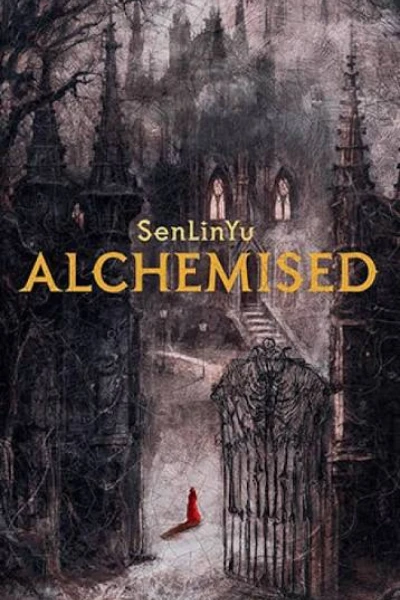
Alchemised by SenLinYu
Alchemised by SenLinYu — Chapter no 6
CHAPTER 6
FERRON LEFT AS THE MAID FINISHED WITH Helena’s slippers, and Helena immediately stood, refusing to let the corpse touch her further.
The maid headed inside. The instant her back was turned, Helena snatched up Ferron’s discarded newspaper, hiding it behind her back as she drew a deep breath and stepped inside.
She focused on the paper in her hand as she hurried towards the stairs.
The shadows loomed but Helena refused to let herself look at them, counting each step, hand pressed against the banister and then along the wall, focusing on the amber pools of light cast by the sconces, until she reached her room.
In her absence, it had been aired out. The bed stripped, linens changed. The air was almost as cold as it had been outside, but the windows were closed and locked again.
Helena was drenched and freezing but Ferron might realise he’d left the newspaper and come for it. She had no time to waste.
She huddled near the window where the light was strongest, her eyes drinking in every word, starting at the very top. NOVEMBRIS 1788.
She stared at the date in shock. That couldn’t be right. Her last memory with a clear date was the hearing about Lila Bayard resuming paladin duties and returning to combat early in 1786.
If the war had ended fourteen months ago, that would have been in late summer of 1787. Which meant that she had no memory of nearly nineteen months of the war. It blurred out of focus when she tried to think back, to remember anything more than the hospital shifts. She had no recollection of anything, not of conversation or the seasons, or Lumithia’s Ascendance and Abeyance, of anything but the endless loop of shift after shift in the hospital, like an eternal scream.
She squeezed her eyes shut, racking her brain. There must be something.
She couldn’t have lost that much, but it was like trying to catch the wind with
her fingers. A sharp pain splintered through her skull.
She blinked, vision flickering red as her eyes opened.
There was a newspaper in her hands.
She clutched it tightly. She had to read quickly before Ferron noticed she’d taken it. Her eyes raced to the first article.
The last fugitive of the extremist group calling themselves the Order of the Eternal Flame has been apprehended and faces interrogation.
New Paladia’s Central office has confirmed the identity of Helena Marino, a foreign alchemy student from the southern islands of Etras.
The Etrasian government denies any involvement in or support of the Eternal Flame’s terrorist activities. To protect the citizens of New Paladia from further violence, Marino has been imprisoned outside the city at Spirefell while her fate is decided.
Spirefell, the renowned Ferron estate, was built of iron by Urius ong the wall, Ferron. With a unique structure, built as a celebration of the family’s e reached her exceptional resonance, the house makes a secure location for
dangerous prisoners. changed. The The Ferrons, one of New Paladia’s oldest families, have a history in the region that predates the Holdfasts. They were frequent victims of the Eternal Flame’s persecution. Iron Guildmaster Atreus Ferron was arrested and executed for speaking against the Holdfasts’ oppressive regime, and his son, Kaine Ferron, was baselessly accused of assassinating Principate Apollo Holdfast. All charges against father and son were later dropped …
Ferron had been accused of killing the Principate? The assassination responsible for causing the war?
She stared at the words until they blurred.
She remembered Principate Apollo’s death. He was found brutally murdered in the Alchemy Institute’s commons, and an investigation had immediately been opened. She didn’t remember there being any conclusion.
There’d been so much happening at the time: the funeral, the preparations for Luc to be crowned Principate. What should have been a joyous occasion was shrouded by grief and shock, Luc in denial even as his friends were swearing he wind with
oaths to die protecting him. The ceremony was barely over before the sedition and the Undying, and the war that never seemed to end.
Had Ferron killed Principate Apollo? Surely not, he would have been only noticed she’dsixteen. Perhaps the claim had been fabricated to further portray the Ferron family as victims of the Holdfasts? That seemed more likely.
She read the rest of the article, hoping for more information but finding simply a reiteration of the Undying’s usual narrative about the war: that they had not started it; that in fact there had never been a “war” but instead civil unrest caused by a small group of religious extremists who refused to acknowledge the democratically elected Paladian Guild Assembly.
It made Luc out to be a power-hungry monster who’d tried to burn down the entire city rather than let anyone else have it.
Luc, who’d gone up onto the roof of the Alchemy Tower the night before becoming Principate, standing alone on the very edge.
Helena had followed him and stood as close as she dared, promising him that she would do anything for him if he would just step back and take her hand.
He hadn’t listened, not until she swore that if he jumped, then she would, too. He’d stepped back to save her.
They’d sat together there on the roof until sunrise. She’d gripped his hand and talked the whole night, telling him about Etras, the cliffs, and the little villages with the donkeys pulling painted carts, the olives, all the farms, and the sea on summer days. They’d go there someday, she told him. Once everything was better, she’d take him and he’d see how beautiful it was.
Luc had never wanted to be Principate. If there had been anyone else, he would have given it up in a heartbeat.
Helena turned the page of the newspaper, blinking hard.
A column within listed executions performed by the High Reeve the previous week. There was a picture of wretched-looking men and women on their knees on a platform. Dressed all in black, with an intricate helmet obscuring his face and hair, stood Ferron, one pale hand outstretched.
She could tell it was Ferron just by his posture and the familiar tilt of his long fingers, but the article only referred to him as the High Reeve.
There was no reference anywhere to Kaine Ferron being the High Reeve.
parations for Was that a secret?
Who would benefit from that? If the deteriorating condition of the estate was anything to go by, it was not the Ferrons.
No. Morrough must be responsible. After all, keeping the High Reeve’s identity hidden provided the High Necromancer with an exceptionally powerful tool. If the High Reeve could be anyone, people were kept paranoid, always wondering. It would also prevent Ferron from gathering his own followers or accumulating enough power to overthrow Morrough.
Perhaps Ferron had ambitions that Morrough feared. That was a tantalising possibility. Something Helena might take advantage of.
It also made Spirefell the perfect trap. If anyone tried to save Helena, they would assume they were attacking a guild heir; they’d have no idea who her captor truly was.
She read the rest of the paper quickly. There were some vague allusions to grain shortages. It was strange. The countries on both sides of Paladia were significant agricultural exporters. The Novis monarchy had historical ties with the Holdfasts, so an embargo by Novis was predictable, but Hevgoss, their western neighbour and a heavily militaristic country, had been angling for better trade agreements with the guilds for decades.
The Holdfasts had always blocked the negotiations, refusing to have alchemy used for industrialised warfare. Guilds found to be violating the trade restrictions with Hevgoss had their access to lumithium cut off, preventing them from alchemical processing on an industrial scale.
Why wouldn’t Hevgoss be pouring grain into Paladia now?
The political section of the paper was almost funny in a horrible way. The Guild Assembly, whose formation was ostensibly the reason for the war, was three weeks into negotiations over the lift fare, as if New Paladia had nothing more urgent to do before the hibernal solstice ushered in the new year.
More interesting was a paragraph mentioning that a Paladian envoy had arrived at the Eastern Empire and been permitted to cross the border. It was the first time any Paladians had been allowed into the Eastern Empire in several hundred years. Was that where that traitor Shiseo had been headed?
Helena mostly skipped the society pages, but she couldn’t help noticing how often Aurelia Ferron’s name was mentioned. Quite the socialite, it seemed.
Then an editorial caught her eye. It was almost innocuous, describing the current labour shortage and lamenting the recent loss of so many talented alchemists in the “conflict” caused by the Eternal Flame. There were statistics presented about how Paladia’s economy was expected to continue to shrink due to a multigenerational loss of alchemists. The solution, the author
declared, was sponsored births. The article suddenly stopped being editorial and read more like an advertisement. The head of the new science and ept paranoid,alchemy department at Central, Irmgard Stroud, was heading up a program to bolster the next generation of alchemists using new scientific selection methods to give them the best start. a tantalisingVolunteers were wanted. Participants would be provided food and lodgings, and upon completion of the program, those with criminal convictions would be eligible for retrial.
Helena read the editorial several times, hardly able to believe what she was seeing. It was a breeding program being passed off as an economic solution.
As if alchemists were dogs to mate in pursuit of economically desirable transmutation abilities.
It wasn’t an entirely new concept. Marrying into the resonance was a well- known term for the guild families’ tendency to marry those with either the same or a complementary alchemical resonance. Aurelia and Ferron were just such an example.
While an alchemist’s resonance repertoire was as heritable as hair or eye colour, resonance could also appear or vanish at random.
Neither of Helena’s parents had been alchemists. Her father had possessed a minor resonance for steel and copper, but not enough to merit training or qualify for a guild. Her mother had no resonance at all that Helena could remember. Luc’s great-aunt, Ilva Holdfast, was famously a Lapse, a child of the war, wasalchemists who never manifested resonance. had nothingNow it seemed Stroud had every intention of testing exactly how heritable resonance was or wasn’t, and she intended to use the prisoners on the Outpost to do it. After all, who else would volunteer for a breeding program because of incentives like food, lodgings, and a retrial?
She thought of Grace, starving and desperate, with brothers too young to work, willing to sell an eye. Helena could only guess how many others were like her.
All those files Stroud had been constantly going through. This must have been what she was working on, winnowing out eligible candidates from the Resistance records.
Helena hid the newspaper in her wardrobe, resolving to drop it somewhere were statisticswhen she next left her room. Her joints were stiff with cold, and she went to the shower, peeling off her wet clothes.
She stood under the hot water until feeling seeped back into her body and the bone-deep cold faded away. She began washing slowly, in no hurry to go a program toback into her freezing room.
As she looked down, she discovered scars that she had no memory of.
The largest was right in the middle of her chest, running between her breasts. The roping scar was raised, slightly puckered, as if her sternum had been split open and stapled back together.
She traced her fingers across it, finding a divot in the bone, the odd what she wassensation of severed nerves.
It didn’t seem like healing had been used. The bone could have been regrown. She could have easily knit the nerve endings back together to avoid the loss of sensation, and then arranged the matrices so that the scarring was was a well-less visible.
None of that had happened. The wound had been left to heal without any ron were justvivimancy.
Perhaps this was the extensive injury Stroud had mentioned.
No, she couldn’t have been placed in stasis with an injury like that. She began to search her body carefully and found more scars.
Her mind seemed trained to overlook them, but she focused, taking note of each one.
There were traces of a large circular wound that went straight through her calf. Hairline scars, one on her stomach and another between two ribs.
Vivimancy had undeniably been used to heal them.
In her right palm there were more scars. Slits in the palm and fingers, as if n the Outpostshe’d gripped a knife blade in her hands, and more oddly, seven tiny punctures. They were perfectly spaced into a circle in her palm. Not large but distinct in the way they marred the skin. She stared at them. The shape felt familiar.
She put her hand down, unsettled, and finally reached up to find the one scar that she did remember.
It was hardly visible, hidden below the shadow of her jaw. It ran long and thin across the left side of her neck, stopping just short of her throat.
FERRON BROUGHT HELENA’S DRIED AND cleaned cloak with him when he arrived the next day and threw it at her head.
Helena followed him, surreptitiously dropping the newspaper along the way. On the veranda, he pulled out another paper. The cover story was about a monument the governor, Fabian Greenfinch, was having built in honour of Morrough as New Paladia’s liberator. It would be unveiled the following year.
It was raining again. Helena glanced around, not sure what to do, finding no appeal in strolling about in circles under Ferron’s supervision.
Perhaps she could find a very sharp stick somewhere and stab him with it.
She wandered along the veranda until she was bored, and then sat observing the stillness of the house, trying to guess at how many rooms there must be in a place so large.
She’d thought the Bayards’ house, Solis Splendour, enormous. It had been one of the few freestanding houses in the city, a remnant from long ago.
Spirefell was much larger.
When Ferron stood and left, she assumed it was a sign to go back inside.
She cast her eyes around and was disappointed to find he hadn’t forgotten his newspaper.
She went to the door. The winter light spilled like quicksilver across the aking note ofdark floor, but the hallway beyond disappeared into darkness like the opening of a mouth. With the winter drapes, the light was blotted out, creating the dusty suffocating feeling of a tomb. The lights were off.
She groped along the wall, trying to find a dial or switch.
Wind rushed out of the dark, and the smell of dust and rot struck her face like a cold breath, followed by a low, shifting groan that made the house vibrate.
Not large butHelena stumbled back outside, heart racing.
If the clouds would lift, it would get brighter. She huddled on the veranda, waiting. Through the obscuring rain, the house around her looked almost like an immense slumbering creature, curved inwards, the spires like spines.
The rain did not cease. Instead the sky dimmed as dusk fell. At this point in the lunar cycles, even Lumithia, the brighter moon, had waned too much for her light to penetrate the cloud cover.
The light in the doorway had shrunk and weakened.
Helena drew a deep breath; she’d taken the route before. There were steps not far into the shadows. If she found them, she could feel her way back.
It was only shadows. It wasn’t the tank. It wasn’t the nothing. Just shadows.
She wavered in the doorway, and everything grew darker, the remaining light outside beginning to vanish.
Helena felt herself disappearing into it. Terror sharp as talons clawed through her as she forced herself forward. She stumbled, colliding with a table, barely feeling the pain that shot up her shin.
Find the stairs.
It’s only a house.
But she felt the darkness swallowing her, dragging her in, the endlessness so close. She gripped the table, hands shaking so violently that the wood rattled. Something fell, crashing onto the floor.
Breathe. Just breathe.
She fought to breathe but pain splintered her chest. Her heart was racing, beating like a caged bird inside her, breaking itself against her ribs.
She made it a few steps before her legs gave out. She curled up on the floor, the wood like bones beneath her hands. She was disappearing into the forgotten hisnothing again. Into the nothing where she couldn’t move … couldn’t scream … and no one ever came … She was gripped by the arms and wrenched off the floor. e the opening“What are you doing?”
She blinked in the sudden light, staring into Ferron’s incensed face.
An electric sconce on the wall glowed, a halo in the dark illuminating only them.
She focused on his face, trying not to see the ocean of black surrounding
her.
“It was—dark,” she forced out.
“What?”
Her breathing was so rapid, her head swam. d almost like“You’re scared of the dark?” His silver eyes were burning, his voice thick with disbelief. t this point inShe tried to pull away—she’d rather suffocate in the hallways than be near Ferron—but he didn’t let go, pulling her over to the stairs, mere steps away, and dragging her to her room, refusing to let her collapse back onto the floor.
“Calm down,” he snarled at her as soon as she was inside the familiar
space.
The door slammed.
Helena dropped into the chair, doubling over and gripping the fabric. Her fingers kept twitching, sending shocks of pain to her arms, but she didn’t
care. She needed to feel that things were real and tangible, not an abyss of nowhere with her body and nothing else.
The air sliced through the inside of her lungs.
She was in her room. The house had not eaten her, because houses did not eat people. Her mind cleared slowly, that suffocating terror gradually ebbing away, allowing reason to seep back in.
It was almost worse to be rational again, to sit knowing her fear made no sense. It didn’t matter. The part of her that was afraid did not care about
being rational.
“What’s wrong with you?”
She started, looking up.
Ferron was still in the room, apparently having lingered to interrogate her now that her fit of panophobia was over.
She averted her eyes.
“If you won’t tell me, I’ll pull the answer out of your head.”
Helena flinched. The thought of his resonance set her teeth on edge. There were parts of her brain that still felt bruised, caved in from the transference.
Her mouth twisted, throat going taut. “I don’t like places I can’t see.”
“Since when? I haven’t noticed you keeping the light on in here constantly.
Or are these shadows different?”
Heat rose across the back of her neck. She stared at the iron bars in the floor. “I know this room. It’s the places I don’t know, that I can’t see the end of. I-In the stasis tank, it was always dark no matter how hard I tried to see, and I couldn’t feel anything around me, just my body floating and not moving. It felt—endless. Like I was nowhere. I was—I was there so long. I kept thinking that eventually someone would come but—” She shook her head. “When I see dark places and I don’t know where they end, I feel like I’ll disappear inside them, but this time, I’ll never be found.”
She sounded irrational. She was irrational, but there was no help for it; there was a schism between her reason and her mind, a fault line shearing them forever apart. Her mind did not care whether the fear made sense; it just wanted to never go back.
Ferron was silent for so long that she finally looked up at him, morbidly curious, but he was unreadable. Still as a statue as he stared at her.
It was the first time she’d bothered to just look at him, to see him for what he was, rather than who he was.
His clothing hid it well, but he was strangely slight. Not at all built like an iron alchemist. He didn’t even have the look or presence of a combat alchemist. She couldn’t imagine him with a heavy weapon in hand.
Aside from the predatory intensity to his eyes, his features were almost too fine, like a statue carved a stroke too far.
Everything about him was slim and sharp-edged.
“You know,” Ferron said, jolting her from her thoughts, “when I heard it was you I’d be getting, I was looking forward to breaking you.”
He shook his head. “But I don’t think it’s possible to exceed what you’ve done to yourself.”
re constantly.
sense; it just
His clothing hid it well, but he was strangely slight. Not at all built like an iron alchemist. He didn’t even have the look or presence of a combat alchemist. She couldn’t imagine him with a heavy weapon in hand.
Aside from the predatory intensity to his eyes, his features were almost too fine, like a statue carved a stroke too far.
Everything about him was slim and sharp-edged.
“You know,” Ferron said, jolting her from her thoughts, “when I heard it was you I’d be getting, I was looking forward to breaking you.”
He shook his head. “But I don’t think it’s possible to exceed what you’ve done to yourself.”